
Promises and Pitfalls:
Linked Data, Privacy, and Library
Catalogs
Emily Dust Nimsakont
Cataloging Librarian, Nebraska Library Commission
TSRT/IFRT Spring Meeting
March 6, 2015
What is
Linked
Data?
Photo credit: http://www.flickr.com/photos/mytudut/5197551003/
Wikipedia says…
“Linked Data describes a method of publishing
structured data, so that it can be interlinked
and become more useful. It builds upon standard
web technologies, such as HTTP and URIs - but
rather than using them to serve web pages for
human readers, it extends them to share
information in a way that can be read
automatically by computers.”
http://en.wikipedia.org/wiki/Linked_Data
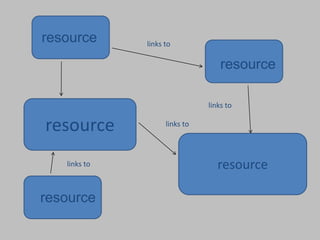
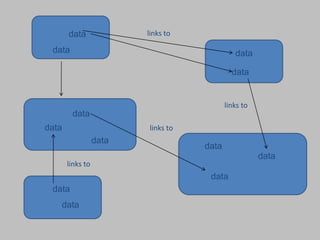
resource
resource
resource
resource
resource links to
links to
links to
links to
data links to
links to
links to
links to
data data
data
data
data
data
data
data
data
data
data
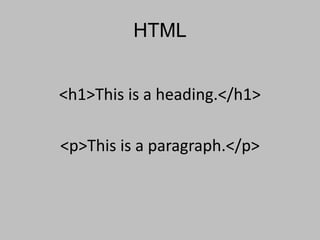
HTML
<h1>This is a heading.</h1>
<p>This is a paragraph.</p>
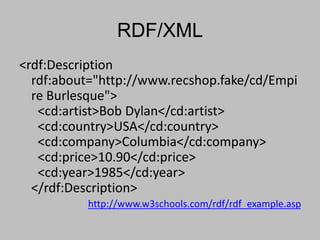
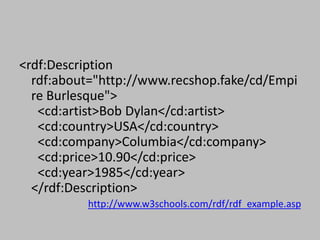
RDF/XML
<rdf:Description
rdf:about="http://www.recshop.fake/cd/Empi
re Burlesque">
<cd:artist>Bob Dylan</cd:artist>
<cd:country>USA</cd:country>
<cd:company>Columbia</cd:company>
<cd:price>10.90</cd:price>
<cd:year>1985</cd:year>
</rdf:Description>
http://www.w3schools.com/rdf/rdf_example.asp
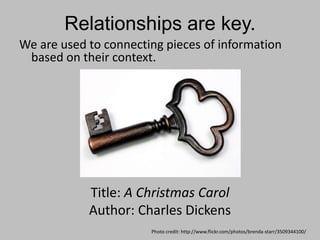
We are used to connecting pieces of information
based on their context.
Title: A Christmas Carol
Author: Charles Dickens
Relationships are key.
Photo credit: http://www.flickr.com/photos/brenda-starr/3509344100/
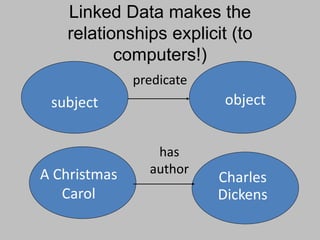
Linked Data makes the
relationships explicit (to
computers!)
subject object
A Christmas
Carol
Charles
Dickens
has
author
predicate
<rdf:Description
rdf:about="http://www.recshop.fake/cd/Empi
re Burlesque">
<cd:artist>Bob Dylan</cd:artist>
<cd:country>USA</cd:country>
<cd:company>Columbia</cd:company>
<cd:price>10.90</cd:price>
<cd:year>1985</cd:year>
</rdf:Description>
http://www.w3schools.com/rdf/rdf_example.asp
“Just as the traditional document Web can be
crawled by following hypertext links, the Web of
Data can be crawled by following RDF links.
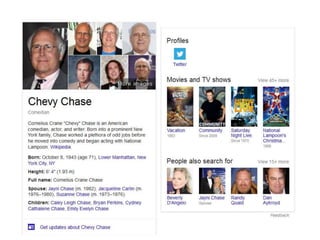
Working on the crawled data, search engines can
provide sophisticated query capabilities...
Because the query results themselves are
structured data, not just links to HTML pages, they
can be immediately processed, thus enabling a
new class of applications based on the Web of
Data.”
Chris Bizer, Richard Cyganiak, and Tom Heath
How to Publish Linked Data on the Web
http://linkeddata.org/docs/how-to-publish
Why should librarians care
about Linked Data?
Photo credit: https://www.flickr.com/photos/stovak/2378145902/
BIBFRAME
Bibliographic Framework
Transition Initiative
http://bibframe.org
http://loc.gov/bibframe
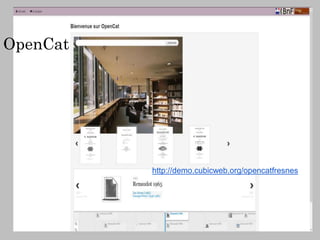
OpenCat
http://demo.cubicweb.org/opencatfresnes
http://files.dnb.de/svensson/UILLD2013/UILLD-submission-3-formatted-final.pdf
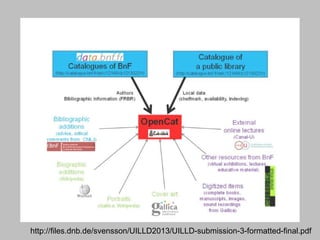
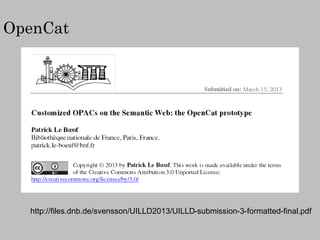
OpenCat
http://files.dnb.de/svensson/UILLD2013/UILLD-submission-3-formatted-final.pdf
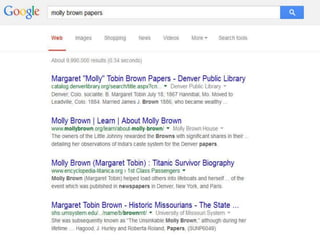
Web Visibility
“When my community searches the web for
something we have, we better show up as an
option.”
Chuck Gibson, Director & CEO
Worthington Public Library
“The Visible Library,” Library Journal Webcast, February 26, 2015
http://goo.gl/8NErmA
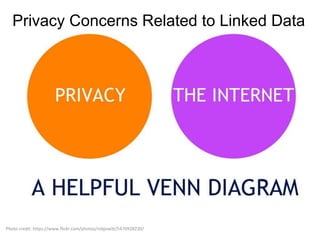
Privacy Concerns Related to Linked Data
Photo credit: https://www.flickr.com/photos/robjewitt/5470928230/
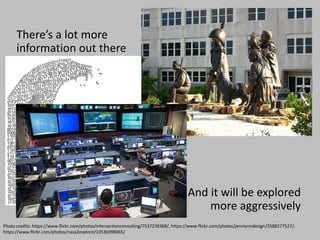
There’s a lot more
information out there
And it will be explored
more aggressively
Photo credits: https://www.flickr.com/photos/intersectionconsulting/7537238368/, https://www.flickr.com/photos/jennlynndesign/2588277527/,
https://www.flickr.com/photos/nasa2explore/10536998065/
Libraries and Privacy
Photo credit: https://www.flickr.com/photos/pong/2404940312/
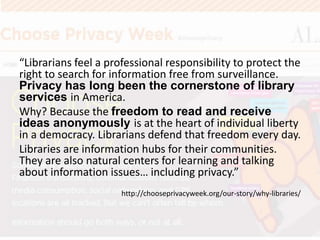
“Librarians feel a professional responsibility to protect the
right to search for information free from surveillance.
Privacy has long been the cornerstone of library
services in America.
Why? Because the freedom to read and receive
ideas anonymously is at the heart of individual liberty
in a democracy. Librarians defend that freedom every day.
Libraries are information hubs for their communities.
They are also natural centers for learning and talking
about information issues… including privacy.”
http://chooseprivacyweek.org/our-story/why-libraries/
Libraries, Rights Management,
and Linked Data
Photo credit: https://www.flickr.com/photos/917press/2583620793/
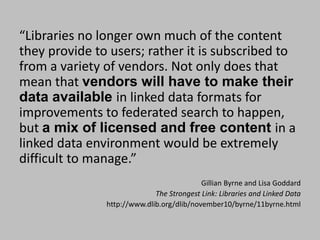
“Libraries no longer own much of the content
they provide to users; rather it is subscribed to
from a variety of vendors. Not only does that
mean that vendors will have to make their
data available in linked data formats for
improvements to federated search to happen,
but a mix of licensed and free content in a
linked data environment would be extremely
difficult to manage.”
Gillian Byrne and Lisa Goddard
The Strongest Link: Libraries and Linked Data
http://www.dlib.org/dlib/november10/byrne/11byrne.html
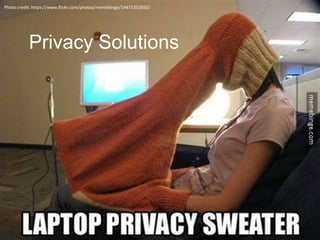
Privacy Solutions
Photo credit: https://www.flickr.com/photos/memebinge/14471353850/
We are not alone.
Photo credit: https://www.flickr.com/photos/gregloby/3515990945/
W3C Schema.org Bibliographic
Extension Community Group
https://www.w3.org/community/schemabibex/
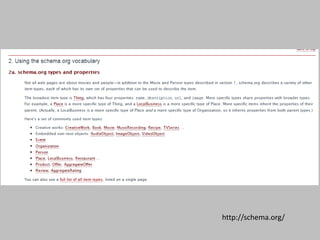
http://schema.org/
W3C Library Linked Data
Incubator Group
http://www.w3.org/2005/Incubator/lld/
http://www.w3.org/2005/Incubator/lld/wiki/Use_Case_Social_Recommendations
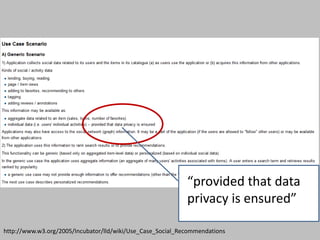
“provided that data
privacy is ensured”
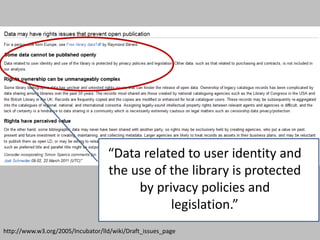
http://www.w3.org/2005/Incubator/lld/wiki/Draft_issues_page
“Data related to user identity and
the use of the library is protected
by privacy policies and
legislation.”
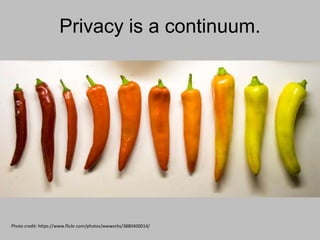
Privacy is a continuum.
Photo credit: https://www.flickr.com/photos/wwworks/3880400014/
Privacy Preference Ontology
Allows users to define “fine-grained privacy
preferences for restricting (or granting)
access” to their information
Owen Sacco and Alexandre Passant
A Privacy Preference Ontology (PPO) for Linked Data
http://events.linkeddata.org/ldow2011/papers/ldow2011-paper01-sacco.pdf
Ontology = Vocabulary
“Vocabularies are used to classify the terms
that can be used in a particular application,
characterize possible relationships, and
define possible constraints on using those
terms.”
http://www.w3.org/standards/semanticweb/ontology
Resources
Matt Enis. “Ending the Invisible Library: Linked
Data.”
http://lj.libraryjournal.com/2015/02/technology/ending-the-invisible-library-
linked-data/
Gillian Byrne and Lisa Goddard. “The Strongest Link:
Libraries and Linked Data.”
http://www.dlib.org/dlib/november10/byrne/11byrne.html
Virginia Schilling. “Transforming Library Metadata
into Linked Library Data.”
http://www.ala.org/alcts/resources/org/cat/research/linked-data
Thank you!
Emily Dust Nimsakont
Cataloging Librarian
Nebraska Library Commission
800-307-2665
emily.dust.nimsakont@nebraska.gov
http://www.slideshare.net/enimsakont
https://delicious.com/enimsakont/tsrt2015

Promises and Pitfalls: Linked Data, Privacy, and Library Catalogs

Editor's Notes