What is Input output processor ?
An input-output processor (IOP) is a special processor used in DMA
that can directly access and store data into memory. It is similar to a
CPU, except that it only handles the tasks of I/O processing. It acts as
an interface between the computer and the I/O devices.
Working of Input-Output Processor
1.When an I/O device has to access or store data to memory, it
requests the DMA controller. The DMA controller then sends a Hold
request (HLD) to the CPU to hold.
2.The CPU, on receiving the Hold request, sends Hold
acknowledgment (HLDA) to the DMA controller.
3.After receiving the HLDA, the DMA controller allows the data transfer
and takes charge of the system bus.
4.On completion of the data transfer, the DMA again issues an
interrupt, letting the CPU know that the data transfer has finished.
•
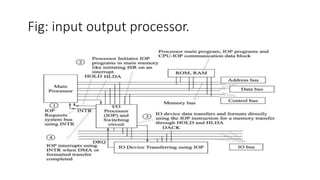
Fig: input output processor.
Advantages of Input-Output processor
1.Speeds up the read-write operations as it does not involve a
processor.
2.I/O devices can access the main memory directly.
3.Reduces the CPU overhead of waiting for I/O to complete.
Disadvantages of Input-Output processor
What is Input output processor by hdl and coa.pptx

What is Input output processor by hdl and coa.pptx

  • 1.
    What is Inputoutput processor ? An input-output processor (IOP) is a special processor used in DMA that can directly access and store data into memory. It is similar to a CPU, except that it only handles the tasks of I/O processing. It acts as an interface between the computer and the I/O devices.
  • 2.
    Working of Input-OutputProcessor 1.When an I/O device has to access or store data to memory, it requests the DMA controller. The DMA controller then sends a Hold request (HLD) to the CPU to hold. 2.The CPU, on receiving the Hold request, sends Hold acknowledgment (HLDA) to the DMA controller. 3.After receiving the HLDA, the DMA controller allows the data transfer and takes charge of the system bus. 4.On completion of the data transfer, the DMA again issues an interrupt, letting the CPU know that the data transfer has finished. •
  • 3.
  • 4.
    Advantages of Input-Outputprocessor 1.Speeds up the read-write operations as it does not involve a processor. 2.I/O devices can access the main memory directly. 3.Reduces the CPU overhead of waiting for I/O to complete.
  • 5.