What Is Copyright?Carteret Community College LibraryContent by Elizabeth Baker
What Is Copyright?Elizabeth Baker, 2009A form of legal protection for creative works.Granted to authors or creators.Extends to both published and unpublished works.
Why Is Copyright Important?Elizabeth Baker, 2009Because it is the law. The copyright statute is found in Article 1, Section 8 of the United States Constitution:“Congress shall have the power ‘To promote the progress of science and useful arts, by securing for limited times to authors and inventors the exclusive right to their respective writings and discoveries.’’http://www.lib.ncsu.edu/scc/tutorial/basics.html
What Works Are Protected?Elizabeth Baker, 2009Literary works.(Books, other printed works)
Musical works.(Songs)
Dramatic works.  (Plays)
Pictorial, graphic, and sculptural works. (Pictures, graphs, art work, statutes, etc.)
Motion pictures and other audiovisual works. (Movies, films, etc.)What Works Are Protected?Elizabeth Baker, 2009Sound recordings.  (Interviews, books on tape, etc.)Pantomimes and other choreographic works. (Dances)Architectural works. (Buildings, blueprints, etc.)http://www.copyright.gov/
Elizabeth Baker, 2009What are the Rights of the Copyright Holder ?The copyright holder has the following exclusive rights:To reproduce the work.  (To make copies)
To prepare derivative works. (To change the original format or style)
To distribute copies of the work. (To sell or market the copies)What are the Rights of the Copyright Holder ?To publicly perform the work. (To sing, act, dance, etc.)To publicly display the work directly or by telecommunication. (To broadcast or publish)To publicly perform a sound recording by digital transmission.  http://www.lib.ncsu.edu/scc/tutorial/basics3.html
Elizabeth Baker, 2009When Does Copyright Begin?Immediately.
However, the work must be in “fixed form.”  This means that it must be written, sung, drawn, etc.
The copyright belongs to the creator or author.
Only the author (or those to whom the author has given rights) can use the work lawfully.
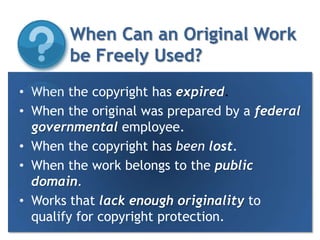
http://www.copyright.gov/circs/circ1.html#wcccWhen Can an Original Work be Freely Used?When the copyright has expired.When the original was prepared by afederal governmental employee.

What is Copyright

  • 1.
    What Is Copyright?CarteretCommunity College LibraryContent by Elizabeth Baker
  • 2.
    What Is Copyright?ElizabethBaker, 2009A form of legal protection for creative works.Granted to authors or creators.Extends to both published and unpublished works.
  • 3.
    Why Is CopyrightImportant?Elizabeth Baker, 2009Because it is the law. The copyright statute is found in Article 1, Section 8 of the United States Constitution:“Congress shall have the power ‘To promote the progress of science and useful arts, by securing for limited times to authors and inventors the exclusive right to their respective writings and discoveries.’’http://www.lib.ncsu.edu/scc/tutorial/basics.html
  • 4.
    What Works AreProtected?Elizabeth Baker, 2009Literary works.(Books, other printed works)
  • 5.
  • 6.
  • 7.
    Pictorial, graphic, andsculptural works. (Pictures, graphs, art work, statutes, etc.)
  • 8.
    Motion pictures andother audiovisual works. (Movies, films, etc.)What Works Are Protected?Elizabeth Baker, 2009Sound recordings. (Interviews, books on tape, etc.)Pantomimes and other choreographic works. (Dances)Architectural works. (Buildings, blueprints, etc.)http://www.copyright.gov/
  • 9.
    Elizabeth Baker, 2009Whatare the Rights of the Copyright Holder ?The copyright holder has the following exclusive rights:To reproduce the work. (To make copies)
  • 10.
    To prepare derivativeworks. (To change the original format or style)
  • 11.
    To distribute copiesof the work. (To sell or market the copies)What are the Rights of the Copyright Holder ?To publicly perform the work. (To sing, act, dance, etc.)To publicly display the work directly or by telecommunication. (To broadcast or publish)To publicly perform a sound recording by digital transmission. http://www.lib.ncsu.edu/scc/tutorial/basics3.html
  • 12.
    Elizabeth Baker, 2009WhenDoes Copyright Begin?Immediately.
  • 13.
    However, the workmust be in “fixed form.” This means that it must be written, sung, drawn, etc.
  • 14.
    The copyright belongsto the creator or author.
  • 15.
    Only the author(or those to whom the author has given rights) can use the work lawfully.
  • 16.
    http://www.copyright.gov/circs/circ1.html#wcccWhen Can anOriginal Work be Freely Used?When the copyright has expired.When the original was prepared by afederal governmental employee.