What Do I Do with all this Stuff?How to Use your Research Information EffectivelyCarteret Community College LibraryElizabeth Baker
How Do I Get Started?Read the magazine, journal, or newspaper article. Use the book’s table of contents or index to locate information quickly.  Read the page or chapter.
While reading, ask yourself:What is the purpose of the article, page, or chapter?What is the author’s main point?What are the most important issues or questions that he/she raises?Do you agree or disagree with the author’s conclusion or point of view?
Begin taking notes.Organize your information from specific to general or from abstract to concrete.Create an outline.Begin writing your research paper.
How Do I Take Notes?Record the title, author, publisher, publication date, and page number(s). Skim the material again.Look at any charts, graphs, or illustrations.Locate the main ideas and list them.Begin to record the supporting facts.
Some key points to remember:Do not copy information straight from the article or book.Put quotation marks around any direct quotes to avoid plagiarism.Remember to summarize or paraphrase the information.Use the dictionary to define any words that you do not recognize.
Why Should I Make an Outline?To organize your thinking.
To eliminate any information or ideas that do not support your topic.
To guide the flow of your paper.
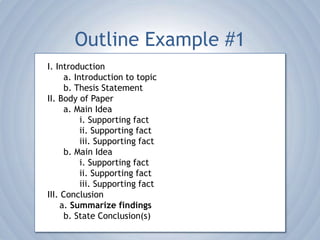
To mark when you have reached the end of your writing.Outline Example #1I. Introductiona. Introduction to topicb. Thesis StatementII. Body of Papera. Main Ideai. Supporting factii. Supporting factiii. Supporting fact b. Main Ideai. Supporting factii. Supporting factiii. Supporting factIII. Conclusion	a. Summarize findingsb. State Conclusion(s)
How Do I Synthesize Information?SummarizeParaphraseQuote
How Do I Summarize?Read the entire passage.Determine the author’s main points.Use this information in your paper or project.Provide the proper citation.
How Do I Paraphrase?Read the entire passage.Convert the author’s words into your own words.Use all the information in your paper or project.Provide the proper citation.
How Do I Quote?Read the entire passage.Record the author’s words exactly as written in your paper or project.Enclose the sentence or passage in quotation marks.Provide the proper citation.
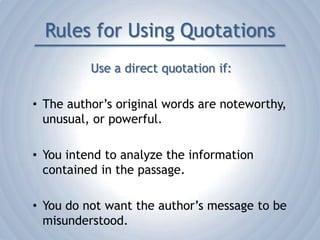
Rules for Using QuotationsUse a direct quotation if:The author’s original words are noteworthy, unusual, or powerful.

What do I do with all this stuff?

  • 1.
    What Do IDo with all this Stuff?How to Use your Research Information EffectivelyCarteret Community College LibraryElizabeth Baker
  • 2.
    How Do IGet Started?Read the magazine, journal, or newspaper article. Use the book’s table of contents or index to locate information quickly. Read the page or chapter.
  • 3.
    While reading, askyourself:What is the purpose of the article, page, or chapter?What is the author’s main point?What are the most important issues or questions that he/she raises?Do you agree or disagree with the author’s conclusion or point of view?
  • 4.
    Begin taking notes.Organizeyour information from specific to general or from abstract to concrete.Create an outline.Begin writing your research paper.
  • 5.
    How Do ITake Notes?Record the title, author, publisher, publication date, and page number(s). Skim the material again.Look at any charts, graphs, or illustrations.Locate the main ideas and list them.Begin to record the supporting facts.
  • 6.
    Some key pointsto remember:Do not copy information straight from the article or book.Put quotation marks around any direct quotes to avoid plagiarism.Remember to summarize or paraphrase the information.Use the dictionary to define any words that you do not recognize.
  • 7.
    Why Should IMake an Outline?To organize your thinking.
  • 8.
    To eliminate anyinformation or ideas that do not support your topic.
  • 9.
    To guide theflow of your paper.
  • 10.
    To mark whenyou have reached the end of your writing.Outline Example #1I. Introductiona. Introduction to topicb. Thesis StatementII. Body of Papera. Main Ideai. Supporting factii. Supporting factiii. Supporting fact b. Main Ideai. Supporting factii. Supporting factiii. Supporting factIII. Conclusion a. Summarize findingsb. State Conclusion(s)
  • 11.
    How Do ISynthesize Information?SummarizeParaphraseQuote
  • 12.
    How Do ISummarize?Read the entire passage.Determine the author’s main points.Use this information in your paper or project.Provide the proper citation.
  • 13.
    How Do IParaphrase?Read the entire passage.Convert the author’s words into your own words.Use all the information in your paper or project.Provide the proper citation.
  • 14.
    How Do IQuote?Read the entire passage.Record the author’s words exactly as written in your paper or project.Enclose the sentence or passage in quotation marks.Provide the proper citation.
  • 15.
    Rules for UsingQuotationsUse a direct quotation if:The author’s original words are noteworthy, unusual, or powerful.
  • 16.
    You intend toanalyze the information contained in the passage.
  • 17.
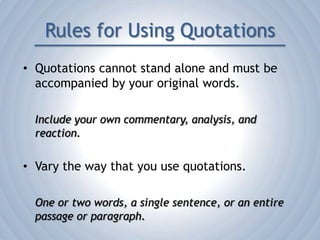
    You do notwant the author’s message to be misunderstood.Rules for Using QuotationsQuotations cannot stand alone and must be accompanied by your original words.Include your own commentary, analysis, and reaction.Vary the way that you use quotations.One or two words, a single sentence, or an entire passage or paragraph.
  • 18.
    If you needany additional help, please see a member of the library staff!Good Luck!