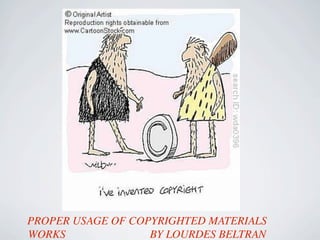
PROPER USAGE OF COPYRIGHTED MATERIALS
WORKS              BY LOURDES BELTRAN
PUBLIC DOMAIN

• Publicdomain is the state of belonging or being
 available to the public as a whole.
HOW CAN WE KNOW A WORK IS IN THE PUBLIC DOMAIN?

                    DOMAIN
 •   Public domain works are those that were created
     before the existence of copyright laws.

 •   Most works from the government are public
     domain like: works done by the federal
     government officers or employees as their official
     duty (written works, photographs, and other
     images).
EXAMPLE OF A PUBLIC DOMAIN WORK


•   This is an example of a public domain work that was done before the copyright laws.
ORPHAN WORKS

• These are works that do not have sufficient information
 to identify the owner or the date it was published.
EXAMPLE OF AN ORPHAN
             WORK


•   The Appalachian frontier: America's first surge westward by John Anthony
    Caruso
USING MATERIALS FROM
         THE INTERNET
• Copyright     Laws govern materials that are found on the
    internet.

•    Some common assumptions about internet material
    usage are: not everything that is posted on the Internet
    is public domain.

• People    that copy and distribute others’ copyrighted
    works without permission can be liable and can face
    fines from $200 to $150,00 for each work.
FAIR USE

• Fair
     use: is a right granted to the public on all
 copyrighted works.

• The role of fair use: Fair use plays a critical role in the
 analog world where duplicating technology is
 cumbersome and authors make money by controlling
 copies. Collective licensing (the Copyright Clearance
 Center)
FAIR USE OF

• Fairuse is a shadowy territory whose boundaries are
 disputed, more so now than ever, since it applies in the
 online environment.

• People now license the public to use their works by
 attaching Creative Commons licenses to them, making
 educational uses much easier without worry about fair
 use.
FAIR USE EXCEPTIONS


• Copyrighted   works may only be used with the
 limitation of using 300 words only. If the whole work is
 copied, it is not considered fair use.
HOW TO GET
   PERMISSION ON WORKS

• CCC   (works that is part of a book or a journal article)

• VERDI(works from Finland, France, Germany, Ireland,
 the Netherlands, and Spain)

• Image   archives: MIRA

• Freelance: Igenta
THE FOUR FAIR USE

• 1. What   is the character of the use?

• 2. What   is the nature of the work to be used?

• 3. How    much of the work will you use?

• 4. What effect would this use have on the market for
 the original or for permissions if the use were
 widespread?
THE TEACH ACT


• Copyright  law that provides educators with a separate
 set of rights in addition to fair use, to display (show)
 and perform (show or play) others’ works in the
 classroom.

• TEACH Act   become law in late 2002.
RESOURCES

•   http://copyright.lib.utexas.edu/useofweb.html

•   http://en.wikipedia.org/wiki/Public_domain

•   New Oxford American Dictionary

•   http://www.wikihow.com/Avoid-Copyright-Infringement

•   http://www.publicdomainsherpa.com/us-government-works.html

•   http://www.lib.purdue.edu/uco/CopyrightBasics/penalties.html

•   http://en.wikipedia.org/wiki/Fair_use

Copyright utb 2011ed week 6

  • 1.
    PROPER USAGE OFCOPYRIGHTED MATERIALS WORKS BY LOURDES BELTRAN
  • 2.
    PUBLIC DOMAIN • Publicdomainis the state of belonging or being available to the public as a whole.
  • 3.
    HOW CAN WEKNOW A WORK IS IN THE PUBLIC DOMAIN? DOMAIN • Public domain works are those that were created before the existence of copyright laws. • Most works from the government are public domain like: works done by the federal government officers or employees as their official duty (written works, photographs, and other images).
  • 4.
    EXAMPLE OF APUBLIC DOMAIN WORK • This is an example of a public domain work that was done before the copyright laws.
  • 5.
    ORPHAN WORKS • Theseare works that do not have sufficient information to identify the owner or the date it was published.
  • 6.
    EXAMPLE OF ANORPHAN WORK • The Appalachian frontier: America's first surge westward by John Anthony Caruso
  • 7.
    USING MATERIALS FROM THE INTERNET • Copyright Laws govern materials that are found on the internet. • Some common assumptions about internet material usage are: not everything that is posted on the Internet is public domain. • People that copy and distribute others’ copyrighted works without permission can be liable and can face fines from $200 to $150,00 for each work.
  • 8.
    FAIR USE • Fair use: is a right granted to the public on all copyrighted works. • The role of fair use: Fair use plays a critical role in the analog world where duplicating technology is cumbersome and authors make money by controlling copies. Collective licensing (the Copyright Clearance Center)
  • 9.
    FAIR USE OF •Fairuse is a shadowy territory whose boundaries are disputed, more so now than ever, since it applies in the online environment. • People now license the public to use their works by attaching Creative Commons licenses to them, making educational uses much easier without worry about fair use.
  • 10.
    FAIR USE EXCEPTIONS •Copyrighted works may only be used with the limitation of using 300 words only. If the whole work is copied, it is not considered fair use.
  • 11.
    HOW TO GET PERMISSION ON WORKS • CCC (works that is part of a book or a journal article) • VERDI(works from Finland, France, Germany, Ireland, the Netherlands, and Spain) • Image archives: MIRA • Freelance: Igenta
  • 12.
    THE FOUR FAIRUSE • 1. What is the character of the use? • 2. What is the nature of the work to be used? • 3. How much of the work will you use? • 4. What effect would this use have on the market for the original or for permissions if the use were widespread?
  • 13.
    THE TEACH ACT •Copyright law that provides educators with a separate set of rights in addition to fair use, to display (show) and perform (show or play) others’ works in the classroom. • TEACH Act become law in late 2002.
  • 14.
    RESOURCES • http://copyright.lib.utexas.edu/useofweb.html • http://en.wikipedia.org/wiki/Public_domain • New Oxford American Dictionary • http://www.wikihow.com/Avoid-Copyright-Infringement • http://www.publicdomainsherpa.com/us-government-works.html • http://www.lib.purdue.edu/uco/CopyrightBasics/penalties.html • http://en.wikipedia.org/wiki/Fair_use

Editor's Notes