Norma ZaremberEDTC 6340Copyright
The importance of copyrightIn the world of education copyright plays a very important role and  with the advance of technology this importance has become paramount.I would like to start by analyzing the definition of copyright:The dictionary describes it as the legal right of creative artists or publishers to control the use and reproduction of their original works.The question becomes who owns the works and what rights does the owner has over the works.
who  owns the worksAN AUTHORBy definition an author is someone who contributes copyrightable expression to the work.By definition copyrightable expression is original authorship, fixed on a tangible medium of expression.Examples of copyrightable expression:Poetry, prose, software application, artwork, musical notation, recorded music and/or song, animation, video, java applets, web page, website design and photographs.
Examples that do not qualify as Copyright ExpressionIdeas
Mere facts
Logos and slogans
Titles and short phrases
Exact duplication of public domain works
Works created by the Federal GovernmentRights of the Copyright OwnerThe owner of a copyright has the exclusive right to reproduce work, to distribute copies, to display the work publicly .
Public Domain and Orphan WorksThe public domain is the realm of material — ideas, images, sounds, discoveries, facts, texts — that is unprotected by intellectual property rights and free for all to use or build upon. It includes our collective cultural and scientific heritage, and the raw materials for future expression, research, democratic dialogue and education.Orphan works are works  under the copyright published before 1923But they are commercially unavailable  and the copyright owner can not be found
Content on the webUsing materials from the Internet Copyright law governs the use of materials you might find on the Internet, just as it governs the use of books, video or music in the analog worldCopyright protectionMany people assume that everything posted on the Internet is public domain, probably because our law used to protect published works only if they displayed the proper copyright notice upon publication. The law, however, has changed: neither publication nor a notice of any kind is required to protect works today. Simply putting the pen to the paper or in the electronic medium, putting the fingers to the save key creates a copyrighted work.
The saving grace: Implied and express licenses to use internet materials Whenever an author posts anything on the Internet, he or she should reasonably expect that it will be read, downloaded, printed out, forwarded, and even used as the basis for other works to some degree. So, just by posting, an author impliedly grants a limited license to use her work in this manner.The trouble with implied licenses is that their boundaries are vague. Express licenses, licenses that spell out in detail what rights the author of a work wants readers, viewers or listeners to have. You can easily give your works an express license by attaching a Creative Commons license to the materials you post on your Website, or upload to other sites. It's easy and it sends the message that you want your materials to be part of the flow of creativity.
Liability for posting infringing workslawsuits against individuals for peer-to-peer file-sharing make clear that individuals can be liable for their own actions when they copy and distribute others' copyrighted works without permission. Universities and libraries can also be liable for the actions of their employees doing their jobs and possibly students who access the Internet through university machines. The role of fair use Fair use plays a critical role in the analog world where duplicating technology is cumbersome and authors make money by controlling copies. It balances authors' rights to reasonable compensation with the public's rights to the ideas contained in copyrighted works. It used to be safe to say that reasonable analog educational, research and scholarly uses were fair uses. But this appears to be changing.Where fair use may be questioned, implied rights may be broader, but an express right to use is best - it's clear and reassuring. It's possible today to search Creative Commons licensed works by license type, or limit your search to be sure that your results include only materials intended for use by educators and students.
FAIR USEWhat is Fair Use? A gray shadowy line whose boundaries are disputed; even so now with easy access to online material.Fair Use liability for infringementa.	You are responsible for your own actions.b.	Know the rules of infringement         c.	“The penalties for infringement are very harsh”
How to determine if you need permissionIs the work protected?Has your campus already licensed rights for you to use the work?Is the work available freely on the open web.b.	Has your campus already have licensed rights for you to use the work?c.	Is the work available freely on the open Webd.	Has the creator used a Creative Commons license to give the public                  	access to his/her work.e.	Is your intended use exempt or excused from the liability infringement?
Fair use Exemptionsa.	Course packs, reserves, course management systemsb.	Image archivesc.	Creative usesd.	Research copiesFour factor of fair usea.	What is the character of the use?b.	What is the nature of the work to be used?c.	How much of the work will you used.	What effect would this use have on the market for the original or for    	permissions if the use were widespread?
THE TEACH ACTThe acronym Teach stands for Technology Education and Copyright Harmonization The Teach Act became a law on 2002. What is ‘’The Teach Act’’ and why is important that educators are aware of it:  In the copyright Act section 110(1) the law allows the teacher to fair use, display, perform and play other’s works in the classroom, however with the new era of digitalization and distant education a new section has been add it to it section 110 (2) this was created to authorize the teachers to digitize parts of the works in an analog tape and utilize them in distant education. 
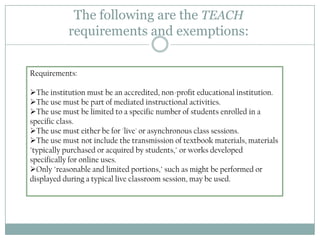
The following are the TEACHrequirements and exemptions:Requirements:The institution must be an accredited, non-profit educational institution.

Copyright

  • 1.
  • 2.
    The importance ofcopyrightIn the world of education copyright plays a very important role and with the advance of technology this importance has become paramount.I would like to start by analyzing the definition of copyright:The dictionary describes it as the legal right of creative artists or publishers to control the use and reproduction of their original works.The question becomes who owns the works and what rights does the owner has over the works.
  • 3.
    who ownsthe worksAN AUTHORBy definition an author is someone who contributes copyrightable expression to the work.By definition copyrightable expression is original authorship, fixed on a tangible medium of expression.Examples of copyrightable expression:Poetry, prose, software application, artwork, musical notation, recorded music and/or song, animation, video, java applets, web page, website design and photographs.
  • 4.
    Examples that donot qualify as Copyright ExpressionIdeas
  • 5.
  • 6.
  • 7.
  • 8.
    Exact duplication ofpublic domain works
  • 9.
    Works created bythe Federal GovernmentRights of the Copyright OwnerThe owner of a copyright has the exclusive right to reproduce work, to distribute copies, to display the work publicly .
  • 10.
    Public Domain andOrphan WorksThe public domain is the realm of material — ideas, images, sounds, discoveries, facts, texts — that is unprotected by intellectual property rights and free for all to use or build upon. It includes our collective cultural and scientific heritage, and the raw materials for future expression, research, democratic dialogue and education.Orphan works are works under the copyright published before 1923But they are commercially unavailable and the copyright owner can not be found
  • 11.
    Content on thewebUsing materials from the Internet Copyright law governs the use of materials you might find on the Internet, just as it governs the use of books, video or music in the analog worldCopyright protectionMany people assume that everything posted on the Internet is public domain, probably because our law used to protect published works only if they displayed the proper copyright notice upon publication. The law, however, has changed: neither publication nor a notice of any kind is required to protect works today. Simply putting the pen to the paper or in the electronic medium, putting the fingers to the save key creates a copyrighted work.
  • 12.
    The saving grace:Implied and express licenses to use internet materials Whenever an author posts anything on the Internet, he or she should reasonably expect that it will be read, downloaded, printed out, forwarded, and even used as the basis for other works to some degree. So, just by posting, an author impliedly grants a limited license to use her work in this manner.The trouble with implied licenses is that their boundaries are vague. Express licenses, licenses that spell out in detail what rights the author of a work wants readers, viewers or listeners to have. You can easily give your works an express license by attaching a Creative Commons license to the materials you post on your Website, or upload to other sites. It's easy and it sends the message that you want your materials to be part of the flow of creativity.
  • 13.
    Liability for postinginfringing workslawsuits against individuals for peer-to-peer file-sharing make clear that individuals can be liable for their own actions when they copy and distribute others' copyrighted works without permission. Universities and libraries can also be liable for the actions of their employees doing their jobs and possibly students who access the Internet through university machines. The role of fair use Fair use plays a critical role in the analog world where duplicating technology is cumbersome and authors make money by controlling copies. It balances authors' rights to reasonable compensation with the public's rights to the ideas contained in copyrighted works. It used to be safe to say that reasonable analog educational, research and scholarly uses were fair uses. But this appears to be changing.Where fair use may be questioned, implied rights may be broader, but an express right to use is best - it's clear and reassuring. It's possible today to search Creative Commons licensed works by license type, or limit your search to be sure that your results include only materials intended for use by educators and students.
  • 14.
    FAIR USEWhat isFair Use? A gray shadowy line whose boundaries are disputed; even so now with easy access to online material.Fair Use liability for infringementa. You are responsible for your own actions.b. Know the rules of infringement c. “The penalties for infringement are very harsh”
  • 15.
    How to determineif you need permissionIs the work protected?Has your campus already licensed rights for you to use the work?Is the work available freely on the open web.b. Has your campus already have licensed rights for you to use the work?c. Is the work available freely on the open Webd. Has the creator used a Creative Commons license to give the public access to his/her work.e. Is your intended use exempt or excused from the liability infringement?
  • 16.
    Fair use Exemptionsa. Coursepacks, reserves, course management systemsb. Image archivesc. Creative usesd. Research copiesFour factor of fair usea. What is the character of the use?b. What is the nature of the work to be used?c. How much of the work will you used. What effect would this use have on the market for the original or for permissions if the use were widespread?
  • 17.
    THE TEACH ACTTheacronym Teach stands for Technology Education and Copyright Harmonization The Teach Act became a law on 2002. What is ‘’The Teach Act’’ and why is important that educators are aware of it:  In the copyright Act section 110(1) the law allows the teacher to fair use, display, perform and play other’s works in the classroom, however with the new era of digitalization and distant education a new section has been add it to it section 110 (2) this was created to authorize the teachers to digitize parts of the works in an analog tape and utilize them in distant education. 
  • 18.
    The following arethe TEACHrequirements and exemptions:Requirements:The institution must be an accredited, non-profit educational institution.