Copyright Law Overview

   By Geralyn Dominguez
What is Copyright?


“Copyright is a form of protection provided
  by the laws of the United States (title 17,
  U.S. Code) to authors of ‘original works of
  authorship,’ including literary, dramatic,
  musical, artistic, and certain other
  intellectual works.”1
What is Infringement?

“Anyone who violates any of
  the exclusive rights of the
  copyright owner ...is an
  infringer of the copyright or
  right of the author.”2
What is Infringement? (cont.)

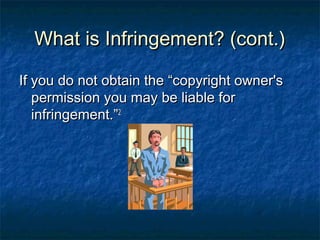
If you do not obtain the “copyright owner's
   permission you may be liable for
   infringement.”2
Material You Can Freely Use
   Unprotected works:
    - “Works that lack originality…
    - Works in the public domain
    - US Government works
    - Facts
    - Ideas, processes, methods,
    and systems described in
    copyrighted works.”3
Material You Can Freely Use
(cont.)
   “Library-licensed works
   Creative Commons licensed works” 3
   Works covered by implied license3
What is the Public Domain?

“A public domain work is a creative work
  that is not protected by copyright and
  which may be freely used by everyone.” 4
What is the Public Domain? (cont.)
         “The reasons that the work is not
           protected include:
           (1) the term of copyright for the
           work has expired;
          (2) the author failed to satisfy
           statutory
           formalities to perfect the copyright
           or
          (3) the work is a work of the U.S.
           Government.”4
What is Creative Commons?
“Creative Commons is a nonprofit
  organization that enables the sharing and
  use of creativity and knowledge through
  legal tools.”5


It’s free and they work with copyright.5
Creative Commons (cont.)

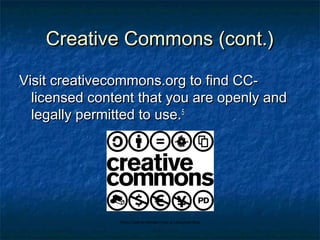
Visit creativecommons.org to find CC-
  licensed content that you are openly and
  legally permitted to use.5


               Photo Credit by Michael Porter at Libraryman Blog
But What is Fair Use?


Fair use allows you to reproduce copyrighted
 works if your intent is considered “fair.”
 Examples include using the work for
 “criticism, comment, news reporting,
 teaching, scholarship, and research.” 6
Fair Use: Two Questions to Ask
        1. “Is the use you want to make
          of another’s work
          transformative--that is, does it
          add value to and repurpose
          the work for a new
          audience”?3
        2. “And is the amount of the
          material you want to use
          appropriate to achieve your
          transformative purpose?”3
Four Question Fair Use Test
1. “What is the character of the use?
2. What is the nature of the work to
  be used?
3. How much of the work will be
  used?
4. What effect would this use have
  on the market for the original or for
  permissions if the use were
  widespread?”3
TEACH Act and the Classroom

The TEACH Act is a “separate set of rights
 in addition to fair use, to display (show)
 and perform (show or play) others’ works
 in the classroom.”7
TEACH Act and the Classroom
            (cont.)
Certain limitations apply for “in-class” vs.
 “distance education” classrooms.


Visit copyright.lib.utexas.edu/teachact.html for
  help in making the determination of use.
You Can Always Ask for
     Permission
          A good starting point is a
           collective rights organization
           such as the Copyright
           Clearance Center.8
          Contact the owner and get
           written permission. 8
          For additional resources, visit:

           http://copyright.lib.utexas.edu/permissn.
           html (sic)
References
1.   Copyright Basics. (May 2012). Copyright: United States Copyright Office. Retrieved
     September 5, 2012. From http://www.copyright.gov/circs/circ01.pdf
2.   Stopping Copyright Infringement. (March 10, 2010). Copyright: United States
     Copyright Office. Retrieved September 7, 2012. From
     http://www.copyright.gov/help/faq/faq-infringement.html
3.   Harper, Georgia K. (2012). Building On Others’ Creative Expression: Fair Use of
     Copyrighted Materials. Copyright Crash Course. Retrieved September 1, 2012. From
     http://copyright.lib.utexas.edu/copypol2.html
4.   Gasaway, Lolly. (November 4, 2003). When U.S. Works Pass into the Public
     Domain. University of North Carlina. Retrieved September 9, 2012. From
     http://www.unc.edu/~unclng/public-d.htm
5.   About. (n.d.). Creative Commons. Retrieved September 4, 2012. From
     http://creativecommons.org/about
6.   Fair Use. (June 2012). Copyright: United States Copyright Office. Retrieved
     September 15, 2012. From http://www.copyright.gov/fls/fl102.html
7.   Harper, Georgia K. (2012). Building On Others’ Creative Expression: The TEACH
     Act. Copyright Crash Course. Retrieved September 1, 2012. From
     http://copyright.lib.utexas.edu/teachact.html
8.   Harper, Georgia K. (2012). Building On Others’ Creative Expression: Getting
     Permission. Copyright Crash Course. Retrieved September 1, 2012. From
     http://copyright.lib.utexas.edu/permissn.html

Copyright law overview 2

  • 1.
    Copyright Law Overview By Geralyn Dominguez
  • 2.
    What is Copyright? “Copyrightis a form of protection provided by the laws of the United States (title 17, U.S. Code) to authors of ‘original works of authorship,’ including literary, dramatic, musical, artistic, and certain other intellectual works.”1
  • 3.
    What is Infringement? “Anyonewho violates any of the exclusive rights of the copyright owner ...is an infringer of the copyright or right of the author.”2
  • 4.
    What is Infringement?(cont.) If you do not obtain the “copyright owner's permission you may be liable for infringement.”2
  • 5.
    Material You CanFreely Use  Unprotected works: - “Works that lack originality… - Works in the public domain - US Government works - Facts - Ideas, processes, methods, and systems described in copyrighted works.”3
  • 6.
    Material You CanFreely Use (cont.)  “Library-licensed works  Creative Commons licensed works” 3  Works covered by implied license3
  • 7.
    What is thePublic Domain? “A public domain work is a creative work that is not protected by copyright and which may be freely used by everyone.” 4
  • 8.
    What is thePublic Domain? (cont.) “The reasons that the work is not protected include: (1) the term of copyright for the work has expired; (2) the author failed to satisfy statutory formalities to perfect the copyright or (3) the work is a work of the U.S. Government.”4
  • 9.
    What is CreativeCommons? “Creative Commons is a nonprofit organization that enables the sharing and use of creativity and knowledge through legal tools.”5 It’s free and they work with copyright.5
  • 10.
    Creative Commons (cont.) Visitcreativecommons.org to find CC- licensed content that you are openly and legally permitted to use.5 Photo Credit by Michael Porter at Libraryman Blog
  • 11.
    But What isFair Use? Fair use allows you to reproduce copyrighted works if your intent is considered “fair.” Examples include using the work for “criticism, comment, news reporting, teaching, scholarship, and research.” 6
  • 12.
    Fair Use: TwoQuestions to Ask 1. “Is the use you want to make of another’s work transformative--that is, does it add value to and repurpose the work for a new audience”?3 2. “And is the amount of the material you want to use appropriate to achieve your transformative purpose?”3
  • 13.
    Four Question FairUse Test 1. “What is the character of the use? 2. What is the nature of the work to be used? 3. How much of the work will be used? 4. What effect would this use have on the market for the original or for permissions if the use were widespread?”3
  • 14.
    TEACH Act andthe Classroom The TEACH Act is a “separate set of rights in addition to fair use, to display (show) and perform (show or play) others’ works in the classroom.”7
  • 15.
    TEACH Act andthe Classroom (cont.) Certain limitations apply for “in-class” vs. “distance education” classrooms. Visit copyright.lib.utexas.edu/teachact.html for help in making the determination of use.
  • 16.
    You Can AlwaysAsk for Permission  A good starting point is a collective rights organization such as the Copyright Clearance Center.8  Contact the owner and get written permission. 8  For additional resources, visit: http://copyright.lib.utexas.edu/permissn. html (sic)
  • 17.
    References 1. Copyright Basics. (May 2012). Copyright: United States Copyright Office. Retrieved September 5, 2012. From http://www.copyright.gov/circs/circ01.pdf 2. Stopping Copyright Infringement. (March 10, 2010). Copyright: United States Copyright Office. Retrieved September 7, 2012. From http://www.copyright.gov/help/faq/faq-infringement.html 3. Harper, Georgia K. (2012). Building On Others’ Creative Expression: Fair Use of Copyrighted Materials. Copyright Crash Course. Retrieved September 1, 2012. From http://copyright.lib.utexas.edu/copypol2.html 4. Gasaway, Lolly. (November 4, 2003). When U.S. Works Pass into the Public Domain. University of North Carlina. Retrieved September 9, 2012. From http://www.unc.edu/~unclng/public-d.htm 5. About. (n.d.). Creative Commons. Retrieved September 4, 2012. From http://creativecommons.org/about 6. Fair Use. (June 2012). Copyright: United States Copyright Office. Retrieved September 15, 2012. From http://www.copyright.gov/fls/fl102.html 7. Harper, Georgia K. (2012). Building On Others’ Creative Expression: The TEACH Act. Copyright Crash Course. Retrieved September 1, 2012. From http://copyright.lib.utexas.edu/teachact.html 8. Harper, Georgia K. (2012). Building On Others’ Creative Expression: Getting Permission. Copyright Crash Course. Retrieved September 1, 2012. From http://copyright.lib.utexas.edu/permissn.html