


aTRAYEE
dUTTA
pRIYANKA lAHA
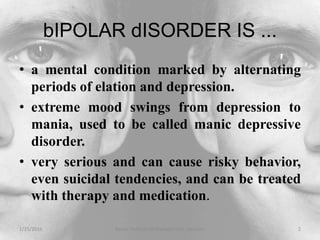
bIPOLAR dISORDER IS ...
• a mental condition marked by alternating
periods of elation and depression.
• extreme mood swings from depression to
mania, used to be called manic depressive
disorder.
• very serious and can cause risky behavior,
even suicidal tendencies, and can be treated
with therapy and medication.
1/15/2016 2Xavier Institute of Management, Jabalpur
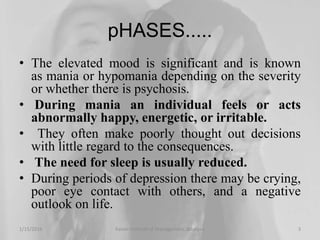
pHASES.....
• The elevated mood is significant and is known
as mania or hypomania depending on the severity
or whether there is psychosis.
• During mania an individual feels or acts
abnormally happy, energetic, or irritable.
• They often make poorly thought out decisions
with little regard to the consequences.
• The need for sleep is usually reduced.
• During periods of depression there may be crying,
poor eye contact with others, and a negative
outlook on life.
1/15/2016 3Xavier Institute of Management, Jabalpur
sIGNS
&
sYMPTONS
1/15/2016 4Xavier Institute of Management, Jabalpur
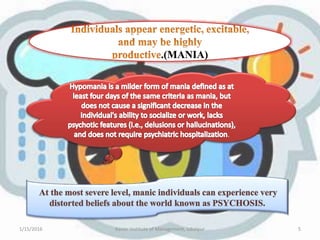
.(MANIA)
.
1/15/2016 5Xavier Institute of Management, Jabalpur
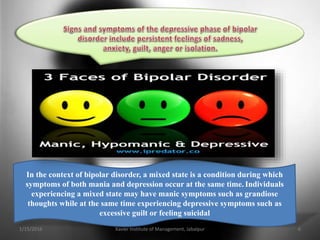
In the context of bipolar disorder, a mixed state is a condition during which
symptoms of both mania and depression occur at the same time. Individuals
experiencing a mixed state may have manic symptoms such as grandiose
thoughts while at the same time experiencing depressive symptoms such as
excessive guilt or feeling suicidal
1/15/2016 6Xavier Institute of Management, Jabalpur
1/15/2016 7Xavier Institute of Management, Jabalpur
cAUSES
1/15/2016 8Xavier Institute of Management, Jabalpur
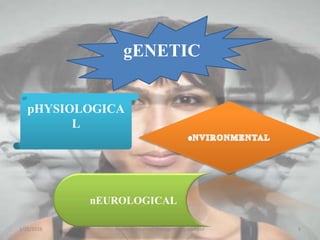
gENETIC
pHYSIOLOGICA
L
nEUROLOGICAL
1/15/2016 9Xavier Institute of Management, Jabalpur
pREVENTION
1/15/2016 10Xavier Institute of Management, Jabalpur
dIAGNOSIS:
 Bipolar disorder often goes unrecognized and is commonly
diagnosed during adolescence or early adulthood.
 Diagnosis of bipolar disorder takes several factors into account
and considers the self-reported experiences of the symptomatic
individual, behaviour abnormalities reported by family
members, friends or co-workers, and observable signs of illness
as assessed by a psychiatrist, nurse, social worker, clinical
psychologist or other health professional.
 An initial assessment may include a physical exam by a
physician. Although there are no biological tests that are
diagnostic of bipolar disorder, tests may be carried out to
exclude medical illnesses with clinical presentations similar to
that of bipolar disorder.
1/15/2016 11Xavier Institute of Management, Jabalpur
1/15/2016 12Xavier Institute of Management, Jabalpur
cRITERIA
&
sUB-TYPES
1/15/2016 13Xavier Institute of Management, Jabalpur
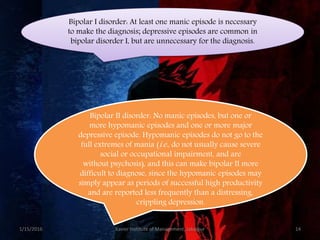
Bipolar I disorder: At least one manic episode is necessary
to make the diagnosis; depressive episodes are common in
bipolar disorder I, but are unnecessary for the diagnosis.
Bipolar II disorder: No manic episodes, but one or
more hypomanic episodes and one or more major
depressive episode. Hypomanic episodes do not go to the
full extremes of mania (i.e., do not usually cause severe
social or occupational impairment, and are
without psychosis), and this can make bipolar II more
difficult to diagnose, since the hypomanic episodes may
simply appear as periods of successful high productivity
and are reported less frequently than a distressing,
crippling depression.
1/15/2016 14Xavier Institute of Management, Jabalpur
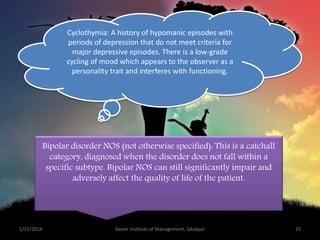
Cyclothymia: A history of hypomanic episodes with
periods of depression that do not meet criteria for
major depressive episodes. There is a low-grade
cycling of mood which appears to the observer as a
personality trait and interferes with functioning.
Bipolar disorder NOS (not otherwise specified): This is a catchall
category, diagnosed when the disorder does not fall within a
specific subtype. Bipolar NOS can still significantly impair and
adversely affect the quality of life of the patient.
1/15/2016 15Xavier Institute of Management, Jabalpur
tREATMENT
1/15/2016 16Xavier Institute of Management, Jabalpur
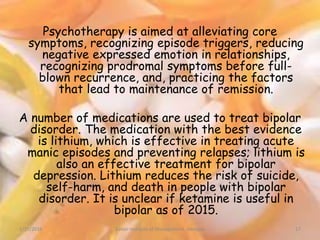
Psychotherapy is aimed at alleviating core
symptoms, recognizing episode triggers, reducing
negative expressed emotion in relationships,
recognizing prodromal symptoms before full-
blown recurrence, and, practicing the factors
that lead to maintenance of remission.
A number of medications are used to treat bipolar
disorder. The medication with the best evidence
is lithium, which is effective in treating acute
manic episodes and preventing relapses; lithium is
also an effective treatment for bipolar
depression. Lithium reduces the risk of suicide,
self-harm, and death in people with bipolar
disorder. It is unclear if ketamine is useful in
bipolar as of 2015.
1/15/2016 17Xavier Institute of Management, Jabalpur
1/15/2016 18Xavier Institute of Management, Jabalpur
1/15/2016 19Xavier Institute of Management, Jabalpur

Bipolar disorder

  • 1.
  • 2.
    bIPOLAR dISORDER IS... • a mental condition marked by alternating periods of elation and depression. • extreme mood swings from depression to mania, used to be called manic depressive disorder. • very serious and can cause risky behavior, even suicidal tendencies, and can be treated with therapy and medication. 1/15/2016 2Xavier Institute of Management, Jabalpur
  • 3.
    pHASES..... • The elevatedmood is significant and is known as mania or hypomania depending on the severity or whether there is psychosis. • During mania an individual feels or acts abnormally happy, energetic, or irritable. • They often make poorly thought out decisions with little regard to the consequences. • The need for sleep is usually reduced. • During periods of depression there may be crying, poor eye contact with others, and a negative outlook on life. 1/15/2016 3Xavier Institute of Management, Jabalpur
  • 4.
  • 5.
  • 6.
    In the contextof bipolar disorder, a mixed state is a condition during which symptoms of both mania and depression occur at the same time. Individuals experiencing a mixed state may have manic symptoms such as grandiose thoughts while at the same time experiencing depressive symptoms such as excessive guilt or feeling suicidal 1/15/2016 6Xavier Institute of Management, Jabalpur
  • 7.
    1/15/2016 7Xavier Instituteof Management, Jabalpur
  • 8.
    cAUSES 1/15/2016 8Xavier Instituteof Management, Jabalpur
  • 9.
  • 10.
  • 11.
    dIAGNOSIS:  Bipolar disorderoften goes unrecognized and is commonly diagnosed during adolescence or early adulthood.  Diagnosis of bipolar disorder takes several factors into account and considers the self-reported experiences of the symptomatic individual, behaviour abnormalities reported by family members, friends or co-workers, and observable signs of illness as assessed by a psychiatrist, nurse, social worker, clinical psychologist or other health professional.  An initial assessment may include a physical exam by a physician. Although there are no biological tests that are diagnostic of bipolar disorder, tests may be carried out to exclude medical illnesses with clinical presentations similar to that of bipolar disorder. 1/15/2016 11Xavier Institute of Management, Jabalpur
  • 12.
    1/15/2016 12Xavier Instituteof Management, Jabalpur
  • 13.
  • 14.
    Bipolar I disorder:At least one manic episode is necessary to make the diagnosis; depressive episodes are common in bipolar disorder I, but are unnecessary for the diagnosis. Bipolar II disorder: No manic episodes, but one or more hypomanic episodes and one or more major depressive episode. Hypomanic episodes do not go to the full extremes of mania (i.e., do not usually cause severe social or occupational impairment, and are without psychosis), and this can make bipolar II more difficult to diagnose, since the hypomanic episodes may simply appear as periods of successful high productivity and are reported less frequently than a distressing, crippling depression. 1/15/2016 14Xavier Institute of Management, Jabalpur
  • 15.
    Cyclothymia: A historyof hypomanic episodes with periods of depression that do not meet criteria for major depressive episodes. There is a low-grade cycling of mood which appears to the observer as a personality trait and interferes with functioning. Bipolar disorder NOS (not otherwise specified): This is a catchall category, diagnosed when the disorder does not fall within a specific subtype. Bipolar NOS can still significantly impair and adversely affect the quality of life of the patient. 1/15/2016 15Xavier Institute of Management, Jabalpur
  • 16.
  • 17.
    Psychotherapy is aimedat alleviating core symptoms, recognizing episode triggers, reducing negative expressed emotion in relationships, recognizing prodromal symptoms before full- blown recurrence, and, practicing the factors that lead to maintenance of remission. A number of medications are used to treat bipolar disorder. The medication with the best evidence is lithium, which is effective in treating acute manic episodes and preventing relapses; lithium is also an effective treatment for bipolar depression. Lithium reduces the risk of suicide, self-harm, and death in people with bipolar disorder. It is unclear if ketamine is useful in bipolar as of 2015. 1/15/2016 17Xavier Institute of Management, Jabalpur
  • 18.
    1/15/2016 18Xavier Instituteof Management, Jabalpur
  • 19.
    1/15/2016 19Xavier Instituteof Management, Jabalpur