INTRODUCTION
• Mood disordersare highly prevalent, have high morbidity, and are
associated with early mortality and suicide.
• They are among the world’s most disabling illnesses, as documented
in The Global Burden of Disease (Murray and Lopez 1996).
3.
Core Concept
• Peoplewith this diagnosis have an abnormal mood
characterized by:
• Depression
• Mania, or
• Both symptoms in alternating fashion
• The abnormal mood may or may not impair the person’s
social or occupational functioning.
4.
• Approximately 8%of adults will experience major depression at some time in
their lives. Approximately 1% will experience bipolar disorder.
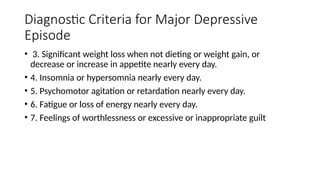
• The onset of mood disorders usually occurs during adolescence.
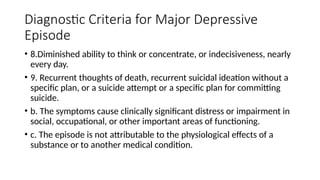
• Worldwide, major depression is the leading cause of years lived with
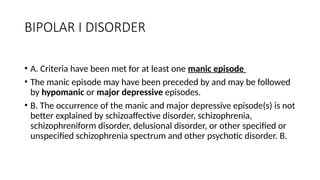
disability, and the fourth cause of disability adjusted life years (DALYs).
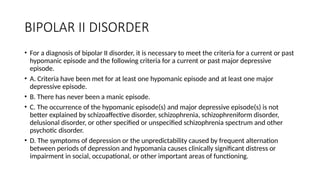
• Mood disorders have a major economic impact through associated health
care costs as well as lost work productivity.
• Hospitalization rates for bipolar disorder in general hospitals are increasing
among women and men between 15 and 24 years of age.
• Individuals with mood disorders are at high risk of suicide
5.
Gender and mooddisorders
• Depressive disorders account for close to 41.9% of the disability from
neuropsychiatric disorders among women compared to 29.3% among men.
• Gender bias occurs in the treatment of psychological disorders. Doctors are more
likely to diagnose depression in women compared with men, even when they have
similar scores on standardized measures of depression or present with identical
symptoms.
• Female gender is a significant predictor of being prescribed mood altering
psychotropic drugs.
• Gender differences exist in patterns of help seeking for psychological disorder.
Women are more likely to seek help from and disclose mental health problems to
their primary health care physician while men are more likely to seek specialist
mental health care and are the principal users of inpatient care.
6.
Definitions
• Depression
• Unusuallysad, gloomy, and dejected mood, or
• Markedly diminished interest and pleasure in everyday activities that is distinctly
different from the person’s non-depressed state.
• Mania
• Unusually and persistently elevated, expansive, or irritable mood that is
distinctly different from the person’s non-manic state
• Marked impairment, requires hospitalization
• Hypomania
• Less severe variant of mania; no hospitalization
7.
Gender and mooddisorders
• Studies have consistently documented higher rates of depression
among women than among men: the female-to-male ratio averages
2:1.3
• Women are 2 to 3 times more likely than men to develop dysthymia.
8.
DSM-5 bipolar andrelated disorders
• Bipolar I disorder
• Bipolar II disorder
• Cyclothymic disorder
• Substance/medication-induced bipolar and related disorder
• Bipolar and related disorder due to another medical condition
• Other specified bipolar and related disorder
• Unspecified bipolar and related disorder
9.
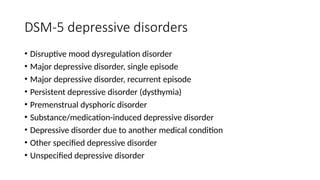
DSM-5 depressive disorders
•Disruptive mood dysregulation disorder
• Major depressive disorder, single episode
• Major depressive disorder, recurrent episode
• Persistent depressive disorder (dysthymia)
• Premenstrual dysphoric disorder
• Substance/medication-induced depressive disorder
• Depressive disorder due to another medical condition
• Other specified depressive disorder
• Unspecified depressive disorder
10.
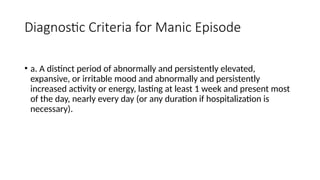
Diagnostic Criteria forManic Episode
• a. A distinct period of abnormally and persistently elevated,
expansive, or irritable mood and abnormally and persistently
increased activity or energy, lasting at least 1 week and present most
of the day, nearly every day (or any duration if hospitalization is
necessary).
11.
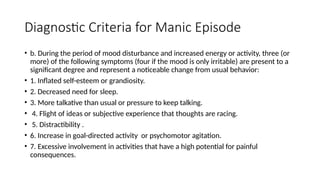
Diagnostic Criteria forManic Episode
• b. During the period of mood disturbance and increased energy or activity, three (or
more) of the following symptoms (four if the mood is only irritable) are present to a
significant degree and represent a noticeable change from usual behavior:
• 1. Inflated self-esteem or grandiosity.
• 2. Decreased need for sleep.
• 3. More talkative than usual or pressure to keep talking.
• 4. Flight of ideas or subjective experience that thoughts are racing.
• 5. Distractibility .
• 6. Increase in goal-directed activity or psychomotor agitation.
• 7. Excessive involvement in activities that have a high potential for painful
consequences.
12.
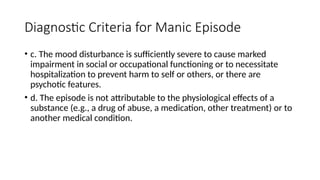
Diagnostic Criteria forManic Episode
• c. The mood disturbance is sufficiently severe to cause marked
impairment in social or occupational functioning or to necessitate
hospitalization to prevent harm to self or others, or there are
psychotic features.
• d. The episode is not attributable to the physiological effects of a
substance (e.g., a drug of abuse, a medication, other treatment) or to
another medical condition.
13.
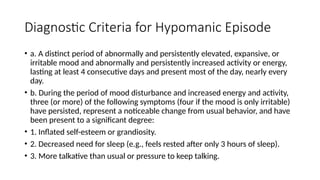
Diagnostic Criteria forHypomanic Episode
• a. A distinct period of abnormally and persistently elevated, expansive, or
irritable mood and abnormally and persistently increased activity or energy,
lasting at least 4 consecutive days and present most of the day, nearly every
day.
• b. During the period of mood disturbance and increased energy and activity,
three (or more) of the following symptoms (four if the mood is only irritable)
have persisted, represent a noticeable change from usual behavior, and have
been present to a significant degree:
• 1. Inflated self-esteem or grandiosity.
• 2. Decreased need for sleep (e.g., feels rested after only 3 hours of sleep).
• 3. More talkative than usual or pressure to keep talking.
14.
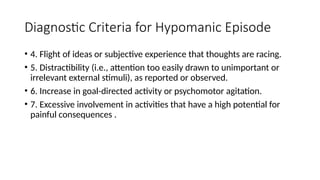
Diagnostic Criteria forHypomanic Episode
• 4. Flight of ideas or subjective experience that thoughts are racing.
• 5. Distractibility (i.e., attention too easily drawn to unimportant or
irrelevant external stimuli), as reported or observed.
• 6. Increase in goal-directed activity or psychomotor agitation.
• 7. Excessive involvement in activities that have a high potential for
painful consequences .
15.
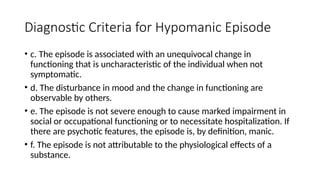
Diagnostic Criteria forHypomanic Episode
• c. The episode is associated with an unequivocal change in
functioning that is uncharacteristic of the individual when not
symptomatic.
• d. The disturbance in mood and the change in functioning are
observable by others.
• e. The episode is not severe enough to cause marked impairment in
social or occupational functioning or to necessitate hospitalization. If
there are psychotic features, the episode is, by definition, manic.
• f. The episode is not attributable to the physiological effects of a
substance.
16.
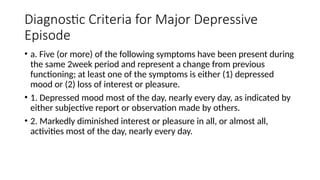
Diagnostic Criteria forMajor Depressive
Episode
• a. Five (or more) of the following symptoms have been present during
the same 2week period and represent a change from previous
functioning; at least one of the symptoms is either (1) depressed
mood or (2) loss of interest or pleasure.
• 1. Depressed mood most of the day, nearly every day, as indicated by
either subjective report or observation made by others.
• 2. Markedly diminished interest or pleasure in all, or almost all,
activities most of the day, nearly every day.
17.
Diagnostic Criteria forMajor Depressive
Episode
• 3. Significant weight loss when not dieting or weight gain, or
decrease or increase in appetite nearly every day.
• 4. Insomnia or hypersomnia nearly every day.
• 5. Psychomotor agitation or retardation nearly every day.
• 6. Fatigue or loss of energy nearly every day.
• 7. Feelings of worthlessness or excessive or inappropriate guilt
18.
Diagnostic Criteria forMajor Depressive
Episode
• 8.Diminished ability to think or concentrate, or indecisiveness, nearly
every day.
• 9. Recurrent thoughts of death, recurrent suicidal ideation without a
specific plan, or a suicide attempt or a specific plan for committing
suicide.
• b. The symptoms cause clinically significant distress or impairment in
social, occupational, or other important areas of functioning.
• c. The episode is not attributable to the physiological effects of a
substance or to another medical condition.
19.
BIPOLAR I DISORDER
•A. Criteria have been met for at least one manic episode
• The manic episode may have been preceded by and may be followed
by hypomanic or major depressive episodes.
• B. The occurrence of the manic and major depressive episode(s) is not
better explained by schizoaffective disorder, schizophrenia,
schizophreniform disorder, delusional disorder, or other specified or
unspecified schizophrenia spectrum and other psychotic disorder. B.
20.
BIPOLAR II DISORDER
•For a diagnosis of bipolar II disorder, it is necessary to meet the criteria for a current or past
hypomanic episode and the following criteria for a current or past major depressive
episode.
• A. Criteria have been met for at least one hypomanic episode and at least one major
depressive episode.
• B. There has never been a manic episode.
• C. The occurrence of the hypomanic episode(s) and major depressive episode(s) is not
better explained by schizoaffective disorder, schizophrenia, schizophreniform disorder,
delusional disorder, or other specified or unspecified schizophrenia spectrum and other
psychotic disorder.
• D. The symptoms of depression or the unpredictability caused by frequent alternation
between periods of depression and hypomania causes clinically significant distress or
impairment in social, occupational, or other important areas of functioning.
21.
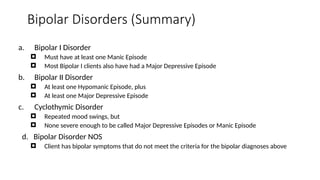
Bipolar Disorders (Summary)
a.Bipolar I Disorder
Must have at least one Manic Episode
Most Bipolar I clients also have had a Major Depressive Episode
b. Bipolar II Disorder
At least one Hypomanic Episode, plus
At least one Major Depressive Episode
c. Cyclothymic Disorder
Repeated mood swings, but
None severe enough to be called Major Depressive Episodes or Manic Episode
d. Bipolar Disorder NOS
Client has bipolar symptoms that do not meet the criteria for the bipolar diagnoses above
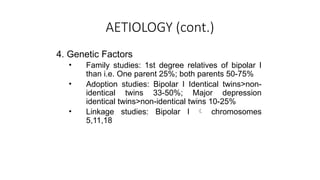
AETIOLOGY (cont.)
4. GeneticFactors
• Family studies: 1st degree relatives of bipolar I
than i.e. One parent 25%; both parents 50-75%
• Adoption studies: Bipolar I Identical twins>non-
identical twins 33-50%; Major depression
identical twins>non-identical twins 10-25%
• Linkage studies: Bipolar I chromosomes
5,11,18
26.
AETIOLOGY (cont.)
6. PsychosocialFactors
• Life events & environment stress e.g. losing a parent before age 11 or loss
of a spouse or job.
• Personality factor: OCD, Histrionic PD, Borderline PD
• Psychodynamic factors:
• Depression: (a) Infant-mother relationship (oral phase), (b) Real/imagined
object loss, (c) Introjections of the departed object, and (d) Direct feeling of
anger inward.
• Mania: a defence against underlying depressions.
27.
AETIOLOGY (cont.)
• 7.Cognitivetheory: Depressogenic schemata (Aaron Beck):
(a) Self- a negative, (b) Environment- hostile & demanding,
and (c) Future-expectation of suffering & failures. Therapy is
to modify these distortions.
• 8. Learned Helplessness: depressive phenomena to the
experience of uncontrolled events (Seligman).
28.
Gender Differences
• Depressionis far more common among women than men.
• Women are also more prone than men to experience recurrent
depressive episodes.
• Both biological and social factors play a part in these patterns. For
example, women who experience severe premenstrual mood changes
are more vulnerable to other mood disorders including postpartum
depression.
• For bipolar disorder, men and woman are equally represented. About
25% of people who are depressed are also bipolar.
29.
Culture Differences
• Depressionmay differ from culture to culture with regard to age of
onset, symptoms, course, etc.
• For example, in many non-Western cultures, depression is more likely to
be experienced in somatic (through not feeling well in the body), rather
than affective terms (feelings emotionally low).
30.
• Depression
• Psychopharmacology
•Selective Serotonin Reuptake inhibitor (SSRI)
• Fluoxetine
• Sertraline
• Paroxetine
SSRIs act by increasing the extracellular level of serotonin by
limiting its reabsorption into the presynaptic cell, increasing
the level of serotonin in the synaptic cleft.
Treatment
INDICATIONS
• poor responseto adequate pharmacotherapy
• unable to tolerate side effects of antidepressants
• depressive stupor, not eating or drinking
Electroconvulsive Therapy
36.
• severe suicidalrisk
• severe depression with delusions, retardation
• severe post partum depression.
Electroconvulsive Therapy
37.
• Intervene whereappropriate e.g.
• Financial – Social Dimension Fund
• Legal – Social Worker can assist
• Establish Social support
• Support Groups like
• Friendship bench
Social Management
38.
• Antipsychotics (Maniaepisode) e.g.
• Haloperidol
• Olanzapine
• Other Antipsychotics e.g. Fluphenazine Decanoate
• In poor compliance
Bipolar Affective Disorder
39.
• First episodemainly antipsychotic Drugs.
• If episodes recur frequently disrupting function need for
Prophylaxis
- Use mood stabilizers
Principles in management