PHRASES AND CLAUSES
By- Dr. Pooja A. Deshmukh
PHRASES AND CLAUSES:
• Pharase: A Pharase is a group of without a finite verb. A ‘finite verb’ is a word that
denotes tense and ‘a non-finite’ is a verb which does not.
• There are three types of phrases:
1. Noun Phrase
• E.g. I found the owner of the dog . “ the owner of the dog’ is a noun phrase.
• 2. Adjective phrase
• E.G. SHE SPEAKS IN AVERY SLOW VOICE.
• 3. adverb phrase
• E.G.The wind is so strong I can hardly hear.
CLAUSES
• DEFINITION: A CLAUSE IS A GROUP OF WORDS HAVING A SUBJECT AND
PREDICATE OF ITS OWN AND FORM APART OF A LARGER SENTENCE. IT
IS A GROUP OF WORDS WHICH CONTAINS A ‘FINITE VERB’.
• CLAUSES ARE OF TWO TYPES;
• MAIN CLAUSE AND SUBORDINATE CLAUSE
• A MAIN CLAUSE IS ALSO CALLED A ‘PRINCIPAL CLAUSE’ OR AN
INDEPENDENT CLAUSE BECAUSE IT MAKES COMPLETE SENSE.
• A SUBORDINATE CLAUSE IS CALLED AS DEPENDENT CLAUSE BECAUSE
IT DOES NOT MAKE A COMPLETE SENSE AND IT IS DEPENDENT ON A
MAIN CLAUSE.
THERE ARE THREE TYPES OF CLAUSES
1. NOUN CLAUSE
2. ADJECTIVE CLAUSE
3. ADVERB CLAUSE
1.NOUN CLAUSE:
A NOUN CLAUSE IS A DEPENDENT CLAUSE THAT TAKES PLACE OF ANY NOUN IN THE SENTENCE, WHETHER THEY ARE SUBJECTS, OBJECTS, OR
SUBJECT COMPLEMENTS.
A NOUN CLAUSE ALWAYS ANSWERS THE QUESTION ‘WHAT’.
CONJUNCTIONS USED: ( that, what, which, why, where, when, whether, whatever, who, if, how, whose)
EXAMPLE:
I think that she knows me.
I know which pen you want.
Can you say whether Raj is in the garden.
I don not remember what he said.
EXAMPLE OF MAIN CLAUSE AND
SUBORDINATE/DEPENDENT CLAUSE
1. I stayed at home because it was raining.
• Main clause: I stayed at home (makes complete sense on its own).
• Subordinate clause: because it was raining (depends on the main clause to make sense
2. She went to bed early since she was feeling tired.
• Main clause: She went to bed early.
• Subordinate clause: since she was feeling tired.
3. We will go to the park if the weather is good.
• Main clause: We will go to the park.
• Subordinate clause: if the weather is good.
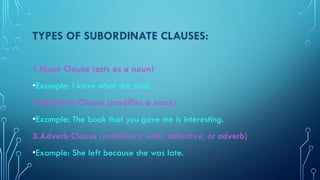
TYPES OF SUBORDINATE CLAUSES:
1.Noun Clause (acts as a noun)
•Example: I know what she said.
2.Adjective Clause (modifies a noun)
•Example: The book that you gave me is interesting.
3.Adverb Clause (modifies a verb, adjective, or adverb)
•Example: She left because she was late.
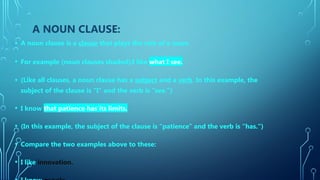
A NOUN CLAUSE:
• A noun clause is a clause that plays the role of a noun.
• For example (noun clauses shaded):I like what I see.
• (Like all clauses, a noun clause has a subject and a verb. In this example, the
subject of the clause is "I" and the verb is "see.")
• I know that patience has its limits.
• (In this example, the subject of the clause is "patience" and the verb is "has.")
• Compare the two examples above to these:
• I like innovation.
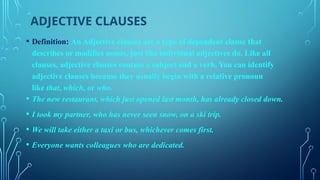
ADJECTIVE CLAUSES
• Definition: An Adjective clauses are a type of dependent clause that
describes or modifies nouns, just like individual adjectives do. Like all
clauses, adjective clauses contain a subject and a verb. You can identify
adjective clauses because they usually begin with a relative pronoun
like that, which, or who.
• The new restaurant, which just opened last month, has already closed down.
• I took my partner, who has never seen snow, on a ski trip.
• We will take either a taxi or bus, whichever comes first.
• Everyone wants colleagues who are dedicated.
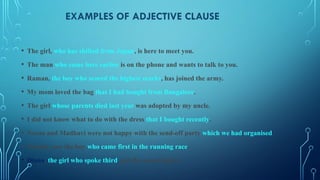
EXAMPLES OF ADJECTIVE CLAUSE
• The girl, who has shifted from Japan, is here to meet you.
• The man who came here earlier is on the phone and wants to talk to you.
• Raman, the boy who scored the highest marks, has joined the army.
• My mom loved the bag that I had bought from Bangalore.
• The girl whose parents died last year was adopted by my uncle.
• I did not know what to do with the dress that I bought recently.
• Neena and Madhavi were not happy with the send-off party which we had organised.
• Nobody saw the boy who came first in the running race.
• Diana, the girl who spoke third, got the second prize.
ADVERB CLAUSE:
• Just like adverbs, adverb clauses are used to describe or provide more
information about the verb, adjective or adverb. An adverb clause is
defined as a subordinate clause that functions as an adverb within a
main clause. Adverb clauses, as discussed earlier, can be used to provide
information about when, where, under what conditions, how and why an
action is taking place. They also give the reader a description of an
adjective and an adverb. Always remember that an adverb clause begins
with a subordinating conjunction like ‘after’, ‘whether’, ‘if’, ‘because’,
‘although’, ‘even though’, etc.
EXAMPLES OF ADVERB CLAUSE
• Although they drove really fast, they could not reach there in time.
• Before you make your decision, make sure you think this through.
• As soon as you meet her, call me.
• My cousins, though they told us that they would not come for the movie, they somehow
made it.
• He remembered, after he left the office, that he had not sent the EOD report.
• Remya, since she was not keeping well, decided not to go to work today and tomorrow.
• The dog got so comfortable with my brother after he cuddled her for a while.
• We felt time was very slow because we were sitting idly.
• You will be able to go to the theatres to watch movies as long as there is no lockdown.
• The dog got so comfortable with my brother after he cuddled her for a while.
• We felt time was very slow because we were sitting idly.
• You will be able to go to the theatres to watch movies as long as there is no lockdown.
THANK YOU
By- Dr. Pooja A. Deshmukh

Clauses.pptx types of clauses with examples

  • 1.
    PHRASES AND CLAUSES By-Dr. Pooja A. Deshmukh
  • 2.
    PHRASES AND CLAUSES: •Pharase: A Pharase is a group of without a finite verb. A ‘finite verb’ is a word that denotes tense and ‘a non-finite’ is a verb which does not. • There are three types of phrases: 1. Noun Phrase • E.g. I found the owner of the dog . “ the owner of the dog’ is a noun phrase. • 2. Adjective phrase • E.G. SHE SPEAKS IN AVERY SLOW VOICE. • 3. adverb phrase • E.G.The wind is so strong I can hardly hear.
  • 3.
    CLAUSES • DEFINITION: ACLAUSE IS A GROUP OF WORDS HAVING A SUBJECT AND PREDICATE OF ITS OWN AND FORM APART OF A LARGER SENTENCE. IT IS A GROUP OF WORDS WHICH CONTAINS A ‘FINITE VERB’. • CLAUSES ARE OF TWO TYPES; • MAIN CLAUSE AND SUBORDINATE CLAUSE • A MAIN CLAUSE IS ALSO CALLED A ‘PRINCIPAL CLAUSE’ OR AN INDEPENDENT CLAUSE BECAUSE IT MAKES COMPLETE SENSE. • A SUBORDINATE CLAUSE IS CALLED AS DEPENDENT CLAUSE BECAUSE IT DOES NOT MAKE A COMPLETE SENSE AND IT IS DEPENDENT ON A MAIN CLAUSE.
  • 4.
    THERE ARE THREETYPES OF CLAUSES 1. NOUN CLAUSE 2. ADJECTIVE CLAUSE 3. ADVERB CLAUSE 1.NOUN CLAUSE: A NOUN CLAUSE IS A DEPENDENT CLAUSE THAT TAKES PLACE OF ANY NOUN IN THE SENTENCE, WHETHER THEY ARE SUBJECTS, OBJECTS, OR SUBJECT COMPLEMENTS. A NOUN CLAUSE ALWAYS ANSWERS THE QUESTION ‘WHAT’. CONJUNCTIONS USED: ( that, what, which, why, where, when, whether, whatever, who, if, how, whose) EXAMPLE: I think that she knows me. I know which pen you want. Can you say whether Raj is in the garden. I don not remember what he said.
  • 5.
    EXAMPLE OF MAINCLAUSE AND SUBORDINATE/DEPENDENT CLAUSE 1. I stayed at home because it was raining. • Main clause: I stayed at home (makes complete sense on its own). • Subordinate clause: because it was raining (depends on the main clause to make sense 2. She went to bed early since she was feeling tired. • Main clause: She went to bed early. • Subordinate clause: since she was feeling tired. 3. We will go to the park if the weather is good. • Main clause: We will go to the park. • Subordinate clause: if the weather is good.
  • 6.
    TYPES OF SUBORDINATECLAUSES: 1.Noun Clause (acts as a noun) •Example: I know what she said. 2.Adjective Clause (modifies a noun) •Example: The book that you gave me is interesting. 3.Adverb Clause (modifies a verb, adjective, or adverb) •Example: She left because she was late.
  • 7.
    A NOUN CLAUSE: •A noun clause is a clause that plays the role of a noun. • For example (noun clauses shaded):I like what I see. • (Like all clauses, a noun clause has a subject and a verb. In this example, the subject of the clause is "I" and the verb is "see.") • I know that patience has its limits. • (In this example, the subject of the clause is "patience" and the verb is "has.") • Compare the two examples above to these: • I like innovation.
  • 8.
    ADJECTIVE CLAUSES • Definition:An Adjective clauses are a type of dependent clause that describes or modifies nouns, just like individual adjectives do. Like all clauses, adjective clauses contain a subject and a verb. You can identify adjective clauses because they usually begin with a relative pronoun like that, which, or who. • The new restaurant, which just opened last month, has already closed down. • I took my partner, who has never seen snow, on a ski trip. • We will take either a taxi or bus, whichever comes first. • Everyone wants colleagues who are dedicated.
  • 9.
    EXAMPLES OF ADJECTIVECLAUSE • The girl, who has shifted from Japan, is here to meet you. • The man who came here earlier is on the phone and wants to talk to you. • Raman, the boy who scored the highest marks, has joined the army. • My mom loved the bag that I had bought from Bangalore. • The girl whose parents died last year was adopted by my uncle. • I did not know what to do with the dress that I bought recently. • Neena and Madhavi were not happy with the send-off party which we had organised. • Nobody saw the boy who came first in the running race. • Diana, the girl who spoke third, got the second prize.
  • 10.
    ADVERB CLAUSE: • Justlike adverbs, adverb clauses are used to describe or provide more information about the verb, adjective or adverb. An adverb clause is defined as a subordinate clause that functions as an adverb within a main clause. Adverb clauses, as discussed earlier, can be used to provide information about when, where, under what conditions, how and why an action is taking place. They also give the reader a description of an adjective and an adverb. Always remember that an adverb clause begins with a subordinating conjunction like ‘after’, ‘whether’, ‘if’, ‘because’, ‘although’, ‘even though’, etc.
  • 11.
    EXAMPLES OF ADVERBCLAUSE • Although they drove really fast, they could not reach there in time. • Before you make your decision, make sure you think this through. • As soon as you meet her, call me. • My cousins, though they told us that they would not come for the movie, they somehow made it. • He remembered, after he left the office, that he had not sent the EOD report. • Remya, since she was not keeping well, decided not to go to work today and tomorrow. • The dog got so comfortable with my brother after he cuddled her for a while. • We felt time was very slow because we were sitting idly. • You will be able to go to the theatres to watch movies as long as there is no lockdown. • The dog got so comfortable with my brother after he cuddled her for a while. • We felt time was very slow because we were sitting idly. • You will be able to go to the theatres to watch movies as long as there is no lockdown.
  • 12.
    THANK YOU By- Dr.Pooja A. Deshmukh