What I learned in Hong Kong
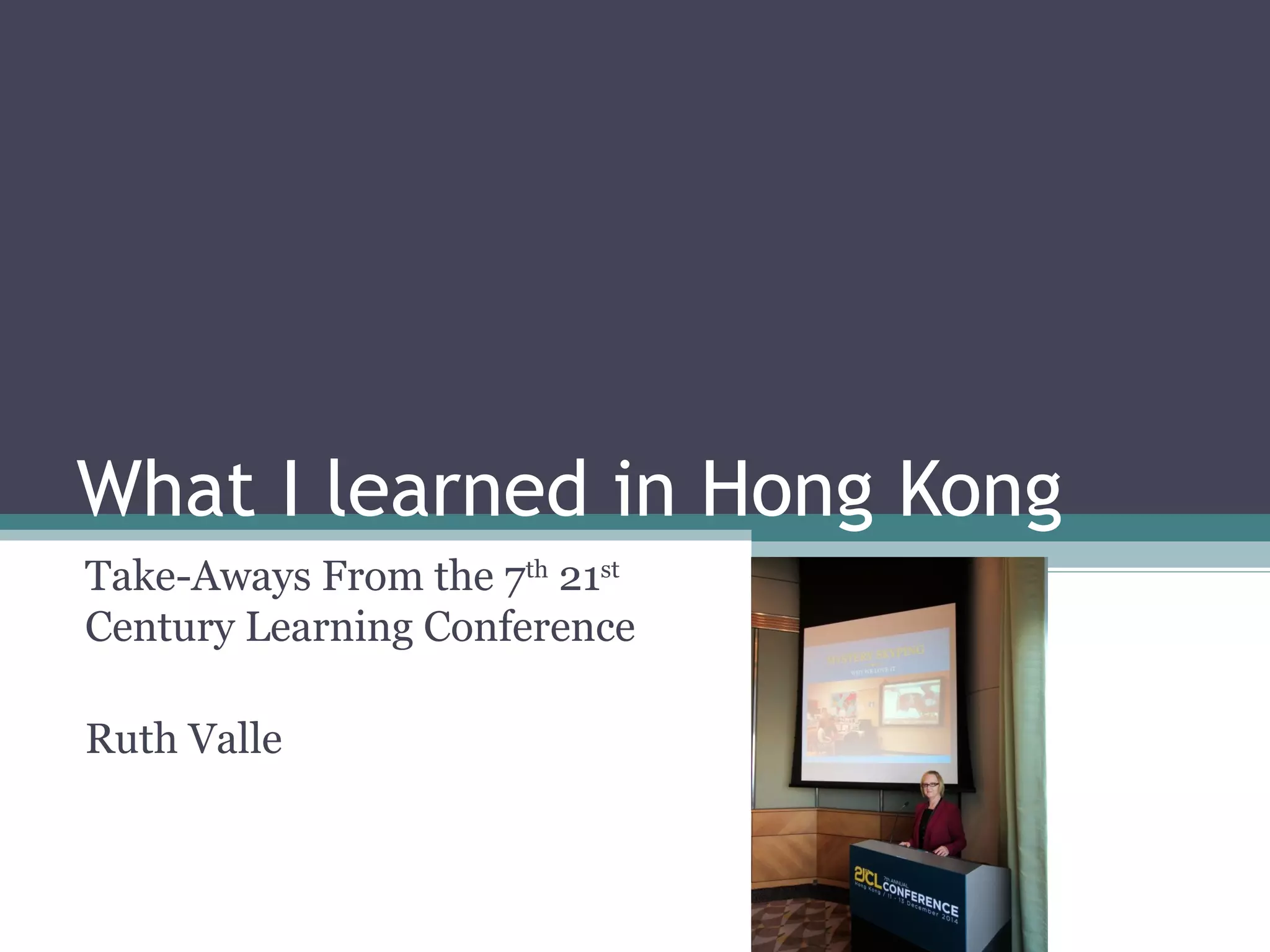
Take-Aways From the 7th
21st
Century Learning Conference
Ruth Valle
Judy Willis
• Build cognitive flexibility-Cognitive
Flexibility and Control is the ability to
change what you are thinking about, how you are
thinking about it and even what you think about
it – in other words, the ability to change your
mind. Cognitive flexibility is required in multiple
ways throughout the school day.
• Being able to multitask is not a bad thing
• Lower the barriers not the bar
Michael Boll
• Go entrepreneurial: a start-up approach to bring
change or a new program to your organization
• What is your new idea?
• Why? (What’s your story?)
• Mission statement
• MVP- minimal viable product (donut)
• List assumptions
• Pick your team
• Always work to reduce friction (learn from
resistance)
Michael Boll
• Everything is marketing
• Develop the “about me” section
• Get people to spread your story
• Find early adopters
• Publicize the adopters
Brenda Petersen- National History
Day
• Nhd.org
Bryant McIntyre
• http://intlbob.com
• International Battle of the Books
Ruben Puentedura
• SAMR Model
• An Introduction to SAMR
Hamish Clark- The future is now
• http://www.hamishclark.com
• Born to learn
Kevin Duncan
• Big Time Presentations
• Time- 3-5 minutes, then build up to 8 minutes
• Set high expectations
• Goals
• Develop a rubric
• Planning and research
• Outine
• Practice/feedback
• Videotape the speeches for review
Kevin Duncan
• Allow to use the front of a 3x5 index card
• Dress up for the speech
• Provide for a venue that’s classy
• Branding- in the videotapes, have identical
beginnings and endings
• Practice answering questions about the speeches
Angela McFarlane
• If you expect to be able to use technology in the
classroom then provide hardwired connections
rather than unreliable WIFI- no serious business
would depend on WIFI
Cris Turple
• Chrome Extensions
• https://docs.google.com/document/d/1qeb8VN
quOmD_PKQaKwN32fZAiS3e41fiUt9qhwbjnjE/
edit
What I learned in Hong Kong
• http://wikitravel.org/en/Hong_Kong
What else I learned in Hong Kong
• Families really only have one or at the most two
children
• They drive on the left side of the road
• They don’t believe in “ladies first”
• They won’t open the door for you
• The food is horrible- really
• Starbucks is everywhere
• They play Christmas music and decorate
buildings
What else I learned in Hong Kong
• All signs are in Mandarin Chinese and English
• After a while you learn to decipher the signs
• It’s very clean- n0 trash anywhere
• Restrooms, called toilets, are everywhere
• People don’t walk on one side in each direction-
anything goes
• Most men and women wear black
• They bow by slightly inclining their necks
What else I learned in Hong Kong
• Asian parents are very involved in their child’s
education- they are constantly at school
• There are lots of American teachers in Asian
countries on 3-5 year assignments
• Some of the international teachers, esp. the ones
from Germany refuse to use technology and believe
that they should teach the way they have been
teaching for 200 years- why change what works?
• The international teachers are not too concerned
about their retirement- job
advancement/satisfaction is their goal
7th
21st
Century Learning Conference
Hong Kong
• Some Pictures
• Question?
• Comments?
• Feedback- use QR code

What I learned in Hong Kong

  • 1.
    What I learnedin Hong Kong Take-Aways From the 7th 21st Century Learning Conference Ruth Valle
  • 2.
    Judy Willis • Buildcognitive flexibility-Cognitive Flexibility and Control is the ability to change what you are thinking about, how you are thinking about it and even what you think about it – in other words, the ability to change your mind. Cognitive flexibility is required in multiple ways throughout the school day. • Being able to multitask is not a bad thing • Lower the barriers not the bar
  • 3.
    Michael Boll • Goentrepreneurial: a start-up approach to bring change or a new program to your organization • What is your new idea? • Why? (What’s your story?) • Mission statement • MVP- minimal viable product (donut) • List assumptions • Pick your team • Always work to reduce friction (learn from resistance)
  • 4.
    Michael Boll • Everythingis marketing • Develop the “about me” section • Get people to spread your story • Find early adopters • Publicize the adopters
  • 5.
    Brenda Petersen- NationalHistory Day • Nhd.org
  • 6.
    Bryant McIntyre • http://intlbob.com •International Battle of the Books
  • 7.
    Ruben Puentedura • SAMRModel • An Introduction to SAMR
  • 8.
    Hamish Clark- Thefuture is now • http://www.hamishclark.com • Born to learn
  • 9.
    Kevin Duncan • BigTime Presentations • Time- 3-5 minutes, then build up to 8 minutes • Set high expectations • Goals • Develop a rubric • Planning and research • Outine • Practice/feedback • Videotape the speeches for review
  • 10.
    Kevin Duncan • Allowto use the front of a 3x5 index card • Dress up for the speech • Provide for a venue that’s classy • Branding- in the videotapes, have identical beginnings and endings • Practice answering questions about the speeches
  • 11.
    Angela McFarlane • Ifyou expect to be able to use technology in the classroom then provide hardwired connections rather than unreliable WIFI- no serious business would depend on WIFI
  • 12.
    Cris Turple • ChromeExtensions • https://docs.google.com/document/d/1qeb8VN quOmD_PKQaKwN32fZAiS3e41fiUt9qhwbjnjE/ edit
  • 13.
    What I learnedin Hong Kong • http://wikitravel.org/en/Hong_Kong
  • 14.
    What else Ilearned in Hong Kong • Families really only have one or at the most two children • They drive on the left side of the road • They don’t believe in “ladies first” • They won’t open the door for you • The food is horrible- really • Starbucks is everywhere • They play Christmas music and decorate buildings
  • 15.
    What else Ilearned in Hong Kong • All signs are in Mandarin Chinese and English • After a while you learn to decipher the signs • It’s very clean- n0 trash anywhere • Restrooms, called toilets, are everywhere • People don’t walk on one side in each direction- anything goes • Most men and women wear black • They bow by slightly inclining their necks
  • 16.
    What else Ilearned in Hong Kong • Asian parents are very involved in their child’s education- they are constantly at school • There are lots of American teachers in Asian countries on 3-5 year assignments • Some of the international teachers, esp. the ones from Germany refuse to use technology and believe that they should teach the way they have been teaching for 200 years- why change what works? • The international teachers are not too concerned about their retirement- job advancement/satisfaction is their goal
  • 17.
    7th 21st Century Learning Conference HongKong • Some Pictures • Question? • Comments? • Feedback- use QR code

Editor's Notes

  • #9 The future is now
  • #10 Distinguished Apple Teacher of the Year