We Don’t Pay Attention To Boring Things


           By: Lindsey Madison
The Ten Minute Rule
• After ten minutes most people
  tend to lose interest in what you
  are talking about.
• Every ten minutes its best for
  teachers to do something
  interesting to regain students
  attention.
Medina, J (2009). Brain
  rules. Retrieved July 10,
  2009, from brainrules.net
  Web site:
  http://www.brainrules.net/
Attention Grabbers

1.   Use a scenario
2.   Use humor
3.   Share experiences
4.   Tell a joke
5.   Show a video

Linus, Matthew (3-5-2005).
    Ideas On Teaching.
    Retrieved July 10,
    2009, from
    cdtl.nus.edu. Web site:
    http://www.cdtl.nus.edu.
    sg/Ideas/iot96.htm
IS IT TRUE???
• Multitasking: is the ability for a person to perform more
  than one task at the same time.
• According to Dr. John Medina, it is impossible to multitask.
• What do you think????

  Medina, J (2009). Brain rules. Retrieved July 10, 2009,
  from brainrules.net Web site: http://www.brainrules.net/
MULTITASKING

• It’s a proven fact that it will take you 50% longer to
  do a task if you are doing other things at the same
  time, than it would if you just do one thing at a time.
• You also make 50% more errors, while trying to
  multitask.
Medina, J (2009). Brain rules. Retrieved July
  10, 2009, from brainrules.net Web site:
  http://www.brainrules.net/
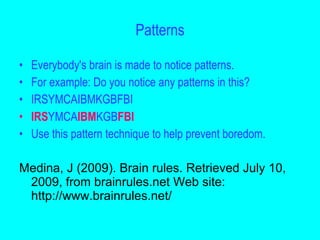
Patterns

•   Everybody's brain is made to notice patterns.
•   For example: Do you notice any patterns in this?
•   IRSYMCAIBMKGBFBI
•   Use this pattern technique to help prevent boredom.

Medina, J (2009). Brain rules. Retrieved July 10,
 2009, from brainrules.net Web site:
 http://www.brainrules.net/
Settings
• Changing the setting of a class
  can help relieve boredom.
• Adding some color.
• Giving 10-15 minute breaks.
• Adding something new to the
  environment to change its
  appearance.
• Switch classrooms.


(2009). Trusted Online Research.
   Retrieved July 10, 2009, from
   Questia.com Web site:
   http://www.questia.com/googleScholar.
   qst;jsessionid=KWTchqKKcvkkJBWj9
   QbLpQBhvhDG18mkdcxy6V1Dp3gVry
   PQghPR!1178491195!1596248468?
   docId=5001677362
Monotone Voices

• Adding some facial expressions
  while speaking can help you be
  more interesting.
• Changing your pitch and the
  loudness of you voice will keep
  your listeners attentive.
  (5-8-2006). Speech and Voice
  Enterprises. Retrieved July 10, 2009,
  from speechandvoice.com Web
  site:http://www.speechandvoice.com/S
  peaking%20Styles%20of%20Known
  %20Broadcasters%20and
  %20Politicians.htm
Boredom

• Some self explanatory reasoning why we don’t pay
  attention to boring things is because we may not
  care about that particular topic.
• We may have already learned about the subject.
• We may not be able to comprehend it at all.
(2009). Hubpages. Retrieved July 10, 2009, from Hubpages.com Web site:
http://hubpages.com/hub/Raising-Kids-Who-Dont-Get-Bored
Is Boredom Good For The Brain?
• According to a 2008 New
  York Times article, they
  say people tune things
  out for a good reason.
• Over time, boredom
  becomes a tool for sorting
  information.
• It acts as our own
  personalized spam filter.
• Benedict, C (8-5-08).Your
  Bored But Your Brain Is
  Tuned In. New York
  Times, 5, F5.
Focusing
• According to Hockenbury &Hockenbury the 5th
  edition, people have a hard time staying focused
  and getting bored easily because of the things that
  are going on around them and already having
  thoughts in their head prior to listening to content
  from teachers or peers.

Hockenbury, DH (2008). Psychology. New
 York, NY: Worth Publishers.
References
•   http://www.slideshare.net
•   http://www.cdtl.nus.edu.org
•   http://www.webster.com
•   http://www.brainrules.net
•   Hockenbury & Hockenbury
•   http://www.nytimes.com
•   http://www.hubpages.com
•   http://www.speechandvoice.com

Lindsey Madison Pp With References

  • 1.
    We Don’t PayAttention To Boring Things By: Lindsey Madison
  • 2.
    The Ten MinuteRule • After ten minutes most people tend to lose interest in what you are talking about. • Every ten minutes its best for teachers to do something interesting to regain students attention. Medina, J (2009). Brain rules. Retrieved July 10, 2009, from brainrules.net Web site: http://www.brainrules.net/
  • 3.
    Attention Grabbers 1. Use a scenario 2. Use humor 3. Share experiences 4. Tell a joke 5. Show a video Linus, Matthew (3-5-2005). Ideas On Teaching. Retrieved July 10, 2009, from cdtl.nus.edu. Web site: http://www.cdtl.nus.edu. sg/Ideas/iot96.htm
  • 4.
    IS IT TRUE??? •Multitasking: is the ability for a person to perform more than one task at the same time. • According to Dr. John Medina, it is impossible to multitask. • What do you think???? Medina, J (2009). Brain rules. Retrieved July 10, 2009, from brainrules.net Web site: http://www.brainrules.net/
  • 5.
    MULTITASKING • It’s aproven fact that it will take you 50% longer to do a task if you are doing other things at the same time, than it would if you just do one thing at a time. • You also make 50% more errors, while trying to multitask. Medina, J (2009). Brain rules. Retrieved July 10, 2009, from brainrules.net Web site: http://www.brainrules.net/
  • 6.
    Patterns • Everybody's brain is made to notice patterns. • For example: Do you notice any patterns in this? • IRSYMCAIBMKGBFBI • IRSYMCAIBMKGBFBI • Use this pattern technique to help prevent boredom. Medina, J (2009). Brain rules. Retrieved July 10, 2009, from brainrules.net Web site: http://www.brainrules.net/
  • 7.
    Settings • Changing thesetting of a class can help relieve boredom. • Adding some color. • Giving 10-15 minute breaks. • Adding something new to the environment to change its appearance. • Switch classrooms. (2009). Trusted Online Research. Retrieved July 10, 2009, from Questia.com Web site: http://www.questia.com/googleScholar. qst;jsessionid=KWTchqKKcvkkJBWj9 QbLpQBhvhDG18mkdcxy6V1Dp3gVry PQghPR!1178491195!1596248468? docId=5001677362
  • 8.
    Monotone Voices • Addingsome facial expressions while speaking can help you be more interesting. • Changing your pitch and the loudness of you voice will keep your listeners attentive. (5-8-2006). Speech and Voice Enterprises. Retrieved July 10, 2009, from speechandvoice.com Web site:http://www.speechandvoice.com/S peaking%20Styles%20of%20Known %20Broadcasters%20and %20Politicians.htm
  • 9.
    Boredom • Some selfexplanatory reasoning why we don’t pay attention to boring things is because we may not care about that particular topic. • We may have already learned about the subject. • We may not be able to comprehend it at all. (2009). Hubpages. Retrieved July 10, 2009, from Hubpages.com Web site: http://hubpages.com/hub/Raising-Kids-Who-Dont-Get-Bored
  • 10.
    Is Boredom GoodFor The Brain? • According to a 2008 New York Times article, they say people tune things out for a good reason. • Over time, boredom becomes a tool for sorting information. • It acts as our own personalized spam filter. • Benedict, C (8-5-08).Your Bored But Your Brain Is Tuned In. New York Times, 5, F5.
  • 11.
    Focusing • According toHockenbury &Hockenbury the 5th edition, people have a hard time staying focused and getting bored easily because of the things that are going on around them and already having thoughts in their head prior to listening to content from teachers or peers. Hockenbury, DH (2008). Psychology. New York, NY: Worth Publishers.
  • 12.
    References • http://www.slideshare.net • http://www.cdtl.nus.edu.org • http://www.webster.com • http://www.brainrules.net • Hockenbury & Hockenbury • http://www.nytimes.com • http://www.hubpages.com • http://www.speechandvoice.com