



www.existentialacademy.com 1
WHAT EVIDENCE WILL WE NEED IN FUTURE
FOR PSYCHOTHERAPY TO DEVELOP?
Digby Tantam
Member, IGA (London)
Clinical Professor of Psychotherapy, University of Sheffield
Senior Visiting Research Fellow, University of Cambridge
Honorary Consultant Psychiatrist, Sheffield Health and Social
Care Trust
Director, Existential Academy
“Exoriare aliquis nostris ex ossibus ultor ! (Let someone arise
from my bones as an Avenger!)” Virgil, Aeneid, IV 625
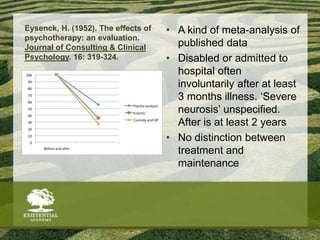
Eysenck, H. (1952). The effects of
psychotherapy: an evaluation.
Journal of Consulting & Clinical
Psychology. 16: 319-324.
• A kind of meta-analysis of
published data
• Disabled or admitted to
hospital often
involuntarily after at least
3 months illness. ‘Severe
neurosis’ unspecified.
After is at least 2 years
• No distinction between
treatment and
maintenance
Problems raised by this particular study have been
considered ever since:
Use of appropriate controls
Standardization of method (‘manualization’)
Clarity about parameters e.g. length of follow up
Separation of treatment and prevention (or maintenance)
But first and foremost is what is the outcome of
psychotherapy
– Early intervention
– Maintenance
• What is this?
3
www.existentialacademy.com
• “(1) if there is no adequate study of psychoanalytic therapy
showing a better improvement rate, then there is no firm
evidence that the therapy is therapeutically effective.
• (2) A review of existing studies showed that indeed there
did not exist any such adequate study.
• (3) Consequently, I concluded that there was no evidence
of therapeutic success for psychoanalysis (or more general
methods of psychotherapy, which I also analysed in a
similar manner)”
www.existentialacademy.com 4
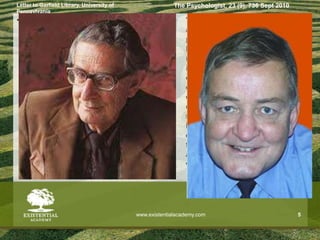
Letter to Garfield Library, University of
Pennsylvania
• As far as I personally am concerned
the outcome was that I was
ostracised by the clinical fraternity,
had efforts to establish alternative
methods of treatment (behaviour
therapy) blocked by psychiatrists,
was refused research grants by
embattled psychoanalysts on
grantgiving bodies, and was
generally treated as an outcast and
a pariah...Efforts were made to
terminate my appointment, and quite
generally I was made to feel that one
does not oppose the Zeitgeist with
impunity, however correct the
argument. Exoriare aliquis nostris ex
ossibus ultor !”
The Psychologist, 23 (9), 736 Sept 2010
• “He (Hans Eysenck) developed
a superb descriptive model of
personality that has scarcely
been bettered and contributed
numerous ingenious theoretical
insights. However, he took his
eye off the ball by trying to
exceed the fame (and citations!)
of Sigmund Freud with
comparably grandiose
speculations. If only my father
had focussed his research more
on behavioural genetics rather
than wasting his time tilting at
an endless succession of
windmills!”
www.existentialacademy.com 5
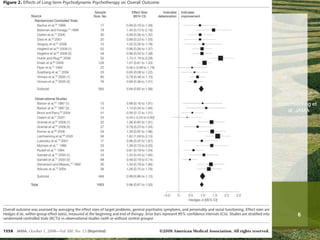
Leichsenring et
al, JAMA
6
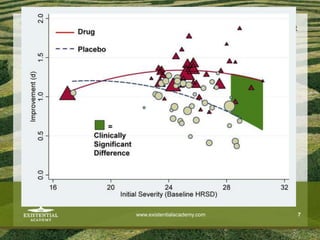
Kirsch, I., B. J. Deacon, et al. (2008). "Initial Severity and Antidepressant
Benefits: A Meta-Analysis of Data Submitted to the Food and Drug
Administration." PLoS Medicine 5(2): e45.
www.existentialacademy.com 7
www.existentialacademy.com 8
What IS a Caucus-race? said Alice; not that she wanted much to know, but the
Dodo had paused as if it thought that SOMEBODY ought to speak, and no one
else seemed inclined to say anything.
Why, said the Dodo, the best way to explain it is to do it. (And, as you might like
to try the thing yourself, some winter day, I will tell you how the Dodo managed
it.)
First it marked out a race-course, in a sort of circle, (the exact shape doesn't
matter, it said,) and then all the party were placed along the course, here and
there. There was no One, two, three, and away, but they began running when
they liked, and left off when they liked, so that it was not easy to know when the
race was over. However, when they had been running half an hour or so, and
were quite dry again, the Dodo suddenly called out The race is over! and they
all crowded round it, panting, and asking, But who has won?
This question the Dodo could not answer without a great deal of thought, and it
sat for a long time with one finger pressed upon its forehead (the position in
which you usually see Shakespeare, in the pictures of him), while the rest
waited in silence. At last the Dodo said, EVERYBODY has won, and all must
have prizes.
Rosenzweig, S. (1936). Some implicit common factors in diverse methods of
psychotherapy. American Journal of Orthopsychiatry, 6, 412-415.
Luborsky, L. and B. Singer (1975). Comparative studies of psychotherapies. Is it true
that "everywone has one and all must have prizes"? Archives of General Psychiatry.
32: 995-1008.
www.existentialacademy.com 9
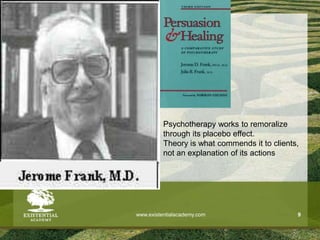
Psychotherapy works to remoralize
through its placebo effect.
Theory is what commends it to clients,
not an explanation of its actions
www.existentialacademy.com 10
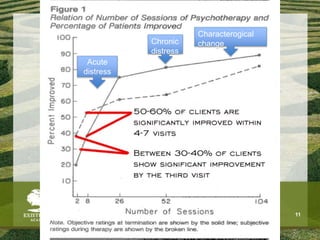
MARGINS OF PLACEBO EFFECT ARE THE
MARGINS OF PSYCHOTHERAPY
But these are fuzzy
So behaviour change, habit change, symptom
suppression, training, and education are like lemon
juice and pips: worth separating but not so easily
done because in nature they are intermingled
www.existentialacademy.com 11
Acute
distress
Chronic
distress
Characterogical
change
SHEDLER, J. (2010). "THE EFFICACY OF PSYCHODYNAMIC PSYCHOTHERAPY." AMERICAN
PSYCHOLOGIST 65(2): 98-109.
“As noted earlier, the goals of psychodynamic psychotherapy include, but
extend beyond, alleviation of acute symptoms. Psychological health is
not merely the absence of symptoms; it is the positive presence of
inner capacities and resources that allow people to live life with a
greater sense of freedom and possibility. Symptom-oriented outcome
measures commonly used in outcome studies (e.g., the Beck
Depression Inventory [Beck et al., 1961] or Hamilton Depression
Rating Scale [Hamilton, 1960]) do not attempt to assess such inner
capacities (Blatt & Auerbach, 2003; Kazdin, 2008). Possibly, the Dodo
bird verdict reflects a failure of researchers, psychodynamic and non-
psychodynamic alike, to adequately assess the range of phenomena
that can change in psychotherapy.
12
www.existentialacademy.com
SHEDLER, J. (2010). "THE EFFICACY OF PSYCHODYNAMIC PSYCHOTHERAPY." AMERICAN
PSYCHOLOGIST 65(2): 98-109.
“As noted earlier, the goals of psychodynamic psychotherapy include, but
extend beyond, alleviation of acute symptoms. Psychological health is
not merely the absence of symptoms; it is the positive presence of
inner capacities and resources that allow people to live life with a
greater sense of freedom and possibility. Symptom-oriented outcome
measures commonly used in outcome studies (e.g., the Beck
Depression Inventory [Beck et al., 1961] or Hamilton Depression
Rating Scale [Hamilton, 1960]) do not attempt to assess such inner
capacities (Blatt & Auerbach, 2003; Kazdin, 2008). Possibly, the
Dodo bird verdict reflects a failure of researchers,
psychodynamic and non-psychodynamic alike, to
adequately assess the range of phenomena that
can change in psychotherapy.
13
www.existentialacademy.com
• Exoriare aliquis nostris ex ossibus ultor !”
• Aeneid, IV 625). “Let someone arise from my bones as
an Avenger." Virgil Aeneid, Iv, 625
• Said by Dido (Carthage) of Aeneas (Rome)
• Who won?
• Rome, not Carthage
• Clever though: a quote from Sigmund Freud, The
Psychopathology of Everyday Life (1901)
www.existentialacademy.com 14
www.existentialacademy.com 15
THINGS THAT CHANGE IN
PSYCHOTHERAPY…AND THAT MIGHT
PROVE USEFUL EVIDENCE FOR
PSYCHOTHERAPY
Defences?
Character or personality?
Quality of personal relationships? Love?
Cognition? Work?
Well being?
www.existentialacademy.com 16
DEFENCES
Militaristic metaphor
Bond and Vaillant study
showed only disorganized
vs. organized defences
were predictive
Does this improve on “messed
up”?
www.existentialacademy.com 17
PERSONALITY CHANGE
Only reliable and enduring measures of personality are
Big 5—openness, conscientiousness, extraversion,
agreeableness, neuroticism (anxiety proneness)—
none obviously linked to clinically relevant dimensions
of personality change
What we call personality is closely linked to current
relationship quality, and may change in months or
years
Large spontaneous changes in personality e.g.
attachment theory
www.existentialacademy.com 18
QUALITY OF SOCIAL RELATIONSHIPS
Strongly correlated with symptom scores
Relationship quality strongly correlated with
depression
www.existentialacademy.com 19
RELAPSE PREVENTION
Attrition
Supervening life events
www.existentialacademy.com 20
WELL BEING
Not symptom reduction
Kahneman
Life evaluation, a comparative measure linked to
mortality
Emotional wellbeing
Lack of suffering
Positive emotions
www.existentialacademy.com 24
25
www.existentialacademy.com
BEHAVIOUR
ACTION
ACTION
Causes or
reasons1
Justifications or
Reasons 2
Tantam, D.
(2002). "Reasons
and
psychological
explanation."
International
Journal Of
Psychotherapy
7(2): 165-173.
Can we learn from medicine?
• Take, as an example, the so-called break through in the
developmental of atypical antipsychotics
• There is no clear evidence of advantages in terms of
symptom control or likelihood of discontinuation (due to
intolerable side effects and/or lack of treatment efficacy)
MeReC (Rapid review) National Prescribing Centre
• Crossley N et al. Efficacy of atypical v. typical
antipsychotics in the treatment of early psychosis:
meta-analysis. B J Psych 2010;196:434-9
www.existentialacademy.com 26
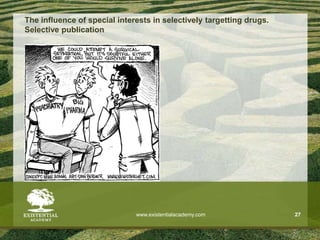
The influence of special interests in selectively targetting drugs.
Selective publication
www.existentialacademy.com 27
www.existentialacademy.com 28
• IAPT stands for ‘Increasing Access to
Psychological Therapies’. It is a national
Department of Health programme aimed to
improve and increase access to evidenced based
psychological therapies such as CBT.
• Clinical evidence has shown that better access to
therapies such as Cognitive Behavioural Therapy
(CBT) can help treat depression and anxiety and
reduce both time off work due to ill-health, and the
claiming of Incapacity Benefits. Patients also
prefer to receive talking therapies rather than
medication alone. Lord Layard’s review of the
economic and emotional costs of mental ill health
demonstrated the financial benefits to providing
psychological therapies to people suffering from
depression and anxiety.
www.existentialacademy.com 29
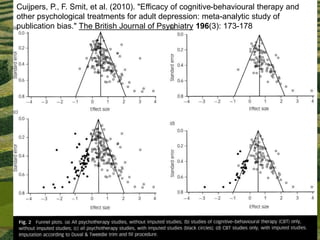
Cuijpers, P., F. Smit, et al. (2010). "Efficacy of cognitive-behavioural therapy and
other psychological treatments for adult depression: meta-analytic study of
publication bias." The British Journal of Psychiatry 196(3): 173-178
• Drugs replace directions
for patients as well as
doctors
www.existentialacademy.com 30
Issue is not main effect, but
persistence with treatment
What are the factors that determine
persistence/compliance?
• Focus on preoccupying
concern
• Congruence of values
• Emotional flavour
• Tantam, D. (2003). "The
flavour of emotions.”
Psychology and
Psychotherapy, 76, 23-45
www.existentialacademy.com 31
www.existentialacademy.com 32
PERSISTENCE IN PSYCHOTHERAPY
Avoidance
Negativity as well as positivity
‘Free communication’
Addiction
Improvement and not deterioration during breaks
www.existentialacademy.com 34
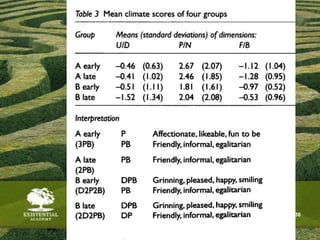
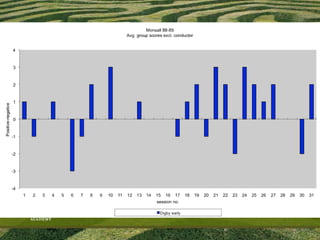
GROUP CLIMATE QUESTIONNAIRE
Date of group: Your number:
If the statement on a line accurately describes how you felt at some time
during the group, please tick all the boxes (there may be between 1 and
3) on that line.
Active, extroverted, self-confident..……………………|__|
Out-going, open, sociable.............………………|__|...|__|
Leading in a friendly, democratic way.……|__|...|__|…|__|
.
.22 other items (total 26)
.
Passive, introverted, inhibited.....................………………………………….|__|
|__| |__| |__| |__| |__| |__|
U P F D N B
FINAL SCORE |__| |__| |__|
www.existentialacademy.com 35
www.existentialacademy.com 36
it’s time for disruptive innovation in psychotherapy
In The Lancet today, David Kessler and colleagues
evaluate the acceptability and clinical effectiveness of
an internet-based psychotherapy programme for
depres- sion.1Nearly two-thirds of those offered the
programme completed five or more therapy sessions, a
substantially higher rate than we would expect with in-
person therapy. Clinical benefits were larger than
generally seen with computerised self-help
programmes, and similar to those with traditional in-
person psychotherapy.
Simon GE, Ludman EJ. It's time for disruptive innovation in psychotherapy. The Lancet.
2009 2009/08/28/;374(9690):594-5.
www.existentialacademy.com 38
www.existentialacademy.com 39
www.existentialacademy.com 40
Thanks for listening
Slides can be found at www.slideshare.net
www.existentialacademy.com 41

What evidence for psychotherapy to develop

  • 1.
    www.existentialacademy.com 1 WHAT EVIDENCEWILL WE NEED IN FUTURE FOR PSYCHOTHERAPY TO DEVELOP? Digby Tantam Member, IGA (London) Clinical Professor of Psychotherapy, University of Sheffield Senior Visiting Research Fellow, University of Cambridge Honorary Consultant Psychiatrist, Sheffield Health and Social Care Trust Director, Existential Academy “Exoriare aliquis nostris ex ossibus ultor ! (Let someone arise from my bones as an Avenger!)” Virgil, Aeneid, IV 625
  • 2.
    Eysenck, H. (1952).The effects of psychotherapy: an evaluation. Journal of Consulting & Clinical Psychology. 16: 319-324. • A kind of meta-analysis of published data • Disabled or admitted to hospital often involuntarily after at least 3 months illness. ‘Severe neurosis’ unspecified. After is at least 2 years • No distinction between treatment and maintenance
  • 3.
    Problems raised bythis particular study have been considered ever since: Use of appropriate controls Standardization of method (‘manualization’) Clarity about parameters e.g. length of follow up Separation of treatment and prevention (or maintenance) But first and foremost is what is the outcome of psychotherapy – Early intervention – Maintenance • What is this? 3 www.existentialacademy.com
  • 4.
    • “(1) ifthere is no adequate study of psychoanalytic therapy showing a better improvement rate, then there is no firm evidence that the therapy is therapeutically effective. • (2) A review of existing studies showed that indeed there did not exist any such adequate study. • (3) Consequently, I concluded that there was no evidence of therapeutic success for psychoanalysis (or more general methods of psychotherapy, which I also analysed in a similar manner)” www.existentialacademy.com 4
  • 5.
    Letter to GarfieldLibrary, University of Pennsylvania • As far as I personally am concerned the outcome was that I was ostracised by the clinical fraternity, had efforts to establish alternative methods of treatment (behaviour therapy) blocked by psychiatrists, was refused research grants by embattled psychoanalysts on grantgiving bodies, and was generally treated as an outcast and a pariah...Efforts were made to terminate my appointment, and quite generally I was made to feel that one does not oppose the Zeitgeist with impunity, however correct the argument. Exoriare aliquis nostris ex ossibus ultor !” The Psychologist, 23 (9), 736 Sept 2010 • “He (Hans Eysenck) developed a superb descriptive model of personality that has scarcely been bettered and contributed numerous ingenious theoretical insights. However, he took his eye off the ball by trying to exceed the fame (and citations!) of Sigmund Freud with comparably grandiose speculations. If only my father had focussed his research more on behavioural genetics rather than wasting his time tilting at an endless succession of windmills!” www.existentialacademy.com 5
  • 6.
  • 7.
    Kirsch, I., B.J. Deacon, et al. (2008). "Initial Severity and Antidepressant Benefits: A Meta-Analysis of Data Submitted to the Food and Drug Administration." PLoS Medicine 5(2): e45. www.existentialacademy.com 7
  • 8.
    www.existentialacademy.com 8 What ISa Caucus-race? said Alice; not that she wanted much to know, but the Dodo had paused as if it thought that SOMEBODY ought to speak, and no one else seemed inclined to say anything. Why, said the Dodo, the best way to explain it is to do it. (And, as you might like to try the thing yourself, some winter day, I will tell you how the Dodo managed it.) First it marked out a race-course, in a sort of circle, (the exact shape doesn't matter, it said,) and then all the party were placed along the course, here and there. There was no One, two, three, and away, but they began running when they liked, and left off when they liked, so that it was not easy to know when the race was over. However, when they had been running half an hour or so, and were quite dry again, the Dodo suddenly called out The race is over! and they all crowded round it, panting, and asking, But who has won? This question the Dodo could not answer without a great deal of thought, and it sat for a long time with one finger pressed upon its forehead (the position in which you usually see Shakespeare, in the pictures of him), while the rest waited in silence. At last the Dodo said, EVERYBODY has won, and all must have prizes. Rosenzweig, S. (1936). Some implicit common factors in diverse methods of psychotherapy. American Journal of Orthopsychiatry, 6, 412-415. Luborsky, L. and B. Singer (1975). Comparative studies of psychotherapies. Is it true that "everywone has one and all must have prizes"? Archives of General Psychiatry. 32: 995-1008.
  • 9.
    www.existentialacademy.com 9 Psychotherapy worksto remoralize through its placebo effect. Theory is what commends it to clients, not an explanation of its actions
  • 10.
    www.existentialacademy.com 10 MARGINS OFPLACEBO EFFECT ARE THE MARGINS OF PSYCHOTHERAPY But these are fuzzy So behaviour change, habit change, symptom suppression, training, and education are like lemon juice and pips: worth separating but not so easily done because in nature they are intermingled
  • 11.
  • 12.
    SHEDLER, J. (2010)."THE EFFICACY OF PSYCHODYNAMIC PSYCHOTHERAPY." AMERICAN PSYCHOLOGIST 65(2): 98-109. “As noted earlier, the goals of psychodynamic psychotherapy include, but extend beyond, alleviation of acute symptoms. Psychological health is not merely the absence of symptoms; it is the positive presence of inner capacities and resources that allow people to live life with a greater sense of freedom and possibility. Symptom-oriented outcome measures commonly used in outcome studies (e.g., the Beck Depression Inventory [Beck et al., 1961] or Hamilton Depression Rating Scale [Hamilton, 1960]) do not attempt to assess such inner capacities (Blatt & Auerbach, 2003; Kazdin, 2008). Possibly, the Dodo bird verdict reflects a failure of researchers, psychodynamic and non- psychodynamic alike, to adequately assess the range of phenomena that can change in psychotherapy. 12 www.existentialacademy.com
  • 13.
    SHEDLER, J. (2010)."THE EFFICACY OF PSYCHODYNAMIC PSYCHOTHERAPY." AMERICAN PSYCHOLOGIST 65(2): 98-109. “As noted earlier, the goals of psychodynamic psychotherapy include, but extend beyond, alleviation of acute symptoms. Psychological health is not merely the absence of symptoms; it is the positive presence of inner capacities and resources that allow people to live life with a greater sense of freedom and possibility. Symptom-oriented outcome measures commonly used in outcome studies (e.g., the Beck Depression Inventory [Beck et al., 1961] or Hamilton Depression Rating Scale [Hamilton, 1960]) do not attempt to assess such inner capacities (Blatt & Auerbach, 2003; Kazdin, 2008). Possibly, the Dodo bird verdict reflects a failure of researchers, psychodynamic and non-psychodynamic alike, to adequately assess the range of phenomena that can change in psychotherapy. 13 www.existentialacademy.com
  • 14.
    • Exoriare aliquisnostris ex ossibus ultor !” • Aeneid, IV 625). “Let someone arise from my bones as an Avenger." Virgil Aeneid, Iv, 625 • Said by Dido (Carthage) of Aeneas (Rome) • Who won? • Rome, not Carthage • Clever though: a quote from Sigmund Freud, The Psychopathology of Everyday Life (1901) www.existentialacademy.com 14
  • 15.
    www.existentialacademy.com 15 THINGS THATCHANGE IN PSYCHOTHERAPY…AND THAT MIGHT PROVE USEFUL EVIDENCE FOR PSYCHOTHERAPY Defences? Character or personality? Quality of personal relationships? Love? Cognition? Work? Well being?
  • 16.
    www.existentialacademy.com 16 DEFENCES Militaristic metaphor Bondand Vaillant study showed only disorganized vs. organized defences were predictive Does this improve on “messed up”?
  • 17.
    www.existentialacademy.com 17 PERSONALITY CHANGE Onlyreliable and enduring measures of personality are Big 5—openness, conscientiousness, extraversion, agreeableness, neuroticism (anxiety proneness)— none obviously linked to clinically relevant dimensions of personality change What we call personality is closely linked to current relationship quality, and may change in months or years Large spontaneous changes in personality e.g. attachment theory
  • 18.
    www.existentialacademy.com 18 QUALITY OFSOCIAL RELATIONSHIPS Strongly correlated with symptom scores Relationship quality strongly correlated with depression
  • 19.
  • 20.
    www.existentialacademy.com 20 WELL BEING Notsymptom reduction Kahneman Life evaluation, a comparative measure linked to mortality Emotional wellbeing Lack of suffering Positive emotions
  • 24.
  • 25.
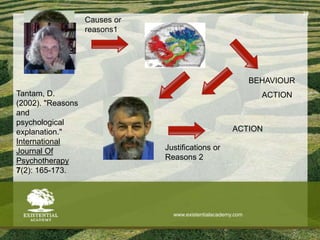
    25 www.existentialacademy.com BEHAVIOUR ACTION ACTION Causes or reasons1 Justifications or Reasons2 Tantam, D. (2002). "Reasons and psychological explanation." International Journal Of Psychotherapy 7(2): 165-173.
  • 26.
    Can we learnfrom medicine? • Take, as an example, the so-called break through in the developmental of atypical antipsychotics • There is no clear evidence of advantages in terms of symptom control or likelihood of discontinuation (due to intolerable side effects and/or lack of treatment efficacy) MeReC (Rapid review) National Prescribing Centre • Crossley N et al. Efficacy of atypical v. typical antipsychotics in the treatment of early psychosis: meta-analysis. B J Psych 2010;196:434-9 www.existentialacademy.com 26
  • 27.
    The influence ofspecial interests in selectively targetting drugs. Selective publication www.existentialacademy.com 27
  • 28.
    www.existentialacademy.com 28 • IAPTstands for ‘Increasing Access to Psychological Therapies’. It is a national Department of Health programme aimed to improve and increase access to evidenced based psychological therapies such as CBT. • Clinical evidence has shown that better access to therapies such as Cognitive Behavioural Therapy (CBT) can help treat depression and anxiety and reduce both time off work due to ill-health, and the claiming of Incapacity Benefits. Patients also prefer to receive talking therapies rather than medication alone. Lord Layard’s review of the economic and emotional costs of mental ill health demonstrated the financial benefits to providing psychological therapies to people suffering from depression and anxiety.
  • 29.
    www.existentialacademy.com 29 Cuijpers, P.,F. Smit, et al. (2010). "Efficacy of cognitive-behavioural therapy and other psychological treatments for adult depression: meta-analytic study of publication bias." The British Journal of Psychiatry 196(3): 173-178
  • 30.
    • Drugs replacedirections for patients as well as doctors www.existentialacademy.com 30
  • 31.
    Issue is notmain effect, but persistence with treatment What are the factors that determine persistence/compliance? • Focus on preoccupying concern • Congruence of values • Emotional flavour • Tantam, D. (2003). "The flavour of emotions.” Psychology and Psychotherapy, 76, 23-45 www.existentialacademy.com 31
  • 32.
    www.existentialacademy.com 32 PERSISTENCE INPSYCHOTHERAPY Avoidance Negativity as well as positivity ‘Free communication’ Addiction Improvement and not deterioration during breaks
  • 33.
  • 34.
    GROUP CLIMATE QUESTIONNAIRE Dateof group: Your number: If the statement on a line accurately describes how you felt at some time during the group, please tick all the boxes (there may be between 1 and 3) on that line. Active, extroverted, self-confident..……………………|__| Out-going, open, sociable.............………………|__|...|__| Leading in a friendly, democratic way.……|__|...|__|…|__| . .22 other items (total 26) . Passive, introverted, inhibited.....................………………………………….|__| |__| |__| |__| |__| |__| |__| U P F D N B FINAL SCORE |__| |__| |__| www.existentialacademy.com 35
  • 35.
  • 37.
    it’s time fordisruptive innovation in psychotherapy In The Lancet today, David Kessler and colleagues evaluate the acceptability and clinical effectiveness of an internet-based psychotherapy programme for depres- sion.1Nearly two-thirds of those offered the programme completed five or more therapy sessions, a substantially higher rate than we would expect with in- person therapy. Clinical benefits were larger than generally seen with computerised self-help programmes, and similar to those with traditional in- person psychotherapy. Simon GE, Ludman EJ. It's time for disruptive innovation in psychotherapy. The Lancet. 2009 2009/08/28/;374(9690):594-5. www.existentialacademy.com 38
  • 38.
  • 39.
  • 40.
    Thanks for listening Slidescan be found at www.slideshare.net www.existentialacademy.com 41

Editor's Notes

  • #3 Famous study that puts psychotherapy under the microscope: is it more than placebo? Leads to vilification and vengeance that has continued every since, plus the use of survival analysis. But is this appropriate? Much of psychiatry has used this method. Also what goes around, comes around.
  • #6 I am working on the association of CNVs on chromosome 15 and atypical psychosis in ASD
  • #7 Prestigious journal but forgot to analyse control group
  • #9 Rosenzweig, S. (1936). Some implicit common factors in diverse methods of psychotherapy. American Journal of Orthopsychiatry, 6, 412-415.
  • #11 Neurobiology reinforces placebo effect
  • #12 Later developed phase idea: Early phase, acute distress/ Middle phase Chronic distress (but of course this might be social rearrangement)/ 3rd phase ‘characterological’
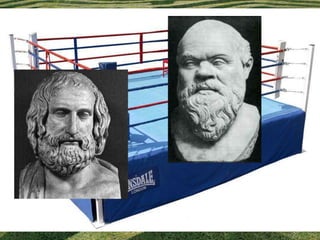
  • #25 Protagoras (blue) the first sophist or wisdom professional/ retailer vs. Socrates (red) the friend of philosophy, or the amateur, who thought that there was an ultimate truth
  • #28 Advertizing has biassed drug prescribing and created a spurious sense of differential potency. Now Layard advertizing has done the same. But the evidence is rather less grand, in both cases Drugs, and psychotherapy, may differ only in side effects.
  • #29 Advertizing has biassed drug prescribing and created a spurious sense of differential potency. Now Layard advertizing has done the same. But the evidence is rather less grand, in both cases Drugs, and psychotherapy, may differ only in side effects.