EXISTENTIAL GROUP TRAINING

Digby Tantam
       Deputy Director, former NSPC
      Clinical Professor of Psychotherapy,
         University of Sheffield
Jackie Lewis


                    www.existentialacademy.com   1
10-10.45    Theory
10.45-11.30 Exercise
12-12.45    Skills training
12.45-1     Feedback
14-14.45    Theory
14.45-15.30 Exercise
16-16.45    Skills training
16.45-17     Feedback


          Existential group training, June 2010
Why isn’t Emmy here?
Where has NSPC gone?
What will happen next term/ year?
.


         Existential group training, June 2010
                    www.existentialacademy.com   3
Why isn’t Emmy here?
Where has NSPC gone?
What will happen next term/ year?

There are 10 skills training sessions, and 16 of
   us: how do these fit together.
The skills training will be to co-conduct a group
   experience
I will conduct the first, Jackie Lewis, the last.

          Existential group training, June 2010
                     www.existentialacademy.com     4
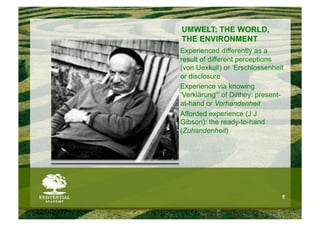
UMWELT: THE WORLD,
            THE ENVIRONMENT
            Experienced differently as a
            result of different perceptions
            (von Uexkull) or ‘Erschlossenheit
            or disclosure
            Experience via knowing
            ‘Verklärung”’ of Dilthey: present-
            at-hand or Vorhandenheit
            Afforded experience (J J
            Gibson): the ready-to-hand
            (Zuhandenheit)


                                             5


22/9/2007
Existential group training, June 2010
           www.existentialacademy.com   6
In section 26 of Being and Time
               Heidegger states: "By reason of
               this with-like being-in-the-world,
               the world is always the one that I
               share with others. The world of
               Dasein is a with-world [Mitwelt].
               Being-in is being-with [Mitsein]
               others. Their being-in-themselves
               within-the-world is Dasein-with
               [Mitdasein]" (Macquarrie and
               Robinson, New York: Harper and
               Row, 1962. p. 155,


MITSEIN


                                                7


22/9/2007
BOTH FACT


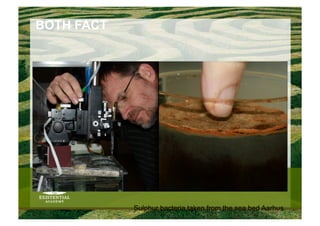
            Sulphur bacteria taken from the sea bed Aarhus
Slime mould Physarum polycephalum metamorphosing in response to starvation to from plasmodium to
sporangiophore in response to starvation
Hunyuan hanging temple, Mt. Hengshan, Shanxi
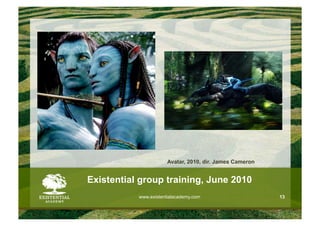
Avatar, 2010, dir. James Cameron


Existential group training, June 2010
           www.existentialacademy.com                     13
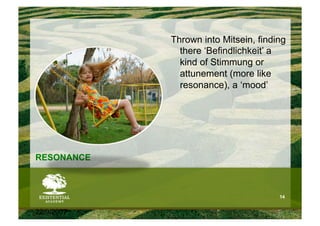
Thrown into Mitsein, finding
              there ‘Befindlichkeit’ a
              kind of Stimmung or
              attunement (more like
              resonance), a ‘mood’


RESONANCE


                                      14


22/9/2007
Existential group training, June 2010
Tallinn Dimensions of personal world view in existential individual and group therapy   15
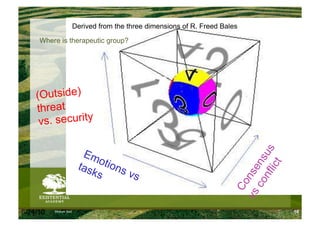
Derived from the three dimensions of R. Freed Bales

     Where is therapeutic group?


    (Outside)
    threat
     vs. security


6/24/10   Modum Bad                                                         16
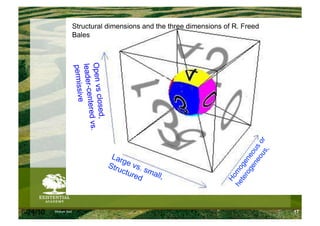
Structural dimensions and the three dimensions of R. Freed
                      Bales


                      Open vs cl
                      leader-cen
                       permissive

                                 osed,
                                 tered vs.


6/24/10   Modum Bad                                                                17
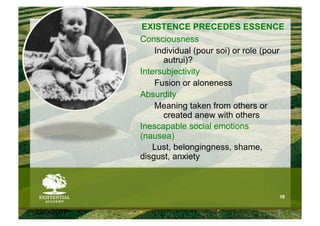
EXISTENCE PRECEDES ESSENCE
            Consciousness
                Individual (pour soi) or role (pour
                  autrui)?
            Intersubjectivity
                Fusion or aloneness
            Absurdity
                Meaning taken from others or
                  created anew with others
            Inescapable social emotions
            (nausea)
               Lust, belongingness, shame,
            disgust, anxiety


                                                 18


22/9/2007
SARTRE:
                       ETRE POUR-SOI
                      Hegel Fürsich


www.existentialacademy.com             19
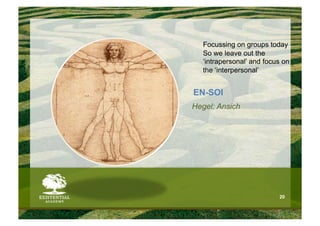
Focussing on groups today
  So we leave out the
  ‘intrapersonal’ and focus on
  the ‘interpersonal’


EN-SOI
Hegel: Ansich


                          20
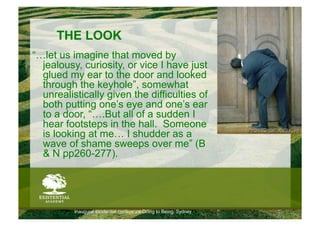
THE LOOK
“…let us imagine that moved by
  jealousy, curiosity, or vice I have just
  glued my ear to the door and looked
  through the keyhole”, somewhat
  unrealistically given the difficulties of
  both putting one’s eye and one’s ear
  to a door, “….But all of a sudden I
  hear footsteps in the hall. Someone
  is looking at me… I shudder as a
  wave of shame sweeps over me” (B
  & N pp260-277).


          Inaugural existential conference Doing to Being, Sydney
THE LOOK
Feeling the look on one’s back
Caught in a moment of private excitement
   –  Jealousy, curiosity, vice
The look is not returned
The other is not a person with a particular
  reaction e.g. a facial expression, but the
  Other, a totalization
The name of the father, the Master, the
  State, authority, grandfather Schweitzer


            Inaugural existential conference Doing to Being, Sydney
ETRE POUR AUTRUI: BEING FOR
OTHERS
“..I persevere in it [in looking through the key-hole],
   I shall feel my heart beat fast, at the slightest
   creaking of the stairs. Far from disappearing
   with my first alarm, the Other is present
   everywhere, below me, above me, in the
   neighbouring rooms, and I continue to feel
   profoundly my being- for-others” (B & Np.277).


                Inaugural existential conference Doing to Being, Sydney
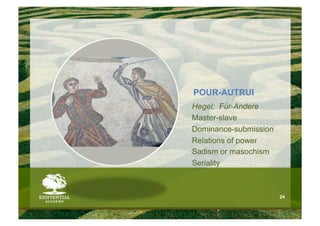
POUR-AUTRUI
Hegel: Für-Andere
Master-slave
Dominance-submission
Relations of power
Sadism or masochism
Seriality


                       24
FORMATIVE SOCIAL CONDITIONS


    Are we at the moment in question orientating
      ourselves to:
       –  A small or a large group?
       –  A consensus or a conflicted group?
       –  A secure or a threatened group?
    Where did this experience come from?


6/24/10   Modum Bad                                25
Think about your first group. Your family
  perhaps
What were its formative conditions, and how has
  it influenced you since?
Be prepared to discuss this with the group for a
  few minutes


         Existential group training, June 2010
                                                   26
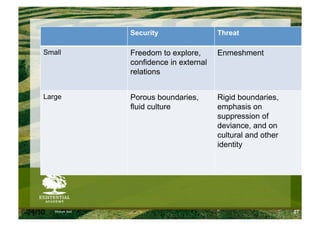
Security                 Threat

      Small           Freedom to explore,      Enmeshment
                      confidence in external
                      relations


      Large           Porous boundaries,       Rigid boundaries,
                      fluid culture            emphasis on
                                               suppression of
                                               deviance, and on
                                               cultural and other
                                               identity


6/24/10   Modum Bad                                                 27
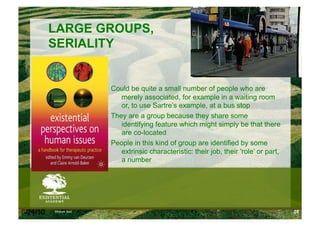
LARGE GROUPS,
          SERIALITY


                      Could be quite a small number of people who are
                         merely associated, for example in a waiting room
                         or, to use Sartre’s example, at a bus stop
                      They are a group because they share some
                         identifying feature which might simply be that there
                         are co-located
                      People in this kind of group are identified by some
                         extrinsic characteristic: their job, their ‘role’ or part,
                         a number


6/24/10   Modum Bad                                                                   28
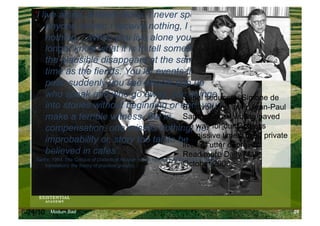
‘I live alone, entirely alone. I never speak to
        anyone, never; I receive nothing, I give
        nothing… When you live alone you no
        longer know what it is to tell something:
        the plausible disappears at the same
        time as the fiends. You let events flow
        past; suddenly you see people pop up
        who speak and who go away, you plungeSerial seducers: Simone de
        into stories without beginning or end: youand lover Jean-Paul
                                             Beauvoir
        make a terrible witness. But in Sartre, whose writing paved
        compensation, one misses nothing, no for our Godless
                                             the way
                                             permissive times, lived private
        improbability or, story too tall to be
                                             lives of utter depravity
        believed in cafes’.                  Read more Daily Mail,
   (Sartre, 1964, The Critique of Dialectical Reason, which has the subtitle (in the English
        translation): the theory of practical groups).                      October 2008


6/24/10   Modum Bad                                                                            29
LARGE VS. SMALL
                                      CITIZENSHIP VS. INTIMACY
                                      PRAXIS VS. PRACTICO-
                                      INERT
                                      SERIALITY VS.
                                      RECIPROCITY
                                        The eternal struggle:
                                      I-THOU VS. I-ITand interbrain
    Bernard Mandeville, 1705.             Consciousness
    Born in Rotterdam, died of ‘flu
    in Hackney, London. Society          (God vs. animal/ ontological vs.
    prospers from vice and not
    virtue i.e from individualism
                                         ontic/ selfish vs. altruistic/
    and not mergence                     resistance vs. transference/
                                         Reflexive processing vs. explicit
                                         processing/ Ego vs. Id)


6/24/10   Modum Bad                                                          30
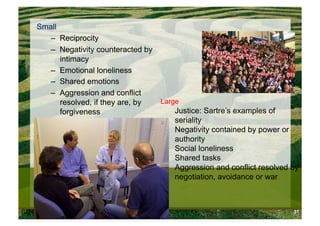
Small
       –  Reciprocity
       –  Negativity counteracted by
          intimacy
       –  Emotional loneliness
       –  Shared emotions
       –  Aggression and conflict
          resolved, if they are, by    Large
          forgiveness                     Justice: Sartre’s examples of
                                          seriality
                                          Negativity contained by power or
                                          authority
                                          Social loneliness
                                          Shared tasks
                                          Aggression and conflict resolved by
                                          negotiation, avoidance or war


6/24/10   Modum Bad                                                        31
SARTRE’S CRITERIA OF RECIPROCITY
    that the Other be a means to the exact degree that
      I am a means myself
    that I recognize the Other as praxis
    that I recognize his movement toward his own
      ends in the very movement by which I project
      myself toward mine
    that I discover myself as an object and instrument
      of his ends by the same act which makes him an
      object and instrument of mine


6/24/10   Modum Bad                                      32
THE THIRD PARTY/   Linking individual and
MEDIATING OTHER      group praxis


                                            33
SARTRE ON SMALL GROUPS


    The fused group
      –  When each becomes the third party for the
         other
    What creates the small group?
      –  Cooperative action
      –  Terror management
      –  The fear of death or annihilation


6/24/10   Modum Bad                                  34
KEY IDEAS OF GROUP THERAPY HISTORY ARE

    the other is a mirror…
    one can discover oneself through group
      participation..
    Based on the social relations school of psychology,
      and the notion of interpersonal learning.
    Adherents of this position include Cooley and the
      Chicago school of social relations, Jung,
      Sullivan, Lewin, encounter groups, and
      humanistic psychology.


6/24/10   Modum Bad                                       35
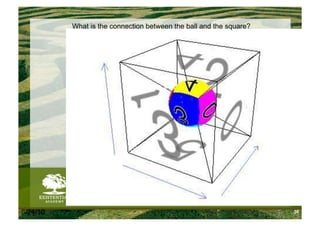
What is the connection between the ball and the square?


6/24/10                                                             36
KEY IDEAS OF GROUP THERAPY HISTORY ARE
    the other is a mirror…
    one can discover oneself through group
      participation..
    Based on the social relations school of psychology,
      and the notion of interpersonal learning.
    Adherents of this position include Cooley and the
      Chicago school of social relations, Jung,
      Sullivan, Lewin, encounter groups, and
      humanistic psychology.


6/24/10    Modum Bad                                      37
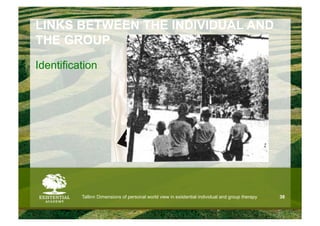
LINKS BETWEEN THE INDIVIDUAL AND
THE GROUP
Identification


          Tallinn Dimensions of personal world view in existential individual and group therapy   38
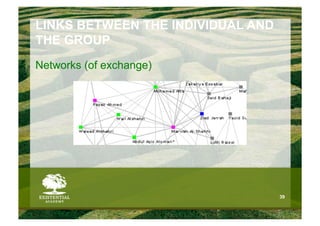
LINKS BETWEEN THE INDIVIDUAL AND
THE GROUP
Networks (of exchange)


                                   39
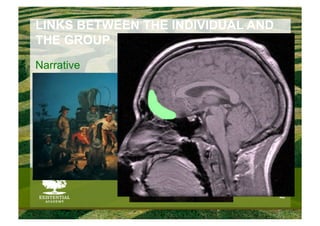
LINKS BETWEEN THE INDIVIDUAL AND
THE GROUP
Narrative


                                   40
Jacob Levy Moreno (born Iacob Levy)
Born      May 18, 1889
Bucharest, Romania
Sephardic family: Spain, Istanbul, Bulgaria, Romania,
Vienna, New York
Died      May 14, 1974 (aged 84)
Residence New York, USA
Fields Theory, education, psychiatry, psychology,
psychotherapy, psychoanalysis
Institutions University of Vienna
Known for Sociometry, Psychodrama, social
      network theory


              Tallinn Dimensions of personal world view in existential individual and group therapy   41
"I attended one of Freud’s lectures. He had just finished an
analysis of a telepathic dream. As the students filed out, he singled
me out from the crowd and asked me what I was doing. I
responded, 'Well, Dr. Freud, I start where you leave off. You meet
people in the artificial setting of your office. I meet them on the
street and in their homes, in their natural surroundings. You
analyze their dreams. I give them the courage to dream again. You
analyze and tear them apart. I let them act out their conflicting roles
and help them to put the parts back together again.’
Jacob Moreno, Autobiography


          Tallinn Dimensions of personal world view in existential individual and group therapy   42
SOCIOGRAM


     Tallinn Dimensions of personal world view in existential individual and group therapy   43
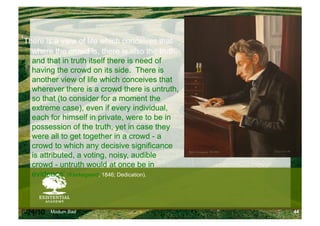
‘There is a view of life which conceives that
   where the crowd is, there is also the truth,
   and that in truth itself there is need of
   having the crowd on its side. There is
   another view of life which conceives that
   wherever there is a crowd there is untruth,
   so that (to consider for a moment the
   extreme case), even if every individual,
   each for himself in private, were to be in
   possession of the truth, yet in case they
   were all to get together in a crowd - a
   crowd to which any decisive significance
   is attributed, a voting, noisy, audible
   crowd - untruth would at once be in
   evidence’ (Kierkegaard, 1846; Dedication).


6/24/10   Modum Bad                               44
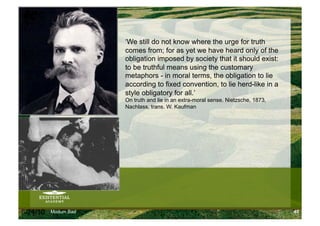
‘We still do not know where the urge for truth
                      comes from; for as yet we have heard only of the
                      obligation imposed by society that it should exist:
                      to be truthful means using the customary
                      metaphors - in moral terms, the obligation to lie
                      according to fixed convention, to lie herd-like in a
                      style obligatory for all.’
                      On truth and lie in an extra-moral sense. Nietzsche, 1873,
                      Nachlass, trans. W. Kaufman


6/24/10   Modum Bad                                                                45
INDIVIDUAL PERSPECTIVES


Large and conflicted group:
   –  Tribal loyalty, stereotyping, identification (cf.
      Sherif and Sherif)
Small and secure group
   –  Identification vs. identity
THEORIES OF THE INTERACTION OF INDIVIDUALS AND SMALL GROUPS

    Moreno:
       -- network
    S H Foulkes:
        –  plexus and nexus (relationships outside the group, relationships
            in the group)
        –  vertical vs. horizontal dimension (internal vs. external object)
        –  for conductor, analysing the individual in the group, or analysis
            the group
        –  matrix
    Lewin
       --- field theory


6/24/10   Modum Bad                                                            47
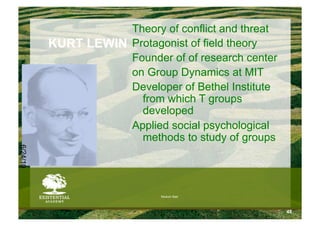
Theory of conflict and threat
          KURT LEWIN Protagonist of field theory
                     Founder of of research center
                     on Group Dynamics at MIT
                     Developer of Bethel Institute
                       from which T groups
                       developed
                     Applied social psychological
                       methods to study of groups
6/24/10


                             Modum Bad


                                                     48
6/24/10   Modum Bad   49
LEWIN’S RESEARCH PRIORITIES AT RESEARCH
    CENTRE ON GROUP DYNAMICS AT MIT
      "The conditions which improve the effectiveness of
       community leaders who are attempting to better
       intergroup relations”
      "The effect of the conditions under which contact
       between persons from different groups takes place”
      "The influences which are most effective in producing in
       minority-group members and increased sense of
       belongingness, and improved personal adjustment, and
       better relations with individuals of other groups" (Marrow, 1969,
          p.192)


6/24/10     Modum Bad                                                      50
FIELD THEORY
    human behaviour should be seen as part of a continuum
    individual variations from the norm being a function of
       tensions between perceptions of the self and of the
       environment
    the whole psychological field, or "lifespace," within which
       the person acted had to be viewed
    the totality of events in this lifespace determined behaviour
       at any one time. used topological systems (maplike
       representations) to graphically depict psychological
       forces


6/24/10   Modum Bad                                                 51
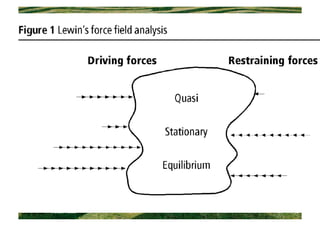
LEWIN’S CONCEPTUAL FRAMEWORK FOR DIAGNOSIS


    clients (individuals, groups, and organizations) become
       "frozen" or stuck in their current, metastable or quasi-
       equilibrium state.
    Change requires"unfreezing" or create movement in the
       client system moving it towards the desired state and
       then
    "re-freezing" the system in the new state.
    The new state may be determined by identification with a
       person or a group, or by an individual’s response to the
       driving and restraining forces in the social field.


6/24/10    Modum Bad                                              52
UNFREEZING METHODS
      Burning platform: Expose or create a crisis.
      Challenge: Inspire them to achieve remarkable things.
      Command: Just tell them to move!
      Evidence: Cold, hard data is difficult to ignore.
      Destabilizing: Shaking people of their comfort zone.
      Education: Learn them to change.
      Management by Objectives (MBO): Tell people what to do, but not
       how.
      Restructuring: Redesign the organization to force behaviour
       change.
      Rites of passage: Hold a wake to help let go of the past.
      Setting goals: Give them a formal objective.
      Visioning: Done well, visions work to create change.
      Whole-system Planning: Everyone planning together.


6/24/10   Modum Bad                                                      53
AGAZARIAN AND SYSTEMS CENTERED
THEORY
Influence of general systems theory and Durkins
Traceable back to Lewin
Bit simplistic but one good idea:
Siding with the sub-group


                                                  54
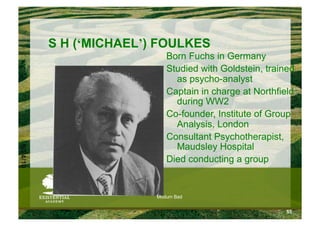
S H (‘MICHAEL’) FOULKES
                            Born Fuchs in Germany
                            Studied with Goldstein, trained
                              as psycho-analyst
                            Captain in charge at Northfield
                              during WW2
                            Co-founder, Institute of Group
                              Analysis, London
                            Consultant Psychotherapist,
                              Maudsley Hospital
6/24/10


                            Died conducting a group


                         Modum Bad


                                                         55
KEY CONCEPTS OF FOULKES
    Plexus and nexus
    Matrix
    Location of a problem in the group
    Resonance of a group theme
    Condenser phenomenon
    Dynamic administration of the conductor
    Interpretation by the group


6/24/10   Modum Bad                           56
A SIMPLIFYING HYPOTHESIS:!
      1. anxiety, depression, and dissatisfaction stem from a
       failure to make or maintain satisfactory social
       relationships"
      2. the failure to make or maintain social relationships is
       due to:"
           a. use of abnormal defences (Freud)"
           b. projective identification and splitting (Klein)"
           c. parataxic distortion (Sullivan)"
      3. distorted social relationships and normal group (e.g.
       family development) are antithetical"


6/24/10   Modum Bad                                                 57
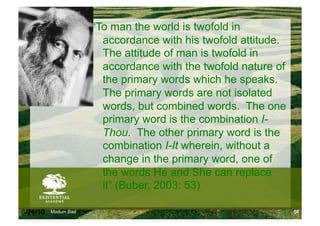
“To man the world is twofold in
                        accordance with his twofold attitude.
                        The attitude of man is twofold in
                        accordance with the twofold nature of
                        the primary words which he speaks.
                        The primary words are not isolated
                        words, but combined words. The one
                        primary word is the combination I-
                        Thou. The other primary word is the
                        combination I-It wherein, without a
                        change in the primary word, one of
                        the words He and She can replace
                        it” (Buber, 2003: 53)

6/24/10   Modum Bad                                             58
UNADDRESSED PROBLEMS
          A group may not be a
            microcosm of society
          Society may turn on the
            deviant
          Morality and the problem of
            evil
          Inherent qualities of the
            individual, esp. shame
          The fundamental opposition
6/24/10


            of individual and group


                                        59
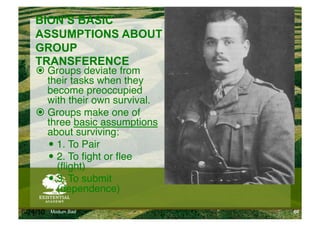
BION’S BASIC
    ASSUMPTIONS ABOUT
    GROUP
    TRANSFERENCE
      Groups deviate from
       their tasks when they
       become preoccupied
       with their own survival."
      Groups make one of
       three basic assumptions
       about surviving:"
         1. To Pair"
         2. To fight or flee
          (flight)"
         3. To submit
          (dependence)

6/24/10   Modum Bad                60
Missing members
portfolioJackie
Feedback
exercise


                  61
FOCAL CONFLICT THEORY (AFTER
    WHITAKER AND EZRIEL)!
    DISTURBING ! !REACTIVE !
    MOTIVE ! ! !MOTIVE!
    (Avoided !      !    !(Calamitous !
    relationship) !      !   !relationship)!
    Desire, wish, or     "   "Fear, guilt, or "
    impulse "   "   "    "shame"

          !!
               !DISPLACEMENT!
               !(Required relationship)!
               "Symptom, ambivalence, double-bind"


6/24/10    Modum Bad                                 62
KEY IDEAS OF GROUP THERAPY HISTORY ARE

    we are, either individuals who discover the social
      world (Freud), or social beings who have to learn
      to be individual (Jung, Foulkes)
    So either being an individual or losing oneself in a
      group are problematized
    May be a cultural dimension to this


6/24/10   Modum Bad                                        63
KEY IDEAS OF GROUP THERAPY HISTORY ARE

    Resistance to change is a sine qua non of being a person
    Resistance to change is therefore reinforced by social
      factors
    Cf. cognitive dissonance
    resistance may be differently attributed to:
        –  an irrational distrust of the kindliness of groups. or
        –  a realistic appraisal of the negative and anti-individual
           forces in groups, such as shaming, jealousy, and
           hatred of the other.


6/24/10   Modum Bad                                                    64
CONDUCTOR'S ROLE UNDER NORMAL CIRCUMSTANCES: TO THE GROUP ITSELF!


    Selection and composition"
    Dynamic administration"
    Boundary management"
    Be reliable "
          –  Personally"
          –  Time, day, place of group"
    Ensure privacy and lack of distraction"
    Respect values of group"
          –  autonomy, confidentiality"
    Have a palatable flavour"


6/24/10   Modum Bad                                                     65
CONDUCTOR'S ROLE UNDER NORMAL CIRCUMSTANCES!

   Use sub-groups effectively"
          –  Agazarian’s ‘system-centered therapy’ and exploratory rather
             than rigid subgrouping "
   Be a culture bearer"
   Translate (into language and cultural symbols)"
   Locate and alter focus from individual to group, or vice
      versa: the advantage rule"
   Attempt to regulate anxiety via structure/ attend to the
      primary task"
   Attempt to regulate social involvement by switching group/
      individual focus (www.ormont.org)"


6/24/10   Modum Bad                                                         66
LOOKING OUTSIDE GROUP PSYCHOTHERAPY: TRANSFORMATIONAL (VS.
 TRANSACTIONAL) LEADERSHIP
 BASS, B. M. AND STEIDLMEIER, P. (1998). ETHICS, CHARACTER AND AUTHENTIC TRANSFORMATIONAL LEADERSHIP, AT:
 HTTP://CLS.BINGHAMTON.EDU/BASSSTEID.HTML


     Increasing their awareness of task importance and
       value.
     Getting them to focus first on team or
       organizational goals, rather than their own
       interests.
     Activating their higher-order needs.
     Charisma necessary, but not sufficient, for example


6/24/10      Modum Bad                                                                                      67
WHAT IS CHARISMA?


    Evoking strong emotions
    Promoting identification of others with them


6/24/10   Modum Bad                                68
INTELLECTUAL FOUNDATIONS OF ‘AUTHENTIC’ TRANSFORMATIONAL LEADERSHIP

    Individualized Consideration – the degree to which the leader attends to each follower's needs, acts
          as a mentor or coach to the follower and listens to the follower's concerns and needs. The leader gives empathy and
          support, keeps communication open and places challenges before the followers. This also encompasses the need for
          respect and celebrates the individual contribution that each follower can make to the team. The followers have a will and
          aspirations for self development and have intrinsic motivation for their tasks.

    Intellectual Stimulation – the degree to which the leader challenges assumptions, takes risks and solicits
          followers' ideas. Leaders with this style stimulate and encourage creativity in their followers. They nurture and develop
          people who think independently. For such a leader, learning is a value and unexpected situations are seen as opportunities
          to learn. The followers ask questions, think deeply about things and figure out better ways to execute their tasks.

    Inspirational Motivation –have a strong sense of purpose if they are to be motivated to act. Purpose and
          meaning provide the energy that drives a group forward. The visionary aspects of leadership are supported by
          communication skills that make the vision understandable, precise, powerful and engaging. The followers are willing to invest
          more effort in their tasks, they are encouraged and optimistic about the future and believe in the degree to which the leader
          articulates a vision that is appealing and inspiring to followers. Leaders with inspirational motivation challenge followers with
          high standards, communicate optimism about future goals, and provide meaning for the task at hand. Followers need to
          believe in their abilities.

    Idealized Influence – Provides a role model for high ethical behavior, instills pride, gains respect and trust.


6/24/10     Modum Bad                                                                                                                         69
MORAL FOUNDATIONS OF ‘AUTHENTIC’ TRANSFORMATIONAL LEADERSHIP

    The moral character of the leader.
    The ethical values embedded in the leader’s vision,
      articulation, and program (which followers either
      embrace or reject).
    The morality of the processes of social ethical choice and
      action that leaders and followers engage in and
      collectively pursue.
    This is in contrast with pseudo-transformational leadership,
      where, for example, in-group/out-group 'us and them'
      games are used to bond followers to the leader.


6/24/10   Modum Bad                                                70
What are the implications for psychotherapy?
      Work with a companion for 5 minute on this.

      WHAT WILL YOU REMEMBER?


6/24/10   Modum Bad                                  71
SARTRE’S CRITERIA OF RECIPROCITY
    that the Other be a means to the exact degree that
      I am a means myself
    that I recognize the Other as praxis
    that I recognize his movement toward his own
      ends in the very movement by which I project
      myself toward mine
    that I discover myself as an object and instrument
      of his ends by the same act which makes him an
      object and instrument of mine


6/24/10   Modum Bad                                      72
CONDUCTOR'S ROLE IN A CRISIS!
    Consider transference and counter-transference:
     falling into unreality"

    Interpret"


6/24/10   Modum Bad                                   73
LEADERSHIP TOWARDS THE DEFINED TASK
    What it’s not
        –  Not fallenness
            •  Not therefore, idle talk
            •  Curiosity
            •  Ambiguity/ equivocation
    An increase in freedom, in the free fling of the soul: may mean an
      increased awareness of particular being in the world
      —’resoluteness’
    Some relation to ethical reflection, to transcendental or spiritual
      concerns, to well-being, to acceptance
    Something that’s good to do but nice to stop, like listening to Bruckner


6/24/10   Modum Bad                                                            74

Existential group training june 2010

  • 1.
    EXISTENTIAL GROUP TRAINING DigbyTantam Deputy Director, former NSPC Clinical Professor of Psychotherapy, University of Sheffield Jackie Lewis www.existentialacademy.com 1
  • 2.
    10-10.45 Theory 10.45-11.30 Exercise 12-12.45 Skills training 12.45-1 Feedback 14-14.45 Theory 14.45-15.30 Exercise 16-16.45 Skills training 16.45-17 Feedback Existential group training, June 2010
  • 3.
    Why isn’t Emmyhere? Where has NSPC gone? What will happen next term/ year? . Existential group training, June 2010 www.existentialacademy.com 3
  • 4.
    Why isn’t Emmyhere? Where has NSPC gone? What will happen next term/ year? There are 10 skills training sessions, and 16 of us: how do these fit together. The skills training will be to co-conduct a group experience I will conduct the first, Jackie Lewis, the last. Existential group training, June 2010 www.existentialacademy.com 4
  • 5.
    UMWELT: THE WORLD, THE ENVIRONMENT Experienced differently as a result of different perceptions (von Uexkull) or ‘Erschlossenheit or disclosure Experience via knowing ‘Verklärung”’ of Dilthey: present- at-hand or Vorhandenheit Afforded experience (J J Gibson): the ready-to-hand (Zuhandenheit) 5 22/9/2007
  • 6.
    Existential group training,June 2010 www.existentialacademy.com 6
  • 7.
    In section 26of Being and Time Heidegger states: "By reason of this with-like being-in-the-world, the world is always the one that I share with others. The world of Dasein is a with-world [Mitwelt]. Being-in is being-with [Mitsein] others. Their being-in-themselves within-the-world is Dasein-with [Mitdasein]" (Macquarrie and Robinson, New York: Harper and Row, 1962. p. 155, MITSEIN 7 22/9/2007
  • 8.
    BOTH FACT Sulphur bacteria taken from the sea bed Aarhus
  • 9.
    Slime mould Physarumpolycephalum metamorphosing in response to starvation to from plasmodium to sporangiophore in response to starvation
  • 11.
    Hunyuan hanging temple,Mt. Hengshan, Shanxi
  • 13.
    Avatar, 2010, dir.James Cameron Existential group training, June 2010 www.existentialacademy.com 13
  • 14.
    Thrown into Mitsein,finding there ‘Befindlichkeit’ a kind of Stimmung or attunement (more like resonance), a ‘mood’ RESONANCE 14 22/9/2007
  • 15.
    Existential group training,June 2010 Tallinn Dimensions of personal world view in existential individual and group therapy 15
  • 16.
    Derived from thethree dimensions of R. Freed Bales Where is therapeutic group? (Outside) threat vs. security 6/24/10 Modum Bad 16
  • 17.
    Structural dimensions andthe three dimensions of R. Freed Bales Open vs cl leader-cen permissive osed, tered vs. 6/24/10 Modum Bad 17
  • 18.
    EXISTENCE PRECEDES ESSENCE Consciousness Individual (pour soi) or role (pour autrui)? Intersubjectivity Fusion or aloneness Absurdity Meaning taken from others or created anew with others Inescapable social emotions (nausea) Lust, belongingness, shame, disgust, anxiety 18 22/9/2007
  • 19.
    SARTRE: ETRE POUR-SOI Hegel Fürsich www.existentialacademy.com 19
  • 20.
    Focussing on groupstoday So we leave out the ‘intrapersonal’ and focus on the ‘interpersonal’ EN-SOI Hegel: Ansich 20
  • 21.
    THE LOOK “…let usimagine that moved by jealousy, curiosity, or vice I have just glued my ear to the door and looked through the keyhole”, somewhat unrealistically given the difficulties of both putting one’s eye and one’s ear to a door, “….But all of a sudden I hear footsteps in the hall. Someone is looking at me… I shudder as a wave of shame sweeps over me” (B & N pp260-277). Inaugural existential conference Doing to Being, Sydney
  • 22.
    THE LOOK Feeling thelook on one’s back Caught in a moment of private excitement –  Jealousy, curiosity, vice The look is not returned The other is not a person with a particular reaction e.g. a facial expression, but the Other, a totalization The name of the father, the Master, the State, authority, grandfather Schweitzer Inaugural existential conference Doing to Being, Sydney
  • 23.
    ETRE POUR AUTRUI:BEING FOR OTHERS “..I persevere in it [in looking through the key-hole], I shall feel my heart beat fast, at the slightest creaking of the stairs. Far from disappearing with my first alarm, the Other is present everywhere, below me, above me, in the neighbouring rooms, and I continue to feel profoundly my being- for-others” (B & Np.277). Inaugural existential conference Doing to Being, Sydney
  • 24.
  • 25.
    FORMATIVE SOCIAL CONDITIONS Are we at the moment in question orientating ourselves to: –  A small or a large group? –  A consensus or a conflicted group? –  A secure or a threatened group? Where did this experience come from? 6/24/10 Modum Bad 25
  • 26.
    Think about yourfirst group. Your family perhaps What were its formative conditions, and how has it influenced you since? Be prepared to discuss this with the group for a few minutes Existential group training, June 2010 26
  • 27.
    Security Threat Small Freedom to explore, Enmeshment confidence in external relations Large Porous boundaries, Rigid boundaries, fluid culture emphasis on suppression of deviance, and on cultural and other identity 6/24/10 Modum Bad 27
  • 28.
    LARGE GROUPS, SERIALITY Could be quite a small number of people who are merely associated, for example in a waiting room or, to use Sartre’s example, at a bus stop They are a group because they share some identifying feature which might simply be that there are co-located People in this kind of group are identified by some extrinsic characteristic: their job, their ‘role’ or part, a number 6/24/10 Modum Bad 28
  • 29.
    ‘I live alone,entirely alone. I never speak to anyone, never; I receive nothing, I give nothing… When you live alone you no longer know what it is to tell something: the plausible disappears at the same time as the fiends. You let events flow past; suddenly you see people pop up who speak and who go away, you plungeSerial seducers: Simone de into stories without beginning or end: youand lover Jean-Paul Beauvoir make a terrible witness. But in Sartre, whose writing paved compensation, one misses nothing, no for our Godless the way permissive times, lived private improbability or, story too tall to be lives of utter depravity believed in cafes’. Read more Daily Mail, (Sartre, 1964, The Critique of Dialectical Reason, which has the subtitle (in the English translation): the theory of practical groups). October 2008 6/24/10 Modum Bad 29
  • 30.
    LARGE VS. SMALL CITIZENSHIP VS. INTIMACY PRAXIS VS. PRACTICO- INERT SERIALITY VS. RECIPROCITY The eternal struggle: I-THOU VS. I-ITand interbrain Bernard Mandeville, 1705. Consciousness Born in Rotterdam, died of ‘flu in Hackney, London. Society (God vs. animal/ ontological vs. prospers from vice and not virtue i.e from individualism ontic/ selfish vs. altruistic/ and not mergence resistance vs. transference/ Reflexive processing vs. explicit processing/ Ego vs. Id) 6/24/10 Modum Bad 30
  • 31.
    Small –  Reciprocity –  Negativity counteracted by intimacy –  Emotional loneliness –  Shared emotions –  Aggression and conflict resolved, if they are, by Large forgiveness Justice: Sartre’s examples of seriality Negativity contained by power or authority Social loneliness Shared tasks Aggression and conflict resolved by negotiation, avoidance or war 6/24/10 Modum Bad 31
  • 32.
    SARTRE’S CRITERIA OFRECIPROCITY that the Other be a means to the exact degree that I am a means myself that I recognize the Other as praxis that I recognize his movement toward his own ends in the very movement by which I project myself toward mine that I discover myself as an object and instrument of his ends by the same act which makes him an object and instrument of mine 6/24/10 Modum Bad 32
  • 33.
    THE THIRD PARTY/ Linking individual and MEDIATING OTHER group praxis 33
  • 34.
    SARTRE ON SMALLGROUPS The fused group –  When each becomes the third party for the other What creates the small group? –  Cooperative action –  Terror management –  The fear of death or annihilation 6/24/10 Modum Bad 34
  • 35.
    KEY IDEAS OFGROUP THERAPY HISTORY ARE the other is a mirror… one can discover oneself through group participation.. Based on the social relations school of psychology, and the notion of interpersonal learning. Adherents of this position include Cooley and the Chicago school of social relations, Jung, Sullivan, Lewin, encounter groups, and humanistic psychology. 6/24/10 Modum Bad 35
  • 36.
    What is theconnection between the ball and the square? 6/24/10 36
  • 37.
    KEY IDEAS OFGROUP THERAPY HISTORY ARE the other is a mirror… one can discover oneself through group participation.. Based on the social relations school of psychology, and the notion of interpersonal learning. Adherents of this position include Cooley and the Chicago school of social relations, Jung, Sullivan, Lewin, encounter groups, and humanistic psychology. 6/24/10 Modum Bad 37
  • 38.
    LINKS BETWEEN THEINDIVIDUAL AND THE GROUP Identification Tallinn Dimensions of personal world view in existential individual and group therapy 38
  • 39.
    LINKS BETWEEN THEINDIVIDUAL AND THE GROUP Networks (of exchange) 39
  • 40.
    LINKS BETWEEN THEINDIVIDUAL AND THE GROUP Narrative 40
  • 41.
    Jacob Levy Moreno(born Iacob Levy) Born May 18, 1889 Bucharest, Romania Sephardic family: Spain, Istanbul, Bulgaria, Romania, Vienna, New York Died May 14, 1974 (aged 84) Residence New York, USA Fields Theory, education, psychiatry, psychology, psychotherapy, psychoanalysis Institutions University of Vienna Known for Sociometry, Psychodrama, social network theory Tallinn Dimensions of personal world view in existential individual and group therapy 41
  • 42.
    "I attended oneof Freud’s lectures. He had just finished an analysis of a telepathic dream. As the students filed out, he singled me out from the crowd and asked me what I was doing. I responded, 'Well, Dr. Freud, I start where you leave off. You meet people in the artificial setting of your office. I meet them on the street and in their homes, in their natural surroundings. You analyze their dreams. I give them the courage to dream again. You analyze and tear them apart. I let them act out their conflicting roles and help them to put the parts back together again.’ Jacob Moreno, Autobiography Tallinn Dimensions of personal world view in existential individual and group therapy 42
  • 43.
    SOCIOGRAM Tallinn Dimensions of personal world view in existential individual and group therapy 43
  • 44.
    ‘There is aview of life which conceives that where the crowd is, there is also the truth, and that in truth itself there is need of having the crowd on its side. There is another view of life which conceives that wherever there is a crowd there is untruth, so that (to consider for a moment the extreme case), even if every individual, each for himself in private, were to be in possession of the truth, yet in case they were all to get together in a crowd - a crowd to which any decisive significance is attributed, a voting, noisy, audible crowd - untruth would at once be in evidence’ (Kierkegaard, 1846; Dedication). 6/24/10 Modum Bad 44
  • 45.
    ‘We still donot know where the urge for truth comes from; for as yet we have heard only of the obligation imposed by society that it should exist: to be truthful means using the customary metaphors - in moral terms, the obligation to lie according to fixed convention, to lie herd-like in a style obligatory for all.’ On truth and lie in an extra-moral sense. Nietzsche, 1873, Nachlass, trans. W. Kaufman 6/24/10 Modum Bad 45
  • 46.
    INDIVIDUAL PERSPECTIVES Large andconflicted group: –  Tribal loyalty, stereotyping, identification (cf. Sherif and Sherif) Small and secure group –  Identification vs. identity
  • 47.
    THEORIES OF THEINTERACTION OF INDIVIDUALS AND SMALL GROUPS Moreno: -- network S H Foulkes: –  plexus and nexus (relationships outside the group, relationships in the group) –  vertical vs. horizontal dimension (internal vs. external object) –  for conductor, analysing the individual in the group, or analysis the group –  matrix Lewin --- field theory 6/24/10 Modum Bad 47
  • 48.
    Theory of conflictand threat KURT LEWIN Protagonist of field theory Founder of of research center on Group Dynamics at MIT Developer of Bethel Institute from which T groups developed Applied social psychological methods to study of groups 6/24/10 Modum Bad 48
  • 49.
    6/24/10 Modum Bad 49
  • 50.
    LEWIN’S RESEARCH PRIORITIESAT RESEARCH CENTRE ON GROUP DYNAMICS AT MIT   "The conditions which improve the effectiveness of community leaders who are attempting to better intergroup relations”   "The effect of the conditions under which contact between persons from different groups takes place”   "The influences which are most effective in producing in minority-group members and increased sense of belongingness, and improved personal adjustment, and better relations with individuals of other groups" (Marrow, 1969, p.192) 6/24/10 Modum Bad 50
  • 51.
    FIELD THEORY human behaviour should be seen as part of a continuum individual variations from the norm being a function of tensions between perceptions of the self and of the environment the whole psychological field, or "lifespace," within which the person acted had to be viewed the totality of events in this lifespace determined behaviour at any one time. used topological systems (maplike representations) to graphically depict psychological forces 6/24/10 Modum Bad 51
  • 52.
    LEWIN’S CONCEPTUAL FRAMEWORKFOR DIAGNOSIS clients (individuals, groups, and organizations) become "frozen" or stuck in their current, metastable or quasi- equilibrium state. Change requires"unfreezing" or create movement in the client system moving it towards the desired state and then "re-freezing" the system in the new state. The new state may be determined by identification with a person or a group, or by an individual’s response to the driving and restraining forces in the social field. 6/24/10 Modum Bad 52
  • 53.
    UNFREEZING METHODS   Burning platform: Expose or create a crisis.   Challenge: Inspire them to achieve remarkable things.   Command: Just tell them to move!   Evidence: Cold, hard data is difficult to ignore.   Destabilizing: Shaking people of their comfort zone.   Education: Learn them to change.   Management by Objectives (MBO): Tell people what to do, but not how.   Restructuring: Redesign the organization to force behaviour change.   Rites of passage: Hold a wake to help let go of the past.   Setting goals: Give them a formal objective.   Visioning: Done well, visions work to create change.   Whole-system Planning: Everyone planning together. 6/24/10 Modum Bad 53
  • 54.
    AGAZARIAN AND SYSTEMSCENTERED THEORY Influence of general systems theory and Durkins Traceable back to Lewin Bit simplistic but one good idea: Siding with the sub-group 54
  • 55.
    S H (‘MICHAEL’)FOULKES Born Fuchs in Germany Studied with Goldstein, trained as psycho-analyst Captain in charge at Northfield during WW2 Co-founder, Institute of Group Analysis, London Consultant Psychotherapist, Maudsley Hospital 6/24/10 Died conducting a group Modum Bad 55
  • 56.
    KEY CONCEPTS OFFOULKES Plexus and nexus Matrix Location of a problem in the group Resonance of a group theme Condenser phenomenon Dynamic administration of the conductor Interpretation by the group 6/24/10 Modum Bad 56
  • 57.
    A SIMPLIFYING HYPOTHESIS:!   1. anxiety, depression, and dissatisfaction stem from a failure to make or maintain satisfactory social relationships"   2. the failure to make or maintain social relationships is due to:"  a. use of abnormal defences (Freud)"  b. projective identification and splitting (Klein)"  c. parataxic distortion (Sullivan)"   3. distorted social relationships and normal group (e.g. family development) are antithetical" 6/24/10 Modum Bad 57
  • 58.
    “To man theworld is twofold in accordance with his twofold attitude. The attitude of man is twofold in accordance with the twofold nature of the primary words which he speaks. The primary words are not isolated words, but combined words. The one primary word is the combination I- Thou. The other primary word is the combination I-It wherein, without a change in the primary word, one of the words He and She can replace it” (Buber, 2003: 53) 6/24/10 Modum Bad 58
  • 59.
    UNADDRESSED PROBLEMS A group may not be a microcosm of society Society may turn on the deviant Morality and the problem of evil Inherent qualities of the individual, esp. shame The fundamental opposition 6/24/10 of individual and group 59
  • 60.
    BION’S BASIC ASSUMPTIONS ABOUT GROUP TRANSFERENCE   Groups deviate from their tasks when they become preoccupied with their own survival."   Groups make one of three basic assumptions about surviving:"   1. To Pair"   2. To fight or flee (flight)"   3. To submit (dependence) 6/24/10 Modum Bad 60
  • 61.
  • 62.
    FOCAL CONFLICT THEORY(AFTER WHITAKER AND EZRIEL)! DISTURBING ! !REACTIVE ! MOTIVE ! ! !MOTIVE! (Avoided ! ! !(Calamitous ! relationship) ! ! !relationship)! Desire, wish, or " "Fear, guilt, or " impulse " " " "shame" !! !DISPLACEMENT! !(Required relationship)! "Symptom, ambivalence, double-bind" 6/24/10 Modum Bad 62
  • 63.
    KEY IDEAS OFGROUP THERAPY HISTORY ARE we are, either individuals who discover the social world (Freud), or social beings who have to learn to be individual (Jung, Foulkes) So either being an individual or losing oneself in a group are problematized May be a cultural dimension to this 6/24/10 Modum Bad 63
  • 64.
    KEY IDEAS OFGROUP THERAPY HISTORY ARE Resistance to change is a sine qua non of being a person Resistance to change is therefore reinforced by social factors Cf. cognitive dissonance resistance may be differently attributed to: –  an irrational distrust of the kindliness of groups. or –  a realistic appraisal of the negative and anti-individual forces in groups, such as shaming, jealousy, and hatred of the other. 6/24/10 Modum Bad 64
  • 65.
    CONDUCTOR'S ROLE UNDERNORMAL CIRCUMSTANCES: TO THE GROUP ITSELF! Selection and composition" Dynamic administration" Boundary management" Be reliable " –  Personally" –  Time, day, place of group" Ensure privacy and lack of distraction" Respect values of group" –  autonomy, confidentiality" Have a palatable flavour" 6/24/10 Modum Bad 65
  • 66.
    CONDUCTOR'S ROLE UNDERNORMAL CIRCUMSTANCES! Use sub-groups effectively" –  Agazarian’s ‘system-centered therapy’ and exploratory rather than rigid subgrouping " Be a culture bearer" Translate (into language and cultural symbols)" Locate and alter focus from individual to group, or vice versa: the advantage rule" Attempt to regulate anxiety via structure/ attend to the primary task" Attempt to regulate social involvement by switching group/ individual focus (www.ormont.org)" 6/24/10 Modum Bad 66
  • 67.
    LOOKING OUTSIDE GROUPPSYCHOTHERAPY: TRANSFORMATIONAL (VS. TRANSACTIONAL) LEADERSHIP BASS, B. M. AND STEIDLMEIER, P. (1998). ETHICS, CHARACTER AND AUTHENTIC TRANSFORMATIONAL LEADERSHIP, AT: HTTP://CLS.BINGHAMTON.EDU/BASSSTEID.HTML Increasing their awareness of task importance and value. Getting them to focus first on team or organizational goals, rather than their own interests. Activating their higher-order needs. Charisma necessary, but not sufficient, for example 6/24/10 Modum Bad 67
  • 68.
    WHAT IS CHARISMA? Evoking strong emotions Promoting identification of others with them 6/24/10 Modum Bad 68
  • 69.
    INTELLECTUAL FOUNDATIONS OF‘AUTHENTIC’ TRANSFORMATIONAL LEADERSHIP Individualized Consideration – the degree to which the leader attends to each follower's needs, acts as a mentor or coach to the follower and listens to the follower's concerns and needs. The leader gives empathy and support, keeps communication open and places challenges before the followers. This also encompasses the need for respect and celebrates the individual contribution that each follower can make to the team. The followers have a will and aspirations for self development and have intrinsic motivation for their tasks. Intellectual Stimulation – the degree to which the leader challenges assumptions, takes risks and solicits followers' ideas. Leaders with this style stimulate and encourage creativity in their followers. They nurture and develop people who think independently. For such a leader, learning is a value and unexpected situations are seen as opportunities to learn. The followers ask questions, think deeply about things and figure out better ways to execute their tasks. Inspirational Motivation –have a strong sense of purpose if they are to be motivated to act. Purpose and meaning provide the energy that drives a group forward. The visionary aspects of leadership are supported by communication skills that make the vision understandable, precise, powerful and engaging. The followers are willing to invest more effort in their tasks, they are encouraged and optimistic about the future and believe in the degree to which the leader articulates a vision that is appealing and inspiring to followers. Leaders with inspirational motivation challenge followers with high standards, communicate optimism about future goals, and provide meaning for the task at hand. Followers need to believe in their abilities. Idealized Influence – Provides a role model for high ethical behavior, instills pride, gains respect and trust. 6/24/10 Modum Bad 69
  • 70.
    MORAL FOUNDATIONS OF‘AUTHENTIC’ TRANSFORMATIONAL LEADERSHIP The moral character of the leader. The ethical values embedded in the leader’s vision, articulation, and program (which followers either embrace or reject). The morality of the processes of social ethical choice and action that leaders and followers engage in and collectively pursue. This is in contrast with pseudo-transformational leadership, where, for example, in-group/out-group 'us and them' games are used to bond followers to the leader. 6/24/10 Modum Bad 70
  • 71.
    What are theimplications for psychotherapy? Work with a companion for 5 minute on this. WHAT WILL YOU REMEMBER? 6/24/10 Modum Bad 71
  • 72.
    SARTRE’S CRITERIA OFRECIPROCITY that the Other be a means to the exact degree that I am a means myself that I recognize the Other as praxis that I recognize his movement toward his own ends in the very movement by which I project myself toward mine that I discover myself as an object and instrument of his ends by the same act which makes him an object and instrument of mine 6/24/10 Modum Bad 72
  • 73.
    CONDUCTOR'S ROLE INA CRISIS! Consider transference and counter-transference: falling into unreality" Interpret" 6/24/10 Modum Bad 73
  • 74.
    LEADERSHIP TOWARDS THEDEFINED TASK What it’s not –  Not fallenness •  Not therefore, idle talk •  Curiosity •  Ambiguity/ equivocation An increase in freedom, in the free fling of the soul: may mean an increased awareness of particular being in the world —’resoluteness’ Some relation to ethical reflection, to transcendental or spiritual concerns, to well-being, to acceptance Something that’s good to do but nice to stop, like listening to Bruckner 6/24/10 Modum Bad 74