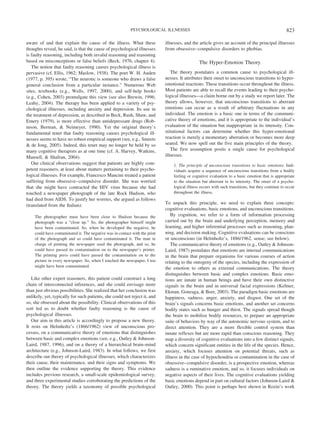
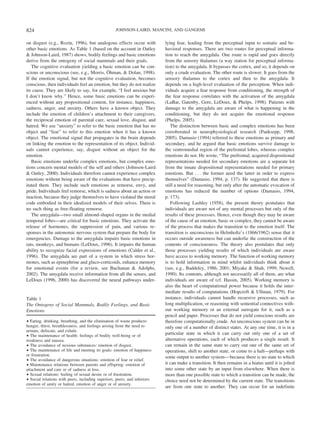
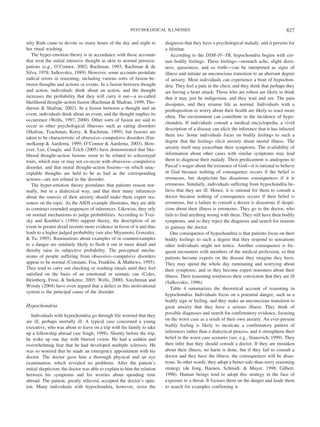
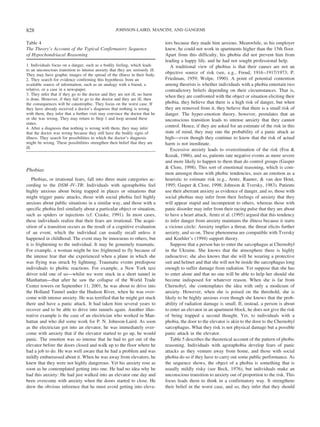
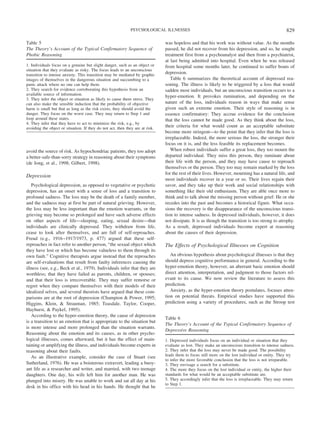
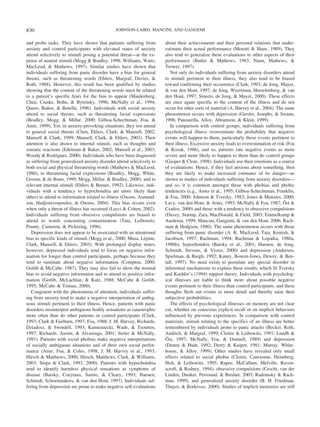
The theory proposes that psychological illnesses originate from unconscious transitions to hyper-emotional reactions in response to cognitive evaluations. Specifically:
1) Individuals experience a sequence of unconscious transitions from a cognitive evaluation to an intense basic emotion that is appropriate but disproportionate to the situation.
2) This hyper-emotional reaction serves as the onset of a psychological illness. The hyper-emotional reactions continue to recur throughout the illness.
3) The hyper-emotional reaction is a basic emotion like anxiety, sadness, or anger. It is felt without conscious awareness of what caused it. This intense basic emotion is what distinguishes the theory from other views that faulty reasoning causes psychological illnesses.
![A Hyper-Emotion Theory of Psychological Illnesses
P. N. Johnson-Laird
Princeton University
Francesco Mancini
Associazione di Psicologia Cognitiva
Amelia Gangemi
Associazione di Psicologia Cognitiva and University of Cagliari
A hyper-emotion theory of psychological illnesses is presented. It postulates that these illnesses have an
onset in which a cognitive evaluation initiates a sequence of unconscious transitions yielding a basic
emotion. This emotion is appropriate for the situation but inappropriate in its intensity. Whenever it
recurs, it leads individuals to a focus on the precipitating situation and to characteristic patterns of
inference that can bolster the illness. Individuals with a propensity to psychological illness accordingly
reason better than more robust individuals, but only on topics relevant to their illness. The theory is
assessed in the light of previous research, a small epidemiological study of patients, and 3 empirical
studies.
Keywords: psychological illnesses, emotions, reasoning, cognitive therapy, unconscious processes
Current knowledge about psychological illnesses is comparable
to the medical understanding of epidemics in the early 19th cen-
tury. Physicians realized then that cholera, for example, was a
specific disease, which killed about a third of the people whom it
infected. What they disagreed about was the cause, the pathology,
and the communication of the disease. Similarly, most medical
professionals these days realize that psychological illnesses occur
(cf. the Diagnostic and Statistical Manual of Mental Disorders,
4th ed., text rev. [DSM–IV–TR]; American Psychiatric Associa-
tion, 2000), but they disagree about their cause and pathology.
Notwithstanding the DSM–IV–TR, we doubt whether any satisfac-
tory a priori definition of psychological illness can exist (cf.
Wakefield, 1992) because it is a matter for theory to elucidate.
However, we owe the reader at least a working definition of our
topic. We take psychological illness to refer to a disorder in an
individual’s thinking, feeling, mood, or ability to relate to others
that has a psychological cause, although neurophysiological fac-
tors may predispose the individual to such an illness. In terms of
the DSM–IV–TR, the main Axis I disorders that our definition is
intended to subsume include certain adjustment disorders; anxiety
disorders, such as phobias, general anxiety disorder, obsessive–
compulsive disorder, and posttraumatic stress disorder (but exclud-
ing substance-induced anxiety); factitious disorders in which indi-
viduals maintain a role of being sick; disorders of mood, such as
reactive depression; and somatoform disorders, such as hypochon-
driasis. The main Axis II disorders that our definition is intended
to subsume include some personality disorders, such as cognitive
disorders (i.e., ways of perceiving oneself) and disorders of affec-
tivity (i.e., in the range, intensity, lability, and appropriateness of
emotional responses). For example, the definition includes cogni-
tive and emotional processes of borderline patients when they
perceive or imagine abandonment in interpersonal relationships,
chronic feelings of emptiness, and inappropriate and intense anger.
Psychological illnesses, we argue, have their origins in individ-
uals’ experiences: experiences that affect their subsequent life and
that may lead them to suffer to the point that they seek professional
help. The human propensity to treat diseases is in no way con-
strained by ignorance of an illness’s cause or pathology. Herink
(1980) listed 250 varieties of psychotherapy from “Active analyt-
ical therapy” to “Zaraleya psychoenergetic technique,” and this
number has grown apace over the past 25 years. Some individuals
appear to get better without any treatment, although psychotherapy
tends to promote a faster recovery (see, e.g., Smith, Glass, &
Miller, 1980).
One influential approach that has an underlying theoretical
rationale is cognitive therapy, or cognitive–behavioral therapy, as
formulated by Beck (1976, e.g.). He doubted the role of uncon-
scious factors in psychological illness and wrote, “Man has the key
to understanding and solving his psychological disturbance within
the scope of his own awareness” (Beck, 1976, p. 3). He also argued
that a closer questioning of patients yields thoughts that they are
P. N. Johnson-Laird, Department of Psychology, Princeton University;
Francesco Mancini, Scuola di Psicoterapia Cognitiva, Associazione di
Psicologia Cognitiva, Rome, Italy; Amelia Gangemi, Scuola di Psicotera-
pia Cognitiva, Associazione di Psicologia Cognitiva, Rome, Italy, and
Department of Psychology, University of Cagliari, Cagliari, Italy.
The research was made possible by National Science Foundation Grant
BCS 0076287 to P. N. Johnson-Laird to study strategies in reasoning and
by a grant to Francesco Mancini and Amelia Gangemi from the Scuola di
Psicoterapia Cognitiva of the Associazione di Psicologia Cognitiva, Rome,
Italy. We are grateful to many colleagues for help and advice: Bruno Bara,
Barbara Barcaccia, Rino Capo, Ronald Comer, Vittorio Girotto, Sam
Glucksberg, Geoffrey Goodwin, Andrea Gragnani, Catrinel Haught, W.
Jake Jacobs, Louis Lee, Ira Noveck, Mike Oaksford, Keith Oatley, Kieron
O’Connor, Claudia Perdighe, Antonella Rainone, Giuseppe Romano, Erika
Sloan, and the many psychiatrists in Rome and Verona who kindly par-
ticipated in our studies.
Correspondence concerning this article should be addressed to P. N.
Johnson-Laird, Department of Psychology, Princeton University, Green
Hall, Princeton, NJ 08544. E-mail: phil@princeton.edu
Psychological Review Copyright 2006 by the American Psychological Association
2006, Vol. 113, No. 4, 822–841 0033-295X/06/$12.00 DOI: 10.1037/0033-295X.113.4.822
822](https://image.slidesharecdn.com/2006hyperemotiontheory-130727034823-phpapp02/85/2006hyperemotiontheory-1-320.jpg)
![A Hyper-Emotion Theory of Psychological Illnesses
P. N. Johnson-Laird
Princeton University
Francesco Mancini
Associazione di Psicologia Cognitiva
Amelia Gangemi
Associazione di Psicologia Cognitiva and University of Cagliari
A hyper-emotion theory of psychological illnesses is presented. It postulates that these illnesses have an
onset in which a cognitive evaluation initiates a sequence of unconscious transitions yielding a basic
emotion. This emotion is appropriate for the situation but inappropriate in its intensity. Whenever it
recurs, it leads individuals to a focus on the precipitating situation and to characteristic patterns of
inference that can bolster the illness. Individuals with a propensity to psychological illness accordingly
reason better than more robust individuals, but only on topics relevant to their illness. The theory is
assessed in the light of previous research, a small epidemiological study of patients, and 3 empirical
studies.
Keywords: psychological illnesses, emotions, reasoning, cognitive therapy, unconscious processes
Current knowledge about psychological illnesses is comparable
to the medical understanding of epidemics in the early 19th cen-
tury. Physicians realized then that cholera, for example, was a
specific disease, which killed about a third of the people whom it
infected. What they disagreed about was the cause, the pathology,
and the communication of the disease. Similarly, most medical
professionals these days realize that psychological illnesses occur
(cf. the Diagnostic and Statistical Manual of Mental Disorders,
4th ed., text rev. [DSM–IV–TR]; American Psychiatric Associa-
tion, 2000), but they disagree about their cause and pathology.
Notwithstanding the DSM–IV–TR, we doubt whether any satisfac-
tory a priori definition of psychological illness can exist (cf.
Wakefield, 1992) because it is a matter for theory to elucidate.
However, we owe the reader at least a working definition of our
topic. We take psychological illness to refer to a disorder in an
individual’s thinking, feeling, mood, or ability to relate to others
that has a psychological cause, although neurophysiological fac-
tors may predispose the individual to such an illness. In terms of
the DSM–IV–TR, the main Axis I disorders that our definition is
intended to subsume include certain adjustment disorders; anxiety
disorders, such as phobias, general anxiety disorder, obsessive–
compulsive disorder, and posttraumatic stress disorder (but exclud-
ing substance-induced anxiety); factitious disorders in which indi-
viduals maintain a role of being sick; disorders of mood, such as
reactive depression; and somatoform disorders, such as hypochon-
driasis. The main Axis II disorders that our definition is intended
to subsume include some personality disorders, such as cognitive
disorders (i.e., ways of perceiving oneself) and disorders of affec-
tivity (i.e., in the range, intensity, lability, and appropriateness of
emotional responses). For example, the definition includes cogni-
tive and emotional processes of borderline patients when they
perceive or imagine abandonment in interpersonal relationships,
chronic feelings of emptiness, and inappropriate and intense anger.
Psychological illnesses, we argue, have their origins in individ-
uals’ experiences: experiences that affect their subsequent life and
that may lead them to suffer to the point that they seek professional
help. The human propensity to treat diseases is in no way con-
strained by ignorance of an illness’s cause or pathology. Herink
(1980) listed 250 varieties of psychotherapy from “Active analyt-
ical therapy” to “Zaraleya psychoenergetic technique,” and this
number has grown apace over the past 25 years. Some individuals
appear to get better without any treatment, although psychotherapy
tends to promote a faster recovery (see, e.g., Smith, Glass, &
Miller, 1980).
One influential approach that has an underlying theoretical
rationale is cognitive therapy, or cognitive–behavioral therapy, as
formulated by Beck (1976, e.g.). He doubted the role of uncon-
scious factors in psychological illness and wrote, “Man has the key
to understanding and solving his psychological disturbance within
the scope of his own awareness” (Beck, 1976, p. 3). He also argued
that a closer questioning of patients yields thoughts that they are
P. N. Johnson-Laird, Department of Psychology, Princeton University;
Francesco Mancini, Scuola di Psicoterapia Cognitiva, Associazione di
Psicologia Cognitiva, Rome, Italy; Amelia Gangemi, Scuola di Psicotera-
pia Cognitiva, Associazione di Psicologia Cognitiva, Rome, Italy, and
Department of Psychology, University of Cagliari, Cagliari, Italy.
The research was made possible by National Science Foundation Grant
BCS 0076287 to P. N. Johnson-Laird to study strategies in reasoning and
by a grant to Francesco Mancini and Amelia Gangemi from the Scuola di
Psicoterapia Cognitiva of the Associazione di Psicologia Cognitiva, Rome,
Italy. We are grateful to many colleagues for help and advice: Bruno Bara,
Barbara Barcaccia, Rino Capo, Ronald Comer, Vittorio Girotto, Sam
Glucksberg, Geoffrey Goodwin, Andrea Gragnani, Catrinel Haught, W.
Jake Jacobs, Louis Lee, Ira Noveck, Mike Oaksford, Keith Oatley, Kieron
O’Connor, Claudia Perdighe, Antonella Rainone, Giuseppe Romano, Erika
Sloan, and the many psychiatrists in Rome and Verona who kindly par-
ticipated in our studies.
Correspondence concerning this article should be addressed to P. N.
Johnson-Laird, Department of Psychology, Princeton University, Green
Hall, Princeton, NJ 08544. E-mail: phil@princeton.edu
Psychological Review Copyright 2006 by the American Psychological Association
2006, Vol. 113, No. 4, 822–841 0033-295X/06/$12.00 DOI: 10.1037/0033-295X.113.4.822
822](https://image.slidesharecdn.com/2006hyperemotiontheory-130727034823-phpapp02/75/2006hyperemotiontheory-1-2048.jpg)
![tic approach to research and treatment. Oxford, England: Oxford Uni-
versity Press.
Harvey, J. M., Richards, J. C., Dziadosz, T., & Swindell, A. (1993).
Misinterpretation of ambiguous stimuli in panic disorder. Cognitive
Therapy and Research, 17, 235–248.
Hassin, R. R. (2005). Nonconscious control and implicit working memory.
In R. R. Hassin, J. S. Uleman, & J. A. Bargh (Eds.), The new uncon-
scious (pp. 196–222). Oxford, England: Oxford University Press.
Helmholtz, H. (1962). Treatise on physiological optics (A. Gullstrand, J. v.
Kries, & W. Nagel, Trans.). New York: Dover. (Original work published
1866)
Herink, R. (Ed.). (1980). The psychotherapy handbook: The A to Z guide
to more than 250 different therapies in use today. New York: New
American Library.
Hertel, P. T., & Hardin, T. S. (1990). Remembering with and without
awareness in a depressed mood: Evidence of deficits in initiative. Jour-
nal of Experimental Psychology, 119, 45–59.
Higgins, E. T., Klein, R., & Strauman, T. (1985). Self-concept discrepancy
theory: A psychological model for distinguishing among different as-
pects of depression and anxiety. Social Cognition, 3, 51–76.
Hirsch, C. R., & Matthews, A. (2000). Impaired positive inferential bias in
social phobia. Journal of Abnormal Psychology, 109, 705–712.
Hirsch, C. R., Matthews, A., Clark, D. M., & Williams, R. M. (2003).
Self-images play a causal role in social phobia. Behaviour Research and
Therapy, 41, 1383–1396.
Hopcroft, J. E., & Ullman, J. D. (1979). Formal languages and their
relation to automata. Reading, MA: Addison-Wesley.
Hull, C. L. (1920). Quantitative aspects of the evolution of concepts.
Psychological Monographs, 28(Whole No. 123).
Isen, A. N., & Gorglione, J. M. (1983). Some specific effects of four
affect-induction procedures. Personality and Social Psychology Bulletin,
9, 136–143.
Jackson, D. C., Malmstadt, J. R., Larson, C. L., & Davidson, R. J. (2000).
Suppression and enhancement of emotional responses to unpleasant
pictures. Psychophysiology, 37, 515–522.
Jang, K. L., McCrae, R. R., Angleitner, A., Riemann, R., & Livesley, W. J.
(1998). Heritability of facet-level traits in a cross-cultural twin sample:
Support for a hierarchical model of personality. Journal of Personality
and Social Psychology, 74, 1556–1565.
Johansen, P. V., Brody, H., Paneth, N., Rachman, S., & Rip, M. (2003).
Cholera, chloroform, and the science of medicine: A life of John Snow.
Oxford, England: Oxford University Press.
Johnson, E. J., & Tversky, A. (1983). Affect, generalization, and the
perception of risk. Journal of Personality and Social Psychology, 45,
21–31.
Johnson-Laird, P. N. (1983). Mental models: Towards a cognitive science
of language, inference, and consciousness. Cambridge, MA: Harvard
University Press.
Johnson-Laird, P. N., & Oatley, K. (2000). The cognitive and social
construction of emotions. In M. Lewis & J. Haviland (Eds.), Handbook
of emotions (2nd ed., pp. 458–475). New York: Guilford Press.
Johnson-Laird, P. N., & Savary, F. (1996). Illusory inferences about
probabilities. Acta Psychologica, 93, 69–90.
Jones, M. K., & Menzies, R. G. (2000). Danger experiences, self-efficacy
and insight in spider phobia. Behaviour Research and Therapy, 38,
585–600.
Kamieniecki, G. W., Wade, T., & Tsourtos, G. (1997). Interpretive bias for
benign sensations in panic disorder with agoraphobia. Journal of Anxiety
Disorder, 11, 141–156.
Kaney, S., Bowen-Jones, K., Dewey, M. E., & Bentall, R. P. (1997). Two
predictions about paranoid ideation: Deluded, depressed and normal
participants’ subjective frequency and consensus judgements for posi-
tive, neutral and negative events. British Journal of Clinical Psychology,
36, 349–364.
Keltner, D., Ekman, P., Gonzaga, G. C., & Beer, J. (2003). Facial expres-
sion of emotion. In R. J. Davidson, K. R. Scherer, & H. H. Goldsmith
(Eds.), Handbook of affective sciences (pp. 415–432). New York: Ox-
ford University Press.
Kessler, R. C., Berglund, P., Demler, O., Jin, R., Merikangas, K. R., &
Walters, E. E. (2005). Lifetime prevalence and age-of-onset distributions
of DSM–IV disorders in the National Comorbidity Survey Replication.
Archives of General Psychiatry, 62, 593–602.
Kindt, M., van den Hout, M., & Buck, N. (2005). Dissociation related to
subjective memory fragmentation and intrusions but not to objective
memory disturbances. Journal of Behavior Therapy and Experimental
Psychiatry, 36, 43–59.
Kleinknecht, R. A., Dinnel, D. L., Kleinknecht, E. E., Hiruma, N., &
Harada, N. (1997). Cultural factors in social anxiety: A comparison of
social phobia symptoms and taijin kyofusho. Journal of Anxiety Disor-
ders, 11, 157–177.
LaBar, K. S., Gatenby, C., Gore, J. C., LeDoux, J. E., & Phelps, E. A.
(1998). Human amygdala activation during conditioned fear acquisition
and extinction: A mixed-trial fMRI study. Neuron, 20, 937–945.
Lashley, K. S. (1958). Cerebral organization and behavior. In H. C.
Solomon, S. Cobb, & W. Penfield (Eds.), The brain and human behavior
(pp. 1–18). Baltimore: Williams & Wilkins.
Lavy, E., van den Hout, M. A., & Arntz, A. (1993). Attentional biases and
phobia: Conceptual and clinical issues. Behaviour Research and Ther-
apy, 31, 17–24.
Lazarus, R. S., & Alfert, E. (1964). Short-circuiting of threat by experi-
mentally altering cognitive appraisal. Journal of Abnormal Psychology,
69, 195–205.
Leahy, R. L. (Ed.). (2004). Contemporary cognitive therapy: Theory,
research, and practice. London: Guilford Press.
Lecci, L., & Cohen, D. J. (2002). Perceptual consequences of illness
concern induction and its relation to hypochondriacal tendencies. Health
Psychology, 21, 147–156.
LeDoux, J. (1996). The emotional brain: The mysterious underpinnings of
emotional life. New York: Simon & Schuster.
LeDoux, J. (2000). Emotion circuits in the brain. Annual Review of Neu-
roscience, 23, 155–184.
Lee, H. J., Cougle, J. R., & Telch, M. J. (2005). Thought–action fusion and
its relationship to schizotypy and OCD symptoms. Behaviour Research
and Therapy, 43, 29–41.
Leon, G. R. (1990). Case histories of psychopathology (4th ed.). Boston:
Allyn & Bacon.
Livesley, W. J., Jang, K. L., & Vernon, P. A. (1993). Genetic and envi-
ronmental contributions to dimensions of personality disorder. American
Journal of Psychiatry, 150, 12–20.
Lundh, L. G., & O¨ st, L.-G. (1997). Explicit and implicit memory bias in
social phobia: The role of subdiagnostic type. Behaviour Research and
Therapy, 35, 1003–1017.
MacLeod, A. K., Tata, P., Kentish, J., & Jacobsen, H. (1997). Retrospec-
tive and prospective cognitions in anxiety and depression. Cognition &
Emotion, 11, 467–479.
MacLeod, C., & McLaughlin, K. (1995). Implicit and explicit memory bias
in anxiety: A conceptual replication. Behaviour Research and Therapy,
33, 1–14.
Maeda, F., & Nathan, J. H. (1999). Understanding taijin kyofusho through
its treatment: Morita therapy. Journal of Psychosomatic Research, 46,
525–530.
Maidenberg, E., Chen, E., Craske, M., Bohn, P., & Bytritsky, A. (1996).
Specificity of attentional bias in panic disorder and social phobia.
Journal of Anxiety Disorders, 10, 529–541.
Mancini, F. (2005). Il disturbo ossessivo compulsivo [The obsessive–
compulsive disturbance]. In B. Bara (Ed.), Nuovo manuale di psicotera-
pia cognitiva (Vol. 2, pp. 98–141). Turin, Italy: Bollati Boringhieri.
Mancini, F., & Gangemi, A. (2002). Il paradosso nevrotico, ovvero della
resistenza al cambiamento [The paradox of neurosis: Resistance to
change]. In C. Castelfranchi, F. Mancini, & M. Miceli (Eds.), Fonda-
839PSYCHOLOGICAL ILLNESSES](https://image.slidesharecdn.com/2006hyperemotiontheory-130727034823-phpapp02/85/2006hyperemotiontheory-18-320.jpg)
![menti di cognitivismo clinico (pp. 156–199). Turin, Italy: Bollati Bor-
inghieri.
Mancini, F., & Gangemi, A. (2004). Fear of guilt of behaving irresponsibly
in obsessive–compulsive disorder. Journal of Behavior Therapy and
Experimental Psychiatry, 35, 109–120.
Mancini, F., Gangemi, A., & van den Hout, M. (2006). Feeling guilty as a
source of information about threat and performance. Manuscript sub-
mitted for publication.
Mansell, W., & Clark, D. M. (1999). How do I appear to others? Social
anxiety and processing of the observable self. Behaviour Research and
Therapy, 37, 419–434.
Mansell, W., Clark, D. M., & Ehlers, A. (2003). Internal versus external
attention in social anxiety: An investigation using a novel paradigm.
Behaviour Research and Therapy, 41, 555–572.
Maslow, A. H. (1938). Cases in personality and abnormal psychology.
New York: Brooklyn College Press.
Mathews, A., & MacLeod, C. (1986). Discrimination of threat cues in
anxiety states. Journal of Abnormal Psychology, 95, 131–138.
Mathews, A., Richards, A., & Eysenck, M. (1989). Interpretation of ho-
mophones related to threat in anxiety states. Journal of Abnormal
Psychology, 98, 31–34.
McCabe, S. B., & Gotlib, I. H. (1995). Selective attention and clinical
depression: Performance on a deployment-of-attention task. Journal of
Abnormal Psychology, 104, 241–245.
McCabe, S. B., & Toman, P. E. (2000). Stimulus exposure duration in a
deployment-of-attention task. Effects on dysphoric, recently dysphoric,
and nondysphoric. Cognition & Emotion, 14, 125–142.
McNally, R. J., Amir, N., Louro, C. E., Lukach, B. M., Riemann, B. C., &
Calamari, J. E. (1994). Cognitive processing of idiographic information
in panic disorder. Behaviour Research and Therapy, 32, 119–122.
McNally, R. J., & Foa, E. B. (1987). Cognition and agoraphobia: Bias in
the interpretation of threat. Cognitive Therapy and Research, 3, 567–
581.
McNally, R. J., Foa, E. B., & Donnell, C. D. (1989). Memory bias for
anxiety information in patients with panic disorder. Cognition & Emo-
tion, 3, 27–44.
Miyake, A., & Shah, P. (1999). Models of working memory: Mechanisms
of active maintenance and executive control. New York: Cambridge
University Press.
Miyamoto, J. M., Gonzalez, R., & Tu, S. (1995). Compositional anomalies
in the semantics of evidence. In J. Busemeyer, R. Hastie, & D. Medin
(Eds.), Decision making from a cognitive perspective (pp. 319–383).
New York: Academic Press.
Mogg, K., & Bradley, B. P. (1998). A cognitive-motivational analysis of
anxiety. Behaviour Research and Therapy, 36, 809–848.
Mogg, K., Millar, N., & Bradley, B. P. (2000). Biases in eye movements
to threatening facial expression in generalized anxiety disorder and
depressive disorder. Journal of Abnormal Psychology, 109, 695–704.
Moretti, M. M., & Shaw, B. F. (1989). Automatic and dysfunctional
cognitive processes in depression. In J. S. Uleman & J. A. Bargh (Eds.),
Unintended thought (pp. 383–421). New York: Guilford Press.
Morris, J. S., O¨ hman, A., & Dolan, R. J. (1998, June 4). Conscious and
unconscious emotional learning in the human amygdala. Nature, 393,
467–470.
Murray, L. A., Whitehouse, W. G., & Alloy, L. B. (1999). Mood congru-
ence and depressive deficits in memory: A forced-recall analysis. Mem-
ory, 7, 175–196.
Musa, C., Le`pine, J. P., Clark, D. M., Mansell, W., & Ehlers, A. (2003).
Selective attention in social phobia and moderating effect of a concur-
rent depressive disorder. Behaviour Research and Therapy, 41, 1043–
1054.
Nakamura, K., Kitanishi, K., Miyake, Y., Hashimoto, K., & Kubota, M.
(2002). The neurotic versus delusional subtype of taijin-kyofu-sho: Their
DSM diagnoses. Psychiatry and Clinical Neurosciences, 56, 595–601.
Newell, A. (1990). Unified theories of cognition. Cambridge, MA: Harvard
University Press.
Nisbett, R. E. (2003). The geography of thought: How Asians and West-
erners think differently . . . and why. New York: Free Press.
Nunn, J. D., Mathews, A., & Trower, P. (1997). Selective processing of
concern-related information in depression. British Journal of Clinical
Psychology, 36, 489–503.
Oatley, K., & Johnson-Laird, P. N. (1987). Towards a cognitive theory of
emotion. Cognition & Emotion, 1, 29–50.
Oatley, K., & Johnson-Laird, P. N. (1996). The communicative theory of
emotions: Empirical tests, mental models, and implications for social
interaction. In L. L. Martin & A. Tesser, (Eds.), Striving and feeling:
Interactions among goals, affect, and self-regulation (pp. 363–393).
Mahwah, NJ: Erlbaum.
O’Connor, K. (2002). Intrusions and inferences in obsessive compulsive
disorder. Clinical Psychology and Psychotherapy, 9, 38–46.
O’Connor, K., & Aardema, F. (2003). Fusion or confusion in obsessive–
compulsive disorder. Psychological Reports, 93, 227–232.
Ortony, A., & Turner, T. J. (1990). What’s basic about basic emotions?
Psychological Review, 97, 315–331.
O¨ st, L.-G., & Csatlos, P. (2000). Probability ratings in claustrophobic
patients and normal controls. Behaviour Research and Therapy, 38,
1107–1116.
Oswald, N. C., Waller, R. E., & Drinkwater, J. (1970). Relationship
between breathlessness and anxiety in asthma and bronchitis: A com-
parative study. British Medical Journal, 2, 14–17.
Owens, K. M. B., Asmundson, G. J. G., Hadjistavropoulos, T., & Owens,
T. J. (2004). Attentional bias toward illness threat in individuals with
elevated health anxiety. Cognitive Therapy and Research, 28, 57–66.
Panksepp, J. (1998). Affective neuroscience: The foundations of human and
animal emotions. Oxford, England: Oxford University Press.
Panksepp, J. (2005). Affective consciousness: Core emotional feelings in
animals and humans. Consciousness and Cognition, 14, 30–80.
Panzarella, C., Alloy, L. B., Abramson, L. Y., & Klein, K. (1999). Cog-
nitive contributions to mental illness and mental health. In F. T. Durso,
R. S. Nickerson, R. W. Schvaneveldt, S. T. Dumais, & M. T. H. Chi
(Eds.), Handbook of applied cognition (pp. 725–755). New York: Wiley.
Pe´lissier, M.-C., & O’Connor, K. P. (2002). Deductive and inductive
reasoning in obsessive–compulsive disorder. British Journal of Clinical
Psychology, 41, 15–27.
Phelps, E. A. (2005). The interaction of emotion and cognition: The
relation between the human amygdala and cognitive awareness. In R. R.
Hassin, J. S. Uleman, & J. A. Bargh (Eds.), The new unconscious (pp.
61–76). Oxford, England: Oxford University Press.
Quero, S., Ban˜os, R., & Botella, C. (1996). Sesgos atencionales y de
memoria en el trastorno de angustia [Attentional and memory biases in
panic disorder]. Ana´lisis y Modificacio´n de Conducta, 22, 409–433.
Rachman, S. (1993). Obsessions, responsibility, and guilt. Behaviour Re-
search and Therapy, 31, 149–154.
Rachman, S. (1994). The overprediction of fear: A review. Behaviour
Research and Therapy, 32, 683–690.
Rachman, S., & de Silva, P. (1978). Abnormal and normal obsessions.
Behaviour Research and Therapy, 16, 233–248.
Rachman, S., & Hodgson, R. (1980). Obsessions and compulsions. Engle-
wood Cliffs, NJ: Prentice-Hall.
Rachman, S., & Lopatka, C. (1986a). Match and mismatch in the predic-
tion of fear: I. Behaviour Research and Therapy, 24, 387–393.
Rachman, S., & Lopatka, C. (1986b). A simple method for determining the
functional independence of two or more fears. Behaviour Research and
Therapy, 24, 661–664.
Rachman, S., & Shafran, R. (1999). Cognitive distortions: Thought–action
fusion. Clinical Psychology and Psychotherapy, 6, 80–85.
Radomsky, A. S., & Rachman, S. (1999). Memory bias in obsessive–
compulsive disorder. Behaviour Research and Therapy, 37, 605–618.
Rapee, R. M., McCallum, S. L., Melville, L. F., Ravenscroft, H., &
840 JOHNSON-LAIRD, MANCINI, AND GANGEMI](https://image.slidesharecdn.com/2006hyperemotiontheory-130727034823-phpapp02/85/2006hyperemotiontheory-19-320.jpg)


![就職活動開始時期を遅らせるべきか[1]](https://cdn.slidesharecdn.com/ss_thumbnails/1-130729211030-phpapp01-thumbnail.jpg?width=640&height=640&fit=bounds)


