
BY
DR ANTHONY MELVIN CRASTO
W O R L D D R U G T R A C K E R
I N D I A
A U G 2 0 1 6
WHAT ARE SUPERGENERICS
This is a vast topic and a short overview is
given
and
in no way complete justice can be done for
this
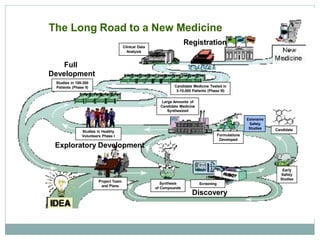
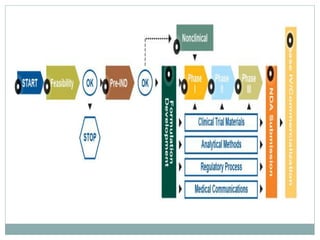
The Long Road to a New Medicine
Discovery
Exploratory Development
Full
Development
Registration
Large Amounts of
Candidate Medicine
Synthesized
Project Team
and Plans
Synthesis
of Compounds
Early
Safety
Studies
Candidate
Formulations
Developed
Extensive
Safety
Studies
Screening
Studies in Healthy
Volunteers Phase I
Candidate Medicine Tested in
3-10,000 Patients (Phase III)
Studies in 100-300
Patients (Phase II)
Clinical Data
Analysis
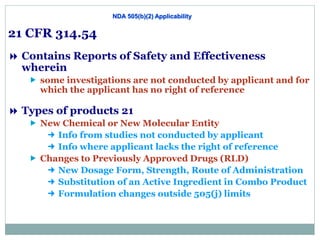
NDA 505(b)(2) Applicability
21 CFR 314.54
 Contains Reports of Safety and Effectiveness
wherein
 some investigations are not conducted by applicant and for
which the applicant has no right of reference
 Types of products 21 CFR 314.54
 New Chemical or New Molecular Entity
 Info from studies not conducted by applicant
 Info where applicant lacks the right of reference
 Changes to Previously Approved Drugs (RLD)
 New Dosage Form, Strength, Route of Administration
 Substitution of an Active Ingredient in Combo Product
 Formulation changes outside 505(j) limits
7
Competitive
Advantage
Innovation is the key…
8
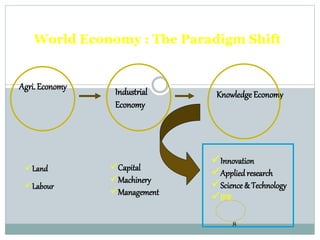
World Economy : The Paradigm Shift
Agri.Economy
Industrial
Economy
Knowledge Economy
Land
Labour
Capital
Machinery
Management
Innovation
Appliedresearch
Science & Technology
IPR
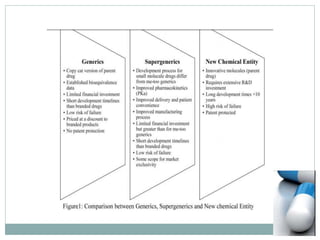
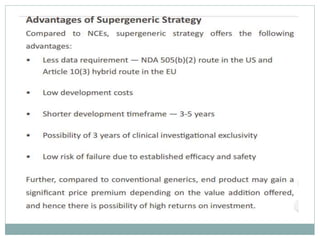
Supergenerics may be able to offer a low-risk, low-cost
alternative to the traditional pharmaceutical
development of new medicines, due to their shorter
development timeline.
New Chemical Entities (NCEs) take a long time to
develop, often at a cost of over $1billion.
Conversely, the development of a supergeneric is more
comparable to that of a generic compound, as it has a
known mechanism of action and an established safety
and efficacy profile.
The supergeneric approval pathway also offers products
a less complex clinical development process. Paper NDA
or 505(b)(2) is the drug development pathway that
companies are required to file under in the US for the
development of novel formulations and new
combinations, such as supergeneric products.
Importantly, this route allows companies to incorporate
pre-existing data, including late-phase clinical data, into
its NDA by reference, which can lead to substantial
savings in comparison to pursuing a NDA 505(b)(1). In
addition, temporary market exclusivity is guaranteed in
the US, as the NDA 505(b)(2) pathway attracts a three-
year period of market exclusivity, providing some
degree of product protection
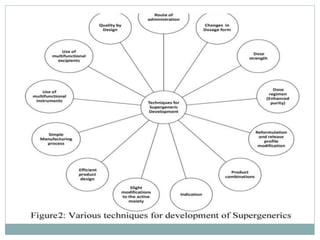
The generic market is more competitive & the pharmaceutical market
players are looking for developing newer versions of generics by adding
value to the product and getting the extension in market exclusivity for
the particular brand. As new drug therapies are reaching the market
after a long term of regulatory battle & high investment on research for
which the companies are getting only 20 years of monopoly (patent),
the markets have been in search for innovations in the generic products
which can extend the patents & also offer extension in market
exclusivity. These super generic drugs are not only better in patient
compliance, but also provide better therapeutic effect than the other
already existing generic versions. The market leaders follow the quality
by design approach, multifunctional excipient, modifying dosage form
& reforming the release pattern to develop the value added therapies
which create a new segment and uplift the growth in generic market
and even assure better quality & economic viability. This article
highlights the global generic segment, market growth and opportunities
for innovation in the generic market to develop super generic versions,
development & commercialization strategies of super generics with due
examples of marketed products of super generics.
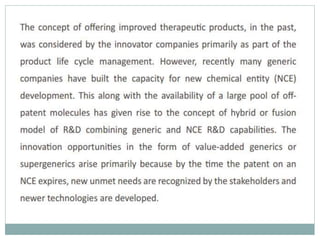
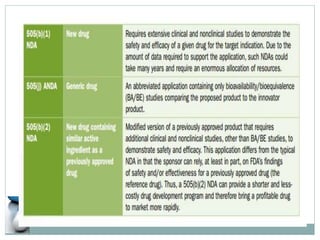
New chemical entity (NCE) / branded drugs
New chemical entities are the innovative
drug molecules of the innovators for which
they have to submit the new drug application
(NDA) with both non clinical and clinical
data and get the exclusivity / patent for 20
years.
Generic drugs These are off patent version of
branded drugs that are identical &
bioequivalent to the innovated drugs in
terms of the dosage form, strength, route of
administration and therapeutic effects.
For the approval of marketing of generic
versions of brands the companies have to file
the abbreviated new drug application
(ANDA) and just have to submit data related
to the bioequivalent studies.
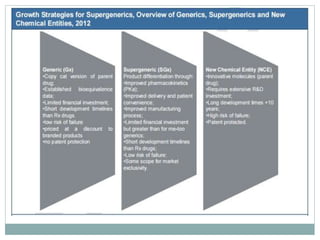
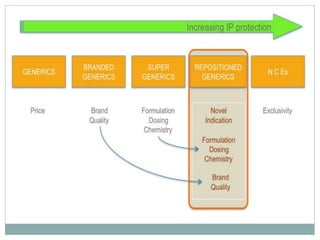
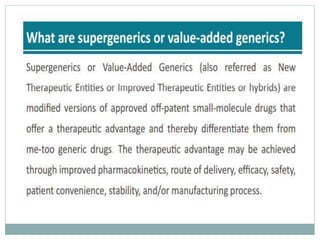
Super generics / improved therapeutic
entity
Super Generics are recent generic product
categories that are differentiated by
improved pharmacokinetics, delivery,
patient convenience /or an improved
manufacturing process and with better
therapeutic effects from me to generic
products.
For approval of marketing of Super
generics companies have to file the new
drug application (NDA).
17
Hatch-Waxman Basics
 Drug Price Competition and Patent Term Restoration Act of 1984
(“Hatch-Waxman”):
 Patent term restoration (partial) to compensate innovators for pre-
market approval regulatory delay
 Process to approve duplicates of approved drugs that rely on
safety and efficacy studies by innovator
 Complex scheme of patent information and patent certifications
 Regulatory exclusivities for new chemical entities, new clinical
investigations and first ANDA patent challenger
18
Drug Application Types
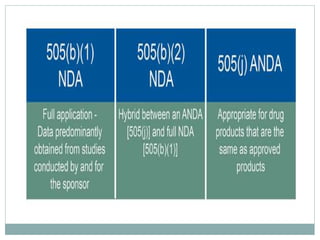
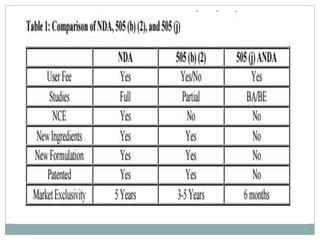
 A New Drug Application (NDA) contains full reports of safety
and efficacy studies conducted by or for applicant or as to which
it has right of reference
 An Abbreviated New Drug Application (ANDA) is for a generic
duplicate of an approved NDA product:
 Borrows safety and efficacy studies from NDA
 Must have identical active ingredient, route of administration,
dosage form, strength, labeling and intended use
 Must demonstrate bioequivalence
19
Drug Application Types
 A “505(b)(2)” application is an NDA for a modification to an
approved drug (e.g., different active ingredient, dosage form,
strength, etc.)
 relies upon one or more studies not conducted by or for
applicant and for which applicant has no right of reference
(e.g., published studies or FDA finding of safety/efficacy of
approved drug)
 application must contain sufficient data to support the
safety/efficacy of the modification
 A Biologics License Application (“BLA”) is an application to
market a biological product (NB. some biologics are approved
by NDA route)
20
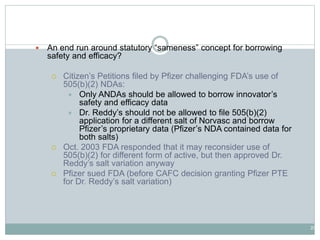
505(b)(2) NDAs
 An end run around statutory “sameness” concept for borrowing
safety and efficacy?
 Citizen’s Petitions filed by Pfizer challenging FDA’s use of
505(b)(2) NDAs:
 Only ANDAs should be allowed to borrow innovator’s
safety and efficacy data
 Dr. Reddy’s should not be allowed to file 505(b)(2)
application for a different salt of Norvasc and borrow
Pfizer’s proprietary data (Pfizer’s NDA contained data for
both salts)
 Oct. 2003 FDA responded that it may reconsider use of
505(b)(2) for different form of active, but then approved Dr.
Reddy’s salt variation anyway
 Pfizer sued FDA (before CAFC decision granting Pfizer PTE
for Dr. Reddy’s salt variation)
21
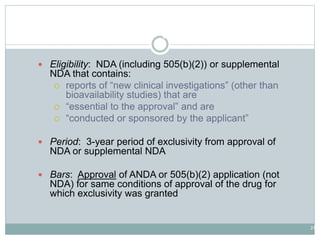
New Clinical Investigations Exclusivity
 Eligibility: NDA (including 505(b)(2)) or supplemental
NDA that contains:
 reports of “new clinical investigations” (other than
bioavailability studies) that are
 “essential to the approval” and are
 “conducted or sponsored by the applicant”
 Period: 3-year period of exclusivity from approval of
NDA or supplemental NDA
 Bars: Approval of ANDA or 505(b)(2) application (not
NDA) for same conditions of approval of the drug for
which exclusivity was granted
Recap
The potential of supergenerics development is to create a
simplest or advanced drug delivery system rather than to
create a complex drug molecule.
The various challenges that company may face while
developing the supergenerics, but supergenerics are
capable to create a global market.
The implementation of QbD paradigm is useful for
developing the supergenerics.
Supergenerics is comes as opportunity on door for Indian
generic companies. Supergenerics also have a market in
personalized medicines.
The supergeneric is an economic strategy for counteracting
the saturation of pharma industry.
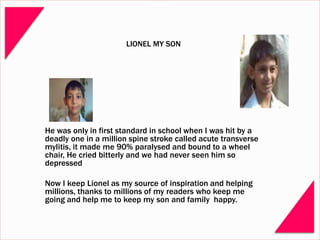
LIONEL MY SON
He was only in first standard in school when I was hit by a
deadly one in a million spine stroke called acute transverse
mylitis, it made me 90% paralysed and bound to a wheel
chair, He cried bitterly and we had never seen him so
depressed
Now I keep Lionel as my source of inspiration and helping
millions, thanks to millions of my readers who keep me
going and help me to keep my son and family happy.
https://newdrugapprovals.org/
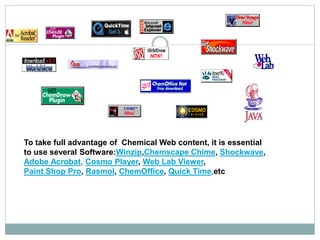
To take full advantage of Chemical Web content, it is essential
to use several Software:Winzip,Chemscape Chime, Shockwave,
Adobe Acrobat, Cosmo Player, Web Lab Viewer,
Paint Shop Pro, Rasmol, ChemOffice, Quick Time,etc
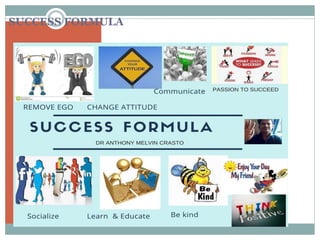
SUCCESS FORMULA

What are Supergenerics

  • 1.
    BY DR ANTHONY MELVINCRASTO W O R L D D R U G T R A C K E R I N D I A A U G 2 0 1 6 WHAT ARE SUPERGENERICS
  • 2.
    This is avast topic and a short overview is given and in no way complete justice can be done for this
  • 3.
    The Long Roadto a New Medicine Discovery Exploratory Development Full Development Registration Large Amounts of Candidate Medicine Synthesized Project Team and Plans Synthesis of Compounds Early Safety Studies Candidate Formulations Developed Extensive Safety Studies Screening Studies in Healthy Volunteers Phase I Candidate Medicine Tested in 3-10,000 Patients (Phase III) Studies in 100-300 Patients (Phase II) Clinical Data Analysis
  • 5.
    NDA 505(b)(2) Applicability 21CFR 314.54  Contains Reports of Safety and Effectiveness wherein  some investigations are not conducted by applicant and for which the applicant has no right of reference  Types of products 21 CFR 314.54  New Chemical or New Molecular Entity  Info from studies not conducted by applicant  Info where applicant lacks the right of reference  Changes to Previously Approved Drugs (RLD)  New Dosage Form, Strength, Route of Administration  Substitution of an Active Ingredient in Combo Product  Formulation changes outside 505(j) limits
  • 7.
  • 8.
    8 World Economy :The Paradigm Shift Agri.Economy Industrial Economy Knowledge Economy Land Labour Capital Machinery Management Innovation Appliedresearch Science & Technology IPR
  • 10.
    Supergenerics may beable to offer a low-risk, low-cost alternative to the traditional pharmaceutical development of new medicines, due to their shorter development timeline. New Chemical Entities (NCEs) take a long time to develop, often at a cost of over $1billion. Conversely, the development of a supergeneric is more comparable to that of a generic compound, as it has a known mechanism of action and an established safety and efficacy profile.
  • 11.
    The supergeneric approvalpathway also offers products a less complex clinical development process. Paper NDA or 505(b)(2) is the drug development pathway that companies are required to file under in the US for the development of novel formulations and new combinations, such as supergeneric products. Importantly, this route allows companies to incorporate pre-existing data, including late-phase clinical data, into its NDA by reference, which can lead to substantial savings in comparison to pursuing a NDA 505(b)(1). In addition, temporary market exclusivity is guaranteed in the US, as the NDA 505(b)(2) pathway attracts a three- year period of market exclusivity, providing some degree of product protection
  • 13.
    The generic marketis more competitive & the pharmaceutical market players are looking for developing newer versions of generics by adding value to the product and getting the extension in market exclusivity for the particular brand. As new drug therapies are reaching the market after a long term of regulatory battle & high investment on research for which the companies are getting only 20 years of monopoly (patent), the markets have been in search for innovations in the generic products which can extend the patents & also offer extension in market exclusivity. These super generic drugs are not only better in patient compliance, but also provide better therapeutic effect than the other already existing generic versions. The market leaders follow the quality by design approach, multifunctional excipient, modifying dosage form & reforming the release pattern to develop the value added therapies which create a new segment and uplift the growth in generic market and even assure better quality & economic viability. This article highlights the global generic segment, market growth and opportunities for innovation in the generic market to develop super generic versions, development & commercialization strategies of super generics with due examples of marketed products of super generics.
  • 14.
    New chemical entity(NCE) / branded drugs New chemical entities are the innovative drug molecules of the innovators for which they have to submit the new drug application (NDA) with both non clinical and clinical data and get the exclusivity / patent for 20 years.
  • 15.
    Generic drugs Theseare off patent version of branded drugs that are identical & bioequivalent to the innovated drugs in terms of the dosage form, strength, route of administration and therapeutic effects. For the approval of marketing of generic versions of brands the companies have to file the abbreviated new drug application (ANDA) and just have to submit data related to the bioequivalent studies.
  • 16.
    Super generics /improved therapeutic entity Super Generics are recent generic product categories that are differentiated by improved pharmacokinetics, delivery, patient convenience /or an improved manufacturing process and with better therapeutic effects from me to generic products. For approval of marketing of Super generics companies have to file the new drug application (NDA).
  • 17.
    17 Hatch-Waxman Basics  DrugPrice Competition and Patent Term Restoration Act of 1984 (“Hatch-Waxman”):  Patent term restoration (partial) to compensate innovators for pre- market approval regulatory delay  Process to approve duplicates of approved drugs that rely on safety and efficacy studies by innovator  Complex scheme of patent information and patent certifications  Regulatory exclusivities for new chemical entities, new clinical investigations and first ANDA patent challenger
  • 18.
    18 Drug Application Types A New Drug Application (NDA) contains full reports of safety and efficacy studies conducted by or for applicant or as to which it has right of reference  An Abbreviated New Drug Application (ANDA) is for a generic duplicate of an approved NDA product:  Borrows safety and efficacy studies from NDA  Must have identical active ingredient, route of administration, dosage form, strength, labeling and intended use  Must demonstrate bioequivalence
  • 19.
    19 Drug Application Types A “505(b)(2)” application is an NDA for a modification to an approved drug (e.g., different active ingredient, dosage form, strength, etc.)  relies upon one or more studies not conducted by or for applicant and for which applicant has no right of reference (e.g., published studies or FDA finding of safety/efficacy of approved drug)  application must contain sufficient data to support the safety/efficacy of the modification  A Biologics License Application (“BLA”) is an application to market a biological product (NB. some biologics are approved by NDA route)
  • 20.
    20 505(b)(2) NDAs  Anend run around statutory “sameness” concept for borrowing safety and efficacy?  Citizen’s Petitions filed by Pfizer challenging FDA’s use of 505(b)(2) NDAs:  Only ANDAs should be allowed to borrow innovator’s safety and efficacy data  Dr. Reddy’s should not be allowed to file 505(b)(2) application for a different salt of Norvasc and borrow Pfizer’s proprietary data (Pfizer’s NDA contained data for both salts)  Oct. 2003 FDA responded that it may reconsider use of 505(b)(2) for different form of active, but then approved Dr. Reddy’s salt variation anyway  Pfizer sued FDA (before CAFC decision granting Pfizer PTE for Dr. Reddy’s salt variation)
  • 21.
    21 New Clinical InvestigationsExclusivity  Eligibility: NDA (including 505(b)(2)) or supplemental NDA that contains:  reports of “new clinical investigations” (other than bioavailability studies) that are  “essential to the approval” and are  “conducted or sponsored by the applicant”  Period: 3-year period of exclusivity from approval of NDA or supplemental NDA  Bars: Approval of ANDA or 505(b)(2) application (not NDA) for same conditions of approval of the drug for which exclusivity was granted
  • 41.
  • 43.
    The potential ofsupergenerics development is to create a simplest or advanced drug delivery system rather than to create a complex drug molecule. The various challenges that company may face while developing the supergenerics, but supergenerics are capable to create a global market. The implementation of QbD paradigm is useful for developing the supergenerics. Supergenerics is comes as opportunity on door for Indian generic companies. Supergenerics also have a market in personalized medicines. The supergeneric is an economic strategy for counteracting the saturation of pharma industry.
  • 44.
    LIONEL MY SON Hewas only in first standard in school when I was hit by a deadly one in a million spine stroke called acute transverse mylitis, it made me 90% paralysed and bound to a wheel chair, He cried bitterly and we had never seen him so depressed Now I keep Lionel as my source of inspiration and helping millions, thanks to millions of my readers who keep me going and help me to keep my son and family happy.
  • 45.
  • 46.
    To take fulladvantage of Chemical Web content, it is essential to use several Software:Winzip,Chemscape Chime, Shockwave, Adobe Acrobat, Cosmo Player, Web Lab Viewer, Paint Shop Pro, Rasmol, ChemOffice, Quick Time,etc
  • 48.