1
International Regulatory Affairs
(Hatch Waxman Act )
Dr.K.Kannan
Professor of Pharmacy
Annamalai University
Annamalainagar – 608 002
2
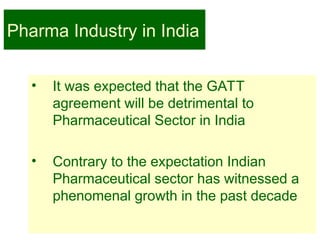
Pharma Industry in India
• It was expected that the GATT
agreement will be detrimental to
Pharmaceutical Sector in India
• Contrary to the expectation Indian
Pharmaceutical sector has witnessed a
phenomenal growth in the past decade
3
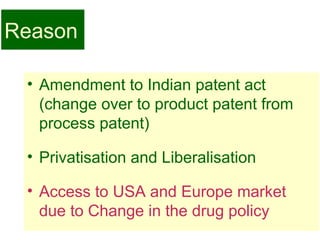
Reason
• Amendment to Indian patent act
(change over to product patent from
process patent)
• Privatisation and Liberalisation
• Access to USA and Europe market
due to Change in the drug policy
4
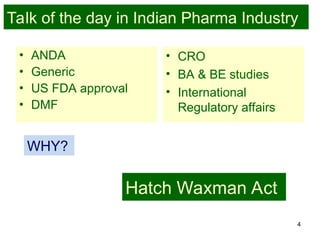
Talk of the day in Indian Pharma Industry
• ANDA
• Generic
• US FDA approval
• DMF
• CRO
• BA & BE studies
• International
Regulatory affairs
WHY?
Hatch Waxman Act
5
H-W act and India
• It has changed the scenario in Indian
Pharmaceutical sector
• Many CRO are coming up
• It has generated huge employment
opportunity for pharmacy graduates &
postgraduates in India
• There is urgent need to include these
aspects in pharmacy curriculum
particularly at PG level
6
Hatch – Waxman Act
also known as
The Drug Price Competition and
Patent Term Restoration Act of
1984
1984
7
Objectives of the act
•To bring down the Drug Price
To bring down the Drug Price
•To encourage research
To encourage research
Though the two objectives are contradictory
they have been achieved diligently
8
To bring down the price
• Market competition by encouraging
Market competition by encouraging
generic drug market
generic drug market
• By encouraging paper NDA filing
By encouraging paper NDA filing
To encourage research
• Patent term restoration
Patent term restoration
9
Patent Term Restoration
• Provides market exclusivity, to the
innovator, beyond patent period to
compensate for the period lost during
drug development process
10
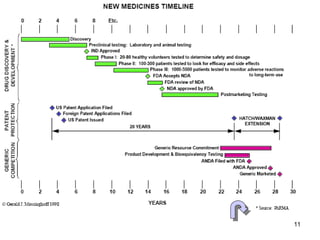
• Patent application is filed during Research &
Development process after identifying potential drug
molecule
• Patent period is only 20 years from the date of filing
application
• To bring the molecule to the market the company has to
spend about 13 years, after filing patent application
• That means the company effectively gets only about 7
years of patent protection.
• Within this period the company has to earn the money it
has spent in developing the drug and also make profit.
• Hence the price is very high
11
12
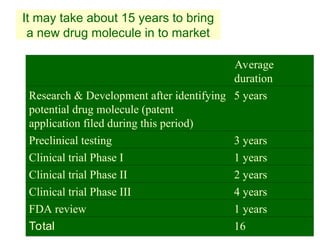
It may take about 15 years to bring
a new drug molecule in to market
Average
duration
Research & Development after identifying
potential drug molecule (patent
application filed during this period)
5 years
Preclinical testing 3 years
Clinical trial Phase I 1 years
Clinical trial Phase II 2 years
Clinical trial Phase III 4 years
FDA review 1 years
Total 16
13
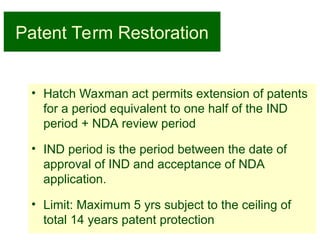
Patent Term Restoration
• Hatch Waxman act permits extension of patents
for a period equivalent to one half of the IND
period + NDA review period
• IND period is the period between the date of
approval of IND and acceptance of NDA
application.
• Limit: Maximum 5 yrs subject to the ceiling of
total 14 years patent protection
14
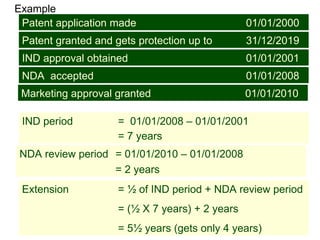
Example
Patent application made 01/01/2000
Patent granted and gets protection up to 31/12/2019
IND approval obtained 01/01/2001
NDA accepted 01/01/2008
Marketing approval granted 01/01/2010
IND period = 01/01/2008 – 01/01/2001
= 7 years
NDA review period = 01/01/2010 – 01/01/2008
= 2 years
Extension = ½ of IND period + NDA review period
= (½ X 7 years) + 2 years
= 5½ years (gets only 4 years)
15
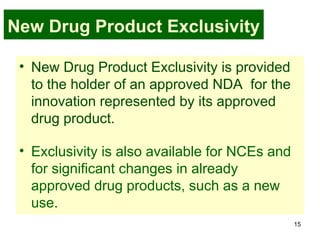
New Drug Product Exclusivity
• New Drug Product Exclusivity is provided
to the holder of an approved NDA for the
innovation represented by its approved
drug product.
• Exclusivity is also available for NCEs and
for significant changes in already
approved drug products, such as a new
use.
16
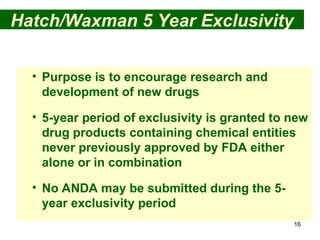
Hatch/Waxman 5 Year Exclusivity
• Purpose is to encourage research and
development of new drugs
• 5-year period of exclusivity is granted to new
drug products containing chemical entities
never previously approved by FDA either
alone or in combination
• No ANDA may be submitted during the 5-
year exclusivity period
17
Hatch/Waxman 3 Year Exclusivity
• A 3-year period of exclusivity is granted for a
change in an approved drug product.
• Approval requires new clinical investigations (other
than bioavailability studies)
• Examples of the changes in an approved drug
product that affect its active ingredient(s) are new
indication, strength, dosage form, route of
administration
• For 3 years FDA may not approve an ANDA
18
Pediatric Exclusivity
•Six months exclusivity as an incentive to
sponsors to conduct more studies of the use
of drug in pediatric populations
•Attaches to the END of all existing marketing
exclusivity and patent periods.
Hatch/Waxman-exclusivity, orphan drug
exclusivity, and patent periods run
concurrently
19
Orphan drug exclusivity
• Orphan drugs are those drugs which are
used for the treatment of rare disease
• Orphan drugs get 7 years patent extension
under H – W act
20
Drug price competition
21
Drug price competition
• USA is market driven economy
• Drug price control act is difficult
• Only way to reduce drug price is to bring in
some competition in the market
• H – W act provides a way for competition
By encouraging generic market
22
Generic
A ‘Generic medicine” means a
prescription/ non- prescription medicine
based on active substance that is out of
patent and which is marketed under
different name from that of the original
branded medicine
23
• Prior to 1962, drugs were approved for safety
only. Efficacy was not insisted
• The Thalidomide problem in infants — involving
safety — resulted in the 1962 drug amendments
to the Federal Food, Drug, and Cosmetic Act,
which added a proof-of-efficacy requirement to
new drug approval.
• Generic version also should have proof of
efficacy & safety. That means generic
manufacturer should also carry out clinical trial
Pre 1984 scenario
24
• Also, for drugs approved prior to 1962, generic versions
could be approved with a “paper” new drug application
(NDA).
• The paper NDA was based solely on published scientific or
medical literature; a generic manufacturer could get its drug
approved by showing that learned articles had been written
about the chemical demonstrating that it was safe.
• After 1962, there were 150 drugs that were off-patent, but
for which there were no generics because generic
companies simply would not spend the time and money
doing the clinical trials to get to market.
• There were only fifteen “paper NDAs,” for post-1962
generics.
Pre 1984 scenario
25
Abbreviated New Drug Application (ANDA)
• Generic approval is obtained by ANDA
• application that contains information to show that the
proposed product is identical in active ingredient, dosage
form, strength, route of administration, labeling, quality,
performance characteristics and intended use, among
other things to a previously approved application (the
reference listed drug (RLD).
• ANDAs do not contain clinical studies as required in
NDAs but are required to contain information
establishing bioequivalence to the RLD.
• In general, the bioequivalence determination allows the
ANDA to rely on the agency’s finding of safety and
efficacy for the RLD.
26
ANDA may be filed with any of four certification
• Para I : when there is no patent for the product
• Para II : Where there was patent but the
term has expired
• Para III : where there is patent but the applicant
certifies that the generic version will come
to market only after expiry of patent term
• Para IV: where there is patent but the applicant
thinks that his product does not infringe
the patent or thinks the patent is invalid
27
Significance
• Para I & Para II are routine filing suitable for
companies wants to play safe
• Enthusiastic companies go for para III which
involve little risk
• More aggressive companies go in for Para IV
28
Para III
• At the time of filing, the product is still under
patent protection but about to come out of patent
• The company wants to get ANDA approved in
advance and keep the product ready for market
on the day the patent term expires
• The risk is that the innovator may get patent
addition or exclusivity in the intervening time
29
• For example, in one case, the brand-name
manufacturer claimed a patent on a method of
use of a metabolite produced by the
administration of the drug
• The patent was for the combination of the
chemical compound in the drug and stomach
acid, when the drug was ingested.
• This patent was listed on the day the existing
patents on the drug were due to expire.
• As a result, the FDA could not approve the
marketing of a generic that the manufacturer had
already loaded on trucks for shipment.
30
Para IV
• The real gambling in generic market is ANDA
with paragraph IV certification
• Para IV filing means the generic company is
challenging the patent claim of innovator
• Here the ANDA is filed with the intension to
market the product while the product is still
under one or more patent protection
• Since the ANDA applicant feels that his product
is not infringing the patent or the patent is invalid
31
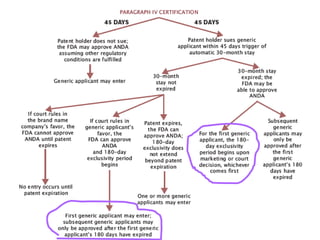
• Once the ANDA with para IV certification is filed
the real legal battle starts.
• Legal battle may result in huge profit or huge
loss to the ANDA applicant
• Once the ANDA with para IV certification is filed
the same has to be notified to the patent holder
by the applicant
• The notice should include a detailed statement
of the factual and legal basis for the ANDA
applicant's opinion that the patent is not valid or
will not be infringed
Para IV
32
• If patent owner desires to files patent infringement suit
against the ANDA applicant it has to do so within 45 days
of the receipt of notice.
• FDA can not give final approval to the ANDA for 30
months unless the court reaches a decision earlier in the
patent infringement case.
• After 30 months the FDA may review the ANDA and give
approval
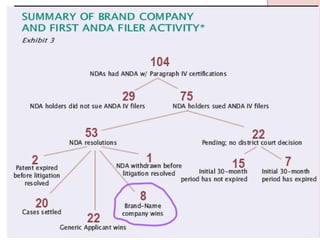
• The first ANDA containing a paragraph IV certification is
eligible for a 180-day period of exclusivity
• This 180 days begins either from the date it starts
commercial marketing, or from the date of a court
decision finding the patent invalid, unenforceable or not
infringed, whichever is first.
Para IV
33
34
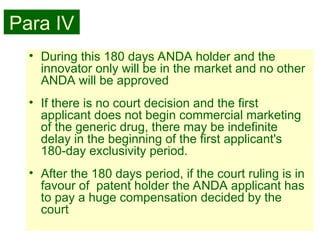
• During this 180 days ANDA holder and the
innovator only will be in the market and no other
ANDA will be approved
• If there is no court decision and the first
applicant does not begin commercial marketing
of the generic drug, there may be indefinite
delay in the beginning of the first applicant's
180-day exclusivity period.
• After the 180 days period, if the court ruling is in
favour of patent holder the ANDA applicant has
to pay a huge compensation decided by the
court
Para IV
35
The Loopholes that the Industry Exploits
Evergreening..
• This is also referred to as warehousing patents.
• When evergreening, The brand-name manufacturer
separately patents multiple attributes of the product.
• It may be for the manufacturing process to tablet color or
even a chemical produced by the body when the drug is
ingested.
• The brand-name manufacturer keeps adding patents to
the Orange Book, essentially forcing the generic
manufacturer to choose between waiting for the patents
(even if bogus) to expire and filing a Paragraph IV
Certification, which risks litigation and the associated
costs and delays.
36
The Loopholes that the Industry Exploits
Sweetheart Deals..
• The generic manufacturer does not have to go to market
when it obtains final FDA approval
• it can determine when it will exercise its 180 days of
exclusivity.
• Until then, the FDA cannot approve another generic.
• With a sweetheart deal, the brand-name manufacturer
and the first generic manufacturer agree that the first
generic will not go to market, suspending the 180-day
clock.
• The brand and generic manufacturer share the financial
rewards
• In one case, the brand-name manufacturer paid the
generic manufacturer $10 million per quarter not to market
37
The Loopholes that the Industry Exploits
• Because a lawsuit based on a Paragraph IV Certification
immediately halts final market approval of the generic, it
is in the brand-name manufacturer's interest to sue,
whether the lawsuit has merits or not.
• Innovator companies are tying up with generic makers to
fight others.
• USFDA has granted Ranbaxy a 180-day exclusivity on
simvastatin.
• On the other hand, Merck the innovator has tied up with
Dr Reddy's as the authorised generic company, to
market its patented drugs in USA.
• Now, Ranbaxy will compete with Dr Reddy's
Laboratories in the US market
38
Derisking
• Dr Reddy's has partnered with ICICI Ventures
for commercialisation of their US ANDAs in the
generic business.
• In a $56 million deal, ICICI Ventures would fund
the development, registration and legal costs
related to the commercialisation of most of the
US ANDAs filed in 2004-05 and 2005-06.
• According to the arrangement, as and when
each of these generics is commercialised, Dr
Reddy's would pay ICICI Venture a royalty on
the net sales for five years.
• Now ICICI has technical experts to evaluate
such proposal ( another job opportunity)
39
Some perils
• Para IV filings are not everyone's cup of tea.
• The companies resorting to a Para IV filing must have the financial
muscle and strong technical team to face the onslaught of
litigation.
• In spite of the interest in this field, Para IV filings are risky, due to
high litigation expenses.
• There is also the uncertainty of legal outcome. However, on
winning a litigation, the costs are covered in the six months, which
makes generic companies enthusiastic of the option.
• "Litigations on a single Para IV filing can cost the company about
$20 million.
• However, a successful Para IV filing gives the generic drug
company exclusive marketing rights for 180 days and it can reap
huge profits during the period.“
• There are many first-to-file on the same day in some cases
40
Why para IV is popular?
• Highly lucrative if properly proceeded
• More than 50% of the case got judgment
in favour of generic
• Many frivolous patents giving loopholes to
challenge
41
Requirement for successful para IV
• Strong technical expertise to understand
the technical intricacies of the patents
• Expertise in IPR to decide how to
challenge the patents
• Strong financial background to meet the
litigation cost
42
43
When to go for ANDA application ?
44
Orange Book
• Orange book is the main source of information for filing
ANDA
• List all the drugs including, brand name, dosage forms,
strength and dose approved.
• Innovator has to give list of patents concerned with the
product along with patent period
• Any addition to the existing patent also to be informed to
FDA so that it can be included in the orange book
• For BE only the brand name listed in Orange book is to
be used for comparison
45
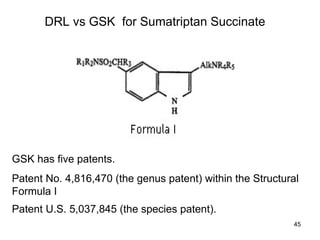
GSK has five patents.
Patent No. 4,816,470 (the genus patent) within the Structural
Formula I
Patent U.S. 5,037,845 (the species patent).
DRL vs GSK for Sumatriptan Succinate
46
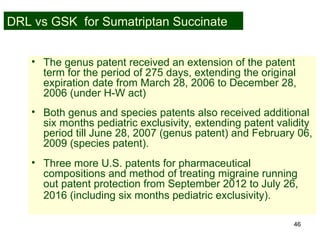
• The genus patent received an extension of the patent
term for the period of 275 days, extending the original
expiration date from March 28, 2006 to December 28,
2006 (under H-W act)
• Both genus and species patents also received additional
six months pediatric exclusivity, extending patent validity
period till June 28, 2007 (genus patent) and February 06,
2009 (species patent).
• Three more U.S. patents for pharmaceutical
compositions and method of treating migraine running
out patent protection from September 2012 to July 26,
2016 (including six months pediatric exclusivity).
DRL vs GSK for Sumatriptan Succinate
47
• U.S. Patent # 5,863,559 for pharmaceutical composition
for film-coated tablet of 3-[2-(dimethylamino)ethyl]-N-
methyl-1H-indole-5-methanesulphonamide succinate
(1:1) salt as active ingredient.
• U.S. Patent # 6,020,001 for pharmaceutical composition
for film-coated tablet of 3-[1-(dimethylamino)ethyl]-N-
methyl-1H-indole-5-methanesulphonamide succinate
(1:1) salt as active ingredient.
• U.S. Patent # 6,368,627 directed to a method of treating
or prophylactically treating a human suffering from
migraine which comprises oral administration of a
pharmaceutical composition comprising a film-coated
solid dosage form of 3-[2-dimethylamino)ethyl]-N-methyl-
1H-indole-5-methanesulfonamide or a pharmaceutically
acceptable salt or solvate therefore as active ingredient.
DRL vs GSK for Sumatriptan Succinate
48
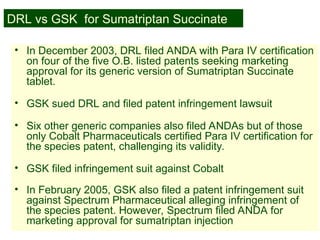
• In December 2003, DRL filed ANDA with Para IV certification
on four of the five O.B. listed patents seeking marketing
approval for its generic version of Sumatriptan Succinate
tablet.
• GSK sued DRL and filed patent infringement lawsuit
• Six other generic companies also filed ANDAs but of those
only Cobalt Pharmaceuticals certified Para IV certification for
the species patent, challenging its validity.
• GSK filed infringement suit against Cobalt
• In February 2005, GSK also filed a patent infringement suit
against Spectrum Pharmaceutical alleging infringement of
the species patent. However, Spectrum filed ANDA for
marketing approval for sumatriptan injection
DRL vs GSK for Sumatriptan Succinate
49
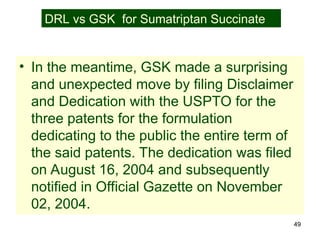
• In the meantime, GSK made a surprising
and unexpected move by filing Disclaimer
and Dedication with the USPTO for the
three patents for the formulation
dedicating to the public the entire term of
the said patents. The dedication was filed
on August 16, 2004 and subsequently
notified in Official Gazette on November
02, 2004.
DRL vs GSK for Sumatriptan Succinate
50
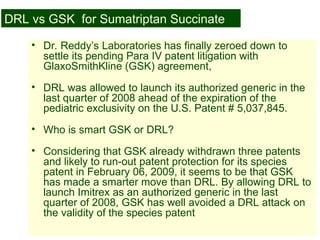
• Dr. Reddy’s Laboratories has finally zeroed down to
settle its pending Para IV patent litigation with
GlaxoSmithKline (GSK) agreement,
• DRL was allowed to launch its authorized generic in the
last quarter of 2008 ahead of the expiration of the
pediatric exclusivity on the U.S. Patent # 5,037,845.
• Who is smart GSK or DRL?
• Considering that GSK already withdrawn three patents
and likely to run-out patent protection for its species
patent in February 06, 2009, it seems to be that GSK
has made a smarter move than DRL. By allowing DRL to
launch Imitrex as an authorized generic in the last
quarter of 2008, GSK has well avoided a DRL attack on
the validity of the species patent
DRL vs GSK for Sumatriptan Succinate
51
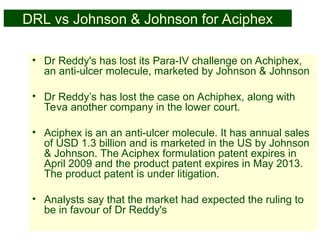
DRL vs Johnson & Johnson for Aciphex
• Dr Reddy's has lost its Para-IV challenge on Achiphex,
an anti-ulcer molecule, marketed by Johnson & Johnson
• Dr Reddy’s has lost the case on Achiphex, along with
Teva another company in the lower court.
• Aciphex is an an anti-ulcer molecule. It has annual sales
of USD 1.3 billion and is marketed in the US by Johnson
& Johnson. The Aciphex formulation patent expires in
April 2009 and the product patent expires in May 2013.
The product patent is under litigation.
• Analysts say that the market had expected the ruling to
be in favour of Dr Reddy's
52
DRL’s unique way
• Pfizer Inc. had patents for amlodipine salts including
maleate and besylate
• Pfizer investigated the maleate salt all the way through
Phase III and then switched to the besylate salt, due to
stability problem with maleate.
• DRL attacked active ingredient patent for amlodipine
besylate in a unique way
• It filed NDA and not ANDA through section 505(b)(2)
[ similar to Paper NDA] using the clinical trial data
submitted by Pfizer to market amlodipin maleate.
• Lower court gave verdict in favour of DRL
• Pfizer went for appeal
53
Did you know that Generic Drugs . . . . . . .
 Are safe and effective alternatives to brand
name prescriptions
 Can help both consumers and the
government reduce the cost of prescription
drugs
 Are currently used in 44% of all
prescriptions dispensed in USA
54
AND . . . . . . .
AND . . . . . . .
 Save an average of $45.50 for every
Prescription sold
 Currently save consumers $ 56.7
billion/year
 Can save consumers an additional $ 1.32
billion/year for every 1% increase in the
use of generic drugs
55
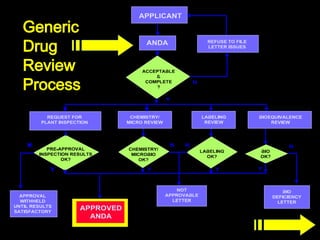
Generic
Generic
Drug
Drug
Review
Review
Process
Process
56
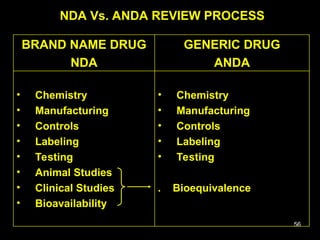
NDA Vs. ANDA REVIEW PROCESS
BRAND NAME DRUG
NDA
GENERIC DRUG
ANDA
• Chemistry
• Manufacturing
• Controls
• Labeling
• Testing
• Animal Studies
• Clinical Studies
• Bioavailability
• Chemistry
• Manufacturing
• Controls
• Labeling
• Testing
. Bioequivalence
57
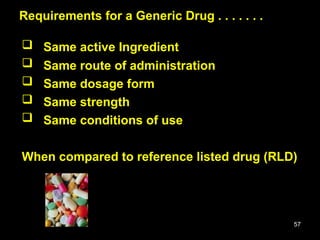
Requirements for a Generic Drug . . . . . . .
 Same active Ingredient
 Same route of administration
 Same dosage form
 Same strength
 Same conditions of use
When compared to reference listed drug (RLD)
58
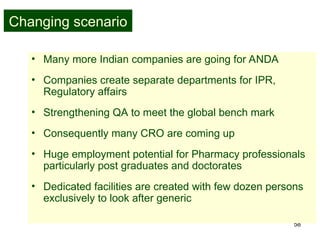
Changing scenario
• Many more Indian companies are going for ANDA
• Companies create separate departments for IPR,
Regulatory affairs
• Strengthening QA to meet the global bench mark
• Consequently many CRO are coming up
• Huge employment potential for Pharmacy professionals
particularly post graduates and doctorates
• Dedicated facilities are created with few dozen persons
exclusively to look after generic
59
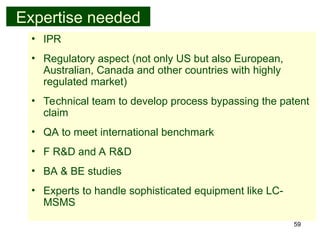
Expertise needed
• IPR
• Regulatory aspect (not only US but also European,
Australian, Canada and other countries with highly
regulated market)
• Technical team to develop process bypassing the patent
claim
• QA to meet international benchmark
• F R&D and A R&D
• BA & BE studies
• Experts to handle sophisticated equipment like LC-
MSMS
60
Academic’s Role
• Revise the syllabi to incorporate the following topics at least at PG
level
– Patent laws
– IND, NDA and ANDA filing based on H-W act in USA
– Marketing authorisation process in European and other countries
– ICH guidelines on safety, efficacy and quality
– Impurity profiling
– Analytical method development and validation including Bioanalytical
methods
– Validation
– Instrumental methods like GC-MS, LC-MSMS, Particle size analyser,
UPLC etc.
– BA & BE studies
– GLP, GCP, GMP
61
Thank You Very Much
Thank You Very Much For Your Patient
For Your Patient
Hearing…………….
Hearing…………….

Hatch Waxman Act for Generic ANDA application

  • 1.
    1 International Regulatory Affairs (HatchWaxman Act ) Dr.K.Kannan Professor of Pharmacy Annamalai University Annamalainagar – 608 002
  • 2.
    2 Pharma Industry inIndia • It was expected that the GATT agreement will be detrimental to Pharmaceutical Sector in India • Contrary to the expectation Indian Pharmaceutical sector has witnessed a phenomenal growth in the past decade
  • 3.
    3 Reason • Amendment toIndian patent act (change over to product patent from process patent) • Privatisation and Liberalisation • Access to USA and Europe market due to Change in the drug policy
  • 4.
    4 Talk of theday in Indian Pharma Industry • ANDA • Generic • US FDA approval • DMF • CRO • BA & BE studies • International Regulatory affairs WHY? Hatch Waxman Act
  • 5.
    5 H-W act andIndia • It has changed the scenario in Indian Pharmaceutical sector • Many CRO are coming up • It has generated huge employment opportunity for pharmacy graduates & postgraduates in India • There is urgent need to include these aspects in pharmacy curriculum particularly at PG level
  • 6.
    6 Hatch – WaxmanAct also known as The Drug Price Competition and The Drug Price Competition and Patent Term Restoration Act of Patent Term Restoration Act of 1984 1984
  • 7.
    7 Objectives of theact •To bring down the Drug Price To bring down the Drug Price •To encourage research To encourage research Though the two objectives are contradictory Though the two objectives are contradictory they have been achieved diligently they have been achieved diligently
  • 8.
    8 To bring downthe price • Market competition by encouraging Market competition by encouraging generic drug market generic drug market • By encouraging paper NDA filing By encouraging paper NDA filing To encourage research • Patent term restoration Patent term restoration
  • 9.
    9 Patent Term Restoration •Provides market exclusivity, to the innovator, beyond patent period to compensate for the period lost during drug development process
  • 10.
    10 • Patent applicationis filed during Research & Development process after identifying potential drug molecule • Patent period is only 20 years from the date of filing application • To bring the molecule to the market the company has to spend about 13 years, after filing patent application • That means the company effectively gets only about 7 years of patent protection. • Within this period the company has to earn the money it has spent in developing the drug and also make profit. • Hence the price is very high
  • 11.
  • 12.
    12 It may takeabout 15 years to bring a new drug molecule in to market Average duration Research & Development after identifying potential drug molecule (patent application filed during this period) 5 years Preclinical testing 3 years Clinical trial Phase I 1 years Clinical trial Phase II 2 years Clinical trial Phase III 4 years FDA review 1 years Total 16
  • 13.
    13 Patent Term Restoration •Hatch Waxman act permits extension of patents for a period equivalent to one half of the IND period + NDA review period • IND period is the period between the date of approval of IND and acceptance of NDA application. • Limit: Maximum 5 yrs subject to the ceiling of total 14 years patent protection
  • 14.
    14 Example Patent application made01/01/2000 Patent granted and gets protection up to 31/12/2019 IND approval obtained 01/01/2001 NDA accepted 01/01/2008 Marketing approval granted 01/01/2010 IND period = 01/01/2008 – 01/01/2001 = 7 years NDA review period = 01/01/2010 – 01/01/2008 = 2 years Extension = ½ of IND period + NDA review period = (½ X 7 years) + 2 years = 5½ years (gets only 4 years)
  • 15.
    15 New Drug ProductExclusivity • New Drug Product Exclusivity is provided to the holder of an approved NDA for the innovation represented by its approved drug product. • Exclusivity is also available for NCEs and for significant changes in already approved drug products, such as a new use.
  • 16.
    16 Hatch/Waxman 5 YearExclusivity • Purpose is to encourage research and development of new drugs • 5-year period of exclusivity is granted to new drug products containing chemical entities never previously approved by FDA either alone or in combination • No ANDA may be submitted during the 5- year exclusivity period
  • 17.
    17 Hatch/Waxman 3 YearExclusivity • A 3-year period of exclusivity is granted for a change in an approved drug product. • Approval requires new clinical investigations (other than bioavailability studies) • Examples of the changes in an approved drug product that affect its active ingredient(s) are new indication, strength, dosage form, route of administration • For 3 years FDA may not approve an ANDA
  • 18.
    18 Pediatric Exclusivity •Six monthsexclusivity as an incentive to sponsors to conduct more studies of the use of drug in pediatric populations •Attaches to the END of all existing marketing exclusivity and patent periods. Hatch/Waxman-exclusivity, orphan drug exclusivity, and patent periods run concurrently
  • 19.
    19 Orphan drug exclusivity •Orphan drugs are those drugs which are used for the treatment of rare disease • Orphan drugs get 7 years patent extension under H – W act
  • 20.
  • 21.
    21 Drug price competition •USA is market driven economy • Drug price control act is difficult • Only way to reduce drug price is to bring in some competition in the market • H – W act provides a way for competition By encouraging generic market
  • 22.
    22 Generic A ‘Generic medicine”means a prescription/ non- prescription medicine based on active substance that is out of patent and which is marketed under different name from that of the original branded medicine
  • 23.
    23 • Prior to1962, drugs were approved for safety only. Efficacy was not insisted • The Thalidomide problem in infants — involving safety — resulted in the 1962 drug amendments to the Federal Food, Drug, and Cosmetic Act, which added a proof-of-efficacy requirement to new drug approval. • Generic version also should have proof of efficacy & safety. That means generic manufacturer should also carry out clinical trial Pre 1984 scenario
  • 24.
    24 • Also, fordrugs approved prior to 1962, generic versions could be approved with a “paper” new drug application (NDA). • The paper NDA was based solely on published scientific or medical literature; a generic manufacturer could get its drug approved by showing that learned articles had been written about the chemical demonstrating that it was safe. • After 1962, there were 150 drugs that were off-patent, but for which there were no generics because generic companies simply would not spend the time and money doing the clinical trials to get to market. • There were only fifteen “paper NDAs,” for post-1962 generics. Pre 1984 scenario
  • 25.
    25 Abbreviated New DrugApplication (ANDA) • Generic approval is obtained by ANDA • application that contains information to show that the proposed product is identical in active ingredient, dosage form, strength, route of administration, labeling, quality, performance characteristics and intended use, among other things to a previously approved application (the reference listed drug (RLD). • ANDAs do not contain clinical studies as required in NDAs but are required to contain information establishing bioequivalence to the RLD. • In general, the bioequivalence determination allows the ANDA to rely on the agency’s finding of safety and efficacy for the RLD.
  • 26.
    26 ANDA may befiled with any of four certification • Para I : when there is no patent for the product • Para II : Where there was patent but the term has expired • Para III : where there is patent but the applicant certifies that the generic version will come to market only after expiry of patent term • Para IV: where there is patent but the applicant thinks that his product does not infringe the patent or thinks the patent is invalid
  • 27.
    27 Significance • Para I& Para II are routine filing suitable for companies wants to play safe • Enthusiastic companies go for para III which involve little risk • More aggressive companies go in for Para IV
  • 28.
    28 Para III • Atthe time of filing, the product is still under patent protection but about to come out of patent • The company wants to get ANDA approved in advance and keep the product ready for market on the day the patent term expires • The risk is that the innovator may get patent addition or exclusivity in the intervening time
  • 29.
    29 • For example,in one case, the brand-name manufacturer claimed a patent on a method of use of a metabolite produced by the administration of the drug • The patent was for the combination of the chemical compound in the drug and stomach acid, when the drug was ingested. • This patent was listed on the day the existing patents on the drug were due to expire. • As a result, the FDA could not approve the marketing of a generic that the manufacturer had already loaded on trucks for shipment.
  • 30.
    30 Para IV • Thereal gambling in generic market is ANDA with paragraph IV certification • Para IV filing means the generic company is challenging the patent claim of innovator • Here the ANDA is filed with the intension to market the product while the product is still under one or more patent protection • Since the ANDA applicant feels that his product is not infringing the patent or the patent is invalid
  • 31.
    31 • Once theANDA with para IV certification is filed the real legal battle starts. • Legal battle may result in huge profit or huge loss to the ANDA applicant • Once the ANDA with para IV certification is filed the same has to be notified to the patent holder by the applicant • The notice should include a detailed statement of the factual and legal basis for the ANDA applicant's opinion that the patent is not valid or will not be infringed Para IV
  • 32.
    32 • If patentowner desires to files patent infringement suit against the ANDA applicant it has to do so within 45 days of the receipt of notice. • FDA can not give final approval to the ANDA for 30 months unless the court reaches a decision earlier in the patent infringement case. • After 30 months the FDA may review the ANDA and give approval • The first ANDA containing a paragraph IV certification is eligible for a 180-day period of exclusivity • This 180 days begins either from the date it starts commercial marketing, or from the date of a court decision finding the patent invalid, unenforceable or not infringed, whichever is first. Para IV
  • 33.
  • 34.
    34 • During this180 days ANDA holder and the innovator only will be in the market and no other ANDA will be approved • If there is no court decision and the first applicant does not begin commercial marketing of the generic drug, there may be indefinite delay in the beginning of the first applicant's 180-day exclusivity period. • After the 180 days period, if the court ruling is in favour of patent holder the ANDA applicant has to pay a huge compensation decided by the court Para IV
  • 35.
    35 The Loopholes thatthe Industry Exploits Evergreening.. • This is also referred to as warehousing patents. • When evergreening, The brand-name manufacturer separately patents multiple attributes of the product. • It may be for the manufacturing process to tablet color or even a chemical produced by the body when the drug is ingested. • The brand-name manufacturer keeps adding patents to the Orange Book, essentially forcing the generic manufacturer to choose between waiting for the patents (even if bogus) to expire and filing a Paragraph IV Certification, which risks litigation and the associated costs and delays.
  • 36.
    36 The Loopholes thatthe Industry Exploits Sweetheart Deals.. • The generic manufacturer does not have to go to market when it obtains final FDA approval • it can determine when it will exercise its 180 days of exclusivity. • Until then, the FDA cannot approve another generic. • With a sweetheart deal, the brand-name manufacturer and the first generic manufacturer agree that the first generic will not go to market, suspending the 180-day clock. • The brand and generic manufacturer share the financial rewards • In one case, the brand-name manufacturer paid the generic manufacturer $10 million per quarter not to market
  • 37.
    37 The Loopholes thatthe Industry Exploits • Because a lawsuit based on a Paragraph IV Certification immediately halts final market approval of the generic, it is in the brand-name manufacturer's interest to sue, whether the lawsuit has merits or not. • Innovator companies are tying up with generic makers to fight others. • USFDA has granted Ranbaxy a 180-day exclusivity on simvastatin. • On the other hand, Merck the innovator has tied up with Dr Reddy's as the authorised generic company, to market its patented drugs in USA. • Now, Ranbaxy will compete with Dr Reddy's Laboratories in the US market
  • 38.
    38 Derisking • Dr Reddy'shas partnered with ICICI Ventures for commercialisation of their US ANDAs in the generic business. • In a $56 million deal, ICICI Ventures would fund the development, registration and legal costs related to the commercialisation of most of the US ANDAs filed in 2004-05 and 2005-06. • According to the arrangement, as and when each of these generics is commercialised, Dr Reddy's would pay ICICI Venture a royalty on the net sales for five years. • Now ICICI has technical experts to evaluate such proposal ( another job opportunity)
  • 39.
    39 Some perils • ParaIV filings are not everyone's cup of tea. • The companies resorting to a Para IV filing must have the financial muscle and strong technical team to face the onslaught of litigation. • In spite of the interest in this field, Para IV filings are risky, due to high litigation expenses. • There is also the uncertainty of legal outcome. However, on winning a litigation, the costs are covered in the six months, which makes generic companies enthusiastic of the option. • "Litigations on a single Para IV filing can cost the company about $20 million. • However, a successful Para IV filing gives the generic drug company exclusive marketing rights for 180 days and it can reap huge profits during the period.“ • There are many first-to-file on the same day in some cases
  • 40.
    40 Why para IVis popular? • Highly lucrative if properly proceeded • More than 50% of the case got judgment in favour of generic • Many frivolous patents giving loopholes to challenge
  • 41.
    41 Requirement for successfulpara IV • Strong technical expertise to understand the technical intricacies of the patents • Expertise in IPR to decide how to challenge the patents • Strong financial background to meet the litigation cost
  • 42.
  • 43.
    43 When to gofor ANDA application ?
  • 44.
    44 Orange Book • Orangebook is the main source of information for filing ANDA • List all the drugs including, brand name, dosage forms, strength and dose approved. • Innovator has to give list of patents concerned with the product along with patent period • Any addition to the existing patent also to be informed to FDA so that it can be included in the orange book • For BE only the brand name listed in Orange book is to be used for comparison
  • 45.
    45 GSK has fivepatents. Patent No. 4,816,470 (the genus patent) within the Structural Formula I Patent U.S. 5,037,845 (the species patent). DRL vs GSK for Sumatriptan Succinate
  • 46.
    46 • The genuspatent received an extension of the patent term for the period of 275 days, extending the original expiration date from March 28, 2006 to December 28, 2006 (under H-W act) • Both genus and species patents also received additional six months pediatric exclusivity, extending patent validity period till June 28, 2007 (genus patent) and February 06, 2009 (species patent). • Three more U.S. patents for pharmaceutical compositions and method of treating migraine running out patent protection from September 2012 to July 26, 2016 (including six months pediatric exclusivity). DRL vs GSK for Sumatriptan Succinate
  • 47.
    47 • U.S. Patent# 5,863,559 for pharmaceutical composition for film-coated tablet of 3-[2-(dimethylamino)ethyl]-N- methyl-1H-indole-5-methanesulphonamide succinate (1:1) salt as active ingredient. • U.S. Patent # 6,020,001 for pharmaceutical composition for film-coated tablet of 3-[1-(dimethylamino)ethyl]-N- methyl-1H-indole-5-methanesulphonamide succinate (1:1) salt as active ingredient. • U.S. Patent # 6,368,627 directed to a method of treating or prophylactically treating a human suffering from migraine which comprises oral administration of a pharmaceutical composition comprising a film-coated solid dosage form of 3-[2-dimethylamino)ethyl]-N-methyl- 1H-indole-5-methanesulfonamide or a pharmaceutically acceptable salt or solvate therefore as active ingredient. DRL vs GSK for Sumatriptan Succinate
  • 48.
    48 • In December2003, DRL filed ANDA with Para IV certification on four of the five O.B. listed patents seeking marketing approval for its generic version of Sumatriptan Succinate tablet. • GSK sued DRL and filed patent infringement lawsuit • Six other generic companies also filed ANDAs but of those only Cobalt Pharmaceuticals certified Para IV certification for the species patent, challenging its validity. • GSK filed infringement suit against Cobalt • In February 2005, GSK also filed a patent infringement suit against Spectrum Pharmaceutical alleging infringement of the species patent. However, Spectrum filed ANDA for marketing approval for sumatriptan injection DRL vs GSK for Sumatriptan Succinate
  • 49.
    49 • In themeantime, GSK made a surprising and unexpected move by filing Disclaimer and Dedication with the USPTO for the three patents for the formulation dedicating to the public the entire term of the said patents. The dedication was filed on August 16, 2004 and subsequently notified in Official Gazette on November 02, 2004. DRL vs GSK for Sumatriptan Succinate
  • 50.
    50 • Dr. Reddy’sLaboratories has finally zeroed down to settle its pending Para IV patent litigation with GlaxoSmithKline (GSK) agreement, • DRL was allowed to launch its authorized generic in the last quarter of 2008 ahead of the expiration of the pediatric exclusivity on the U.S. Patent # 5,037,845. • Who is smart GSK or DRL? • Considering that GSK already withdrawn three patents and likely to run-out patent protection for its species patent in February 06, 2009, it seems to be that GSK has made a smarter move than DRL. By allowing DRL to launch Imitrex as an authorized generic in the last quarter of 2008, GSK has well avoided a DRL attack on the validity of the species patent DRL vs GSK for Sumatriptan Succinate
  • 51.
    51 DRL vs Johnson& Johnson for Aciphex • Dr Reddy's has lost its Para-IV challenge on Achiphex, an anti-ulcer molecule, marketed by Johnson & Johnson • Dr Reddy’s has lost the case on Achiphex, along with Teva another company in the lower court. • Aciphex is an an anti-ulcer molecule. It has annual sales of USD 1.3 billion and is marketed in the US by Johnson & Johnson. The Aciphex formulation patent expires in April 2009 and the product patent expires in May 2013. The product patent is under litigation. • Analysts say that the market had expected the ruling to be in favour of Dr Reddy's
  • 52.
    52 DRL’s unique way •Pfizer Inc. had patents for amlodipine salts including maleate and besylate • Pfizer investigated the maleate salt all the way through Phase III and then switched to the besylate salt, due to stability problem with maleate. • DRL attacked active ingredient patent for amlodipine besylate in a unique way • It filed NDA and not ANDA through section 505(b)(2) [ similar to Paper NDA] using the clinical trial data submitted by Pfizer to market amlodipin maleate. • Lower court gave verdict in favour of DRL • Pfizer went for appeal
  • 53.
    53 Did you knowthat Generic Drugs . . . . . . . Did you know that Generic Drugs . . . . . . .  Are safe and effective alternatives to brand name prescriptions  Can help both consumers and the government reduce the cost of prescription drugs  Are currently used in 44% of all prescriptions dispensed in USA
  • 54.
    54 AND . .. . . . . AND . . . . . . .  Save an average of $45.50 for every Prescription sold  Currently save consumers $ 56.7 billion/year  Can save consumers an additional $ 1.32 billion/year for every 1% increase in the use of generic drugs
  • 55.
  • 56.
    56 NDA Vs. ANDAREVIEW PROCESS NDA Vs. ANDA REVIEW PROCESS BRAND NAME DRUG NDA GENERIC DRUG ANDA • Chemistry • Manufacturing • Controls • Labeling • Testing • Animal Studies • Clinical Studies • Bioavailability • Chemistry • Manufacturing • Controls • Labeling • Testing . Bioequivalence
  • 57.
    57 Requirements for aGeneric Drug . . . . . . . Requirements for a Generic Drug . . . . . . .  Same active Ingredient  Same route of administration  Same dosage form  Same strength  Same conditions of use When compared to reference listed drug (RLD)
  • 58.
    58 Changing scenario • Manymore Indian companies are going for ANDA • Companies create separate departments for IPR, Regulatory affairs • Strengthening QA to meet the global bench mark • Consequently many CRO are coming up • Huge employment potential for Pharmacy professionals particularly post graduates and doctorates • Dedicated facilities are created with few dozen persons exclusively to look after generic
  • 59.
    59 Expertise needed • IPR •Regulatory aspect (not only US but also European, Australian, Canada and other countries with highly regulated market) • Technical team to develop process bypassing the patent claim • QA to meet international benchmark • F R&D and A R&D • BA & BE studies • Experts to handle sophisticated equipment like LC- MSMS
  • 60.
    60 Academic’s Role • Revisethe syllabi to incorporate the following topics at least at PG level – Patent laws – IND, NDA and ANDA filing based on H-W act in USA – Marketing authorisation process in European and other countries – ICH guidelines on safety, efficacy and quality – Impurity profiling – Analytical method development and validation including Bioanalytical methods – Validation – Instrumental methods like GC-MS, LC-MSMS, Particle size analyser, UPLC etc. – BA & BE studies – GLP, GCP, GMP
  • 61.
    61 Thank You VeryMuch Thank You Very Much For Your Patient For Your Patient Hearing……………. Hearing…………….