
BASIC CONCEPTS ABOUT
REGULATORY AFFAIRS
RAJKUMAR KOLEY
EXECUTIVE – QUALITY ASSURANCE
MICRO LABS LTD.
rajkoley89@gmail.com
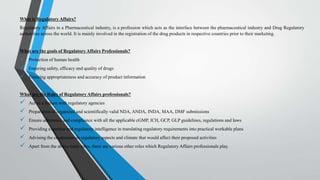
What is Regulatory Affairs?
Regulatory Affairs in a Pharmaceutical industry, is a profession which acts as the interface between the pharmaceutical industry and Drug Regulatory
authorities across the world. It is mainly involved in the registration of the drug products in respective countries prior to their marketing.
What are the goals of Regulatory Affairs Professionals?
 Protection of human health
 Ensuring safety, efficacy and quality of drugs
 Ensuring appropriateness and accuracy of product information
What are the Roles of Regulatory Affairs professionals?
 Act as a liaison with regulatory agencies
 Preparation of organized and scientifically valid NDA, ANDA, INDA, MAA, DMF submissions
 Ensure adherence and compliance with all the applicable cGMP, ICH, GCP, GLP guidelines, regulations and laws
 Providing expertise and regulatory intelligence in translating regulatory requirements into practical workable plans
 Advising the companies on regulatory aspects and climate that would affect their proposed activities
 Apart from the above main roles, there are various other roles which Regulatory Affairs professionals play.
What is an Investigational New Drug (IND) application?
It is an application which is filed with FDA to get approval for legally testing an experimental drug on human subjects after completing preclinical
testing. It is not an application for marketing approval.
Main components of an IND are:
 Description of the drug substance
 Chemistry, manufacturing and control information
 All known pre-clinical information
 Any previous human study reports
 Investigator’s brochure
 Clinical development plan
 Protocol and investigate list submission for the phase I clinical trial.
The FDA has 30 days to respond to the sponsor’s IND. Refer to 21CFR312.23 for specifics regarding the IND format and content.
The IND application must contain information in three broad areas:
 Animal pharmacology and Toxicology studies
 Manufacturing information
 Clinical protocols and Investigator information
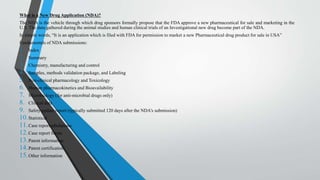
What is a New Drug Application (NDA)?
The NDA is the vehicle through which drug sponsors formally propose that the FDA approve a new pharmaceutical for sale and marketing in the
U.S. The data gathered during the animal studies and human clinical trials of an Investigational new drug become part of the NDA.
In simple words, “It is an application which is filed with FDA for permission to market a new Pharmaceutical drug product for sale in USA”
Fundamentals of NDA submissions:
1. Index
2. Summary
3. Chemistry, manufacturing and control
4. Samples, methods validation package, and Labeling
5. Non-clinical pharmacology and Toxicology
6. Human pharmacokinetics and Bioavailability
7. Microbiology (for anti-microbial drugs only)
8. Clinical data
9. Safety update report (typically submitted 120 days after the NDA’s submission)
10.Statistical
11.Case report tabulations
12.Case report forms
13.Patent information
14.Patent certification
15.Other information
What is an Abbreviated New Drug Application (ANDA)?
It is an application filed with FDA, for a U.S. generic drug approval for an existing licensed medication or approved drug. In simple words, “It is an
application for the approval of Generic Drugs “
Generic drug applications are termed “abbreviated” because they are generally not required to include preclinical (animal) and clinical (human) data
to establish safety and effectiveness. Instead, generic applicants must scientifically demonstrate that their product is bioequivalent.
Bioequivalent review study information:
 Formulation comparison for products whose bioavailability is self-evident.
 Comparative dissolution testing where there is a known correlation between in vitro and in vivo effects.
 In vivo bioequivalence testing comparing the rate and extent of absorption of the generic to the reference product
 For non-classically absorbed products, a head to head evaluation of comparative effectiveness based upon clinical endpoints.
What is a Generic Drug Product?
A generic drug product is the one that is comparable to an innovator drug product in dosage form, strength, route of administration, quality,
performance characteristics and intended use.
What is a 505 (b)(2) application ?
505 (b) (2) application is a type of NDA for which one or more investigations relied on by applicant for approval were not conducted by/for
applicant and for which applicant has not obtained a right of reference.
What kind of application can be submitted as a 505(b)(2) application?
New chemical entity (NCE)/new molecular entity (NME) Changes to previously approved drugs
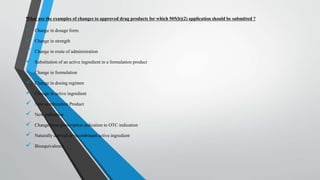
What are the examples of changes to approved drug products for which 505(b)(2) application should be submitted ?
 Change in dosage form.
 Change in strength
 Change in route of administration
 Substitution of an active ingredient in a formulation product
 Change in formulation
 Change in dosing regimen
 Change in active ingredient
 New combination Product
 New indication
 Change from prescription indication to OTC indication
 Naturally derived or recombinant active ingredient
 Bioequivalence
What is a DMF?
A Drug Master File (DMF) is a submission to the Food and Drug Administration (FDA) that may be used to provide confidential detailed
information about facilities, processes, or articles used in the manufacturing, processing, packaging, and storing of one or more human drugs.
Important facts regarding DMFs
 It is submitted to FDA to provide confidential information
 Its submission is not required by law or regulations
 It is neither approved nor disapproved
 It is filed with FDA to support NDA, IND, ANDA another DMF or amendments and supplements to any of these.
 It is provided for in the 21 CFR (Code of Federal Regulations) 314. 420
 It is not required when applicant references its own information
What are the types of DMF’s?
Type I: Manufacturing Site, Facilities, Operating Procedures, and Personnel (No longer accepted by FDA)
Type II: Drug Substance, Drug Substance Intermediate, and Material Used in Their Preparation, or Drug Product
Type III: Packaging Material
Type IV: Excipient, Colorant, Flavor, Essence, or Material Used in Their Preparation
Type V: FDAAccepted Reference Information (FDA discourages its use)
What is a Marketing Authorization Application (MAA)?
It is an application filed with the relevant authority in the Europe (typically, the UK's MHRA or the EMA’s Committee for Medicinal Products for
Human Use (CHMP)) to market a drug or medicine. As per UK’s MHRAApplications for new active substances are described as 'full applications'.
Applications for medicines containing existing active substances are described as 'abbreviated’ or ‘abridged applications’.
What is an ASMF?
Active substance master file (ASMF) is a submission which is made to EMA, MHRA or any other Drug Regulatory Authority in Europe to provide
confidential intellectual property or 'knowhow' of the manufacturer of the active substance.
In simple words, “It is a submission made to European Drug regulatory agencies on the confidential information of Active Substance or Active
pharmaceutical Ingredient (API)”.
What are the types of active substances for which ASMFs are submitted?
 New active substances
 Existing active substances not included in the European Pharmacopoeia (Ph. Eur.) or the pharmacopoeia of an EU Member State
 Pharmacopeias active substances included in the Ph. Eur. or in the pharmacopoeia of an EU Member State
What is the difference between DMF and ASMF (with respect to submission)?
ASMF is submitted as Applicant’s Part (Open Part) and Restricted Part (Closed Part). There isn’t any differentiation of DMF’s into parts.
What is ICH?
International Conference on Harmonization (ICH) of Technical Requirements for Registration of Pharmaceuticals for Human Use (ICH): is a
project that brings together the regulatory authorities of Europe, Japan and the United States and experts from the pharmaceutical industry in
the three regions to discuss scientific and technical aspects of pharmaceutical product registration.
What is CTD?
The Common Technical Document (CTD) is a set of specification for application dossier, for the registration of Medicines and designed to be
used across Europe, Japan and the United States. Quality, Safety and Efficacy information is assembled in a common format through CTD
.The CTD is maintained by the International Conference on Harmonization of Technical Requirements for Registration of Pharmaceuticals for
Human Use (ICH).
CTD format for submission of drug registration applications/dossiers is widely accepted by regulatory authorities of other countries too like
Canada, Australia etc.
What are the ICH guidelines to be referred for preparation of registration dossiers/applications of medicines (With respect to format
and contents in each module)?
M4-Guideline, M4Q-Guideline, M4S-Guideline, M4E-Guideline
What are the modules in CTD?
The Common Technical Document is divided into five modules:
Module 1. Administrative information and prescribing information
Module 2. Common Technical Document summaries (Overview and summary of modules 3 to 5)
Module 3. Quality
Module 4. Nonclinical Study Reports (toxicology studies)
Module 5. Clinical Study Reports (clinical studies)
What is Orange Book?
It is the commonly used name for the book “Approved Drug Products with therapeutic Equivalence Evaluations”, which is published by USFDA. It
contains the list of drug products, approved on the basis of safety and effectiveness by the Food and Drug Administration (FDA) under the Federal
Food, Drug, and Cosmetic Act.
What is Hatch Waxman act?
It is the popular name for Drug Price Competition and Patent Term Restoration Act, 1984. It is considered as the landmark legislation which established
the modern system of generic drugs in USA. Hatch Waxman amendment of the federal food, drug and cosmetics act established the process by which,
would be marketers of generic drugs can file Abbreviated New Drug Application (ANDA) to seek FDA approval of generic drugs. Paragraph IV of the
act, allows 180 day exclusivity to companies that are the "first-to-file" an ANDA against holders of patents for branded counterparts.
In simple words “Hatch Waxman act is the amendment to Federal, Food, Drug and Cosmetics act which established the modern system of approval of
generics”
What are the patent certifications under Hatch Waxman act?
As per the Hatch and Waxman act, generic drug and 505 (b) (2) applicants should include certifications in their applications for each patent listed in the
“Orange Book” for the innovator drug. This certification must state one of the following:
(I) that the required patent information relating to such patent has not been filed (Para I certification)
(II) That such patent has expired (Para II certification)
(III) That the patent will expire on a particular date (Para III certification), or
(IV) That such patent is invalid or will not be infringed by the drug, for which approval is being sought (Para IV certification).
A certification under paragraph I or II permits the ANDA to be approved immediately, if it is otherwise eligible. A certification under paragraph III
indicates that the ANDA may be approved when the patent expires.
What is meant by 180 day exclusivity?
The Hatch Waxman Amendments provide an incentive of 180 days of market exclusivity to the “first” generic applicant who challenges a
listed patent by filing a paragraph IV certification and thereby runs the risk of having to defend a patent infringement suit.
180 Day Exclusivity could be granted to more than one applicant. The recent example is180 day exclusivity was granted to Ranbaxy and
Watson Laboratories for marketing generic version of Lipitor (Atorvastatin calcium).
What are the procedures for Approval of Drug in EU?
1. Centralized Procedure (CP)
2. Decentralized Procedure (DCP)
3. Mutual Recognition Procedure (MRP)
4. National Procedure (NP)
What is the Full form of abbreviation, CEP?
Certificate of Suitability to the monographs of the European Pharmacopoeia (or) Certificate of suitability of monographs of the European
Pharmacopoeia (or) Certification of suitability of European Pharmacopoeia monographs. It is also informally referred to as Certificate of
Suitability (COS). It is the certificate which is issued by Certification of Substances Division of European Directorate for the Quality of
Medicines (EDQM), when the manufacturer of a substance provides proof that the quality of the substance is suitably controlled by the
relevant monographs of the European Pharmacopoeia.
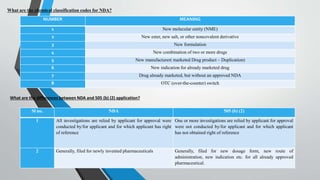
What are the chemical classification codes for NDA?
NUMBER MEANING
1 New molecular entity (NME)
2 New ester, new salt, or other noncovalent derivative
3 New formulation
4 New combination of two or more drugs
5 New manufacturer( marketed Drug product – Duplication)
6 New indication for already marketed drug
7 Drug already marketed, but without an approved NDA
8 OTC (over-the-counter) switch
What are the differences between NDA and 505 (b) (2) application?
Sl no. NDA 505 (b) (2)
1 All investigations are relied by applicant for approval were
conducted by/for applicant and for which applicant has right
of reference
One or more investigations are relied by applicant for approval
were not conducted by/for applicant and for which applicant
has not obtained right of reference
2 Generally, filed for newly invented pharmaceuticals Generally, filed for new dosage form, new route of
administration, new indication etc. for all already approved
pharmaceutical.
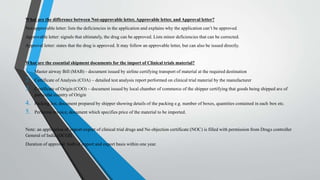
What are the difference between Not-approvable letter, Approvable letter, and Approval letter?
Not-approvable letter: lists the deficiencies in the application and explains why the application can’t be approved.
Approvable letter: signals that ultimately, the drug can be approved. Lists minor deficiencies that can be corrected.
Approval letter: states that the drug is approved. It may follow an approvable letter, but can also be issued directly.
What are the essential shipment documents for the import of Clinical trials material?
1. Master airway Bill (MAB) - document issued by airline certifying transport of material at the required destination
2. Certificate of Analysis (COA) – detailed test analysis report performed on clinical trial material by the manufacturer
3. Certificate of Origin (COO) – document issued by local chamber of commerce of the shipper certifying that goods being shipped are of
particular country of Origin
4. Packing list, document prepared by shipper showing details of the packing e.g. number of boxes, quantities contained in each box etc.
5. Performa invoice, document which specifies price of the material to be imported.
Note: an application of import-export of clinical trial drugs and No objection certificate (NOC) is filled with permission from Drugs controller
General of India (DCGI).
Duration of approval: both of import and export basis within one year.
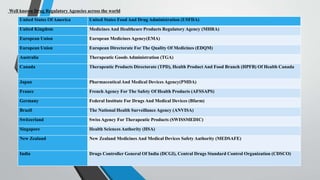
Well known Drug Regulatory Agencies across the world
United States Of America United States Food And Drug Administration (USFDA)
United Kingdom Medicines And Healthcare Products Regulatory Agency (MHRA)
European Union European Medicines Agency(EMA)
European Union European Directorate For The Quality Of Medicines (EDQM)
Australia Therapeutic Goods Administration (TGA)
Canada Therapeutic Products Directorate (TPD), Health Product And Food Branch (HPFB) Of Health Canada
Japan Pharmaceutical And Medical Devices Agency(PMDA)
France French Agency For The Safety Of Health Products (AFSSAPS)
Germany Federal Institute For Drugs And Medical Devices (Bfarm)
Brazil The National Health Surveillance Agency (ANVISA)
Switzerland Swiss Agency For Therapeutic Products (SWISSMEDIC)
Singapore Health Sciences Authority (HSA)
New Zealand New Zealand Medicines And Medical Devices Safety Authority (MEDSAFE)
India Drugs Controller General Of India (DCGI), Central Drugs Standard Control Organization (CDSCO)
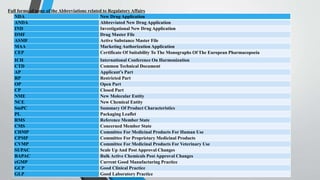
Full forms of some of the Abbreviations related to Regulatory Affairs
NDA New Drug Application
ANDA Abbreviated New Drug Application
IND Investigational New Drug Application
DMF Drug Master File
ASMF Active Substance Master File
MAA Marketing Authorization Application
CEP Certificate Of Suitability To The Monographs Of The European Pharmacopoeia
ICH International Conference On Harmonization
CTD Common Technical Document
AP Applicant’s Part
RP Restricted Part
OP Open Part
CP Closed Part
NME New Molecular Entity
NCE New Chemical Entity
SmPC Summary Of Product Characteristics
PL Packaging Leaflet
RMS Reference Member State
CMS Concerned Member State
CHMP Committee For Medicinal Products For Human Use
CPMP Committee For Proprietary Medicinal Products
CVMP Committee For Medicinal Products For Veterinary Use
SUPAC Scale Up And Post Approval Changes
BAPAC Bulk Active Chemicals Post Approval Changes
cGMP Current Good Manufacturing Practice
GCP Good Clinical Practice
GLP Good Laboratory Practice
Basic concepts about regulatory affairs

Basic concepts about regulatory affairs

  • 1.
    BASIC CONCEPTS ABOUT REGULATORYAFFAIRS RAJKUMAR KOLEY EXECUTIVE – QUALITY ASSURANCE MICRO LABS LTD. rajkoley89@gmail.com
  • 2.
    What is RegulatoryAffairs? Regulatory Affairs in a Pharmaceutical industry, is a profession which acts as the interface between the pharmaceutical industry and Drug Regulatory authorities across the world. It is mainly involved in the registration of the drug products in respective countries prior to their marketing. What are the goals of Regulatory Affairs Professionals?  Protection of human health  Ensuring safety, efficacy and quality of drugs  Ensuring appropriateness and accuracy of product information What are the Roles of Regulatory Affairs professionals?  Act as a liaison with regulatory agencies  Preparation of organized and scientifically valid NDA, ANDA, INDA, MAA, DMF submissions  Ensure adherence and compliance with all the applicable cGMP, ICH, GCP, GLP guidelines, regulations and laws  Providing expertise and regulatory intelligence in translating regulatory requirements into practical workable plans  Advising the companies on regulatory aspects and climate that would affect their proposed activities  Apart from the above main roles, there are various other roles which Regulatory Affairs professionals play.
  • 3.
    What is anInvestigational New Drug (IND) application? It is an application which is filed with FDA to get approval for legally testing an experimental drug on human subjects after completing preclinical testing. It is not an application for marketing approval. Main components of an IND are:  Description of the drug substance  Chemistry, manufacturing and control information  All known pre-clinical information  Any previous human study reports  Investigator’s brochure  Clinical development plan  Protocol and investigate list submission for the phase I clinical trial. The FDA has 30 days to respond to the sponsor’s IND. Refer to 21CFR312.23 for specifics regarding the IND format and content. The IND application must contain information in three broad areas:  Animal pharmacology and Toxicology studies  Manufacturing information  Clinical protocols and Investigator information
  • 4.
    What is aNew Drug Application (NDA)? The NDA is the vehicle through which drug sponsors formally propose that the FDA approve a new pharmaceutical for sale and marketing in the U.S. The data gathered during the animal studies and human clinical trials of an Investigational new drug become part of the NDA. In simple words, “It is an application which is filed with FDA for permission to market a new Pharmaceutical drug product for sale in USA” Fundamentals of NDA submissions: 1. Index 2. Summary 3. Chemistry, manufacturing and control 4. Samples, methods validation package, and Labeling 5. Non-clinical pharmacology and Toxicology 6. Human pharmacokinetics and Bioavailability 7. Microbiology (for anti-microbial drugs only) 8. Clinical data 9. Safety update report (typically submitted 120 days after the NDA’s submission) 10.Statistical 11.Case report tabulations 12.Case report forms 13.Patent information 14.Patent certification 15.Other information
  • 5.
    What is anAbbreviated New Drug Application (ANDA)? It is an application filed with FDA, for a U.S. generic drug approval for an existing licensed medication or approved drug. In simple words, “It is an application for the approval of Generic Drugs “ Generic drug applications are termed “abbreviated” because they are generally not required to include preclinical (animal) and clinical (human) data to establish safety and effectiveness. Instead, generic applicants must scientifically demonstrate that their product is bioequivalent. Bioequivalent review study information:  Formulation comparison for products whose bioavailability is self-evident.  Comparative dissolution testing where there is a known correlation between in vitro and in vivo effects.  In vivo bioequivalence testing comparing the rate and extent of absorption of the generic to the reference product  For non-classically absorbed products, a head to head evaluation of comparative effectiveness based upon clinical endpoints. What is a Generic Drug Product? A generic drug product is the one that is comparable to an innovator drug product in dosage form, strength, route of administration, quality, performance characteristics and intended use. What is a 505 (b)(2) application ? 505 (b) (2) application is a type of NDA for which one or more investigations relied on by applicant for approval were not conducted by/for applicant and for which applicant has not obtained a right of reference. What kind of application can be submitted as a 505(b)(2) application? New chemical entity (NCE)/new molecular entity (NME) Changes to previously approved drugs
  • 6.
    What are theexamples of changes to approved drug products for which 505(b)(2) application should be submitted ?  Change in dosage form.  Change in strength  Change in route of administration  Substitution of an active ingredient in a formulation product  Change in formulation  Change in dosing regimen  Change in active ingredient  New combination Product  New indication  Change from prescription indication to OTC indication  Naturally derived or recombinant active ingredient  Bioequivalence
  • 7.
    What is aDMF? A Drug Master File (DMF) is a submission to the Food and Drug Administration (FDA) that may be used to provide confidential detailed information about facilities, processes, or articles used in the manufacturing, processing, packaging, and storing of one or more human drugs. Important facts regarding DMFs  It is submitted to FDA to provide confidential information  Its submission is not required by law or regulations  It is neither approved nor disapproved  It is filed with FDA to support NDA, IND, ANDA another DMF or amendments and supplements to any of these.  It is provided for in the 21 CFR (Code of Federal Regulations) 314. 420  It is not required when applicant references its own information What are the types of DMF’s? Type I: Manufacturing Site, Facilities, Operating Procedures, and Personnel (No longer accepted by FDA) Type II: Drug Substance, Drug Substance Intermediate, and Material Used in Their Preparation, or Drug Product Type III: Packaging Material Type IV: Excipient, Colorant, Flavor, Essence, or Material Used in Their Preparation Type V: FDAAccepted Reference Information (FDA discourages its use)
  • 8.
    What is aMarketing Authorization Application (MAA)? It is an application filed with the relevant authority in the Europe (typically, the UK's MHRA or the EMA’s Committee for Medicinal Products for Human Use (CHMP)) to market a drug or medicine. As per UK’s MHRAApplications for new active substances are described as 'full applications'. Applications for medicines containing existing active substances are described as 'abbreviated’ or ‘abridged applications’. What is an ASMF? Active substance master file (ASMF) is a submission which is made to EMA, MHRA or any other Drug Regulatory Authority in Europe to provide confidential intellectual property or 'knowhow' of the manufacturer of the active substance. In simple words, “It is a submission made to European Drug regulatory agencies on the confidential information of Active Substance or Active pharmaceutical Ingredient (API)”. What are the types of active substances for which ASMFs are submitted?  New active substances  Existing active substances not included in the European Pharmacopoeia (Ph. Eur.) or the pharmacopoeia of an EU Member State  Pharmacopeias active substances included in the Ph. Eur. or in the pharmacopoeia of an EU Member State What is the difference between DMF and ASMF (with respect to submission)? ASMF is submitted as Applicant’s Part (Open Part) and Restricted Part (Closed Part). There isn’t any differentiation of DMF’s into parts.
  • 9.
    What is ICH? InternationalConference on Harmonization (ICH) of Technical Requirements for Registration of Pharmaceuticals for Human Use (ICH): is a project that brings together the regulatory authorities of Europe, Japan and the United States and experts from the pharmaceutical industry in the three regions to discuss scientific and technical aspects of pharmaceutical product registration. What is CTD? The Common Technical Document (CTD) is a set of specification for application dossier, for the registration of Medicines and designed to be used across Europe, Japan and the United States. Quality, Safety and Efficacy information is assembled in a common format through CTD .The CTD is maintained by the International Conference on Harmonization of Technical Requirements for Registration of Pharmaceuticals for Human Use (ICH). CTD format for submission of drug registration applications/dossiers is widely accepted by regulatory authorities of other countries too like Canada, Australia etc. What are the ICH guidelines to be referred for preparation of registration dossiers/applications of medicines (With respect to format and contents in each module)? M4-Guideline, M4Q-Guideline, M4S-Guideline, M4E-Guideline What are the modules in CTD? The Common Technical Document is divided into five modules: Module 1. Administrative information and prescribing information Module 2. Common Technical Document summaries (Overview and summary of modules 3 to 5) Module 3. Quality Module 4. Nonclinical Study Reports (toxicology studies) Module 5. Clinical Study Reports (clinical studies)
  • 10.
    What is OrangeBook? It is the commonly used name for the book “Approved Drug Products with therapeutic Equivalence Evaluations”, which is published by USFDA. It contains the list of drug products, approved on the basis of safety and effectiveness by the Food and Drug Administration (FDA) under the Federal Food, Drug, and Cosmetic Act. What is Hatch Waxman act? It is the popular name for Drug Price Competition and Patent Term Restoration Act, 1984. It is considered as the landmark legislation which established the modern system of generic drugs in USA. Hatch Waxman amendment of the federal food, drug and cosmetics act established the process by which, would be marketers of generic drugs can file Abbreviated New Drug Application (ANDA) to seek FDA approval of generic drugs. Paragraph IV of the act, allows 180 day exclusivity to companies that are the "first-to-file" an ANDA against holders of patents for branded counterparts. In simple words “Hatch Waxman act is the amendment to Federal, Food, Drug and Cosmetics act which established the modern system of approval of generics” What are the patent certifications under Hatch Waxman act? As per the Hatch and Waxman act, generic drug and 505 (b) (2) applicants should include certifications in their applications for each patent listed in the “Orange Book” for the innovator drug. This certification must state one of the following: (I) that the required patent information relating to such patent has not been filed (Para I certification) (II) That such patent has expired (Para II certification) (III) That the patent will expire on a particular date (Para III certification), or (IV) That such patent is invalid or will not be infringed by the drug, for which approval is being sought (Para IV certification). A certification under paragraph I or II permits the ANDA to be approved immediately, if it is otherwise eligible. A certification under paragraph III indicates that the ANDA may be approved when the patent expires.
  • 11.
    What is meantby 180 day exclusivity? The Hatch Waxman Amendments provide an incentive of 180 days of market exclusivity to the “first” generic applicant who challenges a listed patent by filing a paragraph IV certification and thereby runs the risk of having to defend a patent infringement suit. 180 Day Exclusivity could be granted to more than one applicant. The recent example is180 day exclusivity was granted to Ranbaxy and Watson Laboratories for marketing generic version of Lipitor (Atorvastatin calcium). What are the procedures for Approval of Drug in EU? 1. Centralized Procedure (CP) 2. Decentralized Procedure (DCP) 3. Mutual Recognition Procedure (MRP) 4. National Procedure (NP) What is the Full form of abbreviation, CEP? Certificate of Suitability to the monographs of the European Pharmacopoeia (or) Certificate of suitability of monographs of the European Pharmacopoeia (or) Certification of suitability of European Pharmacopoeia monographs. It is also informally referred to as Certificate of Suitability (COS). It is the certificate which is issued by Certification of Substances Division of European Directorate for the Quality of Medicines (EDQM), when the manufacturer of a substance provides proof that the quality of the substance is suitably controlled by the relevant monographs of the European Pharmacopoeia.
  • 12.
    What are thechemical classification codes for NDA? NUMBER MEANING 1 New molecular entity (NME) 2 New ester, new salt, or other noncovalent derivative 3 New formulation 4 New combination of two or more drugs 5 New manufacturer( marketed Drug product – Duplication) 6 New indication for already marketed drug 7 Drug already marketed, but without an approved NDA 8 OTC (over-the-counter) switch What are the differences between NDA and 505 (b) (2) application? Sl no. NDA 505 (b) (2) 1 All investigations are relied by applicant for approval were conducted by/for applicant and for which applicant has right of reference One or more investigations are relied by applicant for approval were not conducted by/for applicant and for which applicant has not obtained right of reference 2 Generally, filed for newly invented pharmaceuticals Generally, filed for new dosage form, new route of administration, new indication etc. for all already approved pharmaceutical.
  • 13.
    What are thedifference between Not-approvable letter, Approvable letter, and Approval letter? Not-approvable letter: lists the deficiencies in the application and explains why the application can’t be approved. Approvable letter: signals that ultimately, the drug can be approved. Lists minor deficiencies that can be corrected. Approval letter: states that the drug is approved. It may follow an approvable letter, but can also be issued directly. What are the essential shipment documents for the import of Clinical trials material? 1. Master airway Bill (MAB) - document issued by airline certifying transport of material at the required destination 2. Certificate of Analysis (COA) – detailed test analysis report performed on clinical trial material by the manufacturer 3. Certificate of Origin (COO) – document issued by local chamber of commerce of the shipper certifying that goods being shipped are of particular country of Origin 4. Packing list, document prepared by shipper showing details of the packing e.g. number of boxes, quantities contained in each box etc. 5. Performa invoice, document which specifies price of the material to be imported. Note: an application of import-export of clinical trial drugs and No objection certificate (NOC) is filled with permission from Drugs controller General of India (DCGI). Duration of approval: both of import and export basis within one year.
  • 14.
    Well known DrugRegulatory Agencies across the world United States Of America United States Food And Drug Administration (USFDA) United Kingdom Medicines And Healthcare Products Regulatory Agency (MHRA) European Union European Medicines Agency(EMA) European Union European Directorate For The Quality Of Medicines (EDQM) Australia Therapeutic Goods Administration (TGA) Canada Therapeutic Products Directorate (TPD), Health Product And Food Branch (HPFB) Of Health Canada Japan Pharmaceutical And Medical Devices Agency(PMDA) France French Agency For The Safety Of Health Products (AFSSAPS) Germany Federal Institute For Drugs And Medical Devices (Bfarm) Brazil The National Health Surveillance Agency (ANVISA) Switzerland Swiss Agency For Therapeutic Products (SWISSMEDIC) Singapore Health Sciences Authority (HSA) New Zealand New Zealand Medicines And Medical Devices Safety Authority (MEDSAFE) India Drugs Controller General Of India (DCGI), Central Drugs Standard Control Organization (CDSCO)
  • 15.
    Full forms ofsome of the Abbreviations related to Regulatory Affairs NDA New Drug Application ANDA Abbreviated New Drug Application IND Investigational New Drug Application DMF Drug Master File ASMF Active Substance Master File MAA Marketing Authorization Application CEP Certificate Of Suitability To The Monographs Of The European Pharmacopoeia ICH International Conference On Harmonization CTD Common Technical Document AP Applicant’s Part RP Restricted Part OP Open Part CP Closed Part NME New Molecular Entity NCE New Chemical Entity SmPC Summary Of Product Characteristics PL Packaging Leaflet RMS Reference Member State CMS Concerned Member State CHMP Committee For Medicinal Products For Human Use CPMP Committee For Proprietary Medicinal Products CVMP Committee For Medicinal Products For Veterinary Use SUPAC Scale Up And Post Approval Changes BAPAC Bulk Active Chemicals Post Approval Changes cGMP Current Good Manufacturing Practice GCP Good Clinical Practice GLP Good Laboratory Practice