Cognitive Biases
and Effects You
Should Know About
Kevlin Henney
kevlin@curbralan.com
@KevlinHenney
psychoanalysis
 Freudian masturbation.
 Set of very strange ideas about female sexuality.
 Some pretty strange ideas about male sexuality.
 The reason your childhood has ruined the rest of your life.
Urban Dictionary
economics
 A social science discipline with a contemporaneous logical
framework that's based completely on the assumption that
scarcity is a problem intrinsic to society. The effect of
which justifies greed as a virtue.
 An institutional requirement for dime-a-dozen business
majors, usually taught by middle-aged, overly opinionated,
white males in need of serious cultural experiences.
 The study of fufilling ones unlimited wants using the
Earth's limited resources.
Urban Dictionary
Are human beings
"noble in reason" and
"infinite in faculty" as
William Shakespeare
famously wrote?
Perfect, "in God's
image," as some
biblical scholars have
asserted?
Hardly.
A cognitive bias is any of a wide range of observer effects
identified in cognitive science and social psychology including
very basic statistical, social attribution, and memory errors
that are common to all human beings.
http://www.sciencedaily.com/articles/c/cognitive_bias.htm
Biases drastically skew the reliability of anecdotal and legal
evidence.
Social biases, usually called attributional biases, affect our
everyday social interactions.
http://www.sciencedaily.com/articles/c/cognitive_bias.htm
And biases related to probability and decision making
significantly affect the scientific method which is deliberately
designed to minimize such bias from any one observer.
http://www.sciencedaily.com/articles/c/cognitive_bias.htm
On average, we expect things to turn out better than they wind
up being. People hugely underestimate their chances of
getting divorced, losing their job or being diagnosed with
cancer; expect their children to be extraordinarily gifted;
envision themselves achieving more than their peers; and
overestimate their likely life span
Tali Sharot
http://www.time.com/time/health/article/0,8599,2074067-1,00.html
The belief that the future will be much better than the past
and present is known as the optimism bias. It abides in every
race, region and socioeconomic bracket.
Tali Sharot
http://www.time.com/time/health/article/0,8599,2074067-1,00.html
When people learn, their neurons faithfully encode desirable
information that can enhance optimism but fail at
incorporating unexpectedly undesirable information.
Tali Sharot
http://www.time.com/time/health/article/0,8599,2074067-1,00.html
To induce expectations of success, [Sara Bengtsson] primed
college students with words such as smart, intelligent and
clever just before asking them to perform a test. To induce
expectations of failure, she primed them with words like
stupid and ignorant. The students performed better after being
primed with an affirmative message.
Tali Sharot
http://www.time.com/time/health/article/0,8599,2074067-1,00.html
When the mistake followed positive words, she observed
enhanced activity in the anterior medial part of the prefrontal
cortex. However, when the participants were primed with the
word stupid, there was no heightened activity after a wrong
answer. It appears that after being primed with the word
stupid, the brain expected to do poorly and did not show signs
of surprise or conflict when it made an error.
Tali Sharot
http://www.time.com/time/health/article/0,8599,2074067-1,00.html
The assertion that we can learn something from every
failure is often heard. This study by Earl Miller and
his colleagues Mark Histed and Anitha Pasupathy of
the Massachusetts Institute of Technology's Picower
Institute for Learning and Memory tests that notion by
looking at the learning process at the level of neurons.
The study shows how brains learn more effectively
from success than from failure.
http://www.asfct.org/documents/journal/2009-11/Vol1-2-9.pdf
Brain cells keep track of whether recent behaviours
were successful or not. When a certain behaviour was
successful, cells became more finely tuned to what the
animal was learning. After a failure, there was little or
no change in the brain – nor was there any
improvement in behaviour.
http://www.asfct.org/documents/journal/2009-11/Vol1-2-9.pdf
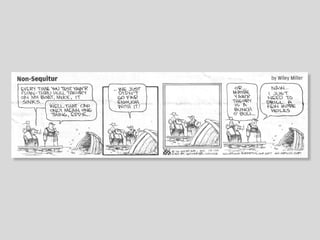
It has become commonplace to suggest that failure is good for
entrepreneurs. In this view, failure that comes early in a
founder's career can teach them important lessons about doing
business and harden them up for the next start-up attempt.
David Storey, "Lessons that are wasted on entrepreneurs"
In the UK, the evidence is that novices are neither more nor
less likely to have a business that either grows or survives
than experienced founders. In Germany, where much more
extensive statistical work has been undertaken, it is clear that
those whose business had failed had worse-performing
businesses if they restarted than did novices.
David Storey, "Lessons that are wasted on entrepreneurs"
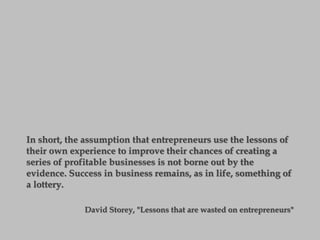
In short, the assumption that entrepreneurs use the lessons of
their own experience to improve their chances of creating a
series of profitable businesses is not borne out by the
evidence. Success in business remains, as in life, something of
a lottery.
David Storey, "Lessons that are wasted on entrepreneurs"
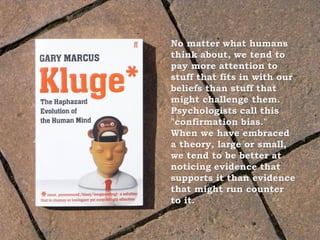
No matter what humans
think about, we tend to
pay more attention to
stuff that fits in with our
beliefs than stuff that
might challenge them.
Psychologists call this
"confirmation bias."
When we have embraced
a theory, large or small,
we tend to be better at
noticing evidence that
supports it than evidence
that might run counter
to it.
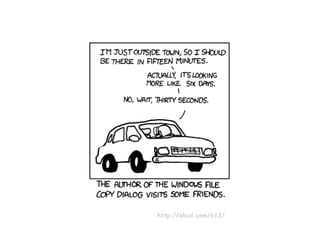
http://xkcd.com/612/
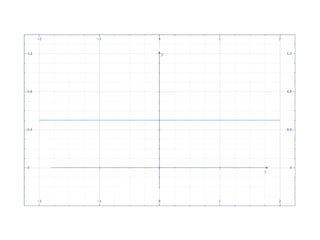
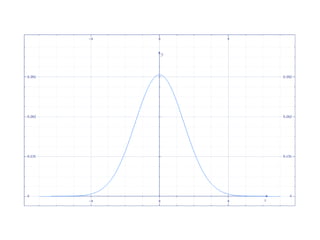
Nothing is so alien to the human
mind as the idea of randomness.
John Cohen
Apophenia is the experience of seeing meaningful patterns or
connections in random or meaningless data.
The term was coined in 1958 by Klaus Conrad, who defined it as
the "unmotivated seeing of connections" accompanied by a
"specific experience of an abnormal meaningfulness", but it has
come to represent the human tendency to seek patterns in
random nature in general, as with gambling, paranormal
phenomena, religion, and even attempts at scientific observation.
http://en.wikipedia.org/wiki/Apophenia
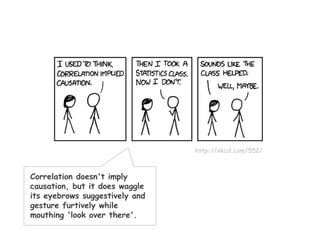
http://xkcd.com/552/
Correlation doesn't imply
causation, but it does waggle
its eyebrows suggestively and
gesture furtively while
mouthing 'look over there'.
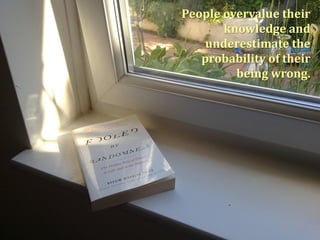
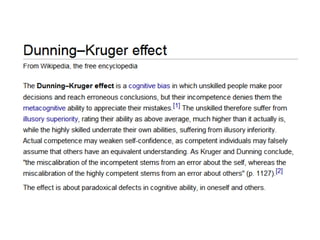
People overvalue their
knowledge and
underestimate the
probability of their
being wrong.
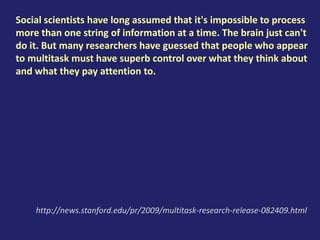
Social scientists have long assumed that it's impossible to process
more than one string of information at a time. The brain just can't
do it. But many researchers have guessed that people who appear
to multitask must have superb control over what they think about
and what they pay attention to.
http://news.stanford.edu/pr/2009/multitask-research-release-082409.html
So [Clifford] Nass and his colleagues, Eyal Ophir and Anthony
Wagner, set out to learn what gives multitaskers their edge. What
is their gift?
"We kept looking for what they're better at, and we didn't find it."
http://news.stanford.edu/pr/2009/multitask-research-release-082409.html
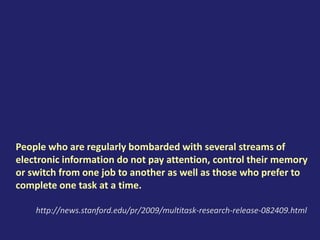
People who are regularly bombarded with several streams of
electronic information do not pay attention, control their memory
or switch from one job to another as well as those who prefer to
complete one task at a time.
http://news.stanford.edu/pr/2009/multitask-research-release-082409.html
If all you could make was a long-term
argument for testing, you could forget
about it. Some people would do it out of a
sense of duty or because someone was
watching over their shoulder. As soon as
the attention wavered or the pressure
increased, no new tests would get written,
the tests that were written wouldn't be run,
and the whole thing would fall apart.
Kent Beck, Extreme Programming Explained
I think that three of the best-documented tenets of economic
psychology can help explain why we collectively took on the
loans that events have proved were so unwise.
The first is materialism. [...]
The second is money. [...]
Finally, we have the most spectacular deviation from
rationality: the massive myopia with which we approach
choices between good things that will arrive at different points
in the future. Humans are quite hopeless at such "inter-
temporal choice", consistently choosing to take small benefits
sooner rather than large benefits later.
http://www.newscientist.com/article/mg20627595.800-
economic-recovery-needs-psychological-recovery.html
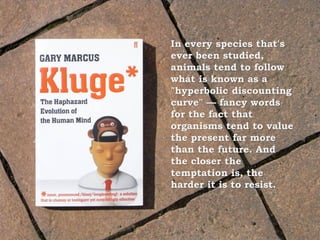
In every species that's
ever been studied,
animals tend to follow
what is known as a
"hyperbolic discounting
curve" — fancy words
for the fact that
organisms tend to value
the present far more
than the future. And
the closer the
temptation is, the
harder it is to resist.
The effect of portion size on how much people eat is
something of a mystery – why don’t they simply leave
what they don’t want, or alternatively, where possible,
why not help themselves to more? Andrew Geier and
colleagues at the University of Pennsylvania think it has
to do with ‘Unit bias’ – “…the sense that a single entity
(within a reasonable range of sizes) is the appropriate
amount to engage, consume or consider”.
http://bps-research-digest.blogspot.com/2006/06/
power-of-one-why-larger-portions-cause.html
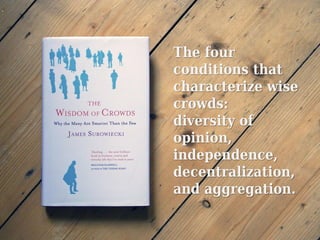
The four
conditions that
characterize wise
crowds:
diversity of
opinion,
independence,
decentralization,
and aggregation.
As any psychologist will tell you, pretty much everything you
think and do is coloured by biases that you are typically totally
unaware of. Rather than seeing the world as it is, you see it
through a veil of prejudice and self-serving hypocrisies.
http://www.newscientist.com/article/
mg21028122.200-the-grand-delusion-blind-to-bias.html
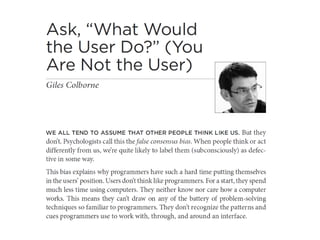
You have just experienced the illusion of naive realism - the
conviction that you, and perhaps you alone, perceive the world
as it really is, and that anybody who sees it differently is
biased.
http://www.newscientist.com/article/
mg21028122.200-the-grand-delusion-blind-to-bias.html
If, at this point, you are thinking: "Yeah, right, that might be
true of other people, but not me," then you have fallen foul of
yet another aspect of the illusion: the bias blind spot. Most
people will happily acknowledge that such biases exist, but
only in other people.
http://www.newscientist.com/article/
mg21028122.200-the-grand-delusion-blind-to-bias.html

Cognitive Biases and Effects You Should Know About

  • 1.
    Cognitive Biases and EffectsYou Should Know About Kevlin Henney kevlin@curbralan.com @KevlinHenney
  • 4.
    psychoanalysis  Freudian masturbation. Set of very strange ideas about female sexuality.  Some pretty strange ideas about male sexuality.  The reason your childhood has ruined the rest of your life. Urban Dictionary
  • 5.
    economics  A socialscience discipline with a contemporaneous logical framework that's based completely on the assumption that scarcity is a problem intrinsic to society. The effect of which justifies greed as a virtue.  An institutional requirement for dime-a-dozen business majors, usually taught by middle-aged, overly opinionated, white males in need of serious cultural experiences.  The study of fufilling ones unlimited wants using the Earth's limited resources. Urban Dictionary
  • 7.
    Are human beings "noblein reason" and "infinite in faculty" as William Shakespeare famously wrote? Perfect, "in God's image," as some biblical scholars have asserted?
  • 8.
  • 9.
    A cognitive biasis any of a wide range of observer effects identified in cognitive science and social psychology including very basic statistical, social attribution, and memory errors that are common to all human beings. http://www.sciencedaily.com/articles/c/cognitive_bias.htm
  • 10.
    Biases drastically skewthe reliability of anecdotal and legal evidence. Social biases, usually called attributional biases, affect our everyday social interactions. http://www.sciencedaily.com/articles/c/cognitive_bias.htm
  • 11.
    And biases relatedto probability and decision making significantly affect the scientific method which is deliberately designed to minimize such bias from any one observer. http://www.sciencedaily.com/articles/c/cognitive_bias.htm
  • 12.
    On average, weexpect things to turn out better than they wind up being. People hugely underestimate their chances of getting divorced, losing their job or being diagnosed with cancer; expect their children to be extraordinarily gifted; envision themselves achieving more than their peers; and overestimate their likely life span Tali Sharot http://www.time.com/time/health/article/0,8599,2074067-1,00.html
  • 13.
    The belief thatthe future will be much better than the past and present is known as the optimism bias. It abides in every race, region and socioeconomic bracket. Tali Sharot http://www.time.com/time/health/article/0,8599,2074067-1,00.html
  • 14.
    When people learn,their neurons faithfully encode desirable information that can enhance optimism but fail at incorporating unexpectedly undesirable information. Tali Sharot http://www.time.com/time/health/article/0,8599,2074067-1,00.html
  • 15.
    To induce expectationsof success, [Sara Bengtsson] primed college students with words such as smart, intelligent and clever just before asking them to perform a test. To induce expectations of failure, she primed them with words like stupid and ignorant. The students performed better after being primed with an affirmative message. Tali Sharot http://www.time.com/time/health/article/0,8599,2074067-1,00.html
  • 16.
    When the mistakefollowed positive words, she observed enhanced activity in the anterior medial part of the prefrontal cortex. However, when the participants were primed with the word stupid, there was no heightened activity after a wrong answer. It appears that after being primed with the word stupid, the brain expected to do poorly and did not show signs of surprise or conflict when it made an error. Tali Sharot http://www.time.com/time/health/article/0,8599,2074067-1,00.html
  • 17.
    The assertion thatwe can learn something from every failure is often heard. This study by Earl Miller and his colleagues Mark Histed and Anitha Pasupathy of the Massachusetts Institute of Technology's Picower Institute for Learning and Memory tests that notion by looking at the learning process at the level of neurons. The study shows how brains learn more effectively from success than from failure. http://www.asfct.org/documents/journal/2009-11/Vol1-2-9.pdf
  • 18.
    Brain cells keeptrack of whether recent behaviours were successful or not. When a certain behaviour was successful, cells became more finely tuned to what the animal was learning. After a failure, there was little or no change in the brain – nor was there any improvement in behaviour. http://www.asfct.org/documents/journal/2009-11/Vol1-2-9.pdf
  • 19.
    It has becomecommonplace to suggest that failure is good for entrepreneurs. In this view, failure that comes early in a founder's career can teach them important lessons about doing business and harden them up for the next start-up attempt. David Storey, "Lessons that are wasted on entrepreneurs"
  • 20.
    In the UK,the evidence is that novices are neither more nor less likely to have a business that either grows or survives than experienced founders. In Germany, where much more extensive statistical work has been undertaken, it is clear that those whose business had failed had worse-performing businesses if they restarted than did novices. David Storey, "Lessons that are wasted on entrepreneurs"
  • 21.
    In short, theassumption that entrepreneurs use the lessons of their own experience to improve their chances of creating a series of profitable businesses is not borne out by the evidence. Success in business remains, as in life, something of a lottery. David Storey, "Lessons that are wasted on entrepreneurs"
  • 23.
    No matter whathumans think about, we tend to pay more attention to stuff that fits in with our beliefs than stuff that might challenge them. Psychologists call this "confirmation bias." When we have embraced a theory, large or small, we tend to be better at noticing evidence that supports it than evidence that might run counter to it.
  • 24.
  • 25.
    Nothing is soalien to the human mind as the idea of randomness. John Cohen
  • 26.
    Apophenia is theexperience of seeing meaningful patterns or connections in random or meaningless data. The term was coined in 1958 by Klaus Conrad, who defined it as the "unmotivated seeing of connections" accompanied by a "specific experience of an abnormal meaningfulness", but it has come to represent the human tendency to seek patterns in random nature in general, as with gambling, paranormal phenomena, religion, and even attempts at scientific observation. http://en.wikipedia.org/wiki/Apophenia
  • 32.
    http://xkcd.com/552/ Correlation doesn't imply causation,but it does waggle its eyebrows suggestively and gesture furtively while mouthing 'look over there'.
  • 33.
    People overvalue their knowledgeand underestimate the probability of their being wrong.
  • 36.
    Social scientists havelong assumed that it's impossible to process more than one string of information at a time. The brain just can't do it. But many researchers have guessed that people who appear to multitask must have superb control over what they think about and what they pay attention to. http://news.stanford.edu/pr/2009/multitask-research-release-082409.html
  • 37.
    So [Clifford] Nassand his colleagues, Eyal Ophir and Anthony Wagner, set out to learn what gives multitaskers their edge. What is their gift? "We kept looking for what they're better at, and we didn't find it." http://news.stanford.edu/pr/2009/multitask-research-release-082409.html
  • 38.
    People who areregularly bombarded with several streams of electronic information do not pay attention, control their memory or switch from one job to another as well as those who prefer to complete one task at a time. http://news.stanford.edu/pr/2009/multitask-research-release-082409.html
  • 39.
    If all youcould make was a long-term argument for testing, you could forget about it. Some people would do it out of a sense of duty or because someone was watching over their shoulder. As soon as the attention wavered or the pressure increased, no new tests would get written, the tests that were written wouldn't be run, and the whole thing would fall apart. Kent Beck, Extreme Programming Explained
  • 40.
    I think thatthree of the best-documented tenets of economic psychology can help explain why we collectively took on the loans that events have proved were so unwise. The first is materialism. [...] The second is money. [...] Finally, we have the most spectacular deviation from rationality: the massive myopia with which we approach choices between good things that will arrive at different points in the future. Humans are quite hopeless at such "inter- temporal choice", consistently choosing to take small benefits sooner rather than large benefits later. http://www.newscientist.com/article/mg20627595.800- economic-recovery-needs-psychological-recovery.html
  • 41.
    In every speciesthat's ever been studied, animals tend to follow what is known as a "hyperbolic discounting curve" — fancy words for the fact that organisms tend to value the present far more than the future. And the closer the temptation is, the harder it is to resist.
  • 43.
    The effect ofportion size on how much people eat is something of a mystery – why don’t they simply leave what they don’t want, or alternatively, where possible, why not help themselves to more? Andrew Geier and colleagues at the University of Pennsylvania think it has to do with ‘Unit bias’ – “…the sense that a single entity (within a reasonable range of sizes) is the appropriate amount to engage, consume or consider”. http://bps-research-digest.blogspot.com/2006/06/ power-of-one-why-larger-portions-cause.html
  • 45.
    The four conditions that characterizewise crowds: diversity of opinion, independence, decentralization, and aggregation.
  • 48.
    As any psychologistwill tell you, pretty much everything you think and do is coloured by biases that you are typically totally unaware of. Rather than seeing the world as it is, you see it through a veil of prejudice and self-serving hypocrisies. http://www.newscientist.com/article/ mg21028122.200-the-grand-delusion-blind-to-bias.html
  • 49.
    You have justexperienced the illusion of naive realism - the conviction that you, and perhaps you alone, perceive the world as it really is, and that anybody who sees it differently is biased. http://www.newscientist.com/article/ mg21028122.200-the-grand-delusion-blind-to-bias.html
  • 50.
    If, at thispoint, you are thinking: "Yeah, right, that might be true of other people, but not me," then you have fallen foul of yet another aspect of the illusion: the bias blind spot. Most people will happily acknowledge that such biases exist, but only in other people. http://www.newscientist.com/article/ mg21028122.200-the-grand-delusion-blind-to-bias.html