WESTERN MODEL OF
COMMUNICATION
J. JANARDHAN
LASSWELL MODEL
 Western models are having origin in Aristotle’s Rhetoric
 Its made up of three elements
The Speaker
The speech
The listener
 Search of all the possible means of persuasion
LASSWELL MODEL
 Harold D. Lasswell describes an act of communication is
to answer to
Who
Says what
In which Channel
To whom
With what effect?
LASSWELL MODEL

FUNCTIONS
 Communication performs three functions.
i. Surveillance of the environment
ii. Correlation of components of society
iii. Cultural transmission b/w generations
PRIMARY GOAL
 The message flows in a multicultural society with multiple
audiences.
 The notion of transmission and transfer of information for
intended effects
 The primary goal is influence through persuasion
ADVANTAGES
 Its easy and simple
 It suits for almost all types of communication
 The concept of effect
DISADVANTAGES
 No scope for feedback
 It doesn’t talk about noise
 Linear model only
SHANNON & WEAVERS’
MATHEMATICAL MODEL
MATHEMATICAL MODEL OF COMM.
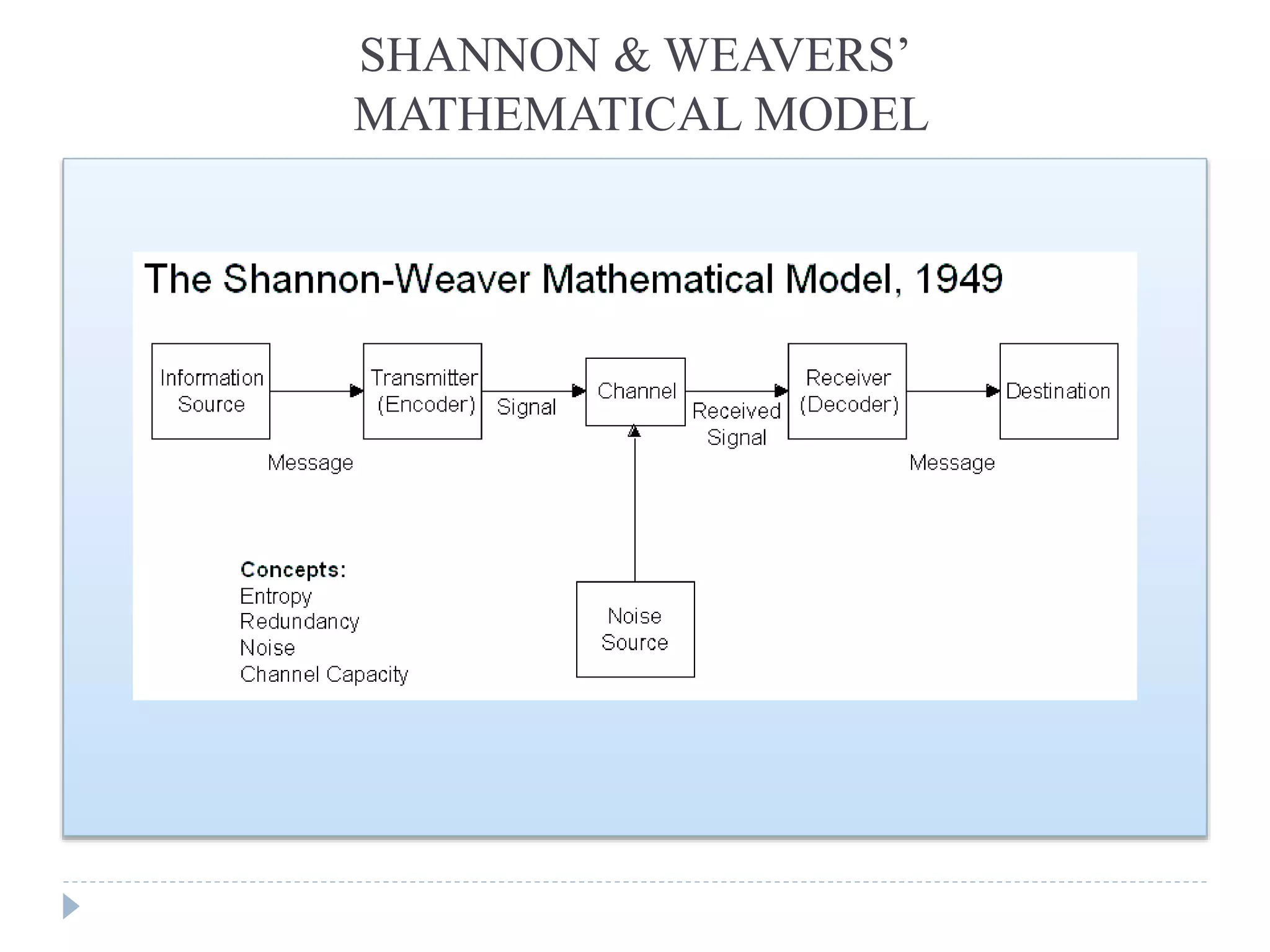
 Shannon theory talks about ‘Signal transmission’
 He introduced Qualitative & Quantitative model
 Its develop the effective comm. b/w sender and receiver
 It also developed to improve the ‘technical comm.’ .
 The model talks about ‘Noise’.
MATHEMATICAL MODEL OF COMM.
 Shannon developed model to separate noise from the
transmitter
 Shannon focused on engineering aspects
 Weaver added the ‘Philosophical aspects’
 Weaver widely applied Shannon’s model to the human
communication
MATHEMATICAL MODEL OF COMM.
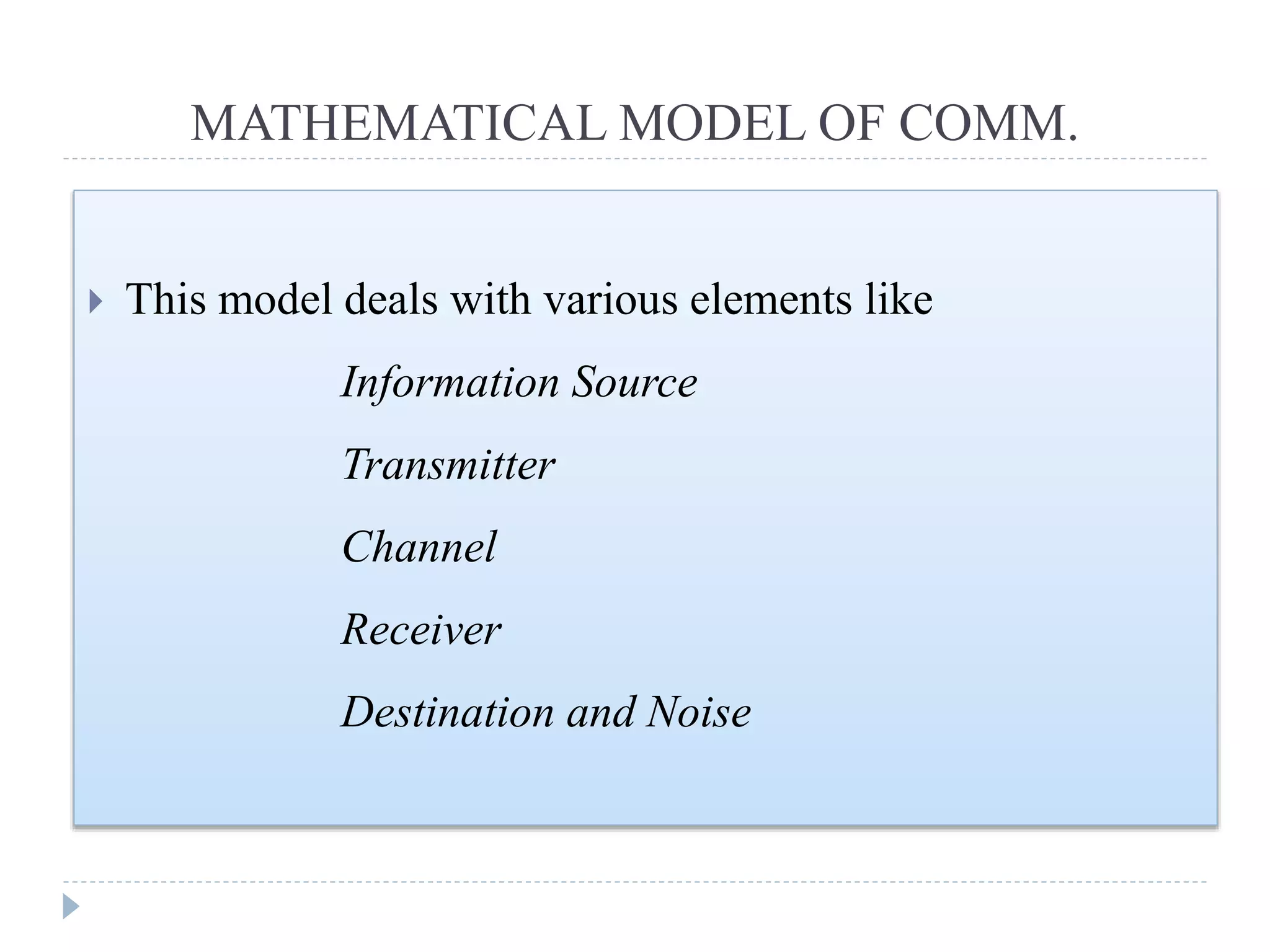
 This model deals with various elements like
Information Source
Transmitter
Channel
Receiver
Destination and Noise
ADVANCES & DIS-ADVANCES
 Simplest model
 It attracts both academicians & information theorists
 It is a Sender and Receiver based model
 More effective in ‘Person-to-Person’ communication
 Understanding ‘Noise’ will help to solve the problems
LEVEL OF NOISE
 Noise finds in three level
i. Technical problem- Simple to understand
ii. Semantic problem- Hard to solve
iii. Effective problem- As manipulation or
Propaganda
 The three levels are interrelated and interdependent
 The source is seen as the decision maker
OSGOOD-WILBUR SCHRAMM MODEL
 Sharing of information, ideas or attitudes
-Wilbur Schramm
 Communication requires at least three elements
Source
Message
Destination
OSGOOD-WILBUR SCHRAMM MODEL
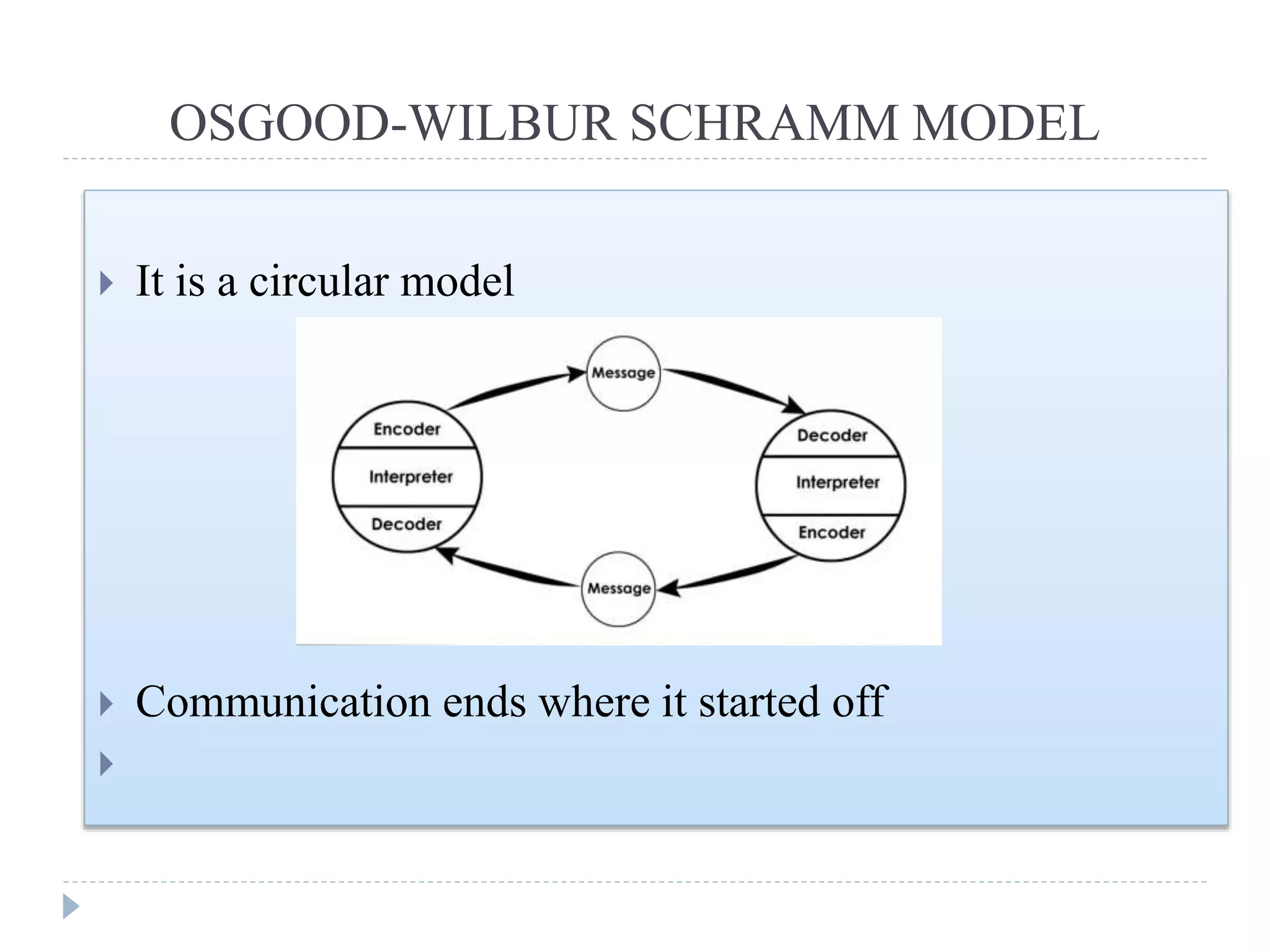
 It is a circular model
 Communication ends where it started off

WILBUR SCHRAMM MODEL
 It breaks the sender and receiver model
 It can happen within our self or two people
 Each person acts as both sender and receiver
 Semantic noise is introduced in the model
 It occurs when sender and receiver apply different
meaning to the same message.
WILBUR SCHRAMM MODEL-Advn
 Dynamic model
 It shows why redundancy is an essential part
 There is no separate sender and receiver
 Communication will be circular in nature
 Feedback-central feature
THANK YOU

Western model of communication ii

  • 1.
  • 2.
    LASSWELL MODEL  Westernmodels are having origin in Aristotle’s Rhetoric  Its made up of three elements The Speaker The speech The listener  Search of all the possible means of persuasion
  • 3.
    LASSWELL MODEL  HaroldD. Lasswell describes an act of communication is to answer to Who Says what In which Channel To whom With what effect?
  • 4.
  • 5.
    FUNCTIONS  Communication performsthree functions. i. Surveillance of the environment ii. Correlation of components of society iii. Cultural transmission b/w generations
  • 6.
    PRIMARY GOAL  Themessage flows in a multicultural society with multiple audiences.  The notion of transmission and transfer of information for intended effects  The primary goal is influence through persuasion
  • 7.
    ADVANTAGES  Its easyand simple  It suits for almost all types of communication  The concept of effect
  • 8.
    DISADVANTAGES  No scopefor feedback  It doesn’t talk about noise  Linear model only
  • 9.
  • 10.
    MATHEMATICAL MODEL OFCOMM.  Shannon theory talks about ‘Signal transmission’  He introduced Qualitative & Quantitative model  Its develop the effective comm. b/w sender and receiver  It also developed to improve the ‘technical comm.’ .  The model talks about ‘Noise’.
  • 11.
    MATHEMATICAL MODEL OFCOMM.  Shannon developed model to separate noise from the transmitter  Shannon focused on engineering aspects  Weaver added the ‘Philosophical aspects’  Weaver widely applied Shannon’s model to the human communication
  • 12.
    MATHEMATICAL MODEL OFCOMM.  This model deals with various elements like Information Source Transmitter Channel Receiver Destination and Noise
  • 13.
    ADVANCES & DIS-ADVANCES Simplest model  It attracts both academicians & information theorists  It is a Sender and Receiver based model  More effective in ‘Person-to-Person’ communication  Understanding ‘Noise’ will help to solve the problems
  • 14.
    LEVEL OF NOISE Noise finds in three level i. Technical problem- Simple to understand ii. Semantic problem- Hard to solve iii. Effective problem- As manipulation or Propaganda  The three levels are interrelated and interdependent  The source is seen as the decision maker
  • 15.
    OSGOOD-WILBUR SCHRAMM MODEL Sharing of information, ideas or attitudes -Wilbur Schramm  Communication requires at least three elements Source Message Destination
  • 16.
    OSGOOD-WILBUR SCHRAMM MODEL It is a circular model  Communication ends where it started off 
  • 17.
    WILBUR SCHRAMM MODEL It breaks the sender and receiver model  It can happen within our self or two people  Each person acts as both sender and receiver  Semantic noise is introduced in the model  It occurs when sender and receiver apply different meaning to the same message.
  • 18.
    WILBUR SCHRAMM MODEL-Advn Dynamic model  It shows why redundancy is an essential part  There is no separate sender and receiver  Communication will be circular in nature  Feedback-central feature
  • 19.