MODELS
OF
COMMUNICATION
COMMUNICATION MODEL
• A pictorial or systematic representation of
the communication process, ideas,
thoughts, or concepts through diagrams,
etc. that help us understand how
communication can be carried out
(Communication Model, n.d).
CLASSIFICATIONS
OF
COMMUNICATION
MODELS
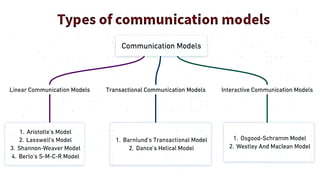
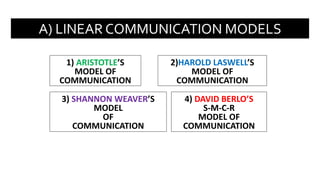
A) LINEAR COMMUNICATION MODELS
➢explains the process of one-way
communication, whereby a sender transmits a
message, and a receiver absorbs or
understands it (What’s a Linear Model of
Communication?, 2024).
A) LINEAR COMMUNICATION MODELS
1) ARISTOTLE’S
MODEL OF
COMMUNICATION
2)HAROLD LASWELL’S
MODEL OF
COMMUNICATION
4) DAVID BERLO’S
S-M-C-R
MODEL OF
COMMUNICATION
3) SHANNON WEAVER’S
MODEL
OF
COMMUNICATION
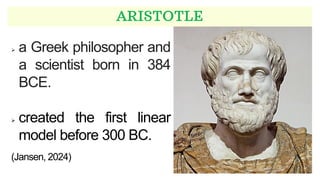
ARISTOTLE
➢ a Greek philosopher and
a scientist born in 384
BCE.
➢ created the first linear
model before 300 BC.
(Jansen, 2024)
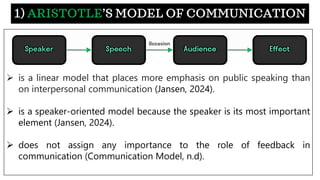
➢ is a linear model that places more emphasis on public speaking than
on interpersonal communication (Jansen, 2024).
➢ is a speaker-oriented model because the speaker is its most important
element (Jansen, 2024).
➢ does not assign any importance to the role of feedback in
communication (Communication Model, n.d).
1) ARISTOTLE’S MODEL OF COMMUNICATION
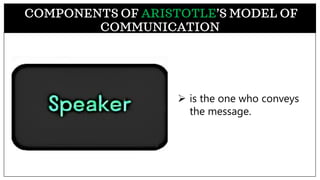
COMPONENTS OF ARISTOTLE’S MODEL OF
COMMUNICATION
➢ is the one who conveys
the message.
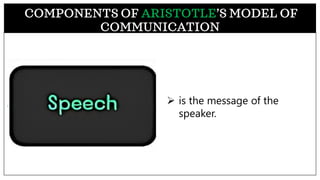
➢ is the message of the
speaker.
COMPONENTS OF ARISTOTLE’S MODEL OF
COMMUNICATION
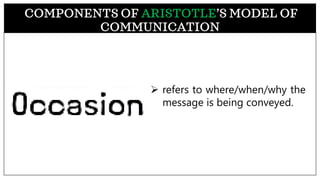
➢ refers to where/when/why the
message is being conveyed.
COMPONENTS OF ARISTOTLE’S MODEL OF
COMMUNICATION
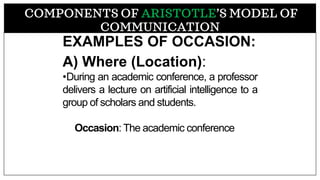
A) Where (Location):
•During an academic conference, a professor
delivers a lecture on artificial intelligence to a
group of scholars and students.
Occasion: The academic conference
EXAMPLES OF OCCASION:
COMPONENTS OF ARISTOTLE’S MODEL OF
COMMUNICATION
EXAMPLES OF OCCASION:
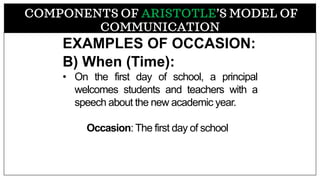
B) When (Time):
• On the first day of school, a principal
welcomes students and teachers with a
speech about the new academic year.
Occasion: The first day of school
COMPONENTS OF ARISTOTLE’S MODEL OF
COMMUNICATION
EXAMPLES OF OCCASION:
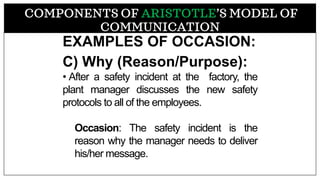
C) Why (Reason/Purpose):
• After a safety incident at the factory, the
plant manager discusses the new safety
protocols to all of the employees.
Occasion: The safety incident is the
reason why the manager needs to deliver
his/her message.
COMPONENTS OF ARISTOTLE’S MODEL OF
COMMUNICATION
➢ refers to the people or
group who will receive
and understand the
message from the
speaker.
COMPONENTS OF ARISTOTLE’S MODEL OF
COMMUNICATION
➢refers to the impact
that the message
created on the
audience.
COMPONENTS OF ARISTOTLE’S MODEL OF
COMMUNICATION
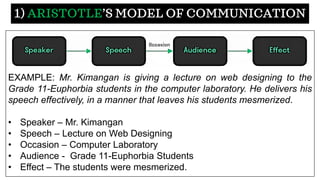
EXAMPLE: Mr. Kimangan is giving a lecture on web designing to the
Grade 11-Euphorbia students in the computer laboratory. He delivers his
speech effectively, in a manner that leaves his students mesmerized.
• Speaker – Mr. Kimangan
• Speech – Lecture on Web Designing
• Occasion – Computer Laboratory
• Audience - Grade 11-Euphorbia Students
• Effect – The students were mesmerized.
1) ARISTOTLE’S MODEL OF COMMUNICATION
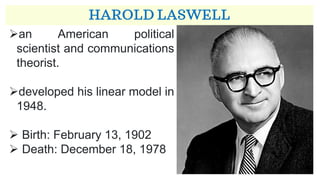
HAROLD LASWELL
➢an American political
scientist and communications
theorist.
➢developed his linear model in
1948.
➢ Birth: February 13, 1902
➢ Death: December 18, 1978
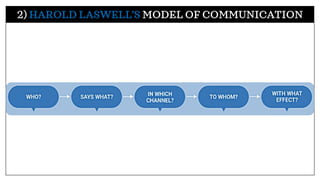
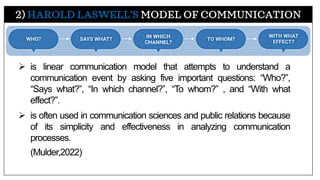
2) HAROLD LASWELL’S MODEL OF COMMUNICATION
➢ is linear communication model that attempts to understand a
communication event by asking five important questions: “Who?”,
“Says what?”, “In which channel?”, “To whom?” , and “With what
effect?”.
➢ is often used in communication sciences and public relations because
of its simplicity and effectiveness in analyzing communication
processes.
(Mulder,2022)
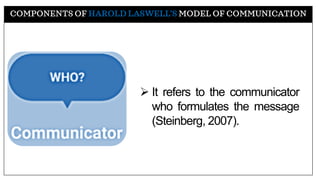
COMPONENTS OF HAROLD LASWELL’S MODEL OF COMMUNICATION
➢ It refers to the communicator
who formulates the message
(Steinberg, 2007).
COMPONENTS OF HAROLD LASWELL’S MODEL OF COMMUNICATION
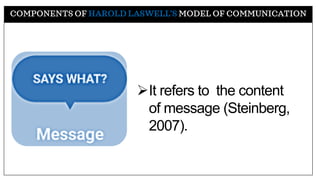
➢It refers to the content
of message (Steinberg,
2007).
COMPONENTS OF HAROLD LASWELL’S MODEL OF COMMUNICATION
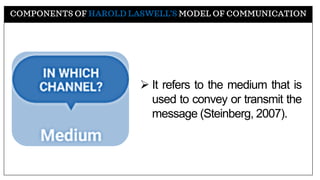
➢ It refers to the medium that is
used to convey or transmit the
message (Steinberg, 2007).
COMPONENTS OF HAROLD LASWELL’S MODEL OF COMMUNICATION
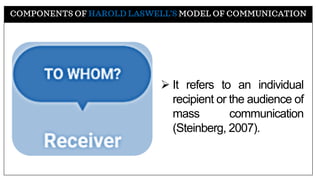
➢ It refers to an individual
recipient or the audience of
mass communication
(Steinberg, 2007).
COMPONENTS OF HAROLD LASWELL’S MODEL OF COMMUNICATION
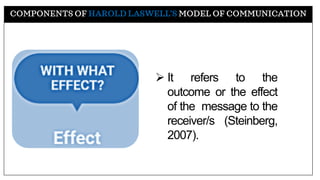
➢ It refers to the
outcome or the effect
of the message to the
receiver/s (Steinberg,
2007).
2) HAROLD LASWELL’S MODEL OF COMMUNICATION
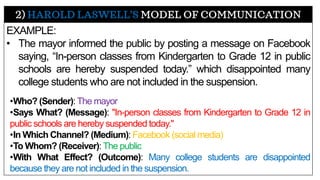
EXAMPLE:
• The mayor informed the public by posting a message on Facebook
saying, “In-person classes from Kindergarten to Grade 12 in public
schools are hereby suspended today.” which disappointed many
college students who are not included in the suspension.
•Who? (Sender): The mayor
•Says What? (Message): "In-person classes from Kindergarten to Grade 12 in
public schools are hereby suspended today."
•In Which Channel? (Medium): Facebook (social media)
•To Whom? (Receiver): The public
•With What Effect? (Outcome): Many college students are disappointed
because they are not included in the suspension.
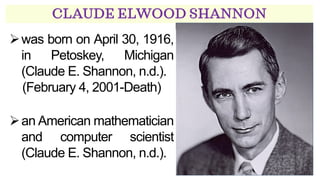
CLAUDE ELWOOD SHANNON
➢was born on April 30, 1916,
in Petoskey, Michigan
(Claude E. Shannon, n.d.).
(February 4, 2001-Death)
➢an American mathematician
and computer scientist
(Claude E. Shannon, n.d.).
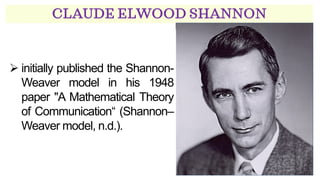
CLAUDE ELWOOD SHANNON
➢ initially published the Shannon-
Weaver model in his 1948
paper "A Mathematical Theory
of Communication“ (Shannon–
Weaver model, n.d.).
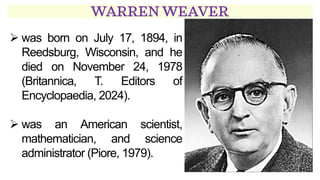
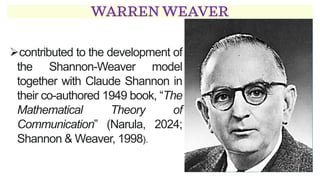
WARREN WEAVER
➢ was born on July 17, 1894, in
Reedsburg, Wisconsin, and he
died on November 24, 1978
(Britannica, T. Editors of
Encyclopaedia, 2024).
➢ was an American scientist,
mathematician, and science
administrator (Piore, 1979).
WARREN WEAVER
➢contributed to the development of
the Shannon-Weaver model
together with Claude Shannon in
their co-authored 1949 book, “The
Mathematical Theory of
Communication” (Narula, 2024;
Shannon & Weaver, 1998).
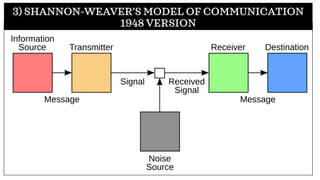
3) SHANNON-WEAVER’S MODEL OF COMMUNICATION
1948 VERSION
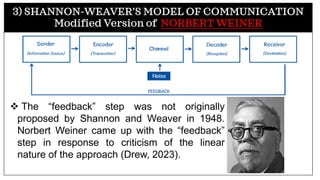
3) SHANNON-WEAVER’S MODEL OF COMMUNICATION
Modified Version of NORBERT WEINER
❖ The “feedback” step was not originally
proposed by Shannon and Weaver in 1948.
Norbert Weiner came up with the “feedback”
step in response to criticism of the linear
nature of the approach (Drew, 2023).
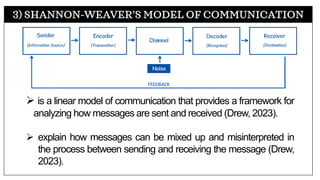
3) SHANNON-WEAVER’S MODEL OF COMMUNICATION
➢ is a linear model of communication that provides a framework for
analyzing how messages are sent and received (Drew, 2023).
➢ explain how messages can be mixed up and misinterpreted in
the process between sending and receiving the message (Drew,
2023).
COMPONENTS OF SHANNON-WEAVER’S MODEL OF
COMMUNICATION
➢starts the process by choosing a
message to send, someone to send the
message to, and a channel through
which to send the message (Drew, 2023).
COMPONENTS OF SHANNON-WEAVER’S MODEL OF
COMMUNICATION
➢refers to the machine that
converts the message into
signals that can be sent from
the sender to the receiver
(Drew, 2023).
COMPONENTS OF SHANNON-WEAVER’S MODEL OF
COMMUNICATION
➢is the infrastructure that gets
information from the sender and
transmitter through to the decoder
and receiver.
➢sometimes called as the “medium”.
(Drew, 2023)
COMPONENTS OF SHANNON-WEAVER’S MODEL OF
COMMUNICATION
➢refers to what interrupts a
message while it’s on the way
from the sender to the receiver.
2 TYPES OF NOISE
➢happens when a sender makes a mistake
encoding a message or a receiver makes a mistake
decoding the message.
EXAMPLES:
➢Shenna misspelled a word in her text message
because she was in a rush to reply her friend’s
message.
➢Jona misinterpreted the message of her gay
friend because of a jargon used by her friend.
1) INTERNAL NOISE
2 TYPES OF NOISE
➢happens when something external that
is not in the control of sender or receiver
disrupts the message.
➢
EXAMPLE:
• Mia cannot hear her friend on the
phone because of the loud honking of
the cars on the highway.
2) EXTERNAL NOISE
COMPONENTS OF SHANNON-WEAVER’S MODEL OF
COMMUNICATION
➢ refers to the machine used to
convert signals or binary data from
the encoder into message
(Bhandari, 2024).
COMPONENTS OF SHANNON-WEAVER’S MODEL OF
COMMUNICATION
➢refers to the person who
receives the message from the
sender (Bhandari, 2024).
COMPONENTS OF SHANNON-WEAVER’S MODEL OF
COMMUNICATION
➢occurs when the receiver of the
message responds to the sender to
close the communication loop
(Drew, 2023).
3) SHANNON-WEAVER’S MODEL OF COMMUNICATION
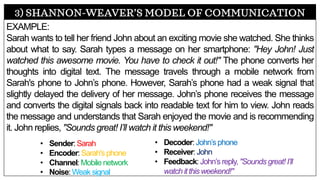
EXAMPLE:
Sarah wants to tell her friend John about an exciting movie she watched. She thinks
about what to say. Sarah types a message on her smartphone: "Hey John! Just
watched this awesome movie. You have to check it out!" The phone converts her
thoughts into digital text. The message travels through a mobile network from
Sarah's phone to John’s phone. However, Sarah’s phone had a weak signal that
slightly delayed the delivery of her message. John’s phone receives the message
and converts the digital signals back into readable text for him to view. John reads
the message and understands that Sarah enjoyed the movie and is recommending
it. John replies, "Sounds great! I’ll watch it this weekend!"
• Sender: Sarah
• Encoder: Sarah's phone
• Channel: Mobile network
• Noise: Weak signal
• Decoder: John’s phone
• Receiver: John
• Feedback: John’s reply, "Sounds great! I’ll
watch it this weekend!"
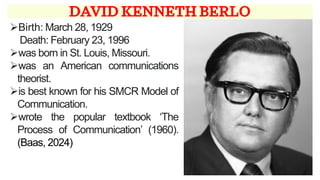
DAVID KENNETH BERLO
➢Birth: March 28, 1929
Death: February 23, 1996
➢was born in St. Louis, Missouri.
➢was an American communications
theorist.
➢is best known for his SMCR Model of
Communication.
➢wrote the popular textbook ‘The
Process of Communication’ (1960).
(Baas, 2024)
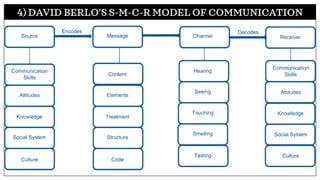
4) DAVID BERLO’S S-M-C-R MODEL OF COMMUNICATION
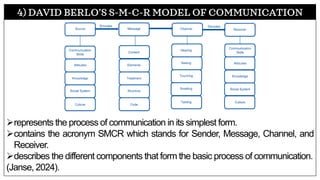
➢represents the process of communication in its simplest form.
➢contains the acronym SMCR which stands for Sender, Message, Channel, and
Receiver.
➢describes the different components that form the basic process of communication.
(Janse, 2024).
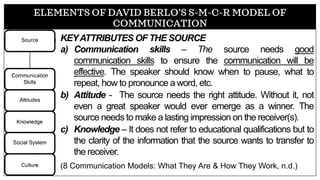
ELEMENTS OF DAVID BERLO’S S-M-C-R MODEL OF
COMMUNICATION
➢or the sender needs to carefully put
their thoughts into words and transfers
the message to the receiver (8
Communication Models: What They
Are & How They Work, n.d.).
ELEMENTS OF DAVID BERLO’S S-M-C-R MODEL OF
COMMUNICATION
KEYATTRIBUTES OF THE SOURCE
a) Communication skills – The source needs good
communication skills to ensure the communication will be
effective. The speaker should know when to pause, what to
repeat, how to pronounce a word, etc.
b) Attitude - The source needs the right attitude. Without it, not
even a great speaker would ever emerge as a winner. The
source needs to make a lasting impression on the receiver(s).
c) Knowledge – It does not refer to educational qualifications but to
the clarity of the information that the source wants to transfer to
the receiver.
(8 Communication Models: What They Are & How They Work, n.d.)
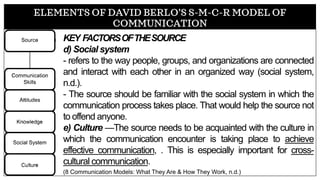
ELEMENTS OF DAVID BERLO’S S-M-C-R MODEL OF
COMMUNICATION
KEY FACTORSOFTHESOURCE
d) Social system
- refers to the way people, groups, and organizations are connected
and interact with each other in an organized way (social system,
n.d.).
- The source should be familiar with the social system in which the
communication process takes place. That would help the source not
to offend anyone.
e) Culture —The source needs to be acquainted with the culture in
which the communication encounter is taking place to achieve
effective communication, . This is especially important for cross-
cultural communication.
(8 Communication Models: What They Are & How They Work, n.d.)
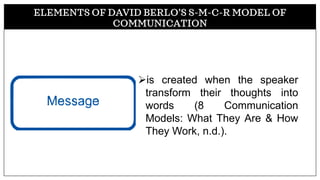
ELEMENTS OF DAVID BERLO’S S-M-C-R MODEL OF
COMMUNICATION
➢is created when the speaker
transform their thoughts into
words (8 Communication
Models: What They Are & How
They Work, n.d.).
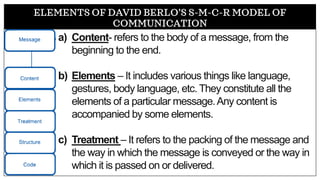
ELEMENTS OF DAVID BERLO’S S-M-C-R MODEL OF
COMMUNICATION
a) Content- refers to the body of a message, from the
beginning to the end.
b) Elements – It includes various things like language,
gestures, body language, etc. They constitute all the
elements of a particular message.Any content is
accompanied by some elements.
c) Treatment – It refers to the packing of the message and
the way in which the message is conveyed or the way in
which it is passed on or delivered.
ELEMENTS OF DAVID BERLO’S S-M-C-R MODEL OF
COMMUNICATION
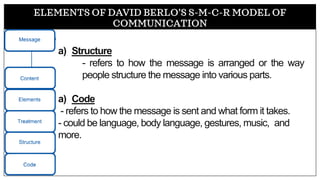
a) Structure
- refers to how the message is arranged or the way
people structure the message into various parts.
a) Code
- refers to how the message is sent and what form it takes.
- could be language, body language, gestures, music, and
more.
ELEMENTS OF DAVID BERLO’S S-M-C-R MODEL OF
COMMUNICATION
➢ Itreferstothefivesenseorgans.
➢ can be any of the 5 senses or
combination.
(BERLO’SSMCRMODELOFCOMMUNICATION,2019)
ELEMENTS OF DAVID BERLO’S S-M-C-R MODEL OF
COMMUNICATION
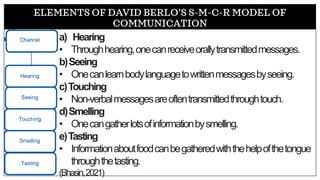
a) Hearing
• Throughhearing,onecanreceiveorallytransmittedmessages.
b)Seeing
• Onecanlearnbodylanguagetowrittenmessagesbyseeing.
c)Touching
• Non-verbalmessagesareoftentransmittedthroughtouch.
d)Smelling
• Onecangatherlotsofinformationbysmelling.
e)Tasting
• Informationaboutfoodcanbegatheredwiththehelpofthetongue
throughthetasting.
(Bhasin,2021)
ELEMENTS OF DAVID BERLO’S S-M-C-R MODEL OF
COMMUNICATION
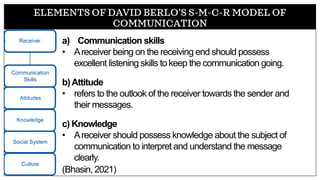
➢refers to the person who receives
and decodes the message.
➢has the responsibility to interpret and
understand the meaning of the
message of the sender.
(Bhasin, 2021)
ELEMENTS OF DAVID BERLO’S S-M-C-R MODEL OF
COMMUNICATION
a) Communication skills
• Areceiver being on the receiving end should possess
excellent listening skills to keep the communication going.
b)Attitude
• refers to the outlook of the receiver towards the sender and
their messages.
c) Knowledge
• Areceiver should possess knowledge about the subject of
communication to interpret and understand the message
clearly.
(Bhasin, 2021)
ELEMENTS OF DAVID BERLO’S S-M-C-R MODEL OF
COMMUNICATION
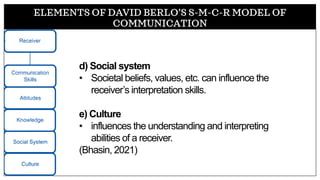
d) Social system
• Societal beliefs, values, etc. can influence the
receiver’s interpretation skills.
e) Culture
• influences the understanding and interpreting
abilities of a receiver.
(Bhasin, 2021)
B) INTERACTIVE COMMUNICATION MODELS
➢ are used in internet-based and mediated
communication such as telephone conversations,
letters, etc.
➢ refer to two-way communication with feedback.
• However, feedback within interactive communication
models is not simultaneous, but rather slow and
indirect.
(8 Communication Models: What They Are & How They Work, n.d.)
B) INTERACTIVE COMMUNICATION MODELS
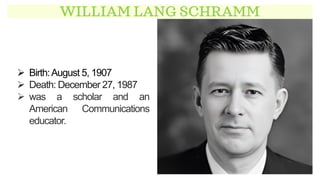
WILLIAM LANG SCHRAMM
➢ Birth:August 5, 1907
➢ Death: December 27, 1987
➢ was a scholar and an
American Communications
educator.
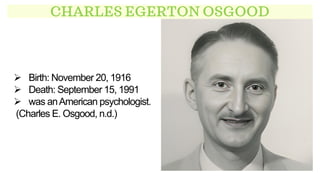
CHARLES EGERTON OSGOOD
➢ Birth: November 20, 1916
➢ Death: September 15, 1991
➢ was anAmerican psychologist.
(Charles E. Osgood, n.d.)
OSGOOD-SCHRAMM MODEL OF COMMUNICATION
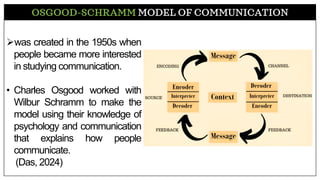
➢was created in the 1950s when
people became more interested
in studying communication.
• Charles Osgood worked with
Wilbur Schramm to make the
model using their knowledge of
psychology and communication
that explains how people
communicate.
(Das, 2024)
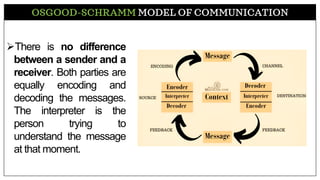
OSGOOD-SCHRAMM MODEL OF COMMUNICATION
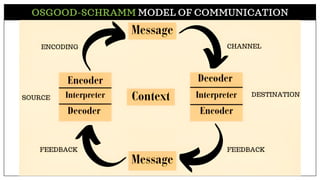
➢There is no difference
between a sender and a
receiver. Both parties are
equally encoding and
decoding the messages.
The interpreter is the
person trying to
understand the message
at that moment.
4 PRINCIPLES OF OSGOOD-SCHRAMM MODEL OF
COMMUNICATION
1.Communication is circular. — Individuals involved in the
communication process are changing their roles as encoders
and decoders.
2.Communication is equal and reciprocal. — Both parties are
equally engaged as encoders and decoders.
3.The message requires interpretation. — The information
needs to be properly interpreted to be understood.
4.As shown in the Osgood-Schramm communication model
diagram below, this model proposes 3 steps in the process of
communication: encoding, decoding, and interpreting.
(8 Communication Models: What They Are & How They Work, n.d.)
COMPONENTS OF OSGOOD-SCHRAMM MODEL OF
COMMUNICATION
1)Sender - the person or group starting the communication.
2)Message - what the sender wants to communicate to the receiver.
3)Receiver - refers to the person meant to get the message.
4)Feedback - the response from the receiver to the sender’s message.
5)Context - the situation and environment where communication happens.
6)Channel - the way the message is shared from the sender to the receiver.
7)Noise - anything that disrupts communication and can cause misunderstandings.
(Das, 2024)
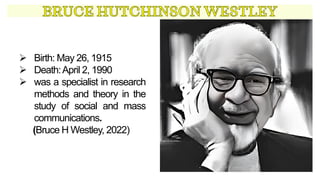
➢ Birth: May 26, 1915
➢ Death:April 2, 1990
➢ was a specialist in research
methods and theory in the
study of social and mass
communications.
(Bruce H Westley, 2022)
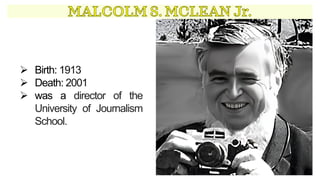
➢ Birth: 1913
➢ Death: 2001
➢ was a director of the
University of Journalism
School.
WESTLEY AND MCLEAN MODEL OF COMMUNICATION
➢ is primarily used for explaining mass
communication.
• Westley and MacLean believed that
communication doesn’t start from day one but
actually begins when the speaker receives
signals or messages from his external
surroundings.
WESTLEY AND MCLEAN MODEL OF COMMUNICATION
MODEL OF
COMMUNICATION
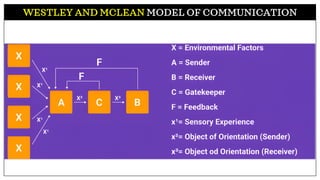
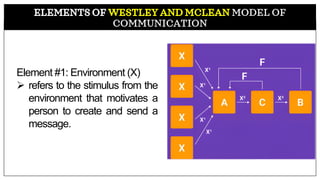
Element #1: Environment (X)
➢ refers to the stimulus from the
environment that motivates a
person to create and send a
message.
MODEL OF
COMMUNICATION
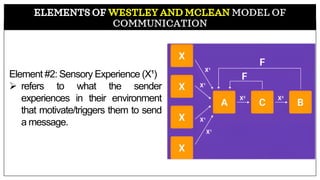
Element #2: Sensory Experience (X¹)
➢ refers to what the sender
experiences in their environment
that motivate/triggers them to send
a message.
MODEL OF
COMMUNICATION
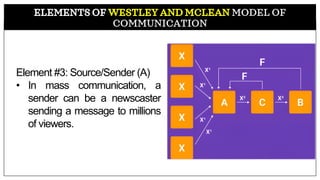
Element #3: Source/Sender (A)
• In mass communication, a
sender can be a newscaster
sending a message to millions
of viewers.
MODEL OF
COMMUNICATION
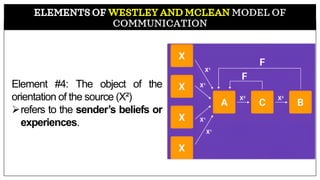
Element #4: The object of the
orientation of the source (X²)
➢refers to the sender’s beliefs or
experiences.
MODEL OF
COMMUNICATION
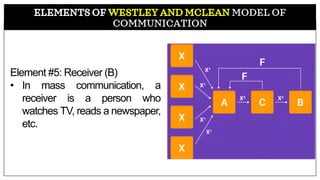
Element #5: Receiver (B)
• In mass communication, a
receiver is a person who
watches TV, reads a newspaper,
etc.
MODEL OF
COMMUNICATION
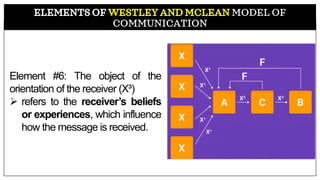
Element #6: The object of the
orientation of the receiver (X³)
➢ refers to the receiver’s beliefs
or experiences, which influence
how the message is received.
MODEL OF
COMMUNICATION
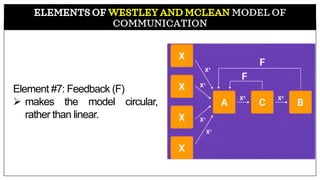
Element #7: Feedback (F)
➢ makes the model circular,
rather than linear.
MODEL OF
COMMUNICATION
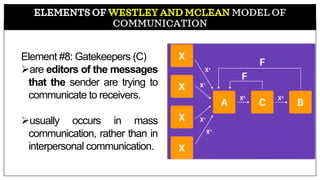
Element #8: Gatekeepers (C)
➢are editors of the messages
that the sender are trying to
communicate to receivers.
➢usually occurs in mass
communication, rather than in
interpersonal communication.
MODEL OF COMMUNICATION
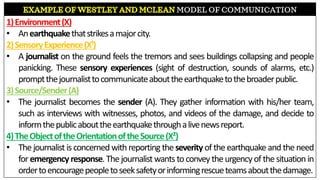
1)Environment(X)
• Anearthquakethatstrikesamajorcity.
2)SensoryExperience(X¹)
• A journalist on the ground feels the tremors and sees buildings collapsing and people
panicking. These sensory experiences (sight of destruction, sounds of alarms, etc.)
promptthejournalisttocommunicateabouttheearthquaketothebroaderpublic.
3)Source/Sender(A)
• The journalist becomes the sender (A). They gather information with his/her team,
such as interviews with witnesses, photos, and videos of the damage, and decide to
informthepublicabouttheearthquakethroughalivenewsreport.
4)TheObjectoftheOrientationoftheSource(X²)
• The journalist is concerned with reporting the severity of the earthquake and the need
for emergency response. The journalist wants to convey the urgency of the situation in
ordertoencouragepeopletoseeksafetyorinformingrescueteamsaboutthedamage.
MODEL OF COMMUNICATION
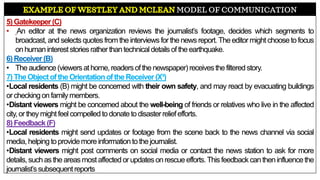
5)Gatekeeper(C)
• An editor at the news organization reviews the journalist’s footage, decides which segments to
broadcast, and selects quotes from theinterviews for thenews report.The editor mightchoose tofocus
onhumanintereststoriesratherthantechnicaldetailsoftheearthquake.
6)Receiver(B)
• Theaudience(viewersathome,readersofthenewspaper)receivesthefilteredstory.
7)TheObjectoftheOrientationoftheReceiver(X³)
•Local residents (B) might be concerned with their own safety, and may react by evacuating buildings
orcheckingonfamilymembers.
•Distant viewers might be concerned about the well-being of friends or relatives who live in the affected
city,ortheymightfeelcompelledtodonatetodisasterreliefefforts.
8)Feedback(F)
•Local residents might send updates or footage from the scene back to the news channel via social
media,helpingtoprovidemoreinformationtothejournalist.
•Distant viewers might post comments on social media or contact the news station to ask for more
details,suchastheareasmostaffectedorupdatesonrescueefforts.Thisfeedbackcantheninfluencethe
journalist’ssubsequentreports
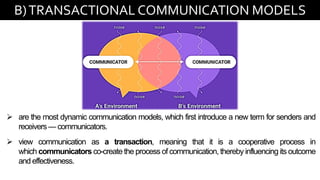
B)TRANSACTIONAL COMMUNICATION MODELS
➢ are the most dynamic communication models, which first introduce a new term for senders and
receivers — communicators.
➢ view communication as a transaction, meaning that it is a cooperative process in
which communicators co-create the process of communication, thereby influencing its outcome
and effectiveness.
BARLUND’S TRANSACTIONAL MODEL OF COMMUNICATION
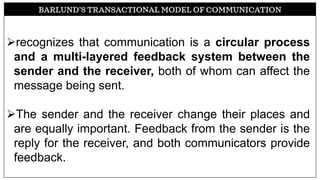
➢recognizes that communication is a circular process
and a multi-layered feedback system between the
sender and the receiver, both of whom can affect the
message being sent.
➢The sender and the receiver change their places and
are equally important. Feedback from the sender is the
reply for the receiver, and both communicators provide
feedback.
COMPONENTS OF BARLUND’S TRANSACTIONAL MODEL OF
COMMUNICATION
• Encoding
• Decoding
• Communicators
- refers both to the sender and receiver.
• Message
- includes the cues, environment, and noise.
• Channel
BARLUND’S TRANSACTIONAL MODEL OF COMMUNICATION
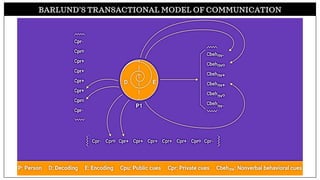
➢ accentuates the role of cues in impacting our messages:
•Public cues (environmental cues),
•Private cues (person’s personal thoughts and background), and
•Behavioral cues (person’s behavior, that can be verbal and nonverbal).
❑All these cues, as well as the environment and noise, are part of the
message. Each communicator’s reaction depends on their background,
experiences, attitudes, and beliefs.
Examples of Barnlund’s Model of communication include:
•Face-to-face interactions,
•Chat sessions,
•Telephone conversations,
•Meetings, etc.
DANCE’S HELICAL MODEL OF COMMUNICATION
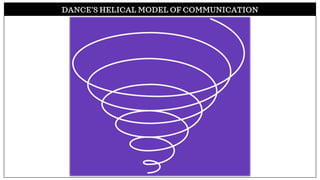
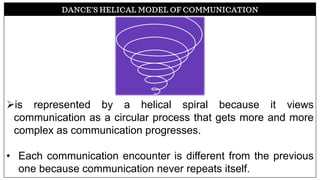
➢is represented by a helical spiral
because it views communication as a
circular process that gets more and
more complex as communication
progresses.
DANCE’S HELICAL MODEL OF COMMUNICATION
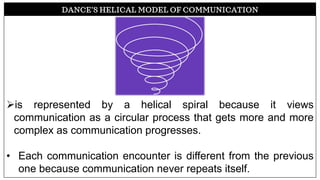
➢is represented by a helical spiral because it views
communication as a circular process that gets more and more
complex as communication progresses.
• Each communication encounter is different from the previous
one because communication never repeats itself.
DANCE’S HELICAL MODEL OF COMMUNICATION
➢is represented by a helical spiral because it views
communication as a circular process that gets more and more
complex as communication progresses.
• Each communication encounter is different from the previous
one because communication never repeats itself.
EXAMPLE OF DANCE’S HELICAL MODEL OF COMMUNICATION
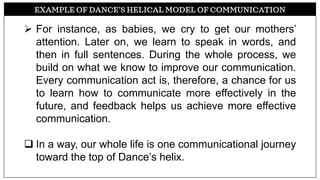
➢ For instance, as babies, we cry to get our mothers’
attention. Later on, we learn to speak in words, and
then in full sentences. During the whole process, we
build on what we know to improve our communication.
Every communication act is, therefore, a chance for us
to learn how to communicate more effectively in the
future, and feedback helps us achieve more effective
communication.
❑ In a way, our whole life is one communicational journey
toward the top of Dance’s helix.

COMMUNICATION MODELS-PURPOSIVE COMMUNICATION.pdf

  • 1.
  • 2.
    COMMUNICATION MODEL • Apictorial or systematic representation of the communication process, ideas, thoughts, or concepts through diagrams, etc. that help us understand how communication can be carried out (Communication Model, n.d).
  • 4.
  • 5.
    A) LINEAR COMMUNICATIONMODELS ➢explains the process of one-way communication, whereby a sender transmits a message, and a receiver absorbs or understands it (What’s a Linear Model of Communication?, 2024).
  • 6.
    A) LINEAR COMMUNICATIONMODELS 1) ARISTOTLE’S MODEL OF COMMUNICATION 2)HAROLD LASWELL’S MODEL OF COMMUNICATION 4) DAVID BERLO’S S-M-C-R MODEL OF COMMUNICATION 3) SHANNON WEAVER’S MODEL OF COMMUNICATION
  • 7.
    ARISTOTLE ➢ a Greekphilosopher and a scientist born in 384 BCE. ➢ created the first linear model before 300 BC. (Jansen, 2024)
  • 8.
    ➢ is alinear model that places more emphasis on public speaking than on interpersonal communication (Jansen, 2024). ➢ is a speaker-oriented model because the speaker is its most important element (Jansen, 2024). ➢ does not assign any importance to the role of feedback in communication (Communication Model, n.d). 1) ARISTOTLE’S MODEL OF COMMUNICATION
  • 9.
    COMPONENTS OF ARISTOTLE’SMODEL OF COMMUNICATION ➢ is the one who conveys the message.
  • 10.
    ➢ is themessage of the speaker. COMPONENTS OF ARISTOTLE’S MODEL OF COMMUNICATION
  • 11.
    ➢ refers towhere/when/why the message is being conveyed. COMPONENTS OF ARISTOTLE’S MODEL OF COMMUNICATION
  • 12.
    A) Where (Location): •Duringan academic conference, a professor delivers a lecture on artificial intelligence to a group of scholars and students. Occasion: The academic conference EXAMPLES OF OCCASION: COMPONENTS OF ARISTOTLE’S MODEL OF COMMUNICATION
  • 13.
    EXAMPLES OF OCCASION: B)When (Time): • On the first day of school, a principal welcomes students and teachers with a speech about the new academic year. Occasion: The first day of school COMPONENTS OF ARISTOTLE’S MODEL OF COMMUNICATION
  • 14.
    EXAMPLES OF OCCASION: C)Why (Reason/Purpose): • After a safety incident at the factory, the plant manager discusses the new safety protocols to all of the employees. Occasion: The safety incident is the reason why the manager needs to deliver his/her message. COMPONENTS OF ARISTOTLE’S MODEL OF COMMUNICATION
  • 15.
    ➢ refers tothe people or group who will receive and understand the message from the speaker. COMPONENTS OF ARISTOTLE’S MODEL OF COMMUNICATION
  • 16.
    ➢refers to theimpact that the message created on the audience. COMPONENTS OF ARISTOTLE’S MODEL OF COMMUNICATION
  • 17.
    EXAMPLE: Mr. Kimanganis giving a lecture on web designing to the Grade 11-Euphorbia students in the computer laboratory. He delivers his speech effectively, in a manner that leaves his students mesmerized. • Speaker – Mr. Kimangan • Speech – Lecture on Web Designing • Occasion – Computer Laboratory • Audience - Grade 11-Euphorbia Students • Effect – The students were mesmerized. 1) ARISTOTLE’S MODEL OF COMMUNICATION
  • 18.
    HAROLD LASWELL ➢an Americanpolitical scientist and communications theorist. ➢developed his linear model in 1948. ➢ Birth: February 13, 1902 ➢ Death: December 18, 1978
  • 19.
    2) HAROLD LASWELL’SMODEL OF COMMUNICATION
  • 20.
    2) HAROLD LASWELL’SMODEL OF COMMUNICATION ➢ is linear communication model that attempts to understand a communication event by asking five important questions: “Who?”, “Says what?”, “In which channel?”, “To whom?” , and “With what effect?”. ➢ is often used in communication sciences and public relations because of its simplicity and effectiveness in analyzing communication processes. (Mulder,2022)
  • 21.
    COMPONENTS OF HAROLDLASWELL’S MODEL OF COMMUNICATION ➢ It refers to the communicator who formulates the message (Steinberg, 2007).
  • 22.
    COMPONENTS OF HAROLDLASWELL’S MODEL OF COMMUNICATION ➢It refers to the content of message (Steinberg, 2007).
  • 23.
    COMPONENTS OF HAROLDLASWELL’S MODEL OF COMMUNICATION ➢ It refers to the medium that is used to convey or transmit the message (Steinberg, 2007).
  • 24.
    COMPONENTS OF HAROLDLASWELL’S MODEL OF COMMUNICATION ➢ It refers to an individual recipient or the audience of mass communication (Steinberg, 2007).
  • 25.
    COMPONENTS OF HAROLDLASWELL’S MODEL OF COMMUNICATION ➢ It refers to the outcome or the effect of the message to the receiver/s (Steinberg, 2007).
  • 26.
    2) HAROLD LASWELL’SMODEL OF COMMUNICATION EXAMPLE: • The mayor informed the public by posting a message on Facebook saying, “In-person classes from Kindergarten to Grade 12 in public schools are hereby suspended today.” which disappointed many college students who are not included in the suspension. •Who? (Sender): The mayor •Says What? (Message): "In-person classes from Kindergarten to Grade 12 in public schools are hereby suspended today." •In Which Channel? (Medium): Facebook (social media) •To Whom? (Receiver): The public •With What Effect? (Outcome): Many college students are disappointed because they are not included in the suspension.
  • 27.
    CLAUDE ELWOOD SHANNON ➢wasborn on April 30, 1916, in Petoskey, Michigan (Claude E. Shannon, n.d.). (February 4, 2001-Death) ➢an American mathematician and computer scientist (Claude E. Shannon, n.d.).
  • 28.
    CLAUDE ELWOOD SHANNON ➢initially published the Shannon- Weaver model in his 1948 paper "A Mathematical Theory of Communication“ (Shannon– Weaver model, n.d.).
  • 29.
    WARREN WEAVER ➢ wasborn on July 17, 1894, in Reedsburg, Wisconsin, and he died on November 24, 1978 (Britannica, T. Editors of Encyclopaedia, 2024). ➢ was an American scientist, mathematician, and science administrator (Piore, 1979).
  • 30.
    WARREN WEAVER ➢contributed tothe development of the Shannon-Weaver model together with Claude Shannon in their co-authored 1949 book, “The Mathematical Theory of Communication” (Narula, 2024; Shannon & Weaver, 1998).
  • 31.
    3) SHANNON-WEAVER’S MODELOF COMMUNICATION 1948 VERSION
  • 32.
    3) SHANNON-WEAVER’S MODELOF COMMUNICATION Modified Version of NORBERT WEINER ❖ The “feedback” step was not originally proposed by Shannon and Weaver in 1948. Norbert Weiner came up with the “feedback” step in response to criticism of the linear nature of the approach (Drew, 2023).
  • 33.
    3) SHANNON-WEAVER’S MODELOF COMMUNICATION ➢ is a linear model of communication that provides a framework for analyzing how messages are sent and received (Drew, 2023). ➢ explain how messages can be mixed up and misinterpreted in the process between sending and receiving the message (Drew, 2023).
  • 34.
    COMPONENTS OF SHANNON-WEAVER’SMODEL OF COMMUNICATION ➢starts the process by choosing a message to send, someone to send the message to, and a channel through which to send the message (Drew, 2023).
  • 35.
    COMPONENTS OF SHANNON-WEAVER’SMODEL OF COMMUNICATION ➢refers to the machine that converts the message into signals that can be sent from the sender to the receiver (Drew, 2023).
  • 36.
    COMPONENTS OF SHANNON-WEAVER’SMODEL OF COMMUNICATION ➢is the infrastructure that gets information from the sender and transmitter through to the decoder and receiver. ➢sometimes called as the “medium”. (Drew, 2023)
  • 37.
    COMPONENTS OF SHANNON-WEAVER’SMODEL OF COMMUNICATION ➢refers to what interrupts a message while it’s on the way from the sender to the receiver.
  • 38.
    2 TYPES OFNOISE ➢happens when a sender makes a mistake encoding a message or a receiver makes a mistake decoding the message. EXAMPLES: ➢Shenna misspelled a word in her text message because she was in a rush to reply her friend’s message. ➢Jona misinterpreted the message of her gay friend because of a jargon used by her friend. 1) INTERNAL NOISE
  • 39.
    2 TYPES OFNOISE ➢happens when something external that is not in the control of sender or receiver disrupts the message. ➢ EXAMPLE: • Mia cannot hear her friend on the phone because of the loud honking of the cars on the highway. 2) EXTERNAL NOISE
  • 40.
    COMPONENTS OF SHANNON-WEAVER’SMODEL OF COMMUNICATION ➢ refers to the machine used to convert signals or binary data from the encoder into message (Bhandari, 2024).
  • 41.
    COMPONENTS OF SHANNON-WEAVER’SMODEL OF COMMUNICATION ➢refers to the person who receives the message from the sender (Bhandari, 2024).
  • 42.
    COMPONENTS OF SHANNON-WEAVER’SMODEL OF COMMUNICATION ➢occurs when the receiver of the message responds to the sender to close the communication loop (Drew, 2023).
  • 43.
    3) SHANNON-WEAVER’S MODELOF COMMUNICATION EXAMPLE: Sarah wants to tell her friend John about an exciting movie she watched. She thinks about what to say. Sarah types a message on her smartphone: "Hey John! Just watched this awesome movie. You have to check it out!" The phone converts her thoughts into digital text. The message travels through a mobile network from Sarah's phone to John’s phone. However, Sarah’s phone had a weak signal that slightly delayed the delivery of her message. John’s phone receives the message and converts the digital signals back into readable text for him to view. John reads the message and understands that Sarah enjoyed the movie and is recommending it. John replies, "Sounds great! I’ll watch it this weekend!" • Sender: Sarah • Encoder: Sarah's phone • Channel: Mobile network • Noise: Weak signal • Decoder: John’s phone • Receiver: John • Feedback: John’s reply, "Sounds great! I’ll watch it this weekend!"
  • 44.
    DAVID KENNETH BERLO ➢Birth:March 28, 1929 Death: February 23, 1996 ➢was born in St. Louis, Missouri. ➢was an American communications theorist. ➢is best known for his SMCR Model of Communication. ➢wrote the popular textbook ‘The Process of Communication’ (1960). (Baas, 2024)
  • 45.
    4) DAVID BERLO’SS-M-C-R MODEL OF COMMUNICATION
  • 46.
    4) DAVID BERLO’SS-M-C-R MODEL OF COMMUNICATION ➢represents the process of communication in its simplest form. ➢contains the acronym SMCR which stands for Sender, Message, Channel, and Receiver. ➢describes the different components that form the basic process of communication. (Janse, 2024).
  • 47.
    ELEMENTS OF DAVIDBERLO’S S-M-C-R MODEL OF COMMUNICATION ➢or the sender needs to carefully put their thoughts into words and transfers the message to the receiver (8 Communication Models: What They Are & How They Work, n.d.).
  • 48.
    ELEMENTS OF DAVIDBERLO’S S-M-C-R MODEL OF COMMUNICATION KEYATTRIBUTES OF THE SOURCE a) Communication skills – The source needs good communication skills to ensure the communication will be effective. The speaker should know when to pause, what to repeat, how to pronounce a word, etc. b) Attitude - The source needs the right attitude. Without it, not even a great speaker would ever emerge as a winner. The source needs to make a lasting impression on the receiver(s). c) Knowledge – It does not refer to educational qualifications but to the clarity of the information that the source wants to transfer to the receiver. (8 Communication Models: What They Are & How They Work, n.d.)
  • 49.
    ELEMENTS OF DAVIDBERLO’S S-M-C-R MODEL OF COMMUNICATION KEY FACTORSOFTHESOURCE d) Social system - refers to the way people, groups, and organizations are connected and interact with each other in an organized way (social system, n.d.). - The source should be familiar with the social system in which the communication process takes place. That would help the source not to offend anyone. e) Culture —The source needs to be acquainted with the culture in which the communication encounter is taking place to achieve effective communication, . This is especially important for cross- cultural communication. (8 Communication Models: What They Are & How They Work, n.d.)
  • 50.
    ELEMENTS OF DAVIDBERLO’S S-M-C-R MODEL OF COMMUNICATION ➢is created when the speaker transform their thoughts into words (8 Communication Models: What They Are & How They Work, n.d.).
  • 51.
    ELEMENTS OF DAVIDBERLO’S S-M-C-R MODEL OF COMMUNICATION a) Content- refers to the body of a message, from the beginning to the end. b) Elements – It includes various things like language, gestures, body language, etc. They constitute all the elements of a particular message.Any content is accompanied by some elements. c) Treatment – It refers to the packing of the message and the way in which the message is conveyed or the way in which it is passed on or delivered.
  • 52.
    ELEMENTS OF DAVIDBERLO’S S-M-C-R MODEL OF COMMUNICATION a) Structure - refers to how the message is arranged or the way people structure the message into various parts. a) Code - refers to how the message is sent and what form it takes. - could be language, body language, gestures, music, and more.
  • 53.
    ELEMENTS OF DAVIDBERLO’S S-M-C-R MODEL OF COMMUNICATION ➢ Itreferstothefivesenseorgans. ➢ can be any of the 5 senses or combination. (BERLO’SSMCRMODELOFCOMMUNICATION,2019)
  • 54.
    ELEMENTS OF DAVIDBERLO’S S-M-C-R MODEL OF COMMUNICATION a) Hearing • Throughhearing,onecanreceiveorallytransmittedmessages. b)Seeing • Onecanlearnbodylanguagetowrittenmessagesbyseeing. c)Touching • Non-verbalmessagesareoftentransmittedthroughtouch. d)Smelling • Onecangatherlotsofinformationbysmelling. e)Tasting • Informationaboutfoodcanbegatheredwiththehelpofthetongue throughthetasting. (Bhasin,2021)
  • 55.
    ELEMENTS OF DAVIDBERLO’S S-M-C-R MODEL OF COMMUNICATION ➢refers to the person who receives and decodes the message. ➢has the responsibility to interpret and understand the meaning of the message of the sender. (Bhasin, 2021)
  • 56.
    ELEMENTS OF DAVIDBERLO’S S-M-C-R MODEL OF COMMUNICATION a) Communication skills • Areceiver being on the receiving end should possess excellent listening skills to keep the communication going. b)Attitude • refers to the outlook of the receiver towards the sender and their messages. c) Knowledge • Areceiver should possess knowledge about the subject of communication to interpret and understand the message clearly. (Bhasin, 2021)
  • 57.
    ELEMENTS OF DAVIDBERLO’S S-M-C-R MODEL OF COMMUNICATION d) Social system • Societal beliefs, values, etc. can influence the receiver’s interpretation skills. e) Culture • influences the understanding and interpreting abilities of a receiver. (Bhasin, 2021)
  • 58.
    B) INTERACTIVE COMMUNICATIONMODELS ➢ are used in internet-based and mediated communication such as telephone conversations, letters, etc. ➢ refer to two-way communication with feedback. • However, feedback within interactive communication models is not simultaneous, but rather slow and indirect. (8 Communication Models: What They Are & How They Work, n.d.)
  • 59.
  • 60.
    WILLIAM LANG SCHRAMM ➢Birth:August 5, 1907 ➢ Death: December 27, 1987 ➢ was a scholar and an American Communications educator.
  • 61.
    CHARLES EGERTON OSGOOD ➢Birth: November 20, 1916 ➢ Death: September 15, 1991 ➢ was anAmerican psychologist. (Charles E. Osgood, n.d.)
  • 62.
  • 63.
    OSGOOD-SCHRAMM MODEL OFCOMMUNICATION ➢was created in the 1950s when people became more interested in studying communication. • Charles Osgood worked with Wilbur Schramm to make the model using their knowledge of psychology and communication that explains how people communicate. (Das, 2024)
  • 64.
    OSGOOD-SCHRAMM MODEL OFCOMMUNICATION ➢There is no difference between a sender and a receiver. Both parties are equally encoding and decoding the messages. The interpreter is the person trying to understand the message at that moment.
  • 65.
    4 PRINCIPLES OFOSGOOD-SCHRAMM MODEL OF COMMUNICATION 1.Communication is circular. — Individuals involved in the communication process are changing their roles as encoders and decoders. 2.Communication is equal and reciprocal. — Both parties are equally engaged as encoders and decoders. 3.The message requires interpretation. — The information needs to be properly interpreted to be understood. 4.As shown in the Osgood-Schramm communication model diagram below, this model proposes 3 steps in the process of communication: encoding, decoding, and interpreting. (8 Communication Models: What They Are & How They Work, n.d.)
  • 66.
    COMPONENTS OF OSGOOD-SCHRAMMMODEL OF COMMUNICATION 1)Sender - the person or group starting the communication. 2)Message - what the sender wants to communicate to the receiver. 3)Receiver - refers to the person meant to get the message. 4)Feedback - the response from the receiver to the sender’s message. 5)Context - the situation and environment where communication happens. 6)Channel - the way the message is shared from the sender to the receiver. 7)Noise - anything that disrupts communication and can cause misunderstandings. (Das, 2024)
  • 67.
    ➢ Birth: May26, 1915 ➢ Death:April 2, 1990 ➢ was a specialist in research methods and theory in the study of social and mass communications. (Bruce H Westley, 2022)
  • 68.
    ➢ Birth: 1913 ➢Death: 2001 ➢ was a director of the University of Journalism School.
  • 69.
    WESTLEY AND MCLEANMODEL OF COMMUNICATION ➢ is primarily used for explaining mass communication. • Westley and MacLean believed that communication doesn’t start from day one but actually begins when the speaker receives signals or messages from his external surroundings.
  • 70.
    WESTLEY AND MCLEANMODEL OF COMMUNICATION
  • 71.
    MODEL OF COMMUNICATION Element #1:Environment (X) ➢ refers to the stimulus from the environment that motivates a person to create and send a message.
  • 72.
    MODEL OF COMMUNICATION Element #2:Sensory Experience (X¹) ➢ refers to what the sender experiences in their environment that motivate/triggers them to send a message.
  • 73.
    MODEL OF COMMUNICATION Element #3:Source/Sender (A) • In mass communication, a sender can be a newscaster sending a message to millions of viewers.
  • 74.
    MODEL OF COMMUNICATION Element #4:The object of the orientation of the source (X²) ➢refers to the sender’s beliefs or experiences.
  • 75.
    MODEL OF COMMUNICATION Element #5:Receiver (B) • In mass communication, a receiver is a person who watches TV, reads a newspaper, etc.
  • 76.
    MODEL OF COMMUNICATION Element #6:The object of the orientation of the receiver (X³) ➢ refers to the receiver’s beliefs or experiences, which influence how the message is received.
  • 77.
    MODEL OF COMMUNICATION Element #7:Feedback (F) ➢ makes the model circular, rather than linear.
  • 78.
    MODEL OF COMMUNICATION Element #8:Gatekeepers (C) ➢are editors of the messages that the sender are trying to communicate to receivers. ➢usually occurs in mass communication, rather than in interpersonal communication.
  • 79.
    MODEL OF COMMUNICATION 1)Environment(X) •Anearthquakethatstrikesamajorcity. 2)SensoryExperience(X¹) • A journalist on the ground feels the tremors and sees buildings collapsing and people panicking. These sensory experiences (sight of destruction, sounds of alarms, etc.) promptthejournalisttocommunicateabouttheearthquaketothebroaderpublic. 3)Source/Sender(A) • The journalist becomes the sender (A). They gather information with his/her team, such as interviews with witnesses, photos, and videos of the damage, and decide to informthepublicabouttheearthquakethroughalivenewsreport. 4)TheObjectoftheOrientationoftheSource(X²) • The journalist is concerned with reporting the severity of the earthquake and the need for emergency response. The journalist wants to convey the urgency of the situation in ordertoencouragepeopletoseeksafetyorinformingrescueteamsaboutthedamage.
  • 80.
    MODEL OF COMMUNICATION 5)Gatekeeper(C) •An editor at the news organization reviews the journalist’s footage, decides which segments to broadcast, and selects quotes from theinterviews for thenews report.The editor mightchoose tofocus onhumanintereststoriesratherthantechnicaldetailsoftheearthquake. 6)Receiver(B) • Theaudience(viewersathome,readersofthenewspaper)receivesthefilteredstory. 7)TheObjectoftheOrientationoftheReceiver(X³) •Local residents (B) might be concerned with their own safety, and may react by evacuating buildings orcheckingonfamilymembers. •Distant viewers might be concerned about the well-being of friends or relatives who live in the affected city,ortheymightfeelcompelledtodonatetodisasterreliefefforts. 8)Feedback(F) •Local residents might send updates or footage from the scene back to the news channel via social media,helpingtoprovidemoreinformationtothejournalist. •Distant viewers might post comments on social media or contact the news station to ask for more details,suchastheareasmostaffectedorupdatesonrescueefforts.Thisfeedbackcantheninfluencethe journalist’ssubsequentreports
  • 81.
    B)TRANSACTIONAL COMMUNICATION MODELS ➢are the most dynamic communication models, which first introduce a new term for senders and receivers — communicators. ➢ view communication as a transaction, meaning that it is a cooperative process in which communicators co-create the process of communication, thereby influencing its outcome and effectiveness.
  • 82.
  • 83.
    BARLUND’S TRANSACTIONAL MODELOF COMMUNICATION ➢recognizes that communication is a circular process and a multi-layered feedback system between the sender and the receiver, both of whom can affect the message being sent. ➢The sender and the receiver change their places and are equally important. Feedback from the sender is the reply for the receiver, and both communicators provide feedback.
  • 84.
    COMPONENTS OF BARLUND’STRANSACTIONAL MODEL OF COMMUNICATION • Encoding • Decoding • Communicators - refers both to the sender and receiver. • Message - includes the cues, environment, and noise. • Channel
  • 85.
    BARLUND’S TRANSACTIONAL MODELOF COMMUNICATION ➢ accentuates the role of cues in impacting our messages: •Public cues (environmental cues), •Private cues (person’s personal thoughts and background), and •Behavioral cues (person’s behavior, that can be verbal and nonverbal). ❑All these cues, as well as the environment and noise, are part of the message. Each communicator’s reaction depends on their background, experiences, attitudes, and beliefs. Examples of Barnlund’s Model of communication include: •Face-to-face interactions, •Chat sessions, •Telephone conversations, •Meetings, etc.
  • 86.
    DANCE’S HELICAL MODELOF COMMUNICATION
  • 87.
    DANCE’S HELICAL MODELOF COMMUNICATION ➢is represented by a helical spiral because it views communication as a circular process that gets more and more complex as communication progresses.
  • 88.
    DANCE’S HELICAL MODELOF COMMUNICATION ➢is represented by a helical spiral because it views communication as a circular process that gets more and more complex as communication progresses. • Each communication encounter is different from the previous one because communication never repeats itself.
  • 89.
    DANCE’S HELICAL MODELOF COMMUNICATION ➢is represented by a helical spiral because it views communication as a circular process that gets more and more complex as communication progresses. • Each communication encounter is different from the previous one because communication never repeats itself.
  • 90.
    EXAMPLE OF DANCE’SHELICAL MODEL OF COMMUNICATION ➢ For instance, as babies, we cry to get our mothers’ attention. Later on, we learn to speak in words, and then in full sentences. During the whole process, we build on what we know to improve our communication. Every communication act is, therefore, a chance for us to learn how to communicate more effectively in the future, and feedback helps us achieve more effective communication. ❑ In a way, our whole life is one communicational journey toward the top of Dance’s helix.