MODELS
OF
COMMUNICATION
Mcquail and Windhahl (1993)
 Model seeks to show the main elements of any structure
or process and the relationships between these elements.
Deutsch (1996)
 Models order and relate systems to each other by giving
us images of wholes.
M O D E L
 It gives a general picture of the particular circumstances
in the communication process.
 Helps in explaining or clarifying the complicated or
ambiguous in communication process.
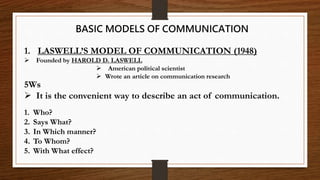
1. LASWELL’S MODEL OF COMMUNICATION (1948)
 Founded by HAROLD D. LASWELL
 American political scientist
 Wrote an article on communication research
BASIC MODELS OF COMMUNICATION
5Ws
 It is the convenient way to describe an act of communication.
1. Who?
2. Says What?
3. In Which manner?
4. To Whom?
5. With What effect?
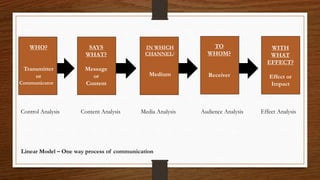
WHO?
Transmitter
or
Communicator
SAYS
WHAT?
Message
or
Content
IN WHICH
CHANNEL?
Medium
TO
WHOM?
Receiver
WITH
WHAT
EFFECT?
Effect or
Impact
Control Analysis Content Analysis Media Analysis Audience Analysis Effect Analysis
Linear Model – One way process of communication
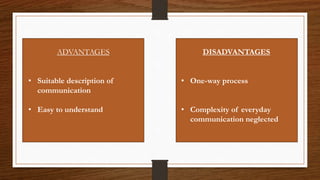
ADVANTAGES
• Suitable description of
communication
• Easy to understand
DISADVANTAGES
• One-way process
• Complexity of everyday
communication neglected
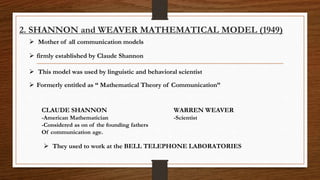
2. SHANNON and WEAVER MATHEMATICAL MODEL (1949)
CLAUDE SHANNON WARREN WEAVER
-American Mathematician -Scientist
-Considered as on of the founding fathers
Of communication age.
 firmly established by Claude Shannon
 Formerly entitled as “ Mathematical Theory of Communication”
 They used to work at the BELL TELEPHONE LABORATORIES
 Mother of all communication models
 This model was used by linguistic and behavioral scientist
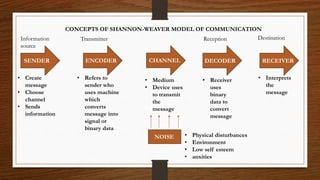
CONCEPTS OF SHANNON-WEAVER MODEL OF COMMUNICATION
SENDER ENCODER CHANNEL DECODER RECEIVER
Information
source
Transmitter Reception Destination
• Create
message
• Choose
channel
• Sends
information
• Refers to
sender who
uses machine
which
converts
message into
signal or
binary data
• Medium
• Device uses
to transmit
the
message
• Interprets
the
message
• Receiver
uses
binary
data to
convert
message
NOISE • Physical disturbances
• Environment
• Low self esteem
• anxities
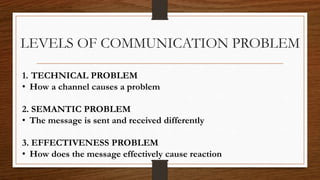
LEVELS OF COMMUNICATION PROBLEM
1. TECHNICAL PROBLEM
• How a channel causes a problem
2. SEMANTIC PROBLEM
• The message is sent and received differently
3. EFFECTIVENESS PROBLEM
• How does the message effectively cause reaction
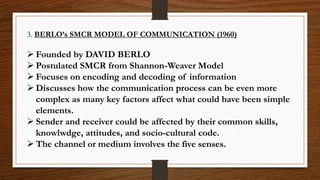
3. BERLO’s SMCR MODEL OF COMMUNICATION (1960)
 Founded by DAVID BERLO
 Postulated SMCR from Shannon-Weaver Model
 Focuses on encoding and decoding of information
 Discusses how the communication process can be even more
complex as many key factors affect what could have been simple
elements.
 Sender and receiver could be affected by their common skills,
knowlwdge, attitudes, and socio-cultural code.
 The channel or medium involves the five senses.
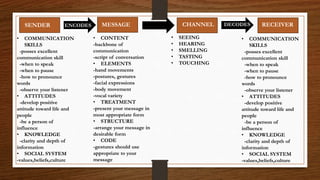
SENDER
SENDER MESSAGE CHANNEL RECEIVER
ENCODES DECODES
• COMMUNICATION
SKILLS
-posses excellent
communication skill
-when to speak
-when to pause
-how to pronounce
words
-observe your listener
• ATTITUDES
-develop positive
attitude toward life and
people
-be a person of
influence
• KNOWLEDGE
-clarity and depth of
information
• SOCIAL SYSTEM
-values,beliefs,culture
• CONTENT
-backbone of
communication
-script of conversation
• ELEMENTS
-hand movements
-postures, gestures
-facial expressions
-body movement
-vocal variety
• TREATMENT
-present your message in
most appropriate form
• STRUCTURE
-arrange your message in
desirable form
• CODE
-gestures should use
appropriate to your
message
• COMMUNICATION
SKILLS
-posses excellent
communication skill
-when to speak
-when to pause
-how to pronounce
words
-observe your listener
• ATTITUDES
-develop positive
attitude toward life and
people
-be a person of
influence
• KNOWLEDGE
-clarity and depth of
information
• SOCIAL SYSTEM
-values,beliefs,culture
• SEEING
• HEARING
• SMELLING
• TASTING
• TOUCHING
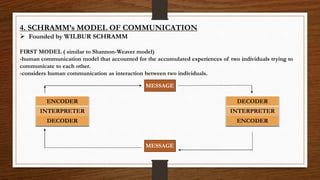
4. SCHRAMM’s MODEL OF COMMUNICATION
 Founded by WILBUR SCHRAMM
FIRST MODEL ( similar to Shannon-Weaver model)
-human communication model that accounted for the accumulated experiences of two individuals trying to
communicate to each other.
-considers human communication as interaction between two individuals.
MESSAGE
MESSAGE
ENCODER
INTERPRETER
DECODER
DECODER
INTERPRETER
ENCODER
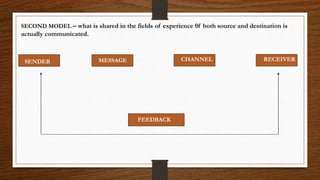
SECOND MODEL – what is shared in the fields of experience 0f both source and destination is
actually communicated.
SENDER MESSAGE CHANNEL RECEIVER
FEEDBACK
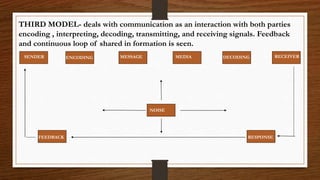
THIRD MODEL- deals with communication as an interaction with both parties
encoding , interpreting, decoding, transmitting, and receiving signals. Feedback
and continuous loop of shared in formation is seen.
SENDER ENCODING MESSAGE MEDIA DECODING RECEIVER
NOISE
FEEDBACK RESPONSE

MODELS-OF-COM.pptx

  • 1.
  • 2.
    Mcquail and Windhahl(1993)  Model seeks to show the main elements of any structure or process and the relationships between these elements. Deutsch (1996)  Models order and relate systems to each other by giving us images of wholes.
  • 3.
    M O DE L  It gives a general picture of the particular circumstances in the communication process.  Helps in explaining or clarifying the complicated or ambiguous in communication process.
  • 4.
    1. LASWELL’S MODELOF COMMUNICATION (1948)  Founded by HAROLD D. LASWELL  American political scientist  Wrote an article on communication research BASIC MODELS OF COMMUNICATION 5Ws  It is the convenient way to describe an act of communication. 1. Who? 2. Says What? 3. In Which manner? 4. To Whom? 5. With What effect?
  • 5.
    WHO? Transmitter or Communicator SAYS WHAT? Message or Content IN WHICH CHANNEL? Medium TO WHOM? Receiver WITH WHAT EFFECT? Effect or Impact ControlAnalysis Content Analysis Media Analysis Audience Analysis Effect Analysis Linear Model – One way process of communication
  • 6.
    ADVANTAGES • Suitable descriptionof communication • Easy to understand DISADVANTAGES • One-way process • Complexity of everyday communication neglected
  • 7.
    2. SHANNON andWEAVER MATHEMATICAL MODEL (1949) CLAUDE SHANNON WARREN WEAVER -American Mathematician -Scientist -Considered as on of the founding fathers Of communication age.  firmly established by Claude Shannon  Formerly entitled as “ Mathematical Theory of Communication”  They used to work at the BELL TELEPHONE LABORATORIES  Mother of all communication models  This model was used by linguistic and behavioral scientist
  • 8.
    CONCEPTS OF SHANNON-WEAVERMODEL OF COMMUNICATION SENDER ENCODER CHANNEL DECODER RECEIVER Information source Transmitter Reception Destination • Create message • Choose channel • Sends information • Refers to sender who uses machine which converts message into signal or binary data • Medium • Device uses to transmit the message • Interprets the message • Receiver uses binary data to convert message NOISE • Physical disturbances • Environment • Low self esteem • anxities
  • 9.
    LEVELS OF COMMUNICATIONPROBLEM 1. TECHNICAL PROBLEM • How a channel causes a problem 2. SEMANTIC PROBLEM • The message is sent and received differently 3. EFFECTIVENESS PROBLEM • How does the message effectively cause reaction
  • 10.
    3. BERLO’s SMCRMODEL OF COMMUNICATION (1960)  Founded by DAVID BERLO  Postulated SMCR from Shannon-Weaver Model  Focuses on encoding and decoding of information  Discusses how the communication process can be even more complex as many key factors affect what could have been simple elements.  Sender and receiver could be affected by their common skills, knowlwdge, attitudes, and socio-cultural code.  The channel or medium involves the five senses.
  • 11.
    SENDER SENDER MESSAGE CHANNELRECEIVER ENCODES DECODES • COMMUNICATION SKILLS -posses excellent communication skill -when to speak -when to pause -how to pronounce words -observe your listener • ATTITUDES -develop positive attitude toward life and people -be a person of influence • KNOWLEDGE -clarity and depth of information • SOCIAL SYSTEM -values,beliefs,culture • CONTENT -backbone of communication -script of conversation • ELEMENTS -hand movements -postures, gestures -facial expressions -body movement -vocal variety • TREATMENT -present your message in most appropriate form • STRUCTURE -arrange your message in desirable form • CODE -gestures should use appropriate to your message • COMMUNICATION SKILLS -posses excellent communication skill -when to speak -when to pause -how to pronounce words -observe your listener • ATTITUDES -develop positive attitude toward life and people -be a person of influence • KNOWLEDGE -clarity and depth of information • SOCIAL SYSTEM -values,beliefs,culture • SEEING • HEARING • SMELLING • TASTING • TOUCHING
  • 12.
    4. SCHRAMM’s MODELOF COMMUNICATION  Founded by WILBUR SCHRAMM FIRST MODEL ( similar to Shannon-Weaver model) -human communication model that accounted for the accumulated experiences of two individuals trying to communicate to each other. -considers human communication as interaction between two individuals. MESSAGE MESSAGE ENCODER INTERPRETER DECODER DECODER INTERPRETER ENCODER
  • 13.
    SECOND MODEL –what is shared in the fields of experience 0f both source and destination is actually communicated. SENDER MESSAGE CHANNEL RECEIVER FEEDBACK
  • 14.
    THIRD MODEL- dealswith communication as an interaction with both parties encoding , interpreting, decoding, transmitting, and receiving signals. Feedback and continuous loop of shared in formation is seen. SENDER ENCODING MESSAGE MEDIA DECODING RECEIVER NOISE FEEDBACK RESPONSE