
Welcome
to the presentation
on
Asking Question
Why do we ask question?
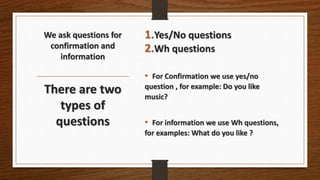
We ask questions for
confirmation and
information
1.Yes/No questions
2.Wh questions
• For Confirmation we use yes/no
question , for example: Do you like
music?
• For information we use Wh questions,
for examples: What do you like ?
There are two
types of
questions
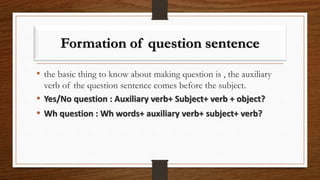
Formation of question sentence
• the basic thing to know about making question is , the auxiliary
verb of the question sentence comes before the subject.
• Yes/No question : Auxiliary verb+ Subject+ verb + object?
• Wh question : Wh words+ auxiliary verb+ subject+ verb?
Process of Making Questions
• We have to know two grammar items before going into the process of making questions. Auxiliary
verbs and Wh words with their functions.
• Auxiliary verbs:
• There are four types of auxiliary verbs:
1. To be: am, is ,are, was, were, be, being, been
2. To have: have, has, had
3. To do: do did, does
4. Modals ( we also call it others auxiliary verbs): can, could, may, might, shall, should, will, would,
must etc.
Ways to use auxiliary verbs in question
sentence.
• Above mentioned verbs are helping verbs which are visible with the main verbs but only ‘to do’
verbs are invisible auxiliary that are hidden within the action verbs.
• For example:
• Drink is an action verb which consists (drink+ do), if I say, ‘drinks’ (it will
be ‘(drink+ does), If I say drank, it will be (drink+ did)
• And secondly, we have to know the wh words and their functions
Wh words and their functions
• We use What for specific thing or object
• Where is used for location or place
• When is used for date and time.
• Why for knowing about reason
• Who to know about people or person.
• Which is used for giving any options or choices.
• How is used to know about any reason of the action.
• How old, how many and how much also can be used to ask about age, number and quantity
respectively.
Let’s make some wh questions from sentences.
• She lives in a flat.
• I want to ask her about her place of living .
• So the question will be: Where does she live?
• So in this sentence we can see ‘lives’ has been broken into ‘live +
does’
• He is doing his homework.
• The question will be
• What is he doing?
• In this sentence we don’t need any ‘to do’ auxiliary verbs
because there is a ‘to be’ verb already in this sentence.
• Like this if we say
• They have completed their work recently.
• When have they completed their work?
And yes/ no question , it is very simple
• We just have to put the auxiliary before the subject.
• For example
• He is a student.
• Is he a student?
• He has done the work.
• Has he done the work?
That’s All for Today
Thank You

Asking Question

  • 1.
  • 2.
  • 3.
    Why do weask question?
  • 4.
    We ask questionsfor confirmation and information 1.Yes/No questions 2.Wh questions • For Confirmation we use yes/no question , for example: Do you like music? • For information we use Wh questions, for examples: What do you like ? There are two types of questions
  • 5.
    Formation of questionsentence • the basic thing to know about making question is , the auxiliary verb of the question sentence comes before the subject. • Yes/No question : Auxiliary verb+ Subject+ verb + object? • Wh question : Wh words+ auxiliary verb+ subject+ verb?
  • 6.
    Process of MakingQuestions • We have to know two grammar items before going into the process of making questions. Auxiliary verbs and Wh words with their functions. • Auxiliary verbs: • There are four types of auxiliary verbs: 1. To be: am, is ,are, was, were, be, being, been 2. To have: have, has, had 3. To do: do did, does 4. Modals ( we also call it others auxiliary verbs): can, could, may, might, shall, should, will, would, must etc.
  • 7.
    Ways to useauxiliary verbs in question sentence. • Above mentioned verbs are helping verbs which are visible with the main verbs but only ‘to do’ verbs are invisible auxiliary that are hidden within the action verbs. • For example: • Drink is an action verb which consists (drink+ do), if I say, ‘drinks’ (it will be ‘(drink+ does), If I say drank, it will be (drink+ did) • And secondly, we have to know the wh words and their functions
  • 8.
    Wh words andtheir functions • We use What for specific thing or object • Where is used for location or place • When is used for date and time. • Why for knowing about reason • Who to know about people or person. • Which is used for giving any options or choices. • How is used to know about any reason of the action. • How old, how many and how much also can be used to ask about age, number and quantity respectively.
  • 9.
    Let’s make somewh questions from sentences. • She lives in a flat. • I want to ask her about her place of living . • So the question will be: Where does she live? • So in this sentence we can see ‘lives’ has been broken into ‘live + does’
  • 10.
    • He isdoing his homework. • The question will be • What is he doing? • In this sentence we don’t need any ‘to do’ auxiliary verbs because there is a ‘to be’ verb already in this sentence. • Like this if we say • They have completed their work recently. • When have they completed their work?
  • 11.
    And yes/ noquestion , it is very simple • We just have to put the auxiliary before the subject. • For example • He is a student. • Is he a student? • He has done the work. • Has he done the work?
  • 12.
    That’s All forToday Thank You