
Welcome
to the
Presentation
on
verb
What is a verb?
• Any action, being or having is called verb.
• Without verb we can’t imagine a sentence.
• A sentence must have a verb.
• That is why verb is called the heart of a sentence.
• That means if a single word is a sentence that is a verb.
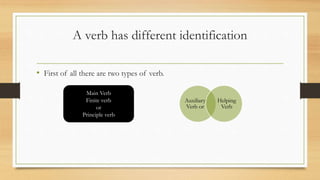
A verb has different identification
• First of all there are two types of verb.
Main Verb
Finite verb
or
Principle verb
Auxiliary
Verb or
Helping
Verb
Helping Verbs or Auxiliary Verbs
• There are four types of auxiliary verbs:
• To be: be, am, is ,are, was, were,
• To have: have, has, had
• To do: do, did, does
• Modals ( ‘others’ auxiliary verbs): can, could, may, might, shall,
should, will, would, must, etc.
Identification process of Auxiliary verbs
• Basically helping verbs always sit before main verb.
• For Example: He has finished his work.
• But sometimes they can be main verb, when they are actually alone in a sentence.
• For Example: He is a student. She has a car.
• Modals verbs never can be main verb because they can not sit alone in a sentence.
• They can run fast. You must be active. Etc.
Finite and non finite verbs
• Finite verb: The verb that we can change according to the tense, number or person .
• For example: I drink water. I drank water. I have drunk water.
• Non Finite verb: The verb that we can not change according to the tense, number
or person.
• For example: He loves to draw.
• If I change this sentence in different tenses ‘to draw’ will not be changed. So ‘to
draw’ in this sentence is a non finite verb.
Types of non- finite verb
• Non-finite verbs are three types:
• 1. Infinitive which is (to +verb) .
• For example: They come here to learn English.
• 2. Gerund: (Verb+ ing) works as a noun.
• For example: Swimming is a good exercise. I love drawing.
• In these sentences swimming and drawing are nouns that have worked here as
subject and object.
• 3. Participle: (Verb + ing) when works as adjectives or adverbs, we call it present
participle.
• For Example: A smiling face is always beautiful. He did the work dancing.
That’s all for today.
Thank You

Basic English Grammar (Verb).

  • 1.
  • 2.
    What is averb? • Any action, being or having is called verb. • Without verb we can’t imagine a sentence. • A sentence must have a verb. • That is why verb is called the heart of a sentence. • That means if a single word is a sentence that is a verb.
  • 3.
    A verb hasdifferent identification • First of all there are two types of verb. Main Verb Finite verb or Principle verb Auxiliary Verb or Helping Verb
  • 4.
    Helping Verbs orAuxiliary Verbs • There are four types of auxiliary verbs: • To be: be, am, is ,are, was, were, • To have: have, has, had • To do: do, did, does • Modals ( ‘others’ auxiliary verbs): can, could, may, might, shall, should, will, would, must, etc.
  • 5.
    Identification process ofAuxiliary verbs • Basically helping verbs always sit before main verb. • For Example: He has finished his work. • But sometimes they can be main verb, when they are actually alone in a sentence. • For Example: He is a student. She has a car. • Modals verbs never can be main verb because they can not sit alone in a sentence. • They can run fast. You must be active. Etc.
  • 6.
    Finite and nonfinite verbs • Finite verb: The verb that we can change according to the tense, number or person . • For example: I drink water. I drank water. I have drunk water. • Non Finite verb: The verb that we can not change according to the tense, number or person. • For example: He loves to draw. • If I change this sentence in different tenses ‘to draw’ will not be changed. So ‘to draw’ in this sentence is a non finite verb.
  • 7.
    Types of non-finite verb • Non-finite verbs are three types: • 1. Infinitive which is (to +verb) . • For example: They come here to learn English. • 2. Gerund: (Verb+ ing) works as a noun. • For example: Swimming is a good exercise. I love drawing. • In these sentences swimming and drawing are nouns that have worked here as subject and object. • 3. Participle: (Verb + ing) when works as adjectives or adverbs, we call it present participle. • For Example: A smiling face is always beautiful. He did the work dancing.
  • 8.
    That’s all fortoday. Thank You