
ENVIRONMENT
HEALTH & SAFETY
WELCOME
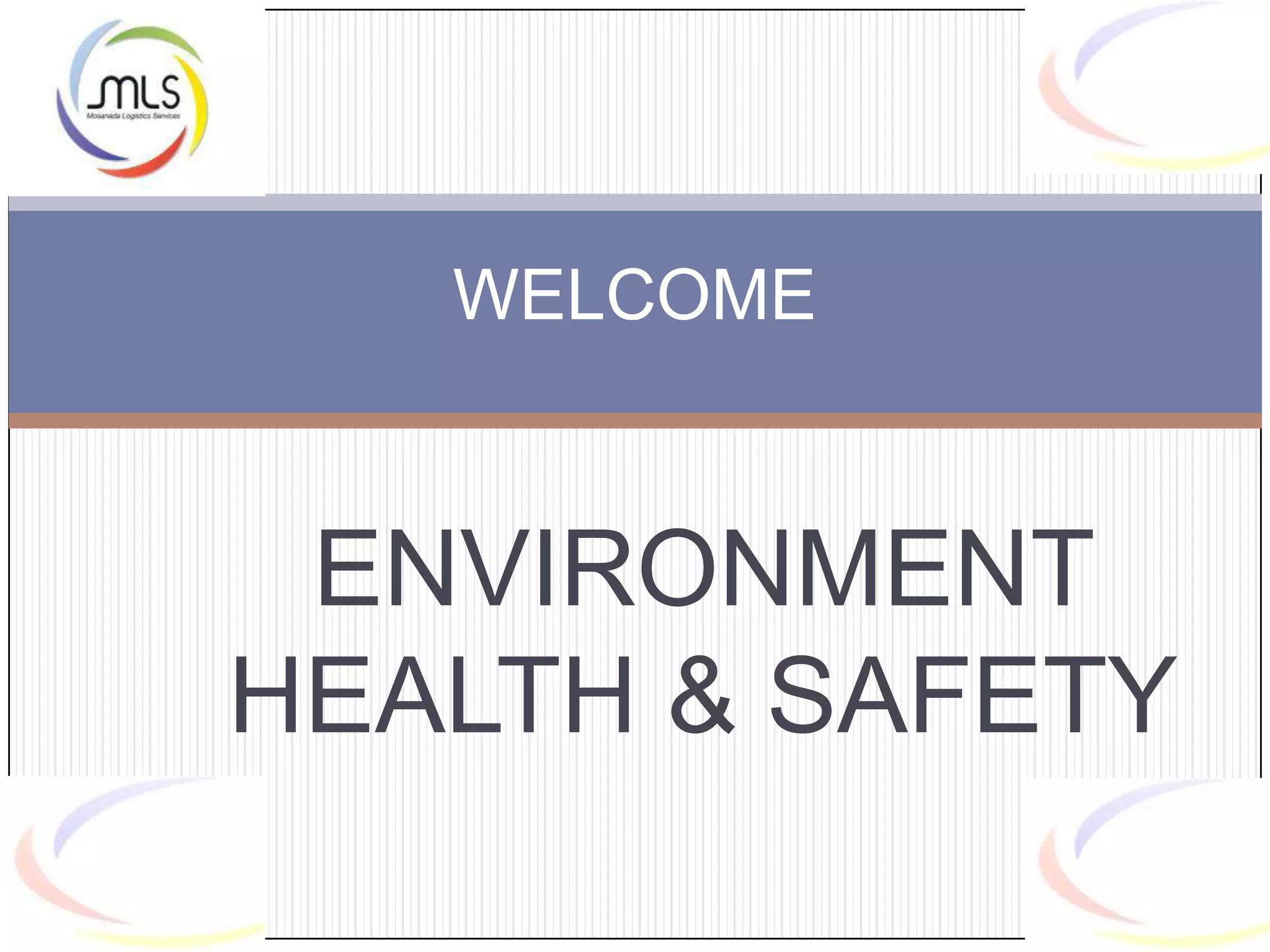
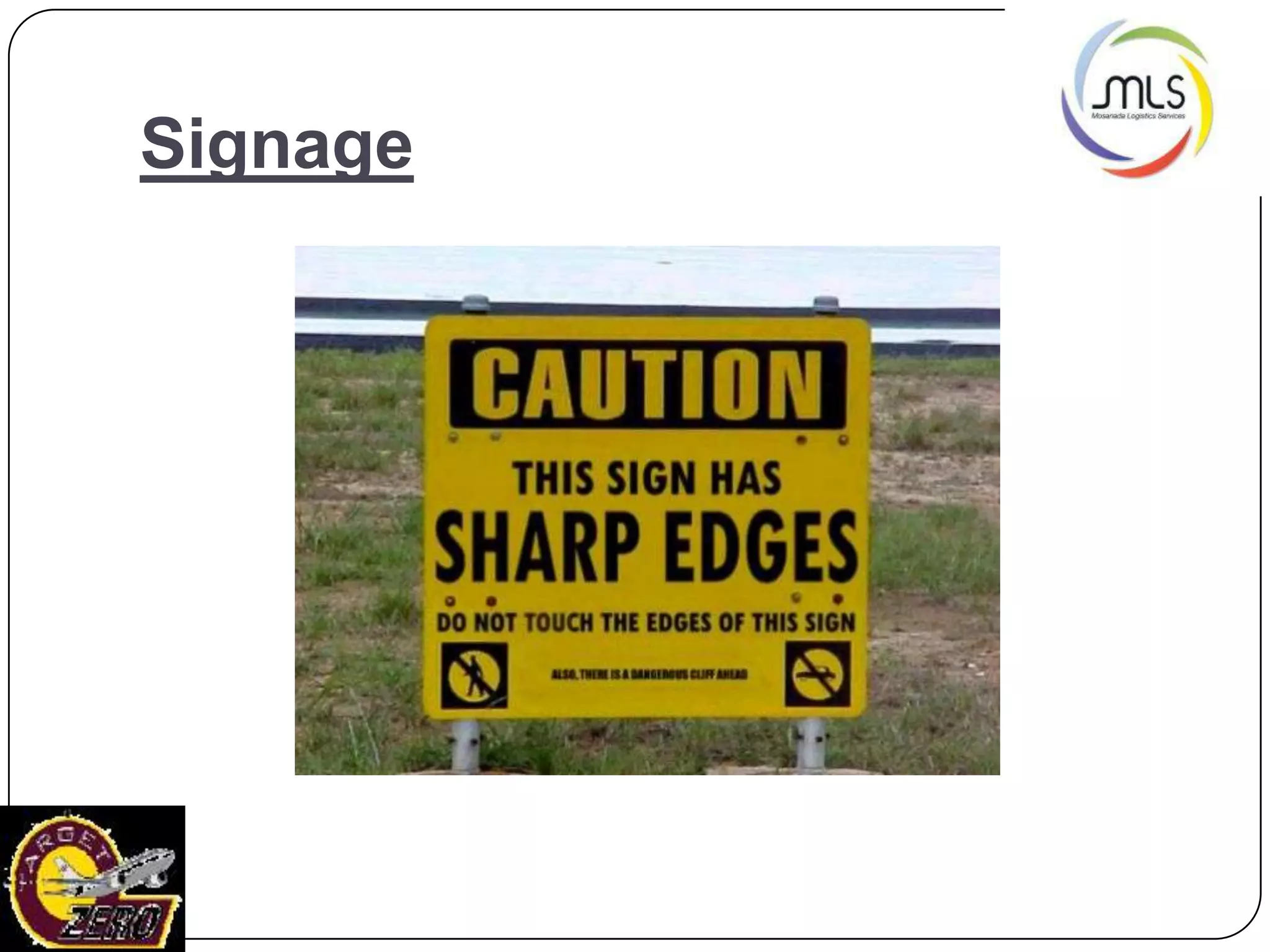
Signage
7/22/20133
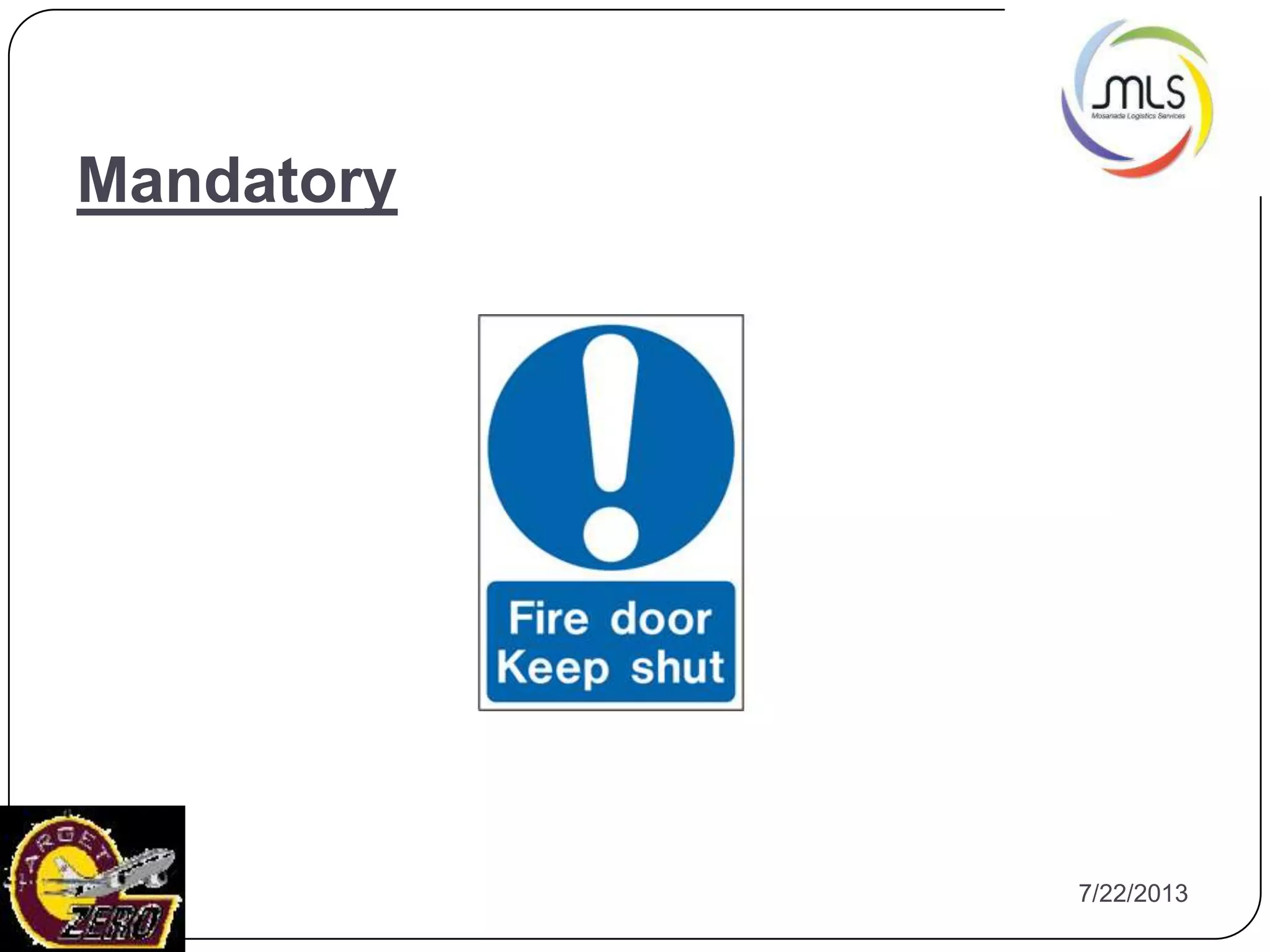
Mandatory
7/22/20134
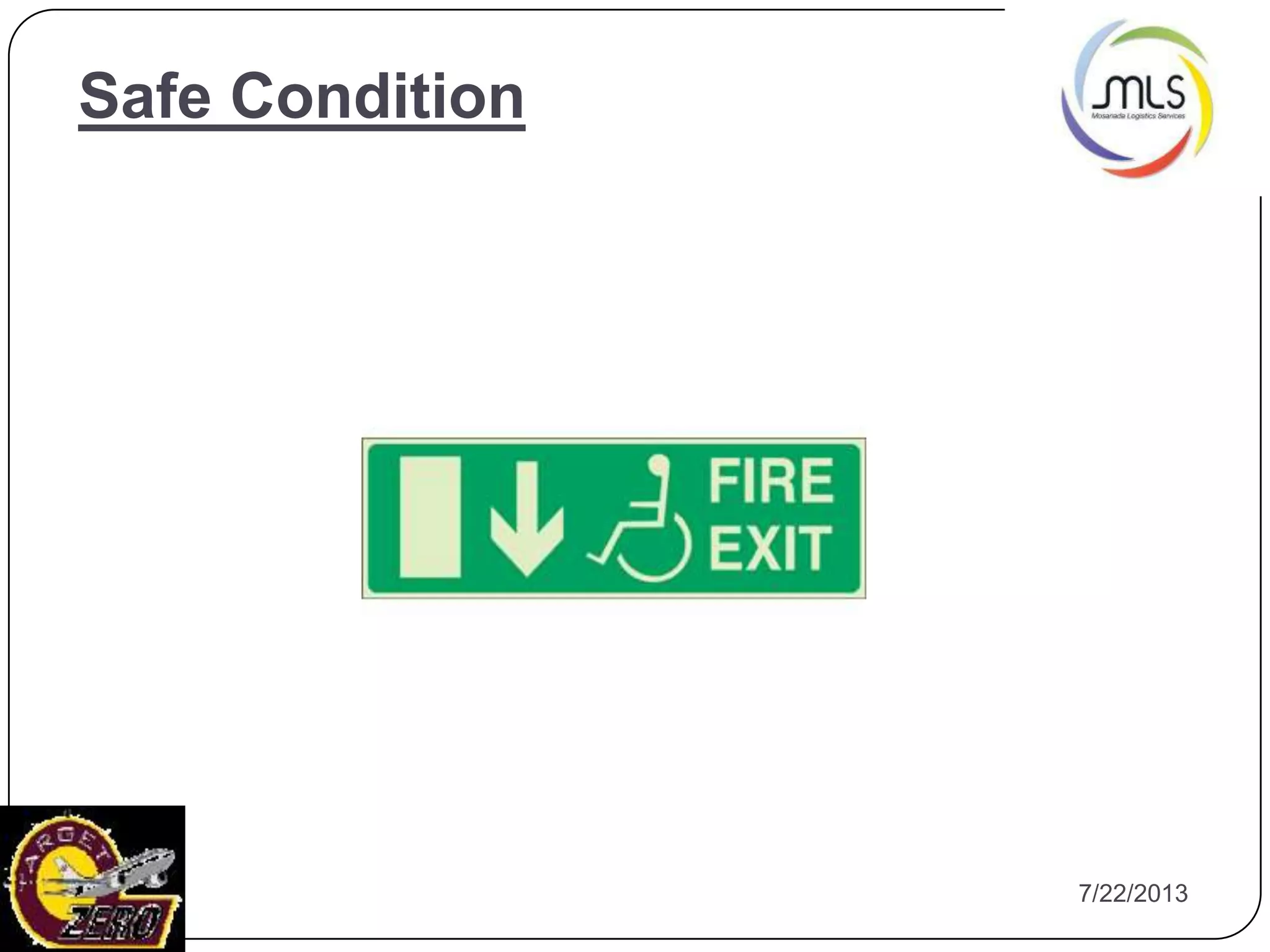
Safe Condition
7/22/20135
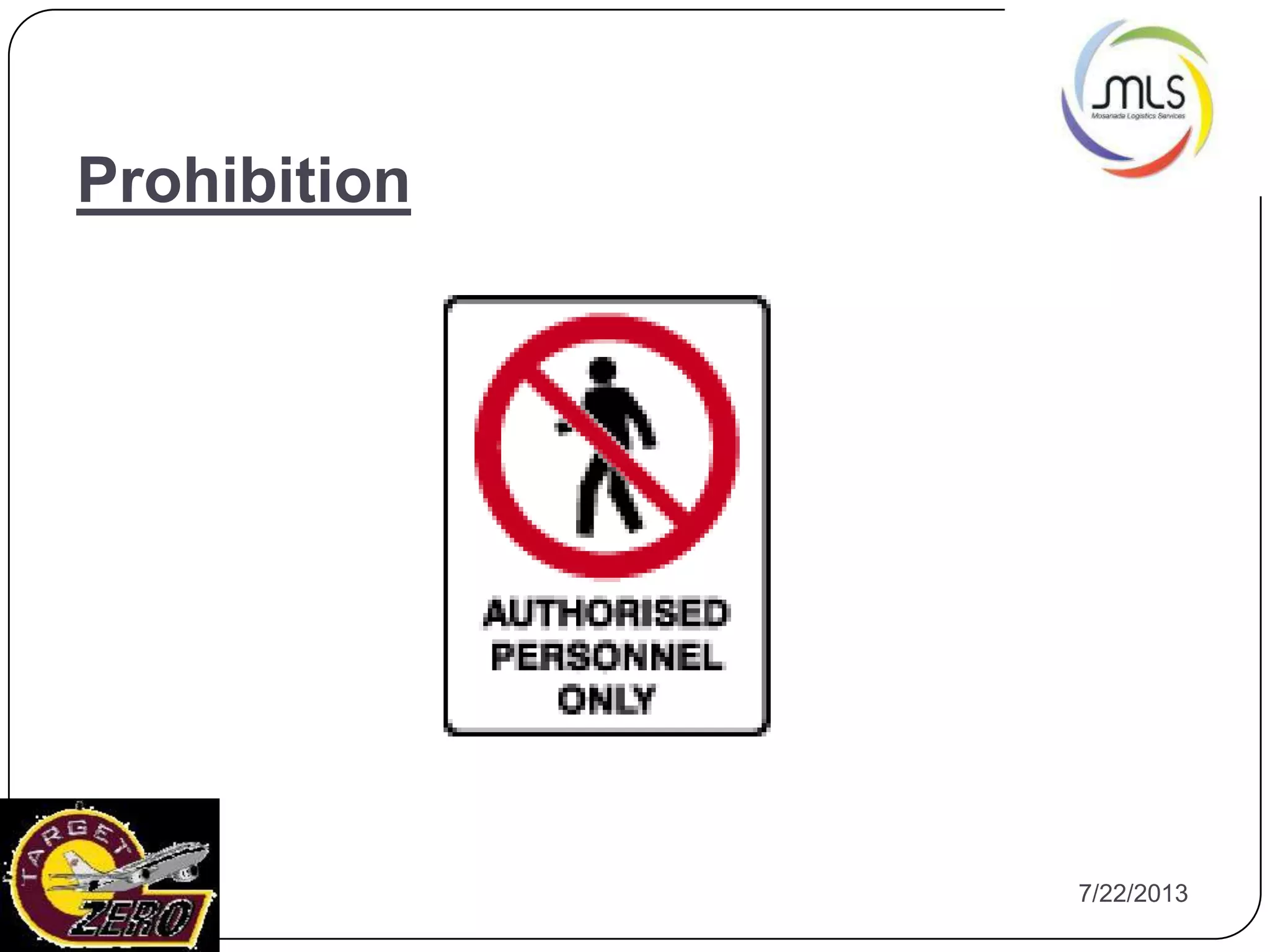
Prohibition
7/22/20136
Warning
7/22/20137
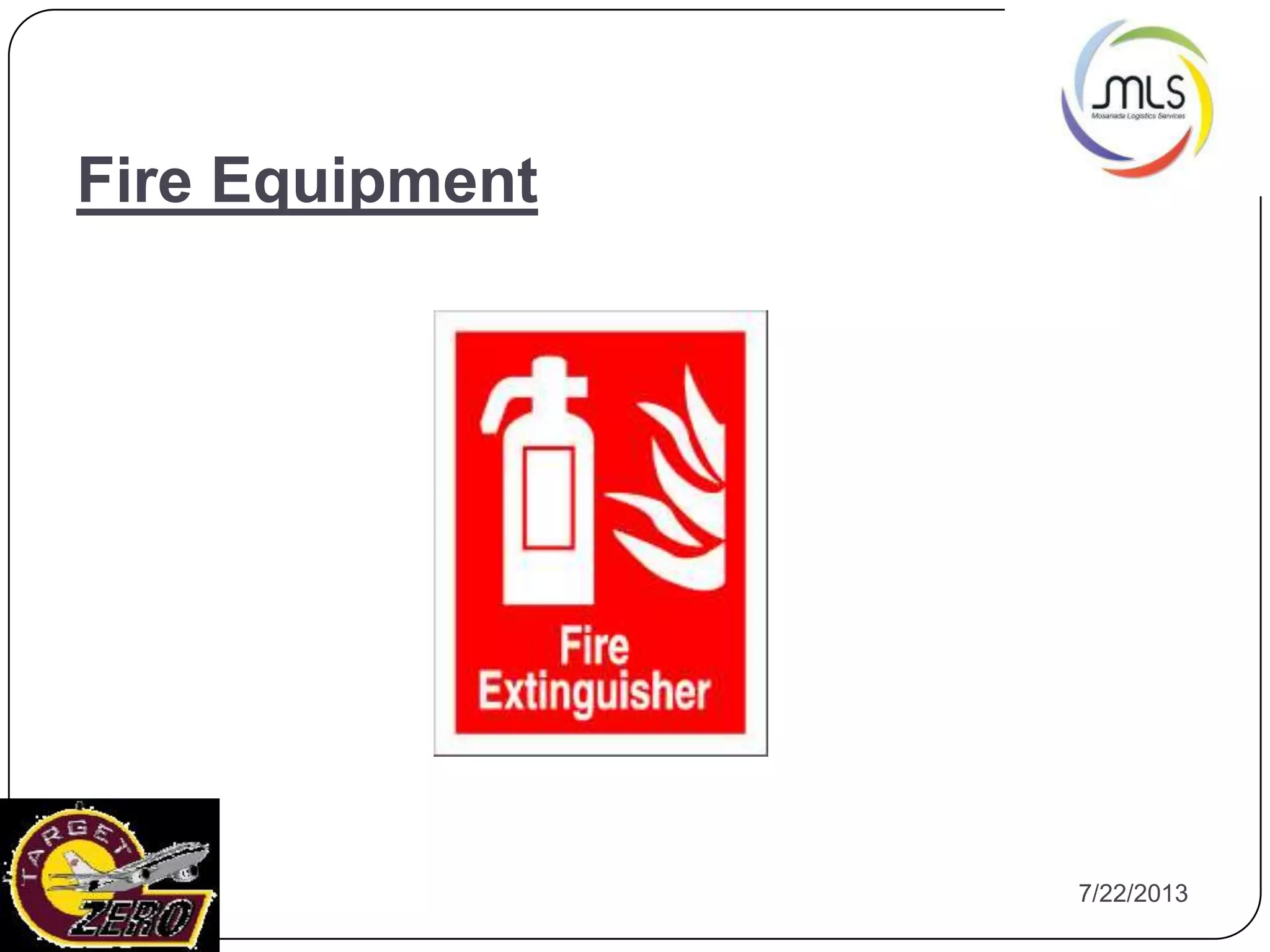
Fire Equipment
7/22/20138
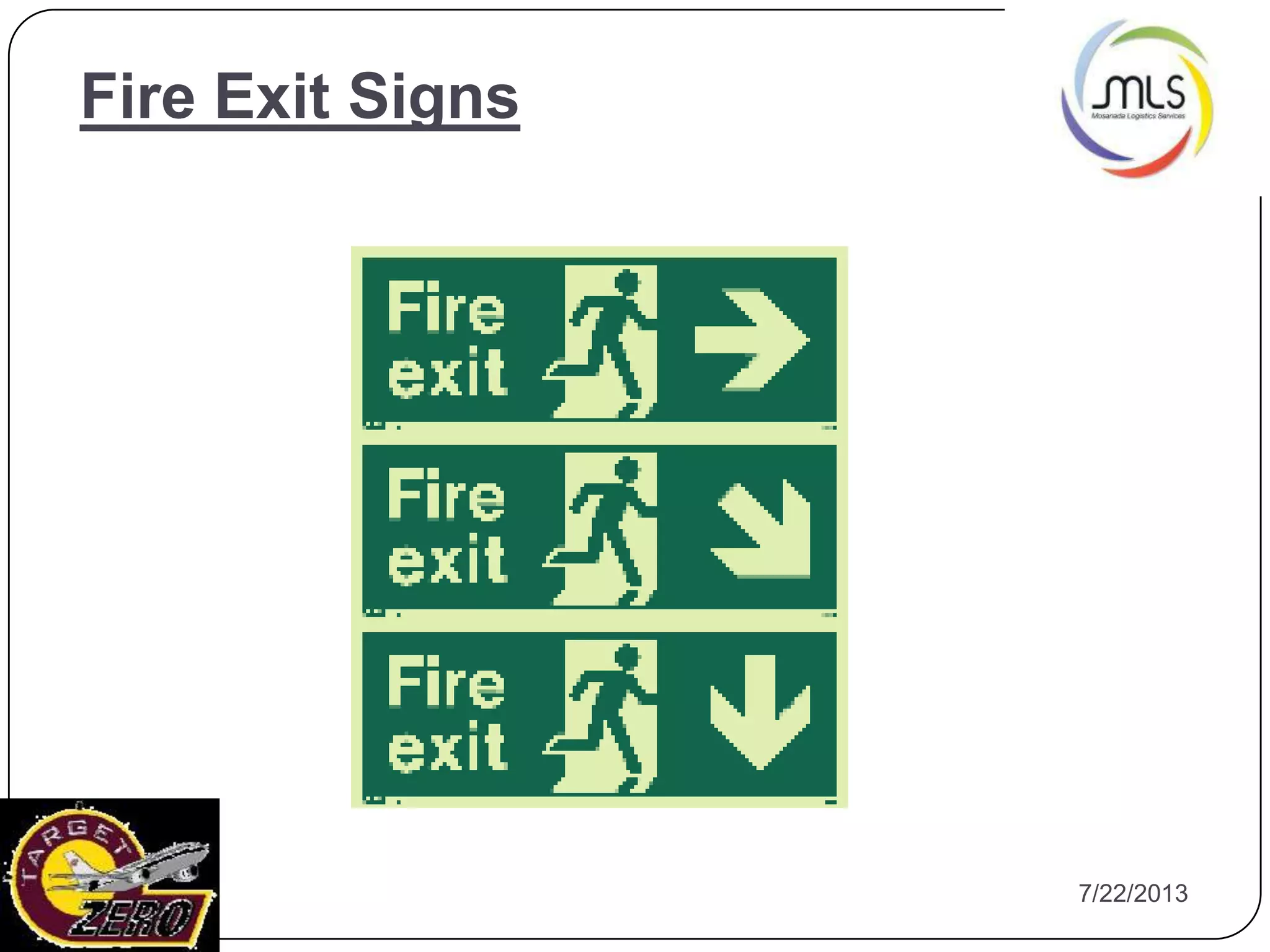
Fire Exit Signs
7/22/20139
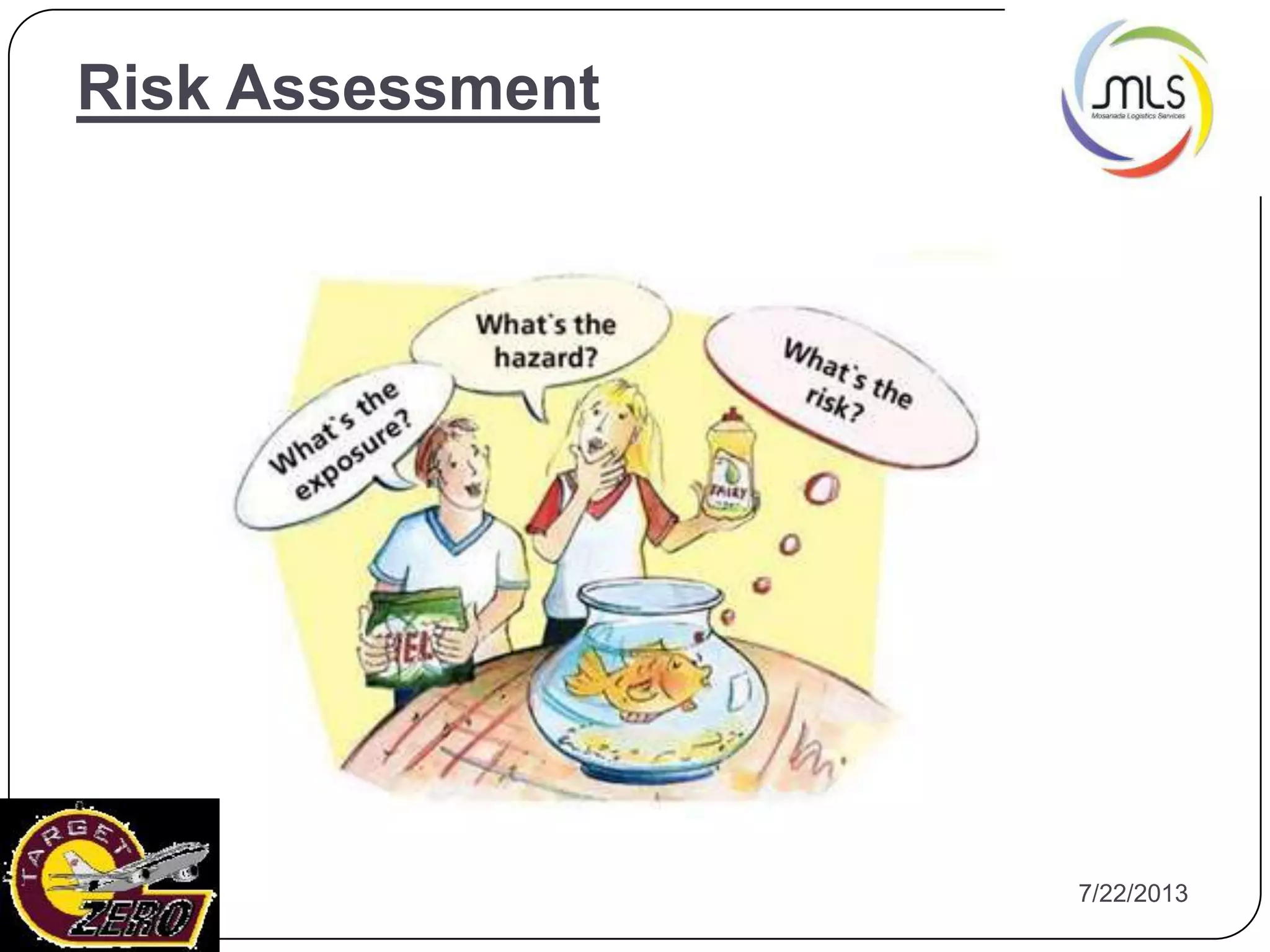
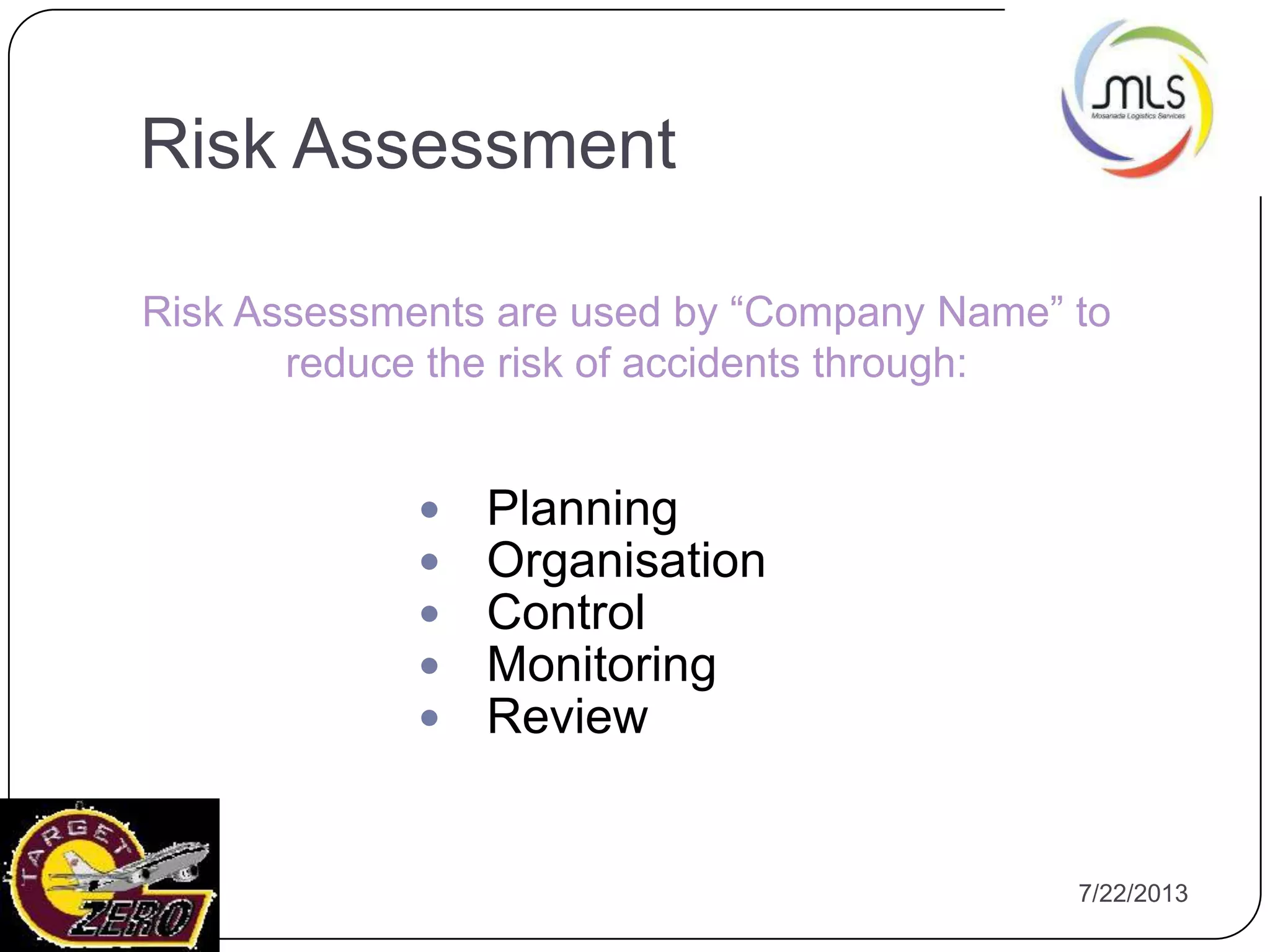
Risk Assessment
7/22/201310
 Planning
 Organisation
 Control
 Monitoring
 Review
Risk Assessments are used by “Company Name” to
reduce the risk of accidents through:
Risk Assessment
7/22/201311
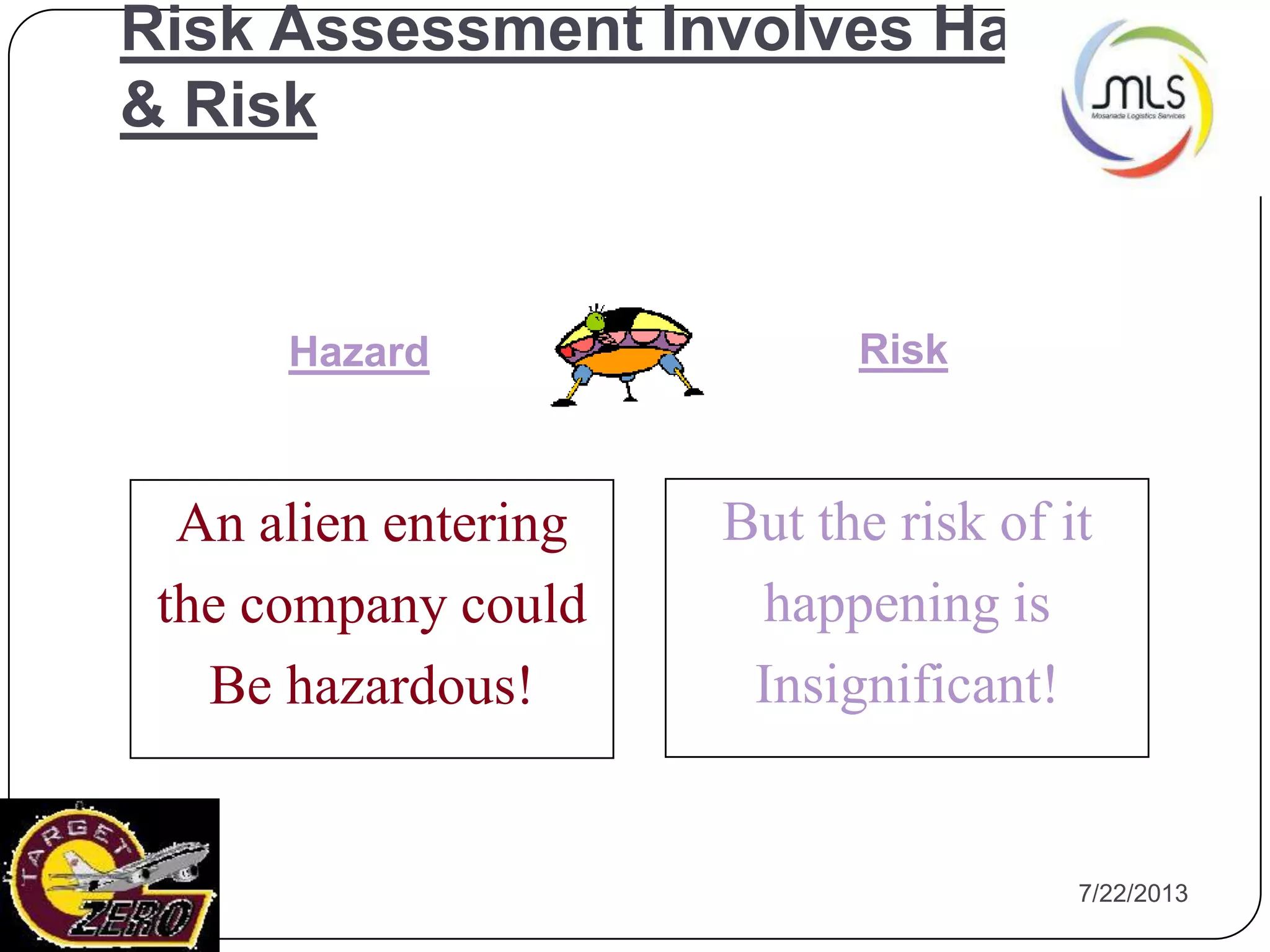
Risk Assessment Involves Hazard
& Risk
Hazard Risk
But the risk of it
happening is
Insignificant!
An alien entering
the company could
Be hazardous!
7/22/201312
Hazards and Risks
Something that has the potential to cause harm.
What is a Hazard?
What is a Risk?
The likelihood that the hazard will cause
harm.
7/22/201313
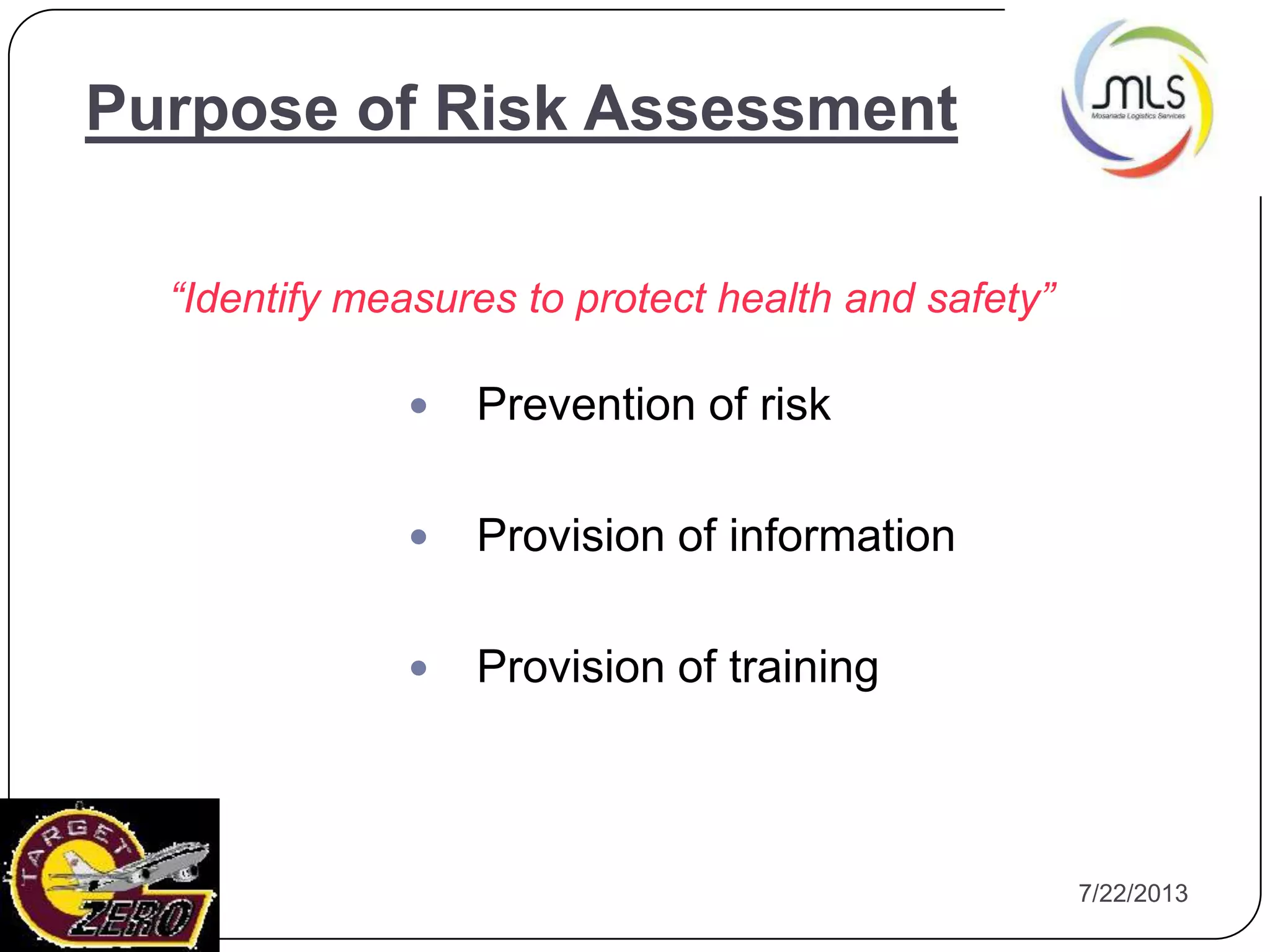
Purpose of Risk Assessment
 Prevention of risk
 Provision of information
 Provision of training
“Identify measures to protect health and safety”
7/22/201314
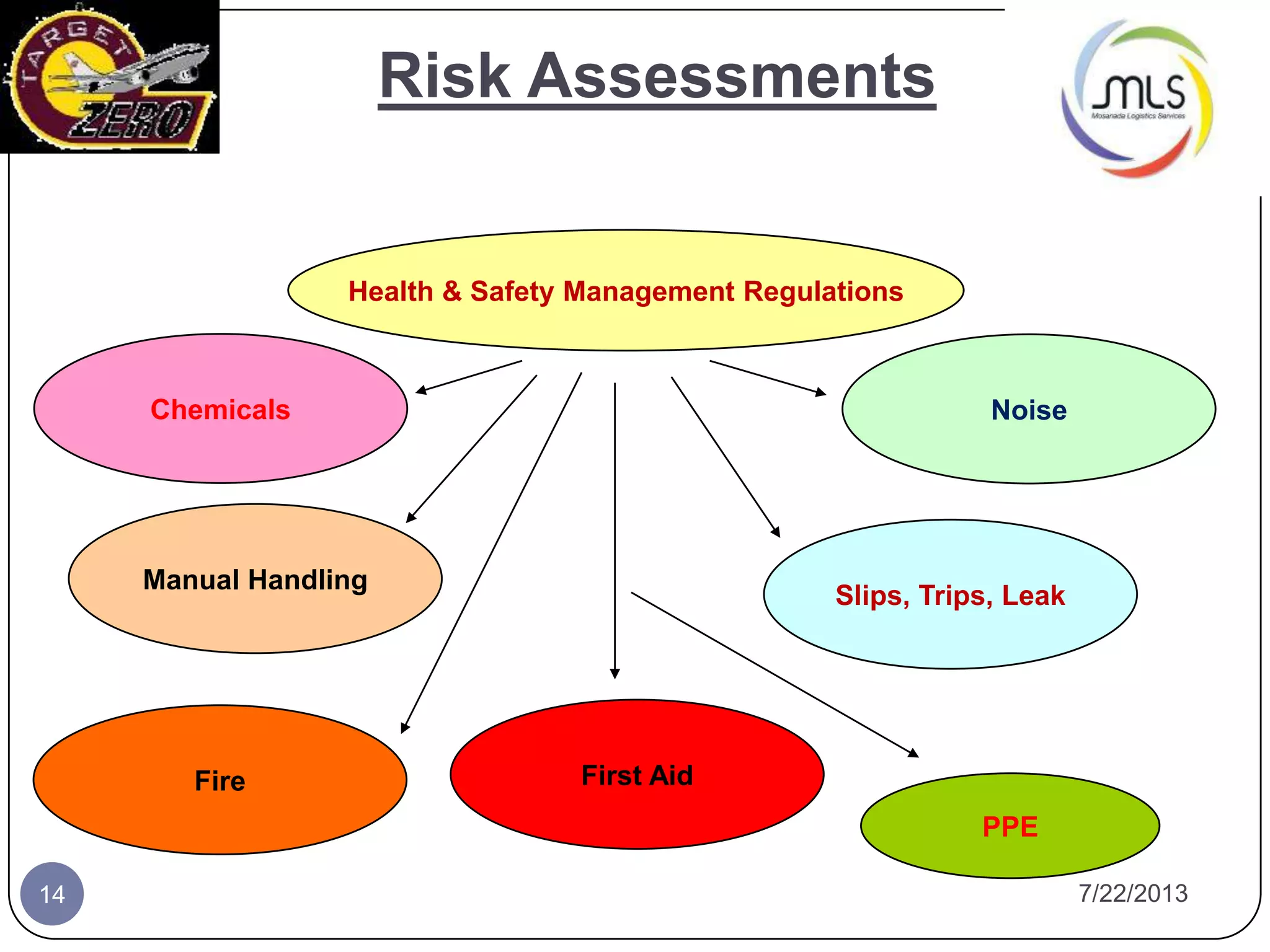
Risk Assessments
Health & Safety Management Regulations
Noise
Slips, Trips, Leak
Chemicals
Manual Handling
First Aid
PPE
Fire
7/22/201315
Who is Covered by Risk
Assessment?
 Employees
 Plant & Equipments
 Temporary workers
 Contractors
 The public
7/22/201316
Simple Risk Assessments
 What are the hazards?
 Who might be harmed?
 Is the risk adequately controlled?
 Any Damages to Plant &
Equipments?
 Can anything else be done?
7/22/201317
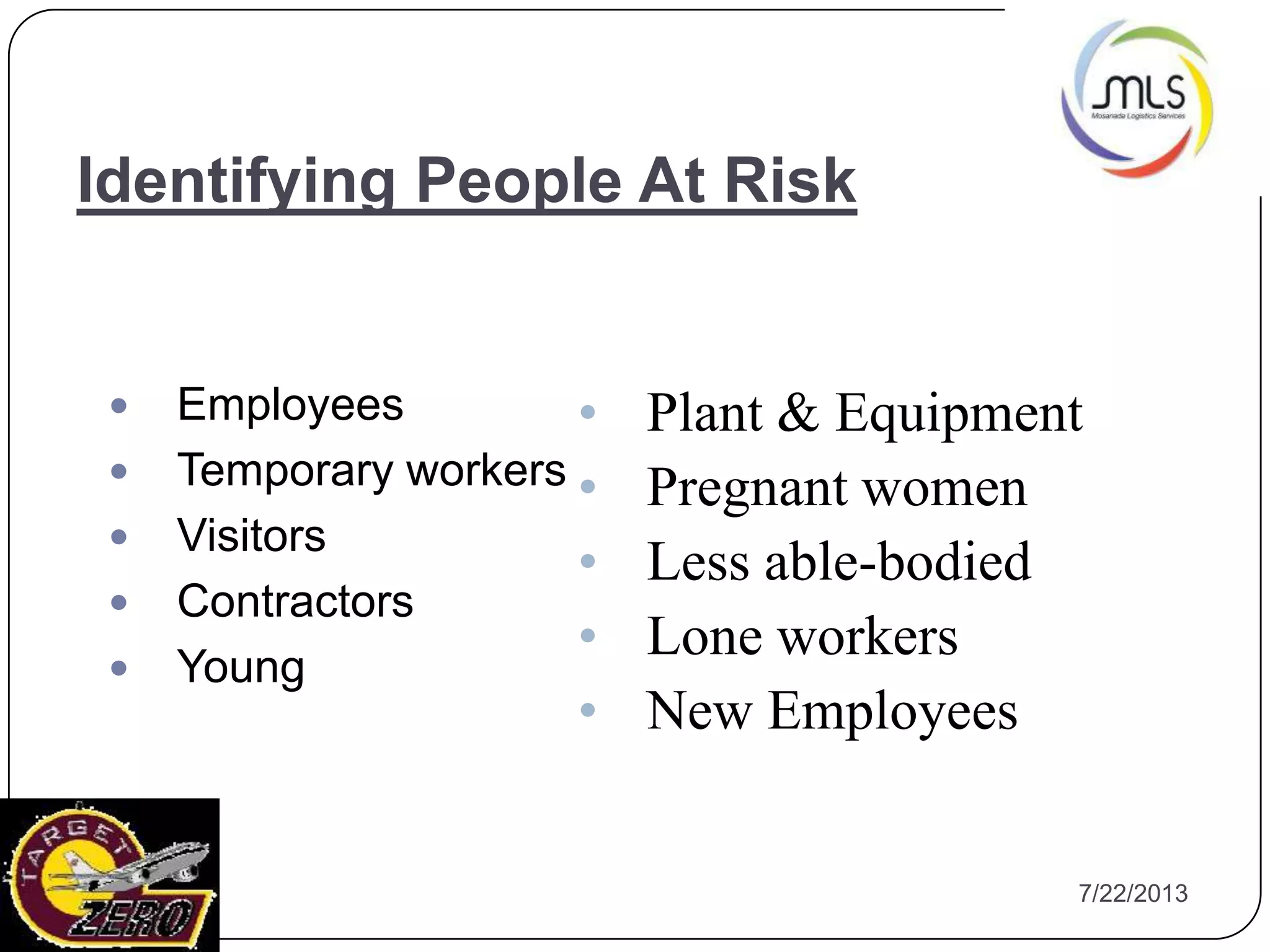
Identifying People At Risk
 Employees
 Temporary workers
 Visitors
 Contractors
 Young
• Plant & Equipment
• Pregnant women
• Less able-bodied
• Lone workers
• New Employees
7/22/201318
Health Risks
 Stress
 Neck and back pain
 Respective Stress
Injury
 Eye strain
 Headaches
 Psychical & Mental
What is STARRT CARD TALK ?
Safety Task Analysis Risk
Reduction Talk (STARRT)
According to OHSAS 18001 Safety Task Analysis
Risk Reduction Talks (STARRT), which have been
running on warehouse site for a little over a
year, are a „foundation stone in the Target Zero
campaign on the MLS.
„They assess the task that is about to be performed
and take a 360 o look at the potential risks involved
ensuring that those about to participate in the
activity are aware of potential risks and hazards
before they are affected by them‟.
Daily shift STARRT Talk (where good & bad
practices along with lessons learned are discussed)
and MLS Supervisor select those nominated are
trained in the STARRT process, the importance of it
and the way in which a STARRT briefing should be
delivered. Through internal training this message is
A Management Health & Safety
System
Plan do
checkAct
level
of
control
Health & Safety System
Health Safety: main components
HEALTH & SAFETY
Environmental
policy
HSE-Planning
HSE-Checking &
corrective action
HSE-Management review
HSE-Implementation
& operation
Continual improvement
Health, safety Environmental
Policy
 Written statement endorsed by top
management, communicated throughout the
organization.
 Demonstrates commitment to continual
improvement and prevention of pollution.
 Demonstrates commitment to compliance with
legislation and regulations.
 A framework for environmental objectives and
targets.
 Made available to the public.
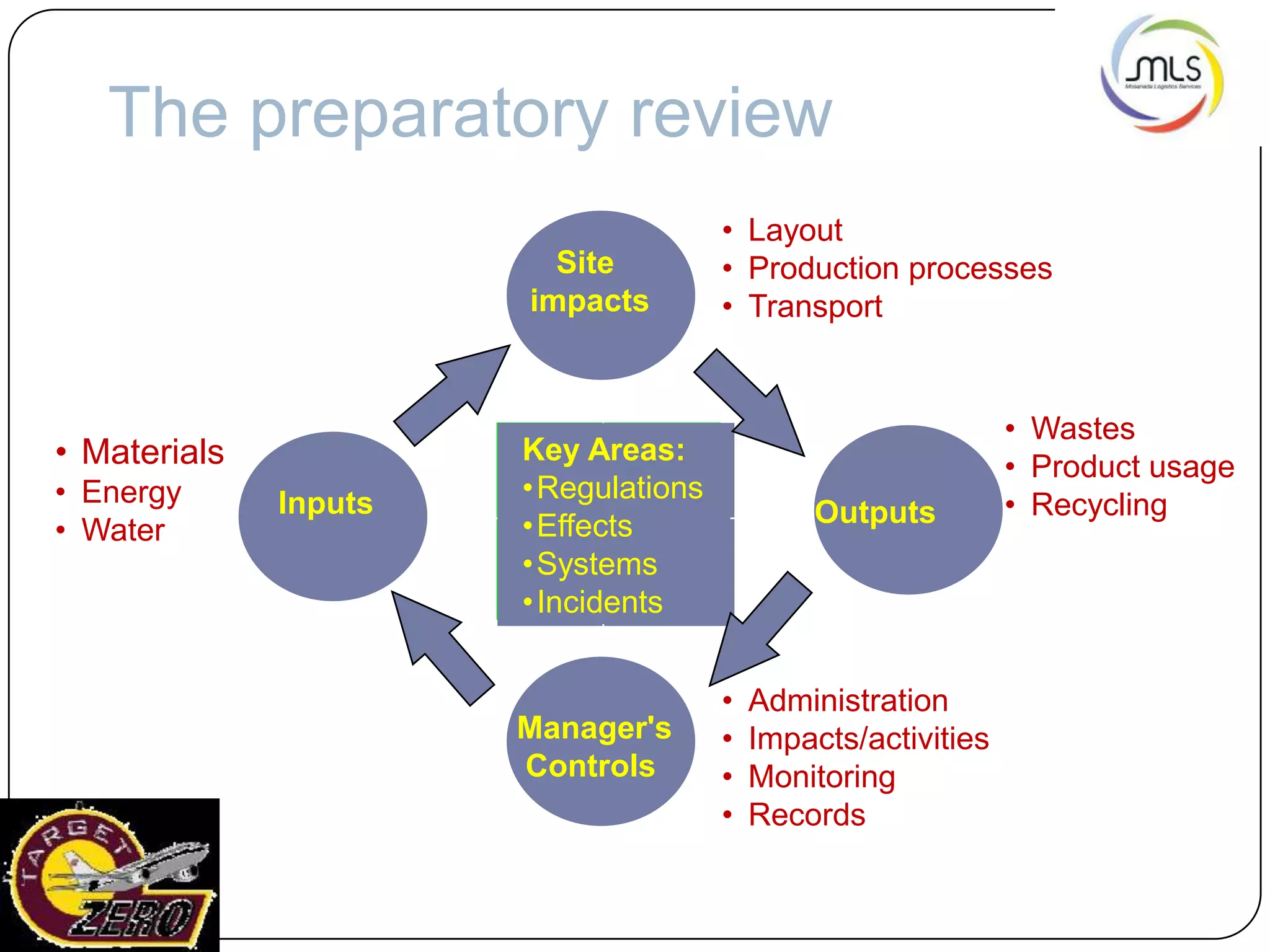
The preparatory review
Site
impacts
Outputs
Manager's
Controls
Inputs
Key Areas:
•Regulations
•Effects
•Systems
•Incidents
• Layout
• Production processes
• Transport
• Wastes
• Product usage
• Recycling
• Administration
• Impacts/activities
• Monitoring
• Records
• Materials
• Energy
• Water
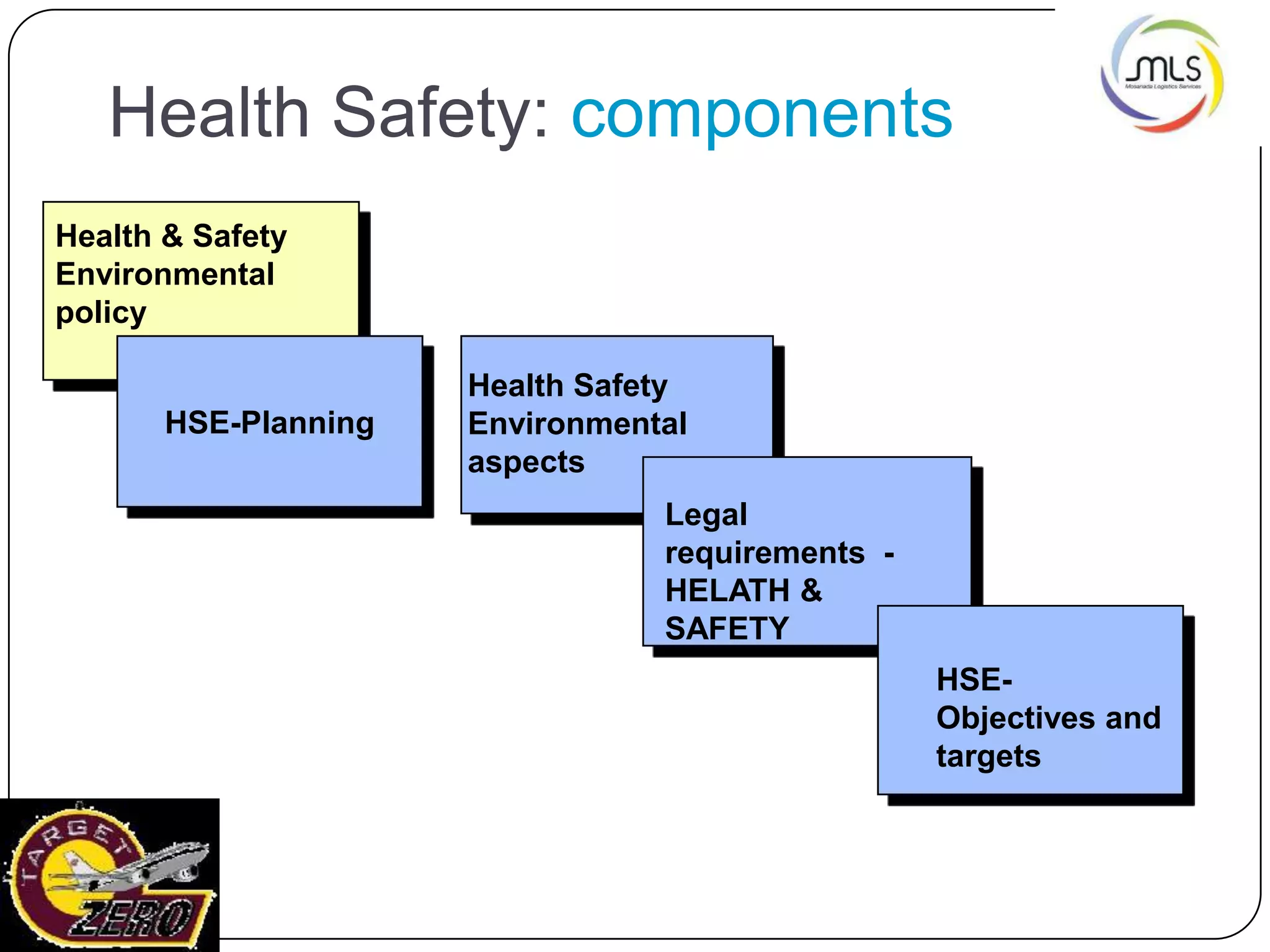
Health Safety: components
Health & Safety
Environmental
policy
HSE-Planning
Health Safety
Environmental
aspects
Legal
requirements -
HELATH &
SAFETY
HSE-
Objectives and
targets
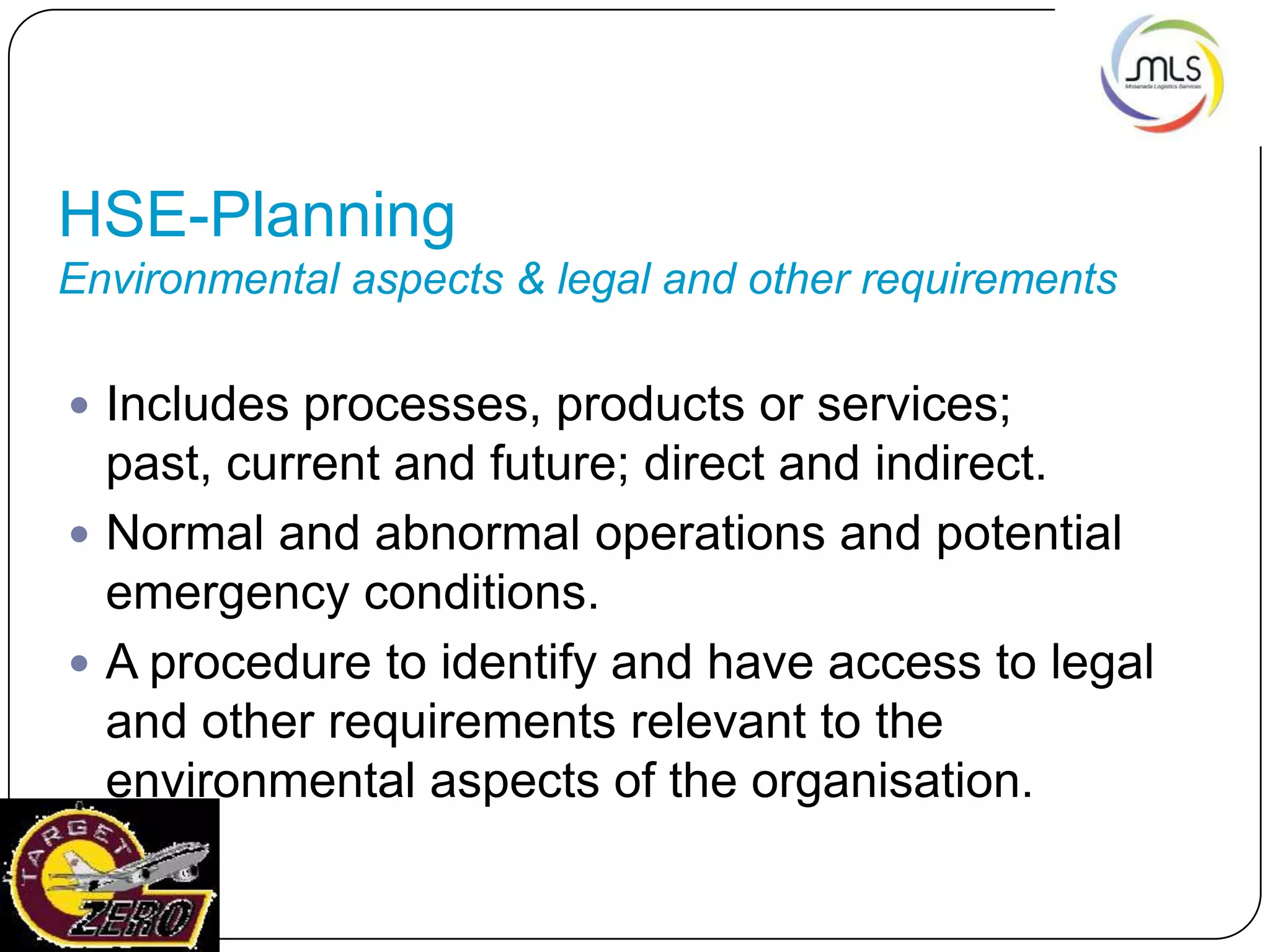
HSE-Planning
Environmental aspects & legal and other requirements
 Includes processes, products or services;
past, current and future; direct and indirect.
 Normal and abnormal operations and potential
emergency conditions.
 A procedure to identify and have access to legal
and other requirements relevant to the
environmental aspects of the organisation.
HSE-Planning
Objectives and targets
 Objectives
Overall goals of the organization aligned with
Health & Safety policy statement and
identified environmental effects, often
included in Health & Safety policy statement.
 Safety Targets
Specific goals of ZERO ACCCIDENT the
organization, should be measurable wherever
practicable.
Health Safety: components
HEALTH & SAFETY
Environmental
policy
HSE-Planning
HSE-Implementation
& operation
Structure &
responsibility
HSE-
Training
Documentation
OF HSESafety
Culture
Operational
control
Emergency
response
HSE - Implementation and operation
Structure and responsibility
 Roles, responsibility, and
authority: making
environmental Health &
Safety management effective.
 Resources and personnel:
implement and control the
EMS.
 Management
representative(s):
co-ordination role - not solely
responsible! Team effort.
Implementation and operation
Training, awareness and communication
 HSE-Training needs
assessment.
 HSE-Training &
awareness programmes:
ensure awareness and
competent personnel.
 Communication
procedures for internal &
external communication.
Implementation and operation
EMS documentation & document control
 Description of the HSE-
management system.
 Linkage to related documentation:
 Process information.
 Organizational charts.
 Internal standards and operational
procedures.
 Site emergency plans.
 Procedures for controlling all
Documents.
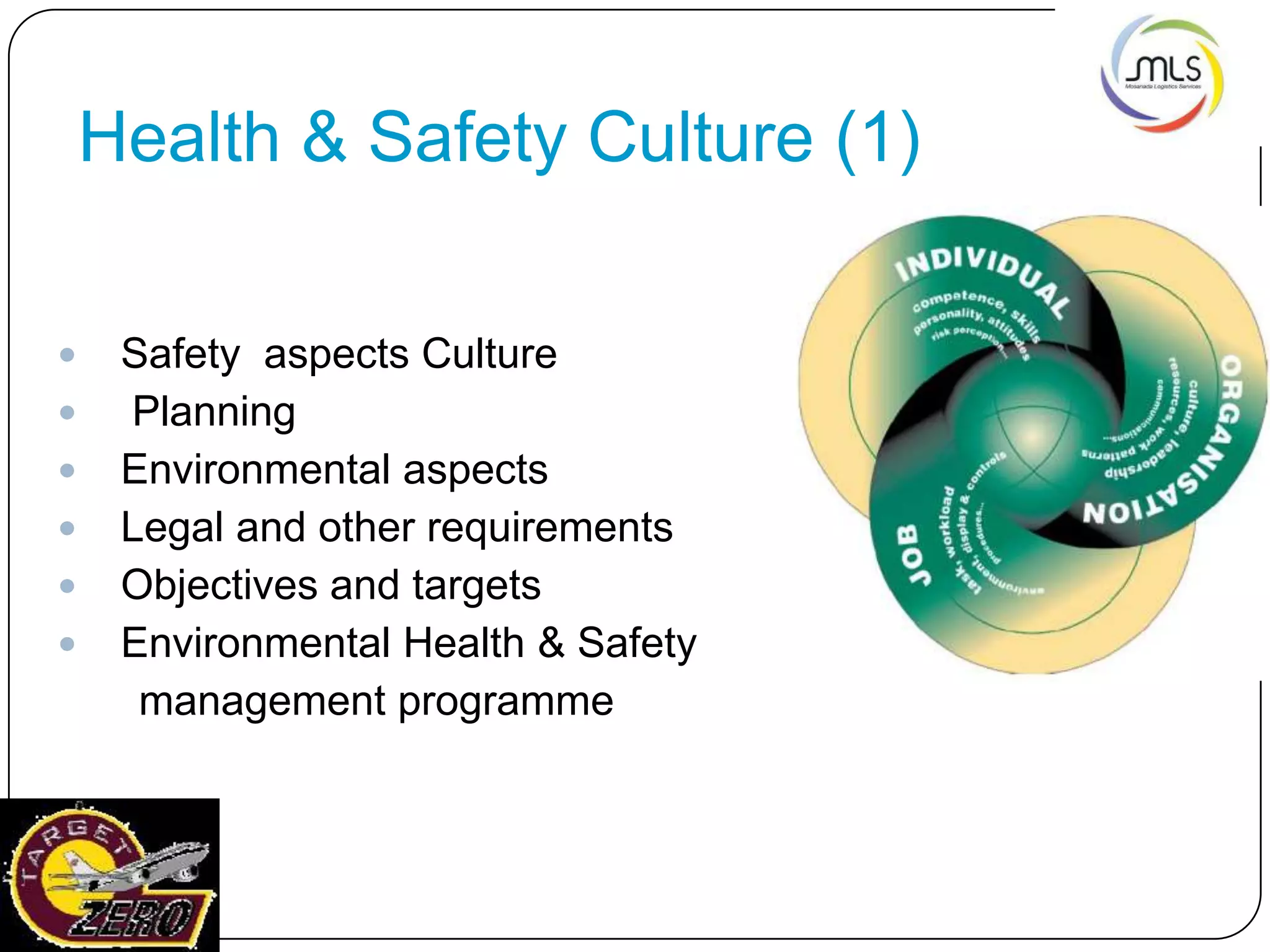
Health & Safety Culture (1)
 Safety aspects Culture
 Planning
 Environmental aspects
 Legal and other requirements
 Objectives and targets
 Environmental Health & Safety
management programme
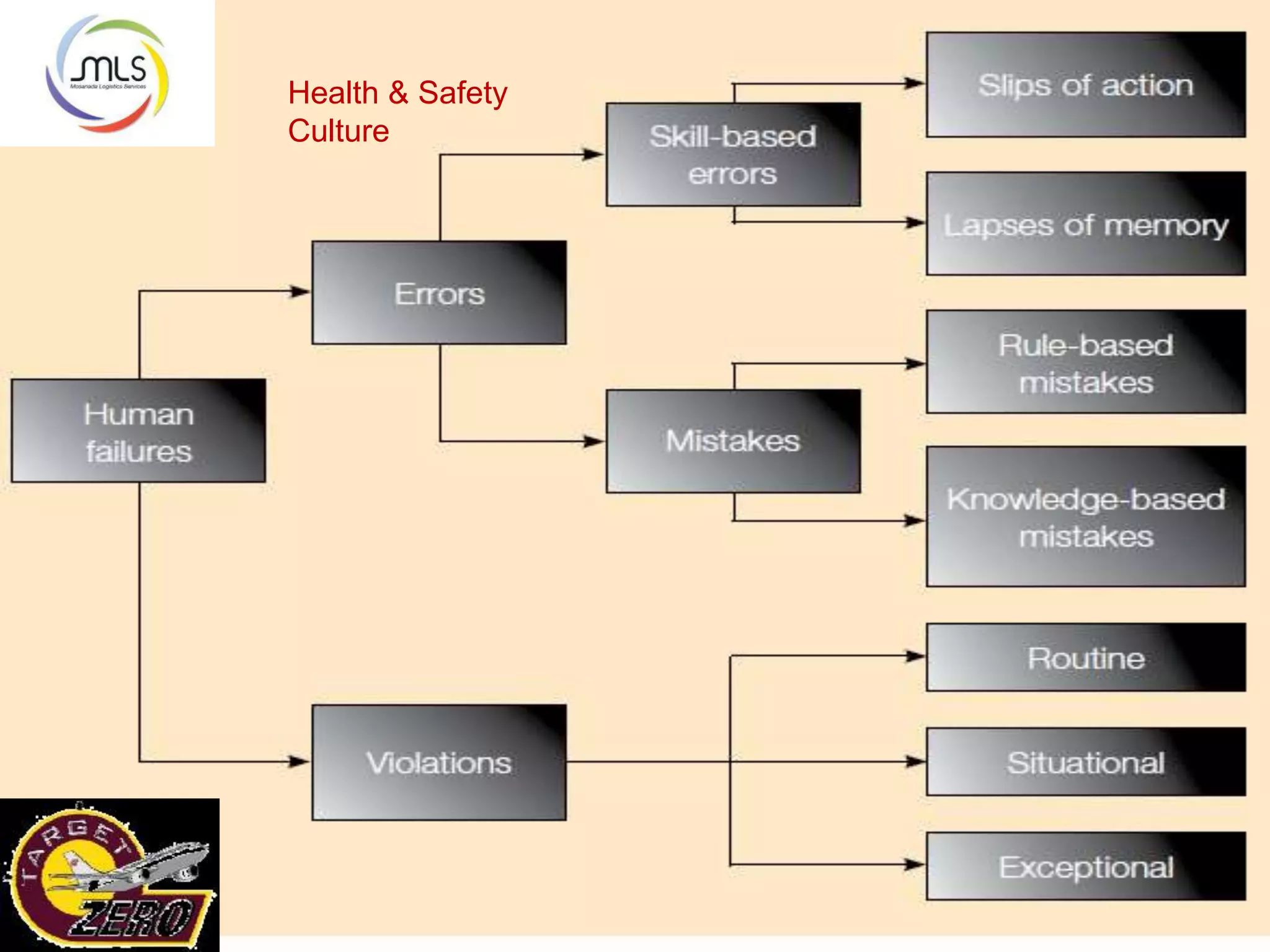
Health & Safety
Culture
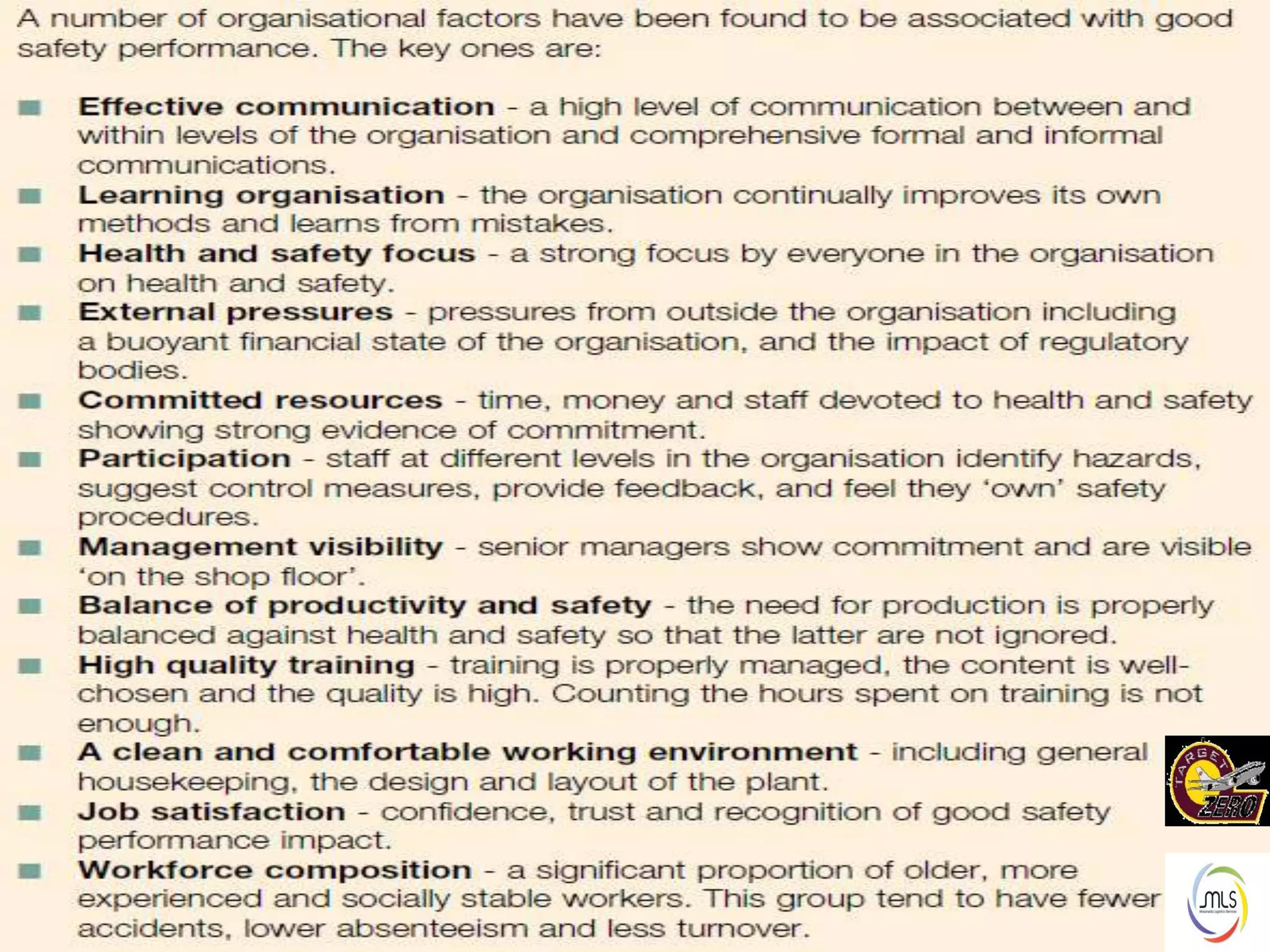
Health & Safety Culture
Health & Safety Culture (2)
 Implementation and Operation
 Structure and Responsibility
 Training, awareness and
competence
 Health & Safety Communication
 Health &Safety management
system documentation
 Health Safety control unsafe
practice
 Operational Good Practice.
 Emergency preparedness and
response
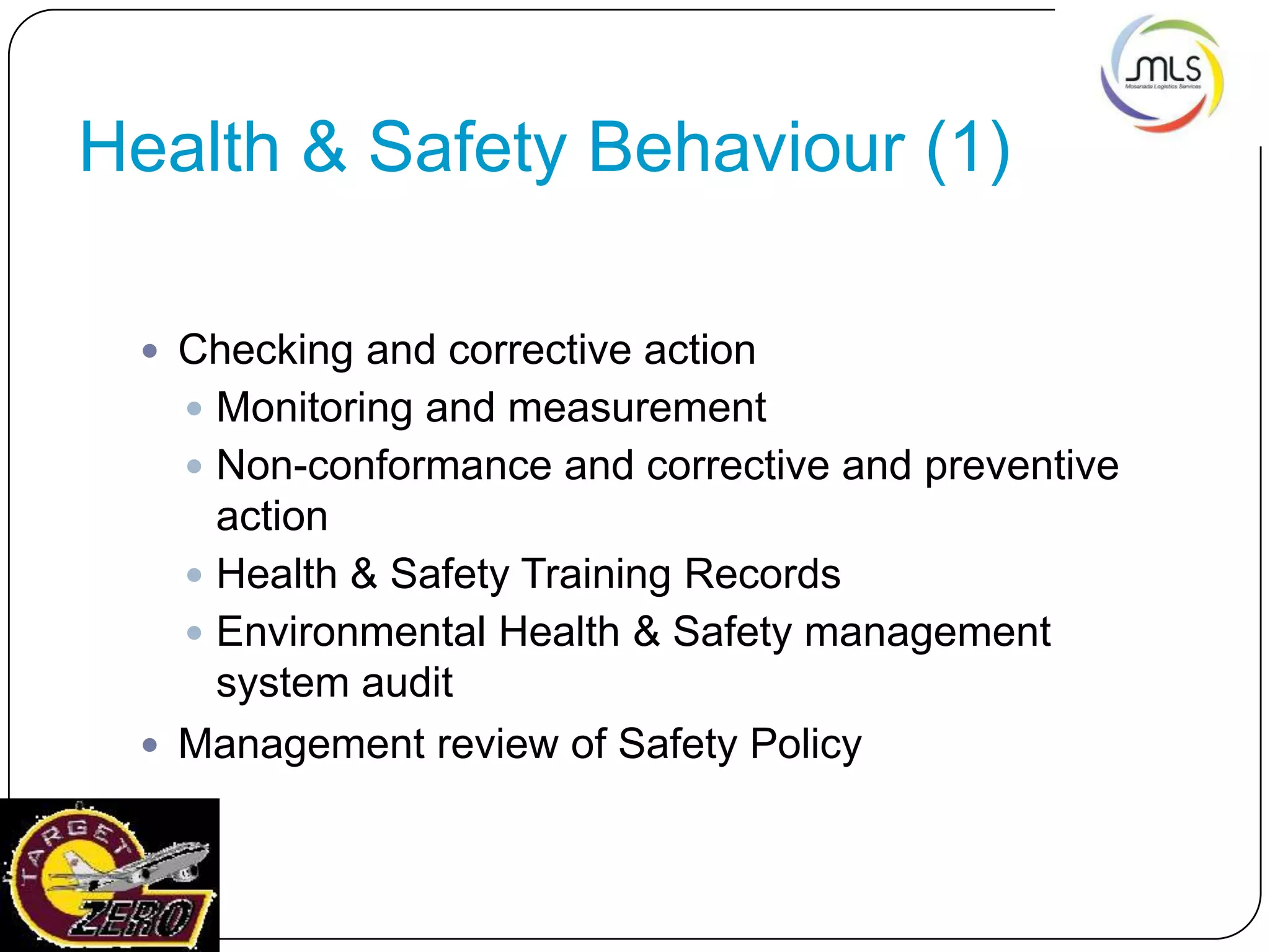
Health & Safety Behaviour (1)
 Checking and corrective action
 Monitoring and measurement
 Non-conformance and corrective and preventive
action
 Health & Safety Training Records
 Environmental Health & Safety management
system audit
 Management review of Safety Policy
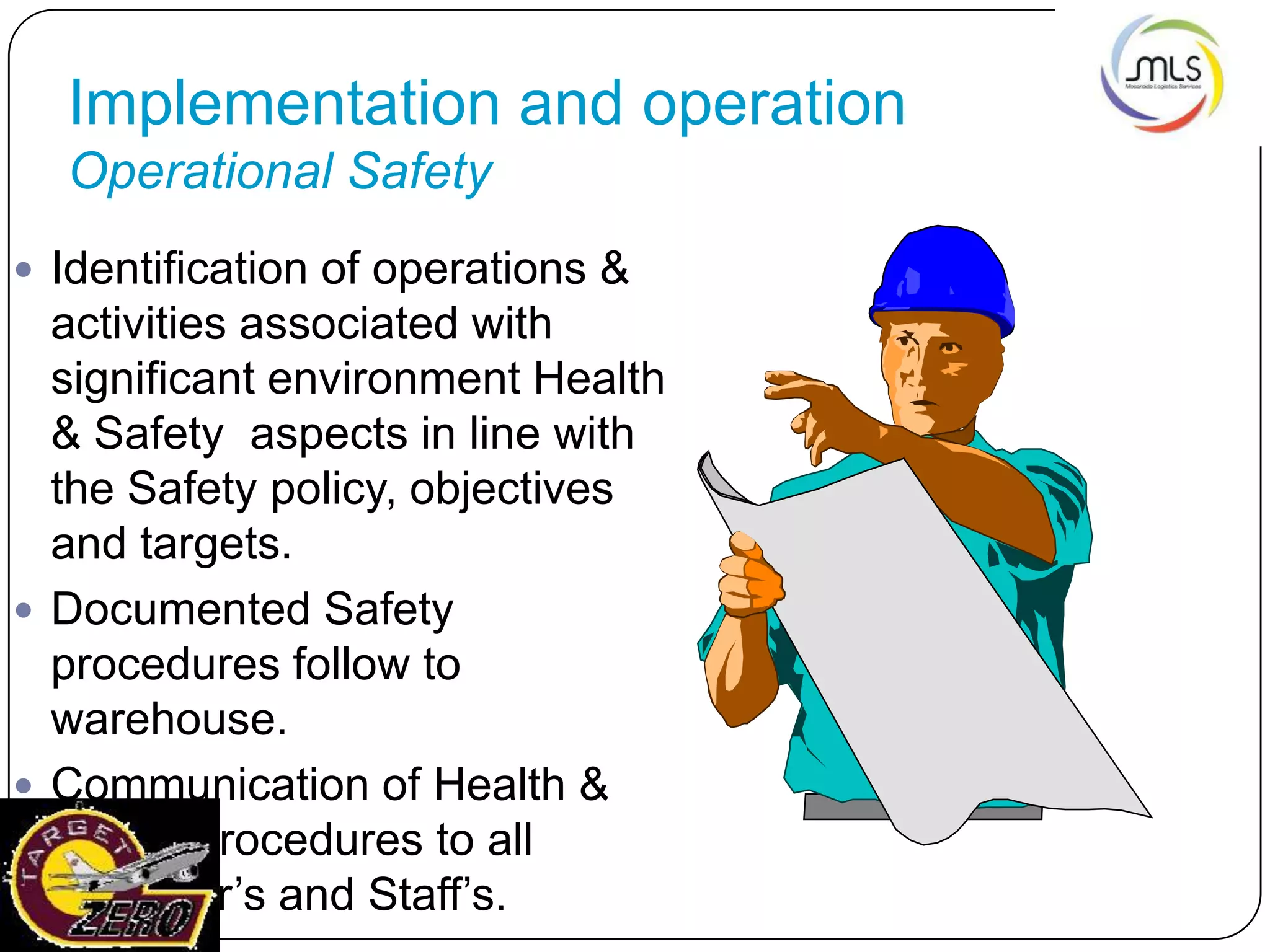
Implementation and operation
Operational Safety
 Identification of operations &
activities associated with
significant environment Health
& Safety aspects in line with
the Safety policy, objectives
and targets.
 Documented Safety
procedures follow to
warehouse.
 Communication of Health &
Safety procedures to all
Manager‟s and Staff‟s.
HSE-Implementation and
operation
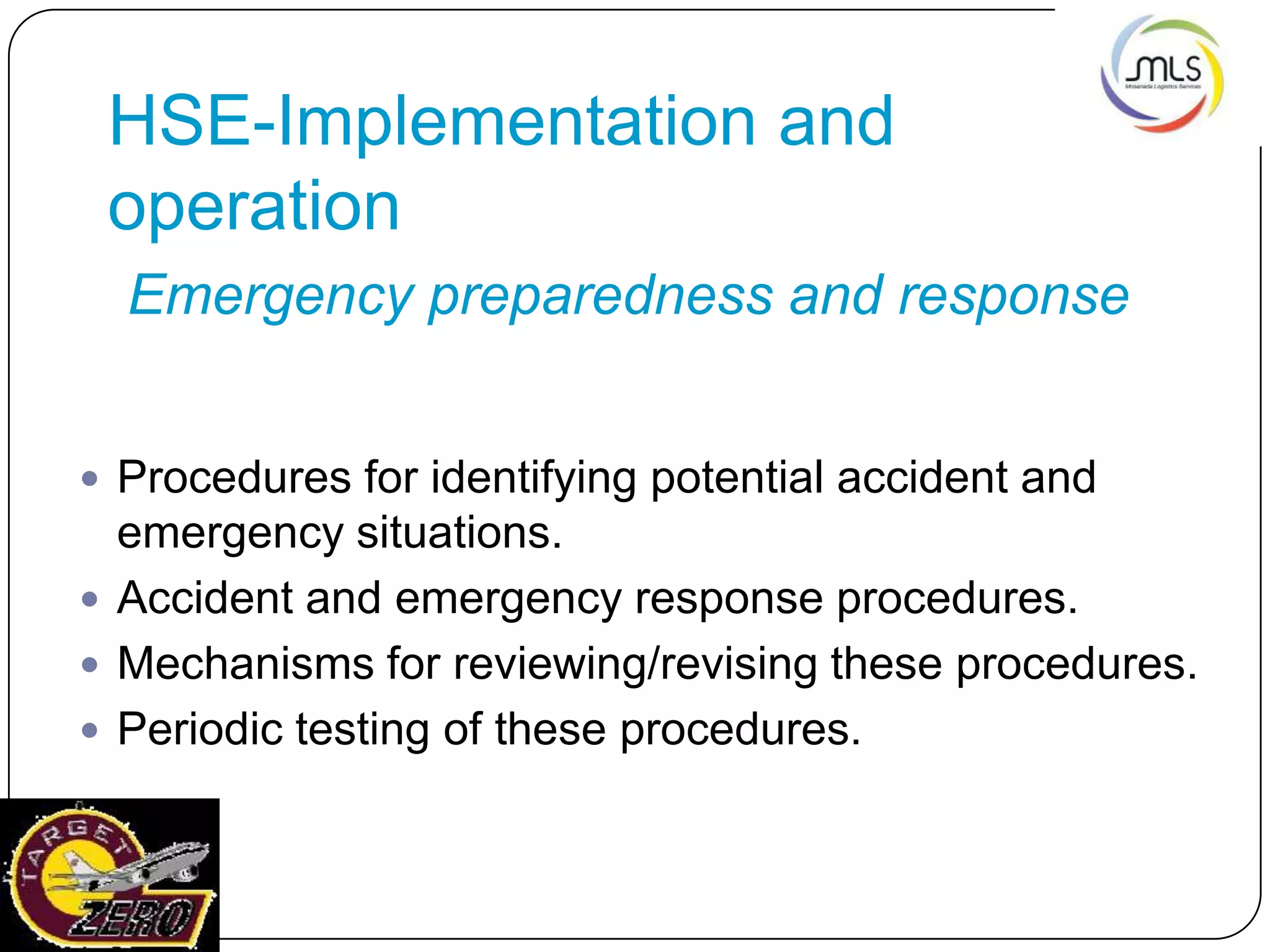
Emergency preparedness and response
 Procedures for identifying potential accident and
emergency situations.
 Accident and emergency response procedures.
 Mechanisms for reviewing/revising these procedures.
 Periodic testing of these procedures.
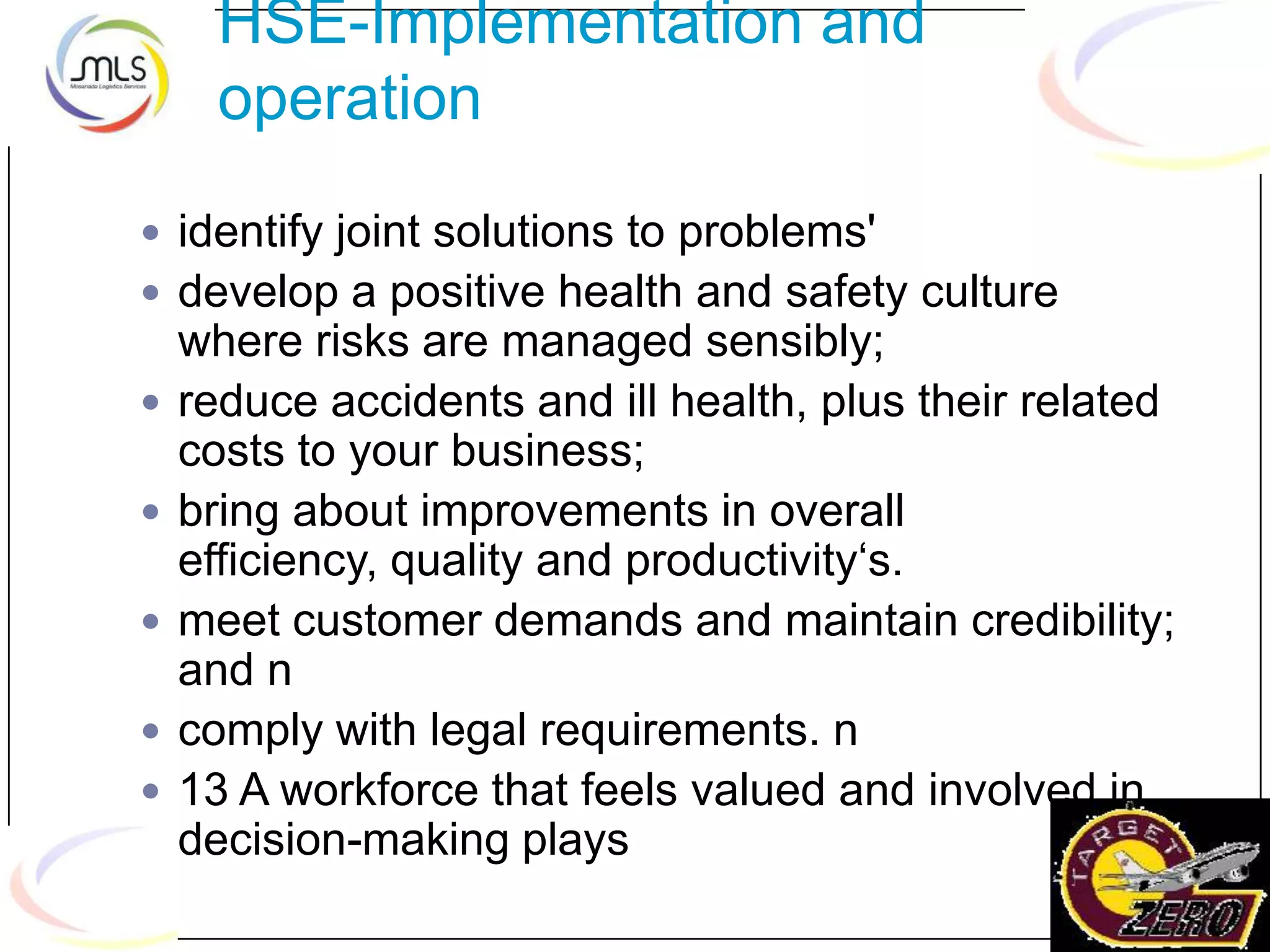
HSE-Implementation and
operation
 identify joint solutions to problems'
 develop a positive health and safety culture
where risks are managed sensibly;
 reduce accidents and ill health, plus their related
costs to your business;
 bring about improvements in overall
efficiency, quality and productivity„s.
 meet customer demands and maintain credibility;
and n
 comply with legal requirements. n
 13 A workforce that feels valued and involved in
decision-making plays
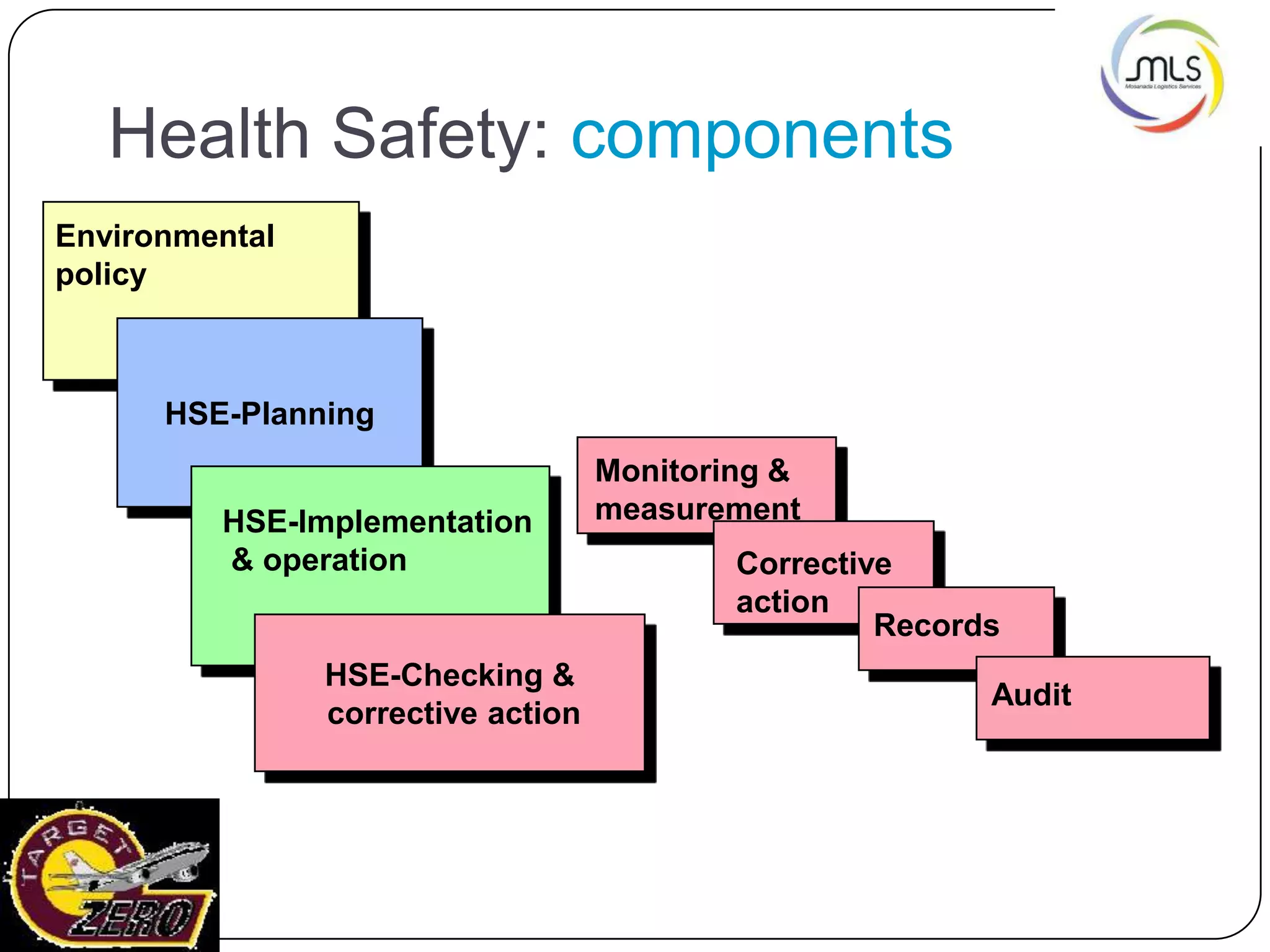
Health Safety: components
Environmental
policy
HSE-Planning
HSE-Checking &
corrective action
HSE-Implementation
& operation
Monitoring &
measurement
Corrective
action
Records
Audit
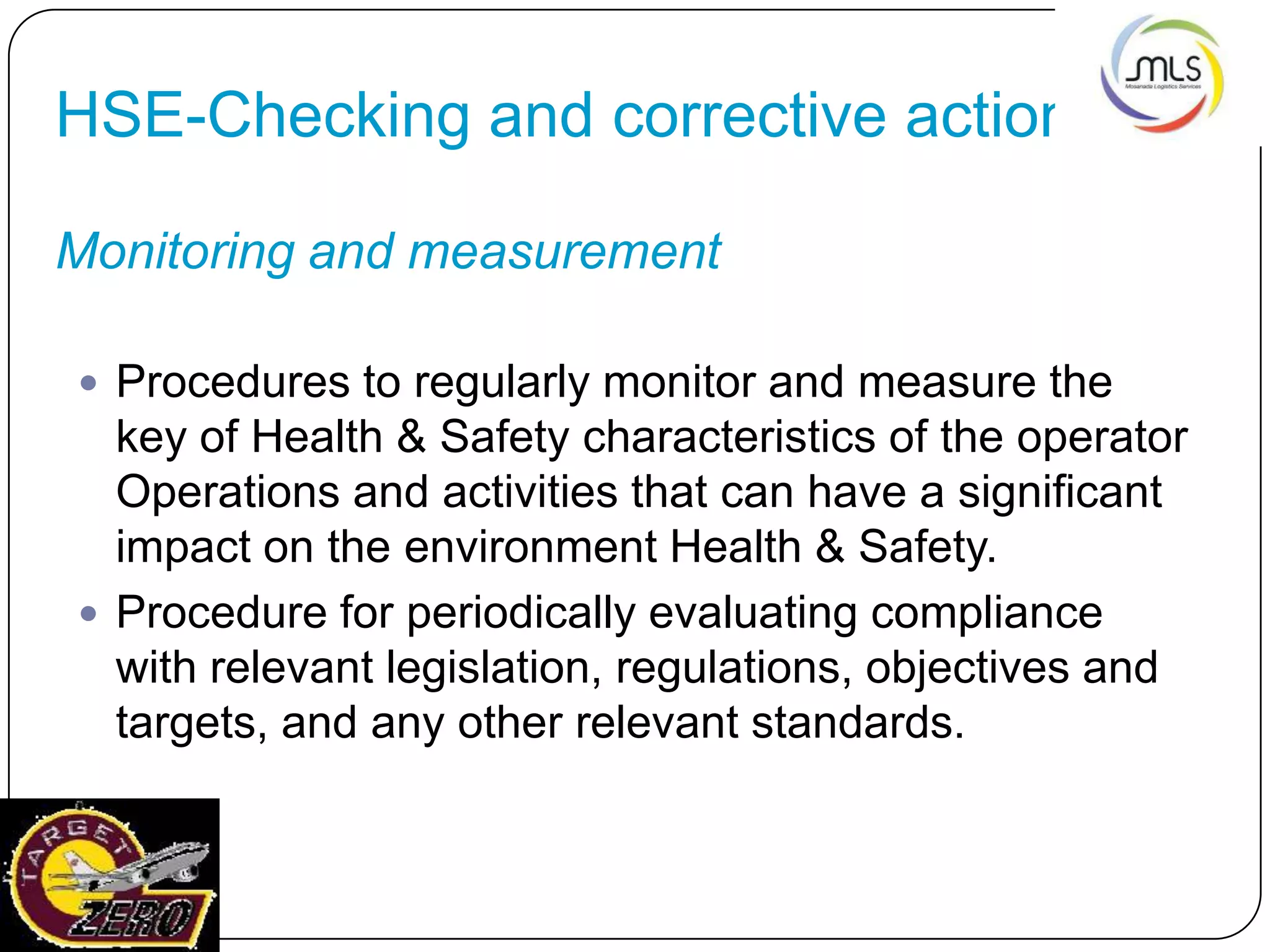
HSE-Checking and corrective action
Monitoring and measurement
 Procedures to regularly monitor and measure the
key of Health & Safety characteristics of the operator
Operations and activities that can have a significant
impact on the environment Health & Safety.
 Procedure for periodically evaluating compliance
with relevant legislation, regulations, objectives and
targets, and any other relevant standards.
HSE-Checking and corrective action
Nonconformance & corrective action and records
 Procedures for defining responsibility and authority
for handling and investigating
nonconformance, which include:
 Action to mitigate any impacts caused.
 Corrective and preventive action.
 Procedures for identification, maintenance and
disposition of environmental records, including:
 Training.
 Review results.
 Audit results.
• The organization shall establish & maintain
programmed and procedures for periodic audits
to be carried out to determine whether or not the
Environment Management System.
• Conforms to planned arrangements for environmental
Health & Safety management, including requirements of
ISO 14001.
• Has been properly implemented & maintained.
HSE-Checking and corrective
action
EMS audit
ISO 14001 components
Environmental
policy
HSE-Planning
HSE-Checking &
corrective action
HSE-Management review
Health & Safety
Implementation
operation
HSE-Management reviews
 Gauges the continuing
suitability, adequacy &
effectiveness of the
Environment Health &
Safety Management
System in the face of
changing internal &
external factors.
 Addresses possible need
for changes to Health &
Safety policy, Safety
objectives & other
elements of the
Environment
Management System.
Welcome heath safety

Welcome heath safety

  • 1.
  • 2.
  • 3.
  • 4.
  • 5.
  • 6.
  • 7.
  • 8.
  • 9.
  • 10.
    7/22/201310  Planning  Organisation Control  Monitoring  Review Risk Assessments are used by “Company Name” to reduce the risk of accidents through: Risk Assessment
  • 11.
    7/22/201311 Risk Assessment InvolvesHazard & Risk Hazard Risk But the risk of it happening is Insignificant! An alien entering the company could Be hazardous!
  • 12.
    7/22/201312 Hazards and Risks Somethingthat has the potential to cause harm. What is a Hazard? What is a Risk? The likelihood that the hazard will cause harm.
  • 13.
    7/22/201313 Purpose of RiskAssessment  Prevention of risk  Provision of information  Provision of training “Identify measures to protect health and safety”
  • 14.
    7/22/201314 Risk Assessments Health &Safety Management Regulations Noise Slips, Trips, Leak Chemicals Manual Handling First Aid PPE Fire
  • 15.
    7/22/201315 Who is Coveredby Risk Assessment?  Employees  Plant & Equipments  Temporary workers  Contractors  The public
  • 16.
    7/22/201316 Simple Risk Assessments What are the hazards?  Who might be harmed?  Is the risk adequately controlled?  Any Damages to Plant & Equipments?  Can anything else be done?
  • 17.
    7/22/201317 Identifying People AtRisk  Employees  Temporary workers  Visitors  Contractors  Young • Plant & Equipment • Pregnant women • Less able-bodied • Lone workers • New Employees
  • 18.
    7/22/201318 Health Risks  Stress Neck and back pain  Respective Stress Injury  Eye strain  Headaches  Psychical & Mental
  • 19.
    What is STARRTCARD TALK ?
  • 20.
    Safety Task AnalysisRisk Reduction Talk (STARRT) According to OHSAS 18001 Safety Task Analysis Risk Reduction Talks (STARRT), which have been running on warehouse site for a little over a year, are a „foundation stone in the Target Zero campaign on the MLS. „They assess the task that is about to be performed and take a 360 o look at the potential risks involved ensuring that those about to participate in the activity are aware of potential risks and hazards before they are affected by them‟. Daily shift STARRT Talk (where good & bad practices along with lessons learned are discussed) and MLS Supervisor select those nominated are trained in the STARRT process, the importance of it and the way in which a STARRT briefing should be delivered. Through internal training this message is
  • 21.
    A Management Health& Safety System Plan do checkAct level of control
  • 22.
  • 23.
    Health Safety: maincomponents HEALTH & SAFETY Environmental policy HSE-Planning HSE-Checking & corrective action HSE-Management review HSE-Implementation & operation Continual improvement
  • 24.
    Health, safety Environmental Policy Written statement endorsed by top management, communicated throughout the organization.  Demonstrates commitment to continual improvement and prevention of pollution.  Demonstrates commitment to compliance with legislation and regulations.  A framework for environmental objectives and targets.  Made available to the public.
  • 25.
    The preparatory review Site impacts Outputs Manager's Controls Inputs KeyAreas: •Regulations •Effects •Systems •Incidents • Layout • Production processes • Transport • Wastes • Product usage • Recycling • Administration • Impacts/activities • Monitoring • Records • Materials • Energy • Water
  • 26.
    Health Safety: components Health& Safety Environmental policy HSE-Planning Health Safety Environmental aspects Legal requirements - HELATH & SAFETY HSE- Objectives and targets
  • 27.
    HSE-Planning Environmental aspects &legal and other requirements  Includes processes, products or services; past, current and future; direct and indirect.  Normal and abnormal operations and potential emergency conditions.  A procedure to identify and have access to legal and other requirements relevant to the environmental aspects of the organisation.
  • 28.
    HSE-Planning Objectives and targets Objectives Overall goals of the organization aligned with Health & Safety policy statement and identified environmental effects, often included in Health & Safety policy statement.  Safety Targets Specific goals of ZERO ACCCIDENT the organization, should be measurable wherever practicable.
  • 29.
    Health Safety: components HEALTH& SAFETY Environmental policy HSE-Planning HSE-Implementation & operation Structure & responsibility HSE- Training Documentation OF HSESafety Culture Operational control Emergency response
  • 30.
    HSE - Implementationand operation Structure and responsibility  Roles, responsibility, and authority: making environmental Health & Safety management effective.  Resources and personnel: implement and control the EMS.  Management representative(s): co-ordination role - not solely responsible! Team effort.
  • 31.
    Implementation and operation Training,awareness and communication  HSE-Training needs assessment.  HSE-Training & awareness programmes: ensure awareness and competent personnel.  Communication procedures for internal & external communication.
  • 32.
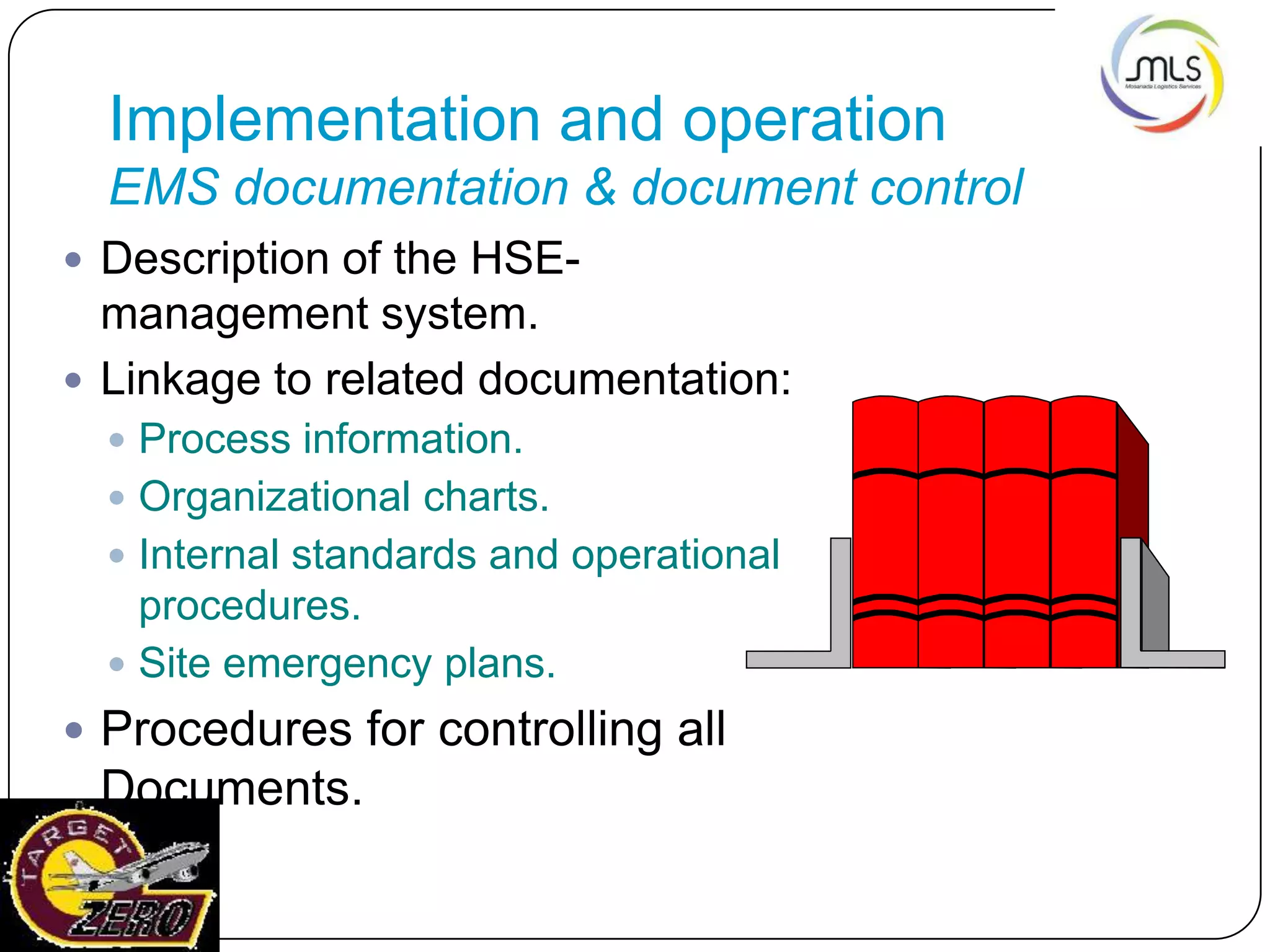
    Implementation and operation EMSdocumentation & document control  Description of the HSE- management system.  Linkage to related documentation:  Process information.  Organizational charts.  Internal standards and operational procedures.  Site emergency plans.  Procedures for controlling all Documents.
  • 33.
    Health & SafetyCulture (1)  Safety aspects Culture  Planning  Environmental aspects  Legal and other requirements  Objectives and targets  Environmental Health & Safety management programme
  • 34.
  • 35.
  • 37.
    Health & SafetyCulture (2)  Implementation and Operation  Structure and Responsibility  Training, awareness and competence  Health & Safety Communication  Health &Safety management system documentation  Health Safety control unsafe practice  Operational Good Practice.  Emergency preparedness and response
  • 38.
    Health & SafetyBehaviour (1)  Checking and corrective action  Monitoring and measurement  Non-conformance and corrective and preventive action  Health & Safety Training Records  Environmental Health & Safety management system audit  Management review of Safety Policy
  • 41.
    Implementation and operation OperationalSafety  Identification of operations & activities associated with significant environment Health & Safety aspects in line with the Safety policy, objectives and targets.  Documented Safety procedures follow to warehouse.  Communication of Health & Safety procedures to all Manager‟s and Staff‟s.
  • 42.
    HSE-Implementation and operation Emergency preparednessand response  Procedures for identifying potential accident and emergency situations.  Accident and emergency response procedures.  Mechanisms for reviewing/revising these procedures.  Periodic testing of these procedures.
  • 43.
    HSE-Implementation and operation  identifyjoint solutions to problems'  develop a positive health and safety culture where risks are managed sensibly;  reduce accidents and ill health, plus their related costs to your business;  bring about improvements in overall efficiency, quality and productivity„s.  meet customer demands and maintain credibility; and n  comply with legal requirements. n  13 A workforce that feels valued and involved in decision-making plays
  • 44.
    Health Safety: components Environmental policy HSE-Planning HSE-Checking& corrective action HSE-Implementation & operation Monitoring & measurement Corrective action Records Audit
  • 45.
    HSE-Checking and correctiveaction Monitoring and measurement  Procedures to regularly monitor and measure the key of Health & Safety characteristics of the operator Operations and activities that can have a significant impact on the environment Health & Safety.  Procedure for periodically evaluating compliance with relevant legislation, regulations, objectives and targets, and any other relevant standards.
  • 46.
    HSE-Checking and correctiveaction Nonconformance & corrective action and records  Procedures for defining responsibility and authority for handling and investigating nonconformance, which include:  Action to mitigate any impacts caused.  Corrective and preventive action.  Procedures for identification, maintenance and disposition of environmental records, including:  Training.  Review results.  Audit results.
  • 47.
    • The organizationshall establish & maintain programmed and procedures for periodic audits to be carried out to determine whether or not the Environment Management System. • Conforms to planned arrangements for environmental Health & Safety management, including requirements of ISO 14001. • Has been properly implemented & maintained. HSE-Checking and corrective action EMS audit
  • 48.
    ISO 14001 components Environmental policy HSE-Planning HSE-Checking& corrective action HSE-Management review Health & Safety Implementation operation
  • 49.
    HSE-Management reviews  Gaugesthe continuing suitability, adequacy & effectiveness of the Environment Health & Safety Management System in the face of changing internal & external factors.  Addresses possible need for changes to Health & Safety policy, Safety objectives & other elements of the Environment Management System.

Editor's Notes