-Dr. AISHWARYA RAI
BPT, FELLOW IN REGENERA
REHABILITATION, CKTP.
Obesity is defined as an unhealthy excess of body fat which
enhances the risk of morbidity and untimely mortality.
It is accompanied by ;
Burden of chronic diseases,
Metabolic complications,
Worsening of quality of life.
It also,
Obesity exacerbates the age related decline in physical function,
and
Frailty & Disability.
INTRODUCTION
BMI (Body Mass Index):
weight(kg)/height Squared (m)
BMI <18.5 underweight
BMI 18.5- 24.9 Normal
BMI 25-29.9 Overweight (I)
BMI 30-39.9 Obesity (II)
BMI >40 Extreme obesity (III)
Waist circumference:
Men > 40 in; Women > 35 in
MEASUREMENT
Other approaches to quantify obesity
Anthropometry (skinfold thickness)
Densitometry (underwater weighing)
Computed tomography (CT)
Magnetic resonance imaging (MRI)
Electrical impedance
Other indices
Lean mass index
Fat percentage
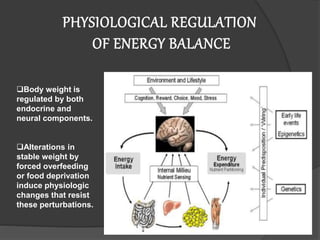
Body weight is
regulated by both
endocrine and
neural components.
Alterations in
stable weight by
forced overfeeding
or food deprivation
induce physiologic
changes that resist
these perturbations.
PHYSIOLOGICAL REGULATION
OF ENERGY BALANCE
AETIOLOGY
Increased caloric intake
▪Availability, price
▪ Extra 50 cal/day
(1 tsp sugar) = 2.25 kg/year = 25 kg over 10 years
More sedentary
▪ Television/Computer
▪ Emphasis on academics
ENVIRONMENTAL
FACTORS
Cushing’s syndrome
Hypothyroidism
Insulinoma
Craniopharyngioma and other disorders involving the
hypothalamus
Drug induced
MEDICAL FACTORS
COMPLICATIONS
Physical exam – Focus on possible complications.
Investigations:
Blood sugar, lipid profile, liver function tests
Other tests based on clinical features
TSH, Sleep studies
Dexamethasone suppression test for Cushing’s
syndrome*
WORK UP
Prevention
Diet
Increased physical activity
Behavior modification
Medicines
TREATMENT
The primary focus of diet therapy is to reduce overall calorie consumption
Very low energy diets (e.g., 400 to 600 kcal/d)
Low-calorie diets, >800 kcal/d
very low fat diets
very low carbohydrate “Atkins” style diets
Guidelines recommend initiating treatment with a calorie deficit of 500– 1000
kcal/d compared with the patient's habitual diet.
Low-carbohydrate, high-protein diets appear to be more effective in lowering
BMI;
improving coronary heart disease risk factors, including an increase in HDL
cholesterol and a decrease in triglyceride levels;
controlling satiety in the short term compared with low-fat diets
DIET
Increased energy expenditure is the most obvious
mechanism for an
effect of exercise
Exercise appears to be a valuable means to
sustain diet therapy
Valuable in the obese individual for its effects on
cardiovascular tone and blood pressure.
EXERCISE
Recommended if BMI >/= 27 with comorbidities or BMI >/= 30
Medications for obesity have traditionally fallen into two major
categories:
1. Appetite suppressants (anorexiants)
2. Gastrointestinal fat blockers
PHARMACOTHERAPY
Indications:
BMI > 35 with an associated comorbidity or a BMI > 40 (irrespective)
Repeated failures of other therapeutic approaches
Capability of tolerating surgery
Weight loss surgeries have traditionally been classified into 3 categories on the basis of
anatomic changes:
Restrictive
Restrictive-malabsorptive
Malabsorptive
SURGERY
Obesity
Obesity

Obesity

  • 1.
    -Dr. AISHWARYA RAI BPT,FELLOW IN REGENERA REHABILITATION, CKTP.
  • 2.
    Obesity is definedas an unhealthy excess of body fat which enhances the risk of morbidity and untimely mortality. It is accompanied by ; Burden of chronic diseases, Metabolic complications, Worsening of quality of life. It also, Obesity exacerbates the age related decline in physical function, and Frailty & Disability. INTRODUCTION
  • 3.
    BMI (Body MassIndex): weight(kg)/height Squared (m) BMI <18.5 underweight BMI 18.5- 24.9 Normal BMI 25-29.9 Overweight (I) BMI 30-39.9 Obesity (II) BMI >40 Extreme obesity (III) Waist circumference: Men > 40 in; Women > 35 in MEASUREMENT
  • 4.
    Other approaches toquantify obesity Anthropometry (skinfold thickness) Densitometry (underwater weighing) Computed tomography (CT) Magnetic resonance imaging (MRI) Electrical impedance Other indices Lean mass index Fat percentage
  • 5.
    Body weight is regulatedby both endocrine and neural components. Alterations in stable weight by forced overfeeding or food deprivation induce physiologic changes that resist these perturbations. PHYSIOLOGICAL REGULATION OF ENERGY BALANCE
  • 7.
  • 8.
    Increased caloric intake ▪Availability,price ▪ Extra 50 cal/day (1 tsp sugar) = 2.25 kg/year = 25 kg over 10 years More sedentary ▪ Television/Computer ▪ Emphasis on academics ENVIRONMENTAL FACTORS
  • 9.
    Cushing’s syndrome Hypothyroidism Insulinoma Craniopharyngioma andother disorders involving the hypothalamus Drug induced MEDICAL FACTORS
  • 10.
  • 13.
    Physical exam –Focus on possible complications. Investigations: Blood sugar, lipid profile, liver function tests Other tests based on clinical features TSH, Sleep studies Dexamethasone suppression test for Cushing’s syndrome* WORK UP
  • 14.
  • 15.
    The primary focusof diet therapy is to reduce overall calorie consumption Very low energy diets (e.g., 400 to 600 kcal/d) Low-calorie diets, >800 kcal/d very low fat diets very low carbohydrate “Atkins” style diets Guidelines recommend initiating treatment with a calorie deficit of 500– 1000 kcal/d compared with the patient's habitual diet. Low-carbohydrate, high-protein diets appear to be more effective in lowering BMI; improving coronary heart disease risk factors, including an increase in HDL cholesterol and a decrease in triglyceride levels; controlling satiety in the short term compared with low-fat diets DIET
  • 16.
    Increased energy expenditureis the most obvious mechanism for an effect of exercise Exercise appears to be a valuable means to sustain diet therapy Valuable in the obese individual for its effects on cardiovascular tone and blood pressure. EXERCISE
  • 17.
    Recommended if BMI>/= 27 with comorbidities or BMI >/= 30 Medications for obesity have traditionally fallen into two major categories: 1. Appetite suppressants (anorexiants) 2. Gastrointestinal fat blockers PHARMACOTHERAPY
  • 18.
    Indications: BMI > 35with an associated comorbidity or a BMI > 40 (irrespective) Repeated failures of other therapeutic approaches Capability of tolerating surgery Weight loss surgeries have traditionally been classified into 3 categories on the basis of anatomic changes: Restrictive Restrictive-malabsorptive Malabsorptive SURGERY