• is abrief restatement of a
texts main points.
• is selecting out key
features of a text to create
a shorter version.
• the output is called
“Summary”
Summarizing
3.
Two aims of
summarizing
Toreproduce
the main idea
and key points
of a text.
To restate these
in as few words
as possible.
4.
• deepen yourunderstanding of the text;
• learn to identify relevant information or key
ideas;
• combine details or examples that support
the main idea/s;
• concentrate on the gist or main idea and
key words presented in the text; and,
capture the key ideas in the text and put
them together clearly and concisely.
Summarizing is an
important skills
because it helps you :
5.
What is not
Summarizing?
•You are not summarizing when you
write down everything
• write down ideas from text word-for-
word;
• write down incoherent and irrelevant
ideas:
• write down ideas that are not stated in
the text; or
• write down a summary that has the
same length or is longer than the
original text.
6.
Guidelines in
Summarizing
1. Clarifyyour purpose before you read.
2. Read the text and understand the meaning. Do not stop
reading until you understand the message conveyed by
the author. Locate the gist or main idea of the text, which
can usually be found either at the beginning, in the
middle, or in the end.
3. Select and underline or circle the key ideas and phrases
while reading; another strategy is to annotate the text.
4. Write all the key ideas and phrases you identified on the
margins or on your notebook in a bullet or outline form.
5. Without looking at the text, identify the connections of
these key ideas and phrases using a concept map.
6. List your ideas in sentence form in a concept map
7.
7. Combine thesentences into a paragraph. Use
appropriate transitional devices to improve cohesion.
8. Ensure that you do not copy a single sentence
from the original text.
9. Refrain from adding comments about the text.
Stick to the ideas it presents.
10. Edit the draft of your summary by eliminating
redundant ideas.
11. Compare your output with the original text to
ensure accuracy.
12. Record the details of the original source (author's
name/s, date of publication, title, publisher, place of
publishing, and URL [if online]). It is not necessary to
indicate the page number/s of the original text in
citing sources in summaries. 13. Format your
summary properly. When you combine your
summaries in a paragraph, use different formats to
show variety in writing.
8.
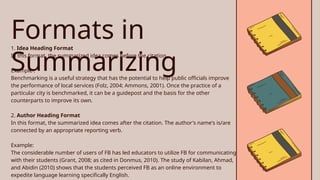
Formats in
Summarizing
1. IdeaHeading Format
In this format, the summarized idea comes before the citation.
Example :
Benchmarking is a useful strategy that has the potential to help public officials improve
the performance of local services (Folz, 2004; Ammons, 2001). Once the practice of a
particular city is benchmarked, it can be a guidepost and the basis for the other
counterparts to improve its own.
2. Author Heading Format
In this format, the summarized idea comes after the citation. The author's name's is/are
connected by an appropriate reporting verb.
Example:
The considerable number of users of FB has led educators to utilize FB for communicating
with their students (Grant, 2008; as cited in Donmus, 2010). The study of Kabilan, Ahmad,
and Abidin (2010) shows that the students perceived FB as an online environment to
expedite language learning specifically English.
9.
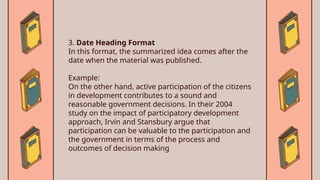
3. Date HeadingFormat
In this format, the summarized idea comes after the
date when the material was published.
Example:
On the other hand, active participation of the citizens
in development contributes to a sound and
reasonable government decisions. In their 2004
study on the impact of participatory development
approach, Irvin and Stansbury argue that
participation can be valuable to the participation and
the government in terms of the process and
outcomes of decision making


![7. Combine the sentences into a paragraph. Use
appropriate transitional devices to improve cohesion.
8. Ensure that you do not copy a single sentence
from the original text.
9. Refrain from adding comments about the text.
Stick to the ideas it presents.
10. Edit the draft of your summary by eliminating
redundant ideas.
11. Compare your output with the original text to
ensure accuracy.
12. Record the details of the original source (author's
name/s, date of publication, title, publisher, place of
publishing, and URL [if online]). It is not necessary to
indicate the page number/s of the original text in
citing sources in summaries. 13. Format your
summary properly. When you combine your
summaries in a paragraph, use different formats to
show variety in writing.](https://image.slidesharecdn.com/summarizing-250302035820-87e949f7/85/Summarizing-techniques-in-englisg-for-acad-purposes-pptx-7-320.jpg)