GROUP 8 – ENGLISH PHONETICS AND PHONOLOGY
1. LÊ THỊ THÙY TRANG
2. TRẦN THỊ NGỌC LAN
3. TRẦN ĐẶNG PHI MINH QUỐC
4. NGUYỄN QUÝ NGUYỆT HỒNG UYÊN
Ms NGUYEN THI THIEN LY
CHAPTER 8 -
INTONATION
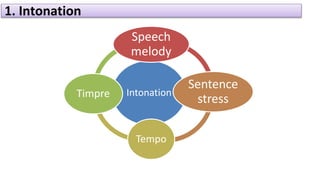
1. Intonation
Intonation
Speech
melody
Sentence
stress
Tempo
Timpre
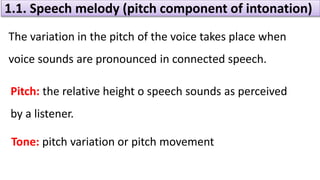
1.1. Speech melody (pitch component of intonation)
The variation in the pitch of the voice takes place when
voice sounds are pronounced in connected speech.
Pitch: the relative height o speech sounds as perceived
by a listener.
Tone: pitch variation or pitch movement
1.2. Tone language and intonation language
Tone: the height of the pitch and change of the pitch which
is associated with the pronunctiationof syllables of words
and affects the meaning of the word
Ex: In Vietnamese, GA means railway station, GÀ means
chicken
Intonation language: languages that use pitch syntactically
or in which the changing pitch of a whole sentence is
otherwise important to the meaning are called intonation
languages
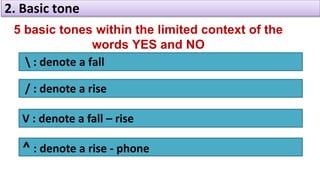
2. Basic tone
5 basic tones within the limited context of the
words YES and NO
 : denote a fall
/ : denote a rise
V : denote a fall – rise
^ : denote a rise - phone
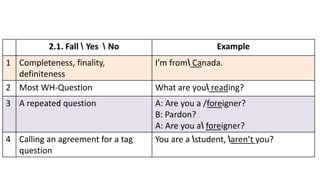
2.1. Fall  Yes  No Example
1 Completeness, finality,
definiteness
I’m from Canada.
2 Most WH-Question What are you reading?
3 A repeated question A: Are you a /foreigner?
B: Pardon?
A: Are you a foreigner?
4 Calling an agreement for a tag
question
You are a student, aren’t you?
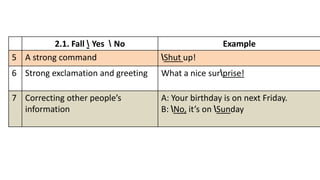
2.1. Fall  Yes  No Example
5 A strong command Shut up!
6 Strong exclamation and greeting What a nice surprise!
7 Correcting other people’s
information
A: Your birthday is on next Friday.
B: No, it’s on Sunday
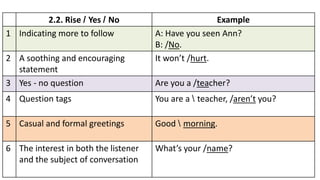
2.2. Rise / Yes / No Example
1 Indicating more to follow A: Have you seen Ann?
B: /No.
2 A soothing and encouraging
statement
It won’t /hurt.
3 Yes - no question Are you a /teacher?
4 Question tags You are a  teacher, /aren’t you?
5 Casual and formal greetings Good  morning.
6 The interest in both the listener
and the subject of conversation
What’s your /name?
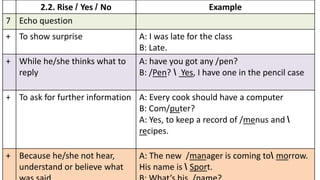
2.2. Rise / Yes / No Example
7 Echo question
+ To show surprise A: I was late for the class
B: Late.
+ While he/she thinks what to
reply
A: have you got any /pen?
B: /Pen?  Yes, I have one in the pencil case
+ To ask for further information A: Every cook should have a computer
B: Com/puter?
A: Yes, to keep a record of /menus and 
recipes.
+ Because he/she not hear,
understand or believe what
A: The new /manager is coming to morrow.
His name is  Sport.
2.3. Fall - Rise
v Yes v No
Example
1 Disagreement to the other
speaker’s opinion
A: Are you at school?
B: vNo, I’m not.
2 Hesitation You v may be right.
3 Correction of what has been
said
He is going to London to day.
To/morrow
2.4. Rise - Fall
^ Yes ^ No
Example
1 Strong feelings of approval,
disapproval or surprise
A: Isn’t she lovely?
B: ^ Yes.
2 Statement of question with
“or”
Do you want /milk or  coffee?
3 Making a list We have to ‘pay for tu/tion and ‘also
for /books
4 Complex senence When he/ came, I asked him to 
wait
5 Non-final phrase and a main
clause
He asked us to write a  story
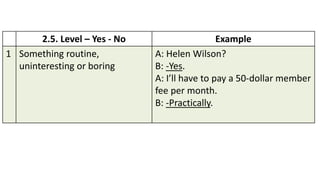
2.5. Level – Yes - No Example
1 Something routine,
uninteresting or boring
A: Helen Wilson?
B: -Yes.
A: I’ll have to pay a 50-dollar member
fee per month.
B: -Practically.
3. Tone - Unit
“
“ Tone – unit is the basic unit
of intonation in a language. ”
15
Examples!
“Is it / you”:
• - Three – syllable utterance consiting of
one tone – unit.
“ John is it you”:
- - Four – syllable utterance consiting of
two tone – unit.
16
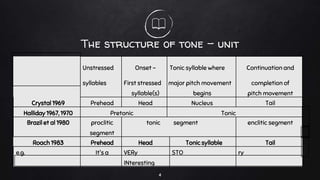
The structure of tone - unit
4
Unstressed Onset - Tonic syllable where Continuation and
syllables First stressed major pitch movement completion of
syllable(s) begins pitch movement
Crystal 1969 Prehead Head Nucleus Tail
Halliday 1967, 1970 Pretonic Tonic
Brazil et al 1980 proclitic tonic segment enclitic segment
segment
Roach 1983 Prehead Head Tonic syllable Tail
e.g. It's a VERy STO ry
INteresting
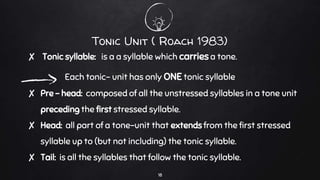
Tonic Unit ( Roach 1983)
✘ Tonic syllable: is a a syllable which carries a tone.
Each tonic- unit has only ONE tonic syllable
✘ Pre – head: composed of all the unstressed syllables in a tone unit
preceding the first stressed syllable.
✘ Head: all part of a tone-unit that extends from the first stressed
syllable up to (but not including) the tonic syllable.
✘ Tail: is all the syllables that follow the tonic syllable.
18
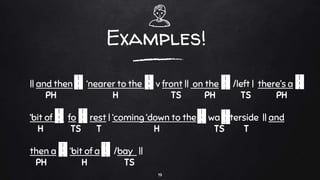
Examples!
19
|| and then ‘nearer to the v front || on the /left | there’s a
PH H TS PH TS PH
‘bit of fo rest | ‘coming ‘down to the wa terside || and
H TS T H TS T
then a ‘bit of a /bay ||
PH H TS
communication
The speaker has to make choice of the place in an utterance
where the movement in pitch begins (choice of tonic syllable).
20
EMPHASIZE
4.
Pitch possibilities in
simple tone unit
21
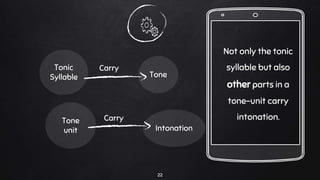
Tonic
Syllable Tone
Tone
unit
22
Carry
Intonation
Carry
Not only the tonic
syllable but also
other parts in a
tone-unit carry
intonation.
✘ In One syllable utterance, the single syllable must have one of the
five tones described above.
Eg: - yes /you vJohn
✘ In a tone-unit of more than one syllable, the tonic syllable must
have one of those tones.
23
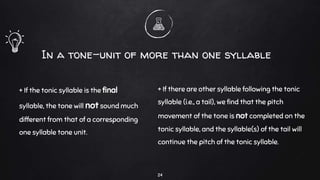
+ If the tonic syllable is the final
syllable, the tone will not sound much
different from that of a corresponding
one syllable tone unit.
In a tone-unit of more than one syllable
+ If there are other syllable following the tonic
syllable (i.e., a tail), we find that the pitch
movement of the tone is not completed on the
tonic syllable, and the syllable(s) of the tail will
continue the pitch of the tonic syllable.
24
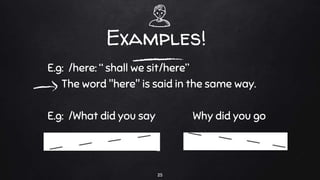
Examples!
E.g: /here: “ shall we sit/here”
The word "here" is said in the same way.
E.g: /What did you say Why did you go
25
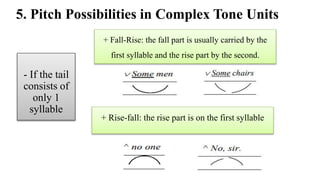
5. Pitch Possibilities in Complex Tone Units
+ Fall-Rise: the fall part is usually carried by the
first syllable and the rise part by the second.
- If the tail
consists of
only 1
syllable
+ Rise-fall: the rise part is on the first syllable
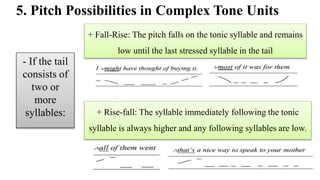
5. Pitch Possibilities in Complex Tone Units
+ Fall-Rise: The pitch falls on the tonic syllable and remains
low until the last stressed syllable in the tail
- If the tail
consists of
two or
more
syllables: + Rise-fall: The syllable immediately following the tonic
syllable is always higher and any following syllables are low.
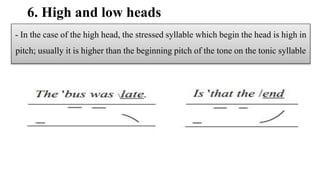
6. High and low heads
- In the case of the high head, the stressed syllable which begin the head is high in
pitch; usually it is higher than the beginning pitch of the tone on the tonic syllable
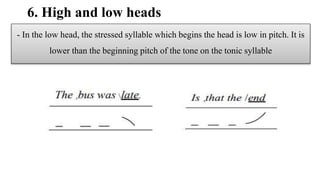
6. High and low heads
- In the low head, the stressed syllable which begins the head is low in pitch. It is
lower than the beginning pitch of the tone on the tonic syllable
6. High and low heads
- It is usual for unstressed syllables to continue the pitch of the stressed syllable
that precedes them
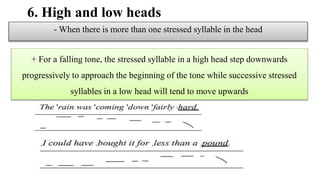
6. High and low heads
- When there is more than one stressed syllable in the head
+ For a falling tone, the stressed syllable in a high head step downwards
progressively to approach the beginning of the tone while successive stressed
syllables in a low head will tend to move upwards
6. High and low heads
- When there is more than one stressed syllable in the head
+ For a rising tone, the stressed syllable in a high head step downwards
progressively to approach the beginning of the tone while successive stressed
syllables in a low head will tend to move upwards
http://dichvudanhvanban.com
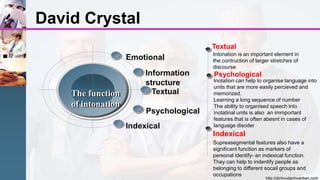
David Crystal
Emotional
Information structure
Expressing a wid range of attitudinal
meaning.
Working along with other prosodic
and paralinguistic features to
provide the basic o all kind of vocal
eamotional pression
Inotonation convey a great deal
about what is new ans what is ready
known in the meaning of an
utterance- what is refeered to as the
informationstructure” of utterance
Emotional
Textual
Information
structure
Psychological
Indexical
The function
of intonation
http://dichvudanhvanban.com
David Crystal
Textual
Indexical
Intonation is an important element in
the contruction of larger stretches of
discourse
Supreasegmental features also have a
significant function as markers of
personal identify- an indexical function.
They can help to indentify people as
belonging to different socail groups and
occupations
Emotional
Textual
Information
structure
Psychological
Indexical
The function
of intonation
Psychological
Inotation can help to organise language into
units that are more easily percieved and
memorized.
Learning a long sequence of number
The ability to organised speech into
inotatinal units is also an immportant
features that is often abesnt in cases of
language disoder
http://dichvudanhvanban.com
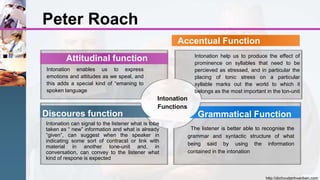
Attitudinal function
Discoures function
Accentual Function
Grammatical Function
Intonation can signal to the listener what is tobe
taken as “ new” information and what is already
“given”, can suggest when the speaker in
indicating some sort of contracst or link with
material in another tone-unit and, in
conversation, can convey to the listener what
kind of respone is expected
The listener is better able to recognise the
grammar and syntactic structure of what
being said by using the information
contained in the intonation
Intonation enables us to express
emotions and attitudes as we speal, and
this adds a special kind of “emaning to
spoken language
Intonation help us to produce the effect of
prominence on syllables that need to be
percieved as stressed, and in particular the
placing of tonic stress on a particular
syllable marks out the world to which it
belongs as the most important in the ton-unit
Intonation
Functions
Peter Roach
L/O/G/O
http://dichvudanhvanban.com
Y o u r B u s i n e s s C o m p a n y s l o g a n i n h e r e

Slide group 8 chapter 8 intonation

  • 1.
    GROUP 8 –ENGLISH PHONETICS AND PHONOLOGY 1. LÊ THỊ THÙY TRANG 2. TRẦN THỊ NGỌC LAN 3. TRẦN ĐẶNG PHI MINH QUỐC 4. NGUYỄN QUÝ NGUYỆT HỒNG UYÊN Ms NGUYEN THI THIEN LY
  • 2.
  • 3.
  • 4.
    1.1. Speech melody(pitch component of intonation) The variation in the pitch of the voice takes place when voice sounds are pronounced in connected speech. Pitch: the relative height o speech sounds as perceived by a listener. Tone: pitch variation or pitch movement
  • 5.
    1.2. Tone languageand intonation language Tone: the height of the pitch and change of the pitch which is associated with the pronunctiationof syllables of words and affects the meaning of the word Ex: In Vietnamese, GA means railway station, GÀ means chicken Intonation language: languages that use pitch syntactically or in which the changing pitch of a whole sentence is otherwise important to the meaning are called intonation languages
  • 6.
    2. Basic tone 5basic tones within the limited context of the words YES and NO : denote a fall / : denote a rise V : denote a fall – rise ^ : denote a rise - phone
  • 7.
    2.1. Fall Yes No Example 1 Completeness, finality, definiteness I’m from Canada. 2 Most WH-Question What are you reading? 3 A repeated question A: Are you a /foreigner? B: Pardon? A: Are you a foreigner? 4 Calling an agreement for a tag question You are a student, aren’t you?
  • 8.
    2.1. Fall Yes No Example 5 A strong command Shut up! 6 Strong exclamation and greeting What a nice surprise! 7 Correcting other people’s information A: Your birthday is on next Friday. B: No, it’s on Sunday
  • 9.
    2.2. Rise /Yes / No Example 1 Indicating more to follow A: Have you seen Ann? B: /No. 2 A soothing and encouraging statement It won’t /hurt. 3 Yes - no question Are you a /teacher? 4 Question tags You are a teacher, /aren’t you? 5 Casual and formal greetings Good morning. 6 The interest in both the listener and the subject of conversation What’s your /name?
  • 10.
    2.2. Rise /Yes / No Example 7 Echo question + To show surprise A: I was late for the class B: Late. + While he/she thinks what to reply A: have you got any /pen? B: /Pen? Yes, I have one in the pencil case + To ask for further information A: Every cook should have a computer B: Com/puter? A: Yes, to keep a record of /menus and recipes. + Because he/she not hear, understand or believe what A: The new /manager is coming to morrow. His name is Sport.
  • 11.
    2.3. Fall -Rise v Yes v No Example 1 Disagreement to the other speaker’s opinion A: Are you at school? B: vNo, I’m not. 2 Hesitation You v may be right. 3 Correction of what has been said He is going to London to day. To/morrow
  • 12.
    2.4. Rise -Fall ^ Yes ^ No Example 1 Strong feelings of approval, disapproval or surprise A: Isn’t she lovely? B: ^ Yes. 2 Statement of question with “or” Do you want /milk or coffee? 3 Making a list We have to ‘pay for tu/tion and ‘also for /books 4 Complex senence When he/ came, I asked him to wait 5 Non-final phrase and a main clause He asked us to write a story
  • 13.
    2.5. Level –Yes - No Example 1 Something routine, uninteresting or boring A: Helen Wilson? B: -Yes. A: I’ll have to pay a 50-dollar member fee per month. B: -Practically.
  • 14.
  • 15.
    “ “ Tone –unit is the basic unit of intonation in a language. ” 15
  • 16.
    Examples! “Is it /you”: • - Three – syllable utterance consiting of one tone – unit. “ John is it you”: - - Four – syllable utterance consiting of two tone – unit. 16
  • 17.
    The structure oftone - unit 4 Unstressed Onset - Tonic syllable where Continuation and syllables First stressed major pitch movement completion of syllable(s) begins pitch movement Crystal 1969 Prehead Head Nucleus Tail Halliday 1967, 1970 Pretonic Tonic Brazil et al 1980 proclitic tonic segment enclitic segment segment Roach 1983 Prehead Head Tonic syllable Tail e.g. It's a VERy STO ry INteresting
  • 18.
    Tonic Unit (Roach 1983) ✘ Tonic syllable: is a a syllable which carries a tone. Each tonic- unit has only ONE tonic syllable ✘ Pre – head: composed of all the unstressed syllables in a tone unit preceding the first stressed syllable. ✘ Head: all part of a tone-unit that extends from the first stressed syllable up to (but not including) the tonic syllable. ✘ Tail: is all the syllables that follow the tonic syllable. 18
  • 19.
    Examples! 19 || and then‘nearer to the v front || on the /left | there’s a PH H TS PH TS PH ‘bit of fo rest | ‘coming ‘down to the wa terside || and H TS T H TS T then a ‘bit of a /bay || PH H TS
  • 20.
    communication The speaker hasto make choice of the place in an utterance where the movement in pitch begins (choice of tonic syllable). 20 EMPHASIZE
  • 21.
  • 22.
    Tonic Syllable Tone Tone unit 22 Carry Intonation Carry Not onlythe tonic syllable but also other parts in a tone-unit carry intonation.
  • 23.
    ✘ In Onesyllable utterance, the single syllable must have one of the five tones described above. Eg: - yes /you vJohn ✘ In a tone-unit of more than one syllable, the tonic syllable must have one of those tones. 23
  • 24.
    + If thetonic syllable is the final syllable, the tone will not sound much different from that of a corresponding one syllable tone unit. In a tone-unit of more than one syllable + If there are other syllable following the tonic syllable (i.e., a tail), we find that the pitch movement of the tone is not completed on the tonic syllable, and the syllable(s) of the tail will continue the pitch of the tonic syllable. 24
  • 25.
    Examples! E.g: /here: “shall we sit/here” The word "here" is said in the same way. E.g: /What did you say Why did you go 25
  • 26.
    5. Pitch Possibilitiesin Complex Tone Units + Fall-Rise: the fall part is usually carried by the first syllable and the rise part by the second. - If the tail consists of only 1 syllable + Rise-fall: the rise part is on the first syllable
  • 27.
    5. Pitch Possibilitiesin Complex Tone Units + Fall-Rise: The pitch falls on the tonic syllable and remains low until the last stressed syllable in the tail - If the tail consists of two or more syllables: + Rise-fall: The syllable immediately following the tonic syllable is always higher and any following syllables are low.
  • 28.
    6. High andlow heads - In the case of the high head, the stressed syllable which begin the head is high in pitch; usually it is higher than the beginning pitch of the tone on the tonic syllable
  • 29.
    6. High andlow heads - In the low head, the stressed syllable which begins the head is low in pitch. It is lower than the beginning pitch of the tone on the tonic syllable
  • 30.
    6. High andlow heads - It is usual for unstressed syllables to continue the pitch of the stressed syllable that precedes them
  • 31.
    6. High andlow heads - When there is more than one stressed syllable in the head + For a falling tone, the stressed syllable in a high head step downwards progressively to approach the beginning of the tone while successive stressed syllables in a low head will tend to move upwards
  • 32.
    6. High andlow heads - When there is more than one stressed syllable in the head + For a rising tone, the stressed syllable in a high head step downwards progressively to approach the beginning of the tone while successive stressed syllables in a low head will tend to move upwards
  • 33.
    http://dichvudanhvanban.com David Crystal Emotional Information structure Expressinga wid range of attitudinal meaning. Working along with other prosodic and paralinguistic features to provide the basic o all kind of vocal eamotional pression Inotonation convey a great deal about what is new ans what is ready known in the meaning of an utterance- what is refeered to as the informationstructure” of utterance Emotional Textual Information structure Psychological Indexical The function of intonation
  • 34.
    http://dichvudanhvanban.com David Crystal Textual Indexical Intonation isan important element in the contruction of larger stretches of discourse Supreasegmental features also have a significant function as markers of personal identify- an indexical function. They can help to indentify people as belonging to different socail groups and occupations Emotional Textual Information structure Psychological Indexical The function of intonation Psychological Inotation can help to organise language into units that are more easily percieved and memorized. Learning a long sequence of number The ability to organised speech into inotatinal units is also an immportant features that is often abesnt in cases of language disoder
  • 35.
    http://dichvudanhvanban.com Attitudinal function Discoures function AccentualFunction Grammatical Function Intonation can signal to the listener what is tobe taken as “ new” information and what is already “given”, can suggest when the speaker in indicating some sort of contracst or link with material in another tone-unit and, in conversation, can convey to the listener what kind of respone is expected The listener is better able to recognise the grammar and syntactic structure of what being said by using the information contained in the intonation Intonation enables us to express emotions and attitudes as we speal, and this adds a special kind of “emaning to spoken language Intonation help us to produce the effect of prominence on syllables that need to be percieved as stressed, and in particular the placing of tonic stress on a particular syllable marks out the world to which it belongs as the most important in the ton-unit Intonation Functions Peter Roach
  • 36.
    L/O/G/O http://dichvudanhvanban.com Y o ur B u s i n e s s C o m p a n y s l o g a n i n h e r e