CONCEPT
OF
REPLICATION
By,
Ashwin Shivashankar
Athira Mary Rajan
Chandana B L
Chinchu Ouseph
Deepak A P
 Copying of genetic information
 Inherited to next generation or to the
daughter cells of cell division
 Allows to receive complete copy of
genetic information
 Prior to cell division during the S phase of
interphase
 At the end of their 1953 paper Watson
and Crick wrote-
“It has not escaped our notice that the
specific pairing we have postulated
immediately suggests a possible copying
mechanism for the genetic material”
 As two strands are complementary, one
could act as template and determine the
sequence of other
 After Watson and Crick proposed the double
helix model, 3 models for DNA replication were
proposed
1. CONSERVATIVEMODEL
- two parental DNA strands binds back after
replication
- one daughter molecule with both parental
strands and the other with two newly
synthesized strands
2. SEMICONSERVATIVEMODEL
-the daughter molecules will have one parental
strand and one newly synthesized strand
3. Dispersivemodel
-daughter molecules each with parental and
progeny DNA segments interspersed
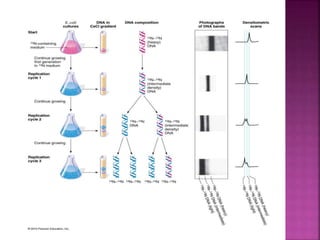
 Matthew Meselson and Franklin Stahl ( 1958 )
 Controlled isotopic composition of nucleotides
incorporated in the newly synthesized daughter
DNA
 E.coli grown for several generations in media in
which all nitrogen were normal isotope 14N;
culture served as control
 Other culture with E.coli grown for several
generations in media with only N source was
heavy isotope 15N
 Culture with E.coli having 15N labeled DNA
transferred to new medium were all nitrogen were
14N
 Any DNA synthesized after transfer would contain
lighter isotope
 Isolated DNA from cells grown in different N-
isotope cultures and subjected to equilibrium
density gradient centrifugation
 15N DNA denser than 14N DNA thus forming band
closer to bottom of tube
 Resultant 1st generation cells formed band at
density intermediate to pure 15N DNA and pure 14N
DNA
 Specific base pairing
 Begins at sequences called origins
 Initiated by short fragments of RNA called
primers
 Elongation of DNA strand always in 5‘-3‘ direction
 New nucleotides added to 3‘-OH group of
growing strand
 New nucleotide strands complementary and
antiparallel to template strand
 ORIGIN : where replication begins
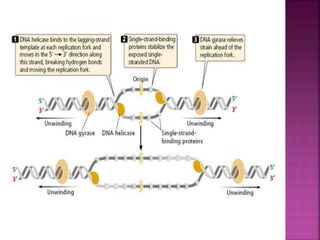
 HELICASES : unwinding proteins of double helix
 SINGLE-STRANDED BINDING PROTEINS : stabilizes
single stranded regions of DNA
 TOPOISOMERASES : relaxes stress further up the
strand
 DNA POYMERASE : 5‘-3‘ DNA synthesis
 PRIMER : a segment of new strand with 3‘ hydroxyl
group to which nucleotides can be added
 PRIMASE : synthesize RNA primers
 LIGASE : fills in final gaps on lagging strand
 3 major steps –
1. INITIATION
2. ELONGATION
3. TERMINATION
 Occurs in 5‘-3‘ direction at a rate of 1000
nucleotides per second
 3 types of polymerases
- DNA pol I – exonuclease activity
- DNA pol II - repair function
- DNA pol III – DNA synthesis
 Single origin of replication
 Origin of Replication
 245 base pair long
 AT rich sites
 9 bp and 13 bp repeats
-DnaA box (4 nos.): 5’ - TTATCCACA - 3’
-DnaB box (3 nos.): 5’ - GATCTNTTNTTTT - 3
 INITIATION
 DNA binds around initiator protein complex DNA-A
 DNA-B or helicase unwinds ori C
 SSB binds to single stranded region to protect it
from breakage and prevent premature reannealing
 DNA gyrase relives stress ahead of replication fork
 DNA primer attaches to DNA and synthesis a short
RNA primer
 ELONGATION
 DNA pol III is loaded and it extends the RNA primer
 Leading strand :
- the new strand continuously synthesized in
5‘-3‘ direction in the 3‘-5‘ oriented template strand
 Lagging strand :
- the new strand discontinuously synthesized in
small fragments in 5‘-3‘ oriented template strand
 After synthesis by DNA pol III, with its 5‘-3‘
exonuclease activity DNA pol I removes RNA primer
and fills gap with DNA
 DNA ligase fills gaps and nicks
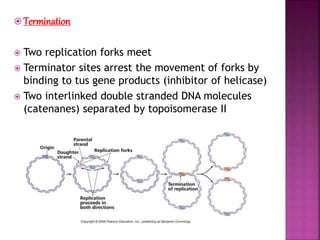
 Termination
 Two replication forks meet
 Terminator sites arrest the movement of forks by
binding to tus gene products (inhibitor of helicase)
 Two interlinked double stranded DNA molecules
(catenanes) separated by topoisomerase II
 Multiple origin of replication
 Formed of about 150 nucleotides
 Replication occurs at various points simultaneously
 Slow, at a rate of 100 nucleotides per second
 PRE REPLICATIONCOMPLEX
 Protein complex that forms at the ori
 Assembling of complex occurs during late M phase
and early G1 phase when CDK activity is low
 This timing and other regulatory mechanisms
ensure that DNA replication occur only once during
the cell cycle
 Complex activated during S phase
 Separation of assembly and activation to different
phase prevents origin firing more than once in a
single cell cycle
 Termination
 DNA pol halts on reaching a section of DNA
template that has already been replicated
 DNA pol cannot catalyze phosphodiester bond
formation between two segments of new DNA
strand and it falls off
 These unattached sections of full replicated DNA
strands are called nicks
 Enzymes FEN1 and Rnase H remove RNA primers
 Once RNA primers are removed free floating
DNA pol lands at 3‘ end of preceding DNA
fragment and extends DNA over gap
 Eukaryotes lack termination sequences and
proteins analogous to Ter sites and Tus protein
in prokaryotes
 Protective caps at ends crucial in preserving the
structural integrity of each chromosome
 DNA pol can reconstruct only the 3‘ end and not the
5 end
 If left to its own devices, chromosomes of
successive generations of cells would become
shorter and shorter
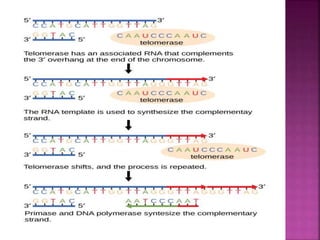
 Telomeres and an enzyme telomerase
countermeasure to this problem
 Special repetitive sequence of telomeres
contain no protein coding genes
 Telomerase - carries its own RNA template with
it
 Telomerase also has several additional protein
domains needed to assemble the enzyme at the
ends of chromosomes properly
 When eukaryotic DNA is replicated, it
complexes with histones.
– This requires synthesis of histone
proteins and assembly of new nucleosomes.
 Transcription of histone genes is initiated
near the end of G1 phase, and translation of
histone proteins occurs throughout S phase.
Concept of replication

Concept of replication

  • 1.
    CONCEPT OF REPLICATION By, Ashwin Shivashankar Athira MaryRajan Chandana B L Chinchu Ouseph Deepak A P
  • 2.
     Copying ofgenetic information  Inherited to next generation or to the daughter cells of cell division  Allows to receive complete copy of genetic information  Prior to cell division during the S phase of interphase
  • 3.
     At theend of their 1953 paper Watson and Crick wrote- “It has not escaped our notice that the specific pairing we have postulated immediately suggests a possible copying mechanism for the genetic material”  As two strands are complementary, one could act as template and determine the sequence of other
  • 4.
     After Watsonand Crick proposed the double helix model, 3 models for DNA replication were proposed 1. CONSERVATIVEMODEL - two parental DNA strands binds back after replication - one daughter molecule with both parental strands and the other with two newly synthesized strands
  • 5.
    2. SEMICONSERVATIVEMODEL -the daughtermolecules will have one parental strand and one newly synthesized strand 3. Dispersivemodel -daughter molecules each with parental and progeny DNA segments interspersed
  • 6.
     Matthew Meselsonand Franklin Stahl ( 1958 )  Controlled isotopic composition of nucleotides incorporated in the newly synthesized daughter DNA  E.coli grown for several generations in media in which all nitrogen were normal isotope 14N; culture served as control  Other culture with E.coli grown for several generations in media with only N source was heavy isotope 15N
  • 7.
     Culture withE.coli having 15N labeled DNA transferred to new medium were all nitrogen were 14N  Any DNA synthesized after transfer would contain lighter isotope  Isolated DNA from cells grown in different N- isotope cultures and subjected to equilibrium density gradient centrifugation  15N DNA denser than 14N DNA thus forming band closer to bottom of tube  Resultant 1st generation cells formed band at density intermediate to pure 15N DNA and pure 14N DNA
  • 9.
     Specific basepairing  Begins at sequences called origins  Initiated by short fragments of RNA called primers  Elongation of DNA strand always in 5‘-3‘ direction  New nucleotides added to 3‘-OH group of growing strand  New nucleotide strands complementary and antiparallel to template strand
  • 10.
     ORIGIN :where replication begins  HELICASES : unwinding proteins of double helix  SINGLE-STRANDED BINDING PROTEINS : stabilizes single stranded regions of DNA  TOPOISOMERASES : relaxes stress further up the strand  DNA POYMERASE : 5‘-3‘ DNA synthesis  PRIMER : a segment of new strand with 3‘ hydroxyl group to which nucleotides can be added  PRIMASE : synthesize RNA primers  LIGASE : fills in final gaps on lagging strand
  • 11.
     3 majorsteps – 1. INITIATION 2. ELONGATION 3. TERMINATION
  • 12.
     Occurs in5‘-3‘ direction at a rate of 1000 nucleotides per second  3 types of polymerases - DNA pol I – exonuclease activity - DNA pol II - repair function - DNA pol III – DNA synthesis  Single origin of replication
  • 13.
     Origin ofReplication  245 base pair long  AT rich sites  9 bp and 13 bp repeats -DnaA box (4 nos.): 5’ - TTATCCACA - 3’ -DnaB box (3 nos.): 5’ - GATCTNTTNTTTT - 3
  • 14.
     INITIATION  DNAbinds around initiator protein complex DNA-A  DNA-B or helicase unwinds ori C  SSB binds to single stranded region to protect it from breakage and prevent premature reannealing  DNA gyrase relives stress ahead of replication fork  DNA primer attaches to DNA and synthesis a short RNA primer
  • 16.
     ELONGATION  DNApol III is loaded and it extends the RNA primer  Leading strand : - the new strand continuously synthesized in 5‘-3‘ direction in the 3‘-5‘ oriented template strand  Lagging strand : - the new strand discontinuously synthesized in small fragments in 5‘-3‘ oriented template strand
  • 17.
     After synthesisby DNA pol III, with its 5‘-3‘ exonuclease activity DNA pol I removes RNA primer and fills gap with DNA  DNA ligase fills gaps and nicks
  • 18.
     Termination  Tworeplication forks meet  Terminator sites arrest the movement of forks by binding to tus gene products (inhibitor of helicase)  Two interlinked double stranded DNA molecules (catenanes) separated by topoisomerase II
  • 20.
     Multiple originof replication  Formed of about 150 nucleotides  Replication occurs at various points simultaneously  Slow, at a rate of 100 nucleotides per second
  • 21.
     PRE REPLICATIONCOMPLEX Protein complex that forms at the ori  Assembling of complex occurs during late M phase and early G1 phase when CDK activity is low  This timing and other regulatory mechanisms ensure that DNA replication occur only once during the cell cycle  Complex activated during S phase  Separation of assembly and activation to different phase prevents origin firing more than once in a single cell cycle
  • 22.
     Termination  DNApol halts on reaching a section of DNA template that has already been replicated  DNA pol cannot catalyze phosphodiester bond formation between two segments of new DNA strand and it falls off  These unattached sections of full replicated DNA strands are called nicks  Enzymes FEN1 and Rnase H remove RNA primers
  • 23.
     Once RNAprimers are removed free floating DNA pol lands at 3‘ end of preceding DNA fragment and extends DNA over gap  Eukaryotes lack termination sequences and proteins analogous to Ter sites and Tus protein in prokaryotes
  • 25.
     Protective capsat ends crucial in preserving the structural integrity of each chromosome  DNA pol can reconstruct only the 3‘ end and not the 5 end  If left to its own devices, chromosomes of successive generations of cells would become shorter and shorter  Telomeres and an enzyme telomerase countermeasure to this problem
  • 26.
     Special repetitivesequence of telomeres contain no protein coding genes  Telomerase - carries its own RNA template with it  Telomerase also has several additional protein domains needed to assemble the enzyme at the ends of chromosomes properly
  • 28.
     When eukaryoticDNA is replicated, it complexes with histones. – This requires synthesis of histone proteins and assembly of new nucleosomes.  Transcription of histone genes is initiated near the end of G1 phase, and translation of histone proteins occurs throughout S phase.