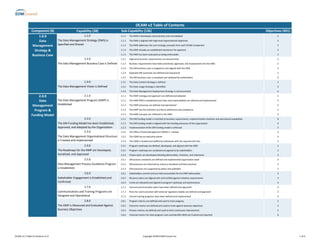
Component (8) Capability (38) Objectives (491)
1.0.0 1.1.0 1.1.1 The DMS is developed, documented, and consolidated 3
1.1.2 The DMS is aligned with high-level organizational objectives 3
1.1.3 The DMS addresses the core strategy concepts from each DCAM component 3
1.1.4 The DMS includes an established mechanism for approval 3
1.1.5 The DMS has been evaluated as being enforceable 2
1.2.0 1.2.1 High-level business requirements are documented 2
1.2.2 Business requirements have been prioritized, approved, and incorporated into the DMS 2
1.2.3 The DM business case is mapped to and aligned with the DMS 3
1.2.4 Expected DM outcomes are defined and sequenced 2
1.2.5 The DM business case is socialized and validated by stakeholders 3
1.3.0 1.3.1 The Data Content Strategy is defined 2
1.3.2 The Data Usage Strategy is identified 3
1.3.3 The Data Management Deployment Strategy is communicated 4
2.0.0 2.1.0 2.1.1 The DMP strategy and approach are defined and adopted 5
2.1.2 The DMP PMO is established and roles and responsibilities are defined and implemented 5
2.1.3 The DMP processes are defined and operational 3
2.1.4 The DMP has the authority to enforce adherence and compliance 2
2.1.5 The DMP concepts are reflected in the DMS 3
2.2.0 2.2.1 The DM funding model is matched to business requirements, implementation timelines and operational capabilities 8
2.2.2 The DM funding model is aligned with the funding processes of the organization 4
2.2.3 Implementation of the DM funding model is enforced 3
2.3.0 2.3.1 The Office of Data Management (ODM) is created 3
2.3.2 The ODM has an executive owner 4
2.3.3 The ODM is funded and staffed by individuals with the required skill-sets 2
2.4.0 2.4.1 Program roadmaps are defined, developed, and aligned with the DMS 2
2.4.2 Program roadmaps are socialized and agreed to by stakeholders 2
2.4.3 Project plans are developed detailing deliverables, timelines, and milestones 3
2.5.0 2.5.1 DM process standards are defined and implemented organization-wide 3
2.5.2 DM processes are informed by industry standards and best practices 2
2.5.3 DM processes are supported by policy and auditable 5
2.6.0 2.6.1 Stakeholders commit and are held accountable for the DMP deliverables 4
2.6.2 Resource plans are aligned with and verified against initiative requirements 3
2.6.3 Funds are allocated and aligned to program roadmaps and workstreams 4
2.7.0 2.7.1 Internal communication plans have been defined and approved 4
2.7.2 Plans for communication with external regulatory bodies are defined and approved 3
2.7.3 Formal training programs have been defined and implemented 3
2.8.0 2.8.1 Program metrics are defined and used to track progress 5
2.8.2 Outcome metrics are defined and used to track against business objectives 5
2.8.3 Process metrics are defined and used to drive continuous improvement 5
2.8.4 Financial metrics for total program costs and benefits (ROI) are tracked and reported 6
Data
Management
Strategy &
Business Case
Data
Management
Program &
Funding Model
The Data Management Strategy (DMS) is
Specified and Shared
The Data Management Business Case is Defined
The Data Management Vision is Defined
Sub-Capability (136)
The Data Management Organizational Structure
is Created and Implemented
The Roadmaps for the DMP are Developed,
Socialized, and Approved
Data Management Process Excellence Program
is Established
Stakeholder Engagement is Established and
Confirmed
DCAM v2 Table of Contents
Communications and Training Programs are
Designed and Operational
The DMP is Measured and Evaluated Against
Business Objectives
The Data Management Program (DMP) is
Established
The DM Funding Model has been Established,
Approved, and Adopted by the Organization
DCAM v2.2 Table of Contents v1.0 Copyright ©2019 EDM Council Inc. 1 of 4
Component (8) Capability (38) Objectives (491)
Sub-Capability (136)
DCAM v2 Table of Contents
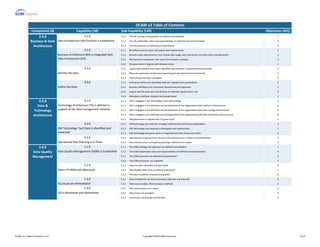
3.0.0 3.1.0 3.1.1 The DA strategy and approach are defined and adopted 7
3.1.2 The DA stakeholder roles and responsibilities are defined and communicated 4
3.1.3 The DA processes are defined and operational 3
3.2.0 3.2.1 BA defines process input and output data requirements 2
3.2.2 Business data requirements must include data usage, data restrictions and data ethics considerations 2
3.2.3 BA processes incorporate root cause fix of people or process 1
3.2.4 DA governance is aligned with BA governance 2
3.3.0 3.3.1 Logical data domains have been identified, documented, inventoried and authorized 3
3.3.2 Physical repositories of data have been located, documented and inventoried 2
3.3.3 Physical data has been cataloged 3
3.4.0 3.4.1 Enterprise entities are identified, defined, modeled and standardized 6
3.4.2 Business definitions are composed, documented and approved 2
3.4.3 Unique identification and classification are defined, applied and in use 3
3.4.4 Metadata is defined, modeled and standardized 3
4.0.0 4.1.0 4.1.1 DM is engaged in the Technology vision and strategy 3
4.1.2 DM is engaged in the definition and development of the organization-wide platform infrastructure 6
4.1.3 DM is engaged in the definition and development of the organization-wide data storage infrastructure 6
4.1.4 DM is engaged in the definition and development of the organization-wide data distribution infrastructure 6
4.1.5 DM governance is aligned with TA governance 3
4.2.0 4.2.1 DM technology tool selection strategy is defined and verified by stakeholders 2
4.2.2 DM Technology tool roadmap is developed and implemented 2
4.2.3 DM technology tool governance is integrated into Data Governance (DG) 3
4.3.0 4.3.1 Operational risk governance structure and processes are in place and implemented 3
Operational Risk Planning is in Place 4.3.2 Data infrastructure contingency planning is defined and in place 2
5.0.0 5.1.0 5.1.1 The DQM strategy and approach are defined and adopted 7
5.1.2 The DQM stakeholder roles and responsibilities are defined and implemented 4
5.1.3 The DQM processes are defined and operational 3
5.1.4 The DQM processes are auditable 5
5.2.0 5.2.1 Data has been identified and prioritized 3
5.2.2 Data Quality (DQ) rules are defined and tested 5
5.2.3 The data is profiled, analyzed and graded 6
5.3.0 5.3.1 Data remediation has been prioritized, planned, and actioned 4
DQ Issues are Remediated 5.3.2 Root-cause analysis (RCA) process is defined 3
5.4.0 5.4.1 DQ control points are in place 3
5.4.2 Data issues are managed 3
5.4.3 Continuous monitoring is performed 2
Technology Architecture (TA) is defined in
support of the data management initiative
DM Technology Tool Stack is Identified and
Governed
Data Quality Management (DQM) is Established
Data is Profiled and Measured
Data Quality
Management
Data &
Technology
Architecture
Define the Data
DQ is Monitored and Maintained
Data Architecture (DA) function is established
Business Architecture (BA) is Integrated with
Data Architecture (DA)
Identify the Data
Business & Data
Architecture
DCAM v2.2 Table of Contents v1.0 Copyright ©2019 EDM Council Inc. 2 of 4
Component (8) Capability (38) Objectives (491)
Sub-Capability (136)
DCAM v2 Table of Contents
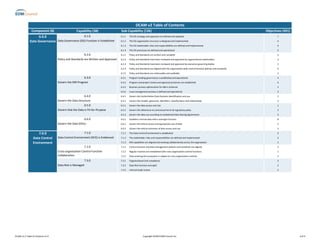
6.0.0 6.1.0 6.1.1 The DG strategy and approach are defined and adopted 7
6.1.2 The DG organization structure is designed and implemented 6
6.1.3 The DG stakeholder roles and responsibilities are defined and implemented 4
6.1.4 The DG processes are defined and operational 3
6.2.0 6.2.1 Policy and Standards are written and complete 3
6.2.2 Policy and Standards have been reviewed and approved by organizational stakeholders 3
6.2.3 Policy and Standards have been reviewed and approved by executive governing bodies 2
6.2.4 Policy and Standards are aligned with the organization-wide control function policies and standards 4
6.2.5 Policy and Standards are enforceable and auditable 2
6.3.0 6.3.1 Program funding governance is established and operational 4
6.3.2 Program and project review and approval processes are established 4
6.3.3 Business process optimization for DM is enforced 2
6.3.4 Issue management process is defined and operational 3
6.4.0 6.4.1 Govern the Authoritative Data Domains identification and use 2
Govern the Data Structure 6.4.2 Govern the models, glossaries, identifiers, classifications and relationships 3
6.5.0 6.5.1 Govern the data access and Use 1
6.5.2 Govern the adherence to contractual terms & regulatory policy 2
6.5.3 Govern the data use according to established Data Sharing Agreements 3
6.6.0 6.6.1 Establish a formal data ethics oversight function 8
6.6.2 Govern the ethical access and appropriate use of data 2
6.6.3 Govern the ethical outcomes of data access and use 3
7.0.0 7.1.0 7.1.1 The Data Control Environment is established 3
7.1.2 The stakeholder roles and responsibilities are defined and implemented 2
7.1.3 DM capabilities are aligned and working collaboratively across the organization 2
7.2.0 7.2.1 Control function and data management policies and standards are aligned 2
7.2.2 Regular routines are established with cross-organization control functions 1
7.2.3 Data entering the ecosystem is subject to cross-organization controls 2
7.3.0 7.3.1 Organizational Unit compliance 3
7.3.2 Data Risk function oversight 2
7.3.3 Internal Audit review 2
Data Risk is Managed
Data Control
Environment
Data Governance Data Governance (DG) Function is Established
Policy and Standards are Written and Approved
Cross-organization Control Function
Collaboration
Govern the DM Program
Govern that the Data is Fit-for-Purpose
Govern the Data Ethics
Data Control Environment (DCE) is Evidenced
DCAM v2.2 Table of Contents v1.0 Copyright ©2019 EDM Council Inc. 3 of 4
Component (8) Capability (38) Objectives (491)
Sub-Capability (136)
DCAM v2 Table of Contents
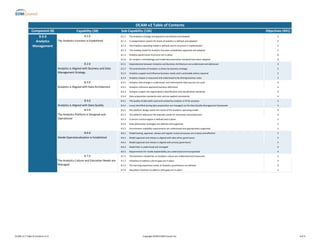
8.0.0 8.1.0 8.1.1 The Analytics strategy and approach are defined and adopted 5
8.1.2 A categorization system for levels of analytics is defined and adopted 4
8.1.3 The Analytics operating model is defined, and its structure is implemented 5
8.1.4 The funding model for Analytics has been established, approved and adopted 5
8.1.5 Analytics governance structures are in place 8
8.1.6 An analytics methodology and model documentation standard have been adopted 6
8.2.0 8.2.1 Dependencies between Analytics and Business Architecture are understood and addressed 4
8.2.2 The prioritization of Analytics is driven by business strategy 5
8.2.3 Analytics support and influence business needs and is actionable where required 5
8.2.4 Analytics impact is measured and understood to be driving business value 5
8.3.0 8.3.1 Analytics data lineage is understood, and authoritative data sources are used 4
8.3.2 Analytics reference approved business definitions 4
8.3.3 Analytics respect the organization's identification and classification standards 4
8.3.4 Data preparation standards exist and are applied consistently 4
8.4.0 8.4.1 The quality of data both used and created by analytics is fit-for-purpose 4
Analytics is Aligned with Data Quality 8.4.2 Issues identified during data preparation are managed via the Data Quality Management framework 4
8.5.0 8.5.1 The platform design meets the needs of the Analytics operating model 4
8.5.2 The platform addresses the separate needs for innovation and production 4
8.5.3 A version control regime is defined and in place 5
8.5.4 Data obfuscation strategies are defined and supported 2
8.5.5 Environment scalability requirements are understood and appropriately supported 3
8.6.0 8.6.1 Model testing, approval, release and regular review processes are in place and effective 5
8.6.2 Model approval and release is aligned with data ethics governance 5
8.6.3 Model approval and release is aligned with privacy governance 5
8.6.4 Model bias is understood and managed 4
8.6.5 Requirements for model explainability are understood and incorporated 4
8.7.0 8.7.1 The behaviors needed for an Analytics culture are understood and measured 5
8.7.2 Initiatives to address culture gaps are in place 5
8.7.3 The learning experience needs of Analytics practitioners are defined 4
8.7.4 Education initiatives to address skills gaps are in place 4
Analytics
Management
Model Operationalization is Established
Analytics is Aligned with Data Architecture
The Analytics Platform is Designed and
Operational
The Analytics Function is Established
Analytics is Aligned with Business and Data
Management Strategy
The Analytics Culture and Education Needs are
Managed
DCAM v2.2 Table of Contents v1.0 Copyright ©2019 EDM Council Inc. 4 of 4

Dcam v2.2 table_of_contents_

  • 1.
    Component (8) Capability(38) Objectives (491) 1.0.0 1.1.0 1.1.1 The DMS is developed, documented, and consolidated 3 1.1.2 The DMS is aligned with high-level organizational objectives 3 1.1.3 The DMS addresses the core strategy concepts from each DCAM component 3 1.1.4 The DMS includes an established mechanism for approval 3 1.1.5 The DMS has been evaluated as being enforceable 2 1.2.0 1.2.1 High-level business requirements are documented 2 1.2.2 Business requirements have been prioritized, approved, and incorporated into the DMS 2 1.2.3 The DM business case is mapped to and aligned with the DMS 3 1.2.4 Expected DM outcomes are defined and sequenced 2 1.2.5 The DM business case is socialized and validated by stakeholders 3 1.3.0 1.3.1 The Data Content Strategy is defined 2 1.3.2 The Data Usage Strategy is identified 3 1.3.3 The Data Management Deployment Strategy is communicated 4 2.0.0 2.1.0 2.1.1 The DMP strategy and approach are defined and adopted 5 2.1.2 The DMP PMO is established and roles and responsibilities are defined and implemented 5 2.1.3 The DMP processes are defined and operational 3 2.1.4 The DMP has the authority to enforce adherence and compliance 2 2.1.5 The DMP concepts are reflected in the DMS 3 2.2.0 2.2.1 The DM funding model is matched to business requirements, implementation timelines and operational capabilities 8 2.2.2 The DM funding model is aligned with the funding processes of the organization 4 2.2.3 Implementation of the DM funding model is enforced 3 2.3.0 2.3.1 The Office of Data Management (ODM) is created 3 2.3.2 The ODM has an executive owner 4 2.3.3 The ODM is funded and staffed by individuals with the required skill-sets 2 2.4.0 2.4.1 Program roadmaps are defined, developed, and aligned with the DMS 2 2.4.2 Program roadmaps are socialized and agreed to by stakeholders 2 2.4.3 Project plans are developed detailing deliverables, timelines, and milestones 3 2.5.0 2.5.1 DM process standards are defined and implemented organization-wide 3 2.5.2 DM processes are informed by industry standards and best practices 2 2.5.3 DM processes are supported by policy and auditable 5 2.6.0 2.6.1 Stakeholders commit and are held accountable for the DMP deliverables 4 2.6.2 Resource plans are aligned with and verified against initiative requirements 3 2.6.3 Funds are allocated and aligned to program roadmaps and workstreams 4 2.7.0 2.7.1 Internal communication plans have been defined and approved 4 2.7.2 Plans for communication with external regulatory bodies are defined and approved 3 2.7.3 Formal training programs have been defined and implemented 3 2.8.0 2.8.1 Program metrics are defined and used to track progress 5 2.8.2 Outcome metrics are defined and used to track against business objectives 5 2.8.3 Process metrics are defined and used to drive continuous improvement 5 2.8.4 Financial metrics for total program costs and benefits (ROI) are tracked and reported 6 Data Management Strategy & Business Case Data Management Program & Funding Model The Data Management Strategy (DMS) is Specified and Shared The Data Management Business Case is Defined The Data Management Vision is Defined Sub-Capability (136) The Data Management Organizational Structure is Created and Implemented The Roadmaps for the DMP are Developed, Socialized, and Approved Data Management Process Excellence Program is Established Stakeholder Engagement is Established and Confirmed DCAM v2 Table of Contents Communications and Training Programs are Designed and Operational The DMP is Measured and Evaluated Against Business Objectives The Data Management Program (DMP) is Established The DM Funding Model has been Established, Approved, and Adopted by the Organization DCAM v2.2 Table of Contents v1.0 Copyright ©2019 EDM Council Inc. 1 of 4
  • 2.
    Component (8) Capability(38) Objectives (491) Sub-Capability (136) DCAM v2 Table of Contents 3.0.0 3.1.0 3.1.1 The DA strategy and approach are defined and adopted 7 3.1.2 The DA stakeholder roles and responsibilities are defined and communicated 4 3.1.3 The DA processes are defined and operational 3 3.2.0 3.2.1 BA defines process input and output data requirements 2 3.2.2 Business data requirements must include data usage, data restrictions and data ethics considerations 2 3.2.3 BA processes incorporate root cause fix of people or process 1 3.2.4 DA governance is aligned with BA governance 2 3.3.0 3.3.1 Logical data domains have been identified, documented, inventoried and authorized 3 3.3.2 Physical repositories of data have been located, documented and inventoried 2 3.3.3 Physical data has been cataloged 3 3.4.0 3.4.1 Enterprise entities are identified, defined, modeled and standardized 6 3.4.2 Business definitions are composed, documented and approved 2 3.4.3 Unique identification and classification are defined, applied and in use 3 3.4.4 Metadata is defined, modeled and standardized 3 4.0.0 4.1.0 4.1.1 DM is engaged in the Technology vision and strategy 3 4.1.2 DM is engaged in the definition and development of the organization-wide platform infrastructure 6 4.1.3 DM is engaged in the definition and development of the organization-wide data storage infrastructure 6 4.1.4 DM is engaged in the definition and development of the organization-wide data distribution infrastructure 6 4.1.5 DM governance is aligned with TA governance 3 4.2.0 4.2.1 DM technology tool selection strategy is defined and verified by stakeholders 2 4.2.2 DM Technology tool roadmap is developed and implemented 2 4.2.3 DM technology tool governance is integrated into Data Governance (DG) 3 4.3.0 4.3.1 Operational risk governance structure and processes are in place and implemented 3 Operational Risk Planning is in Place 4.3.2 Data infrastructure contingency planning is defined and in place 2 5.0.0 5.1.0 5.1.1 The DQM strategy and approach are defined and adopted 7 5.1.2 The DQM stakeholder roles and responsibilities are defined and implemented 4 5.1.3 The DQM processes are defined and operational 3 5.1.4 The DQM processes are auditable 5 5.2.0 5.2.1 Data has been identified and prioritized 3 5.2.2 Data Quality (DQ) rules are defined and tested 5 5.2.3 The data is profiled, analyzed and graded 6 5.3.0 5.3.1 Data remediation has been prioritized, planned, and actioned 4 DQ Issues are Remediated 5.3.2 Root-cause analysis (RCA) process is defined 3 5.4.0 5.4.1 DQ control points are in place 3 5.4.2 Data issues are managed 3 5.4.3 Continuous monitoring is performed 2 Technology Architecture (TA) is defined in support of the data management initiative DM Technology Tool Stack is Identified and Governed Data Quality Management (DQM) is Established Data is Profiled and Measured Data Quality Management Data & Technology Architecture Define the Data DQ is Monitored and Maintained Data Architecture (DA) function is established Business Architecture (BA) is Integrated with Data Architecture (DA) Identify the Data Business & Data Architecture DCAM v2.2 Table of Contents v1.0 Copyright ©2019 EDM Council Inc. 2 of 4
  • 3.
    Component (8) Capability(38) Objectives (491) Sub-Capability (136) DCAM v2 Table of Contents 6.0.0 6.1.0 6.1.1 The DG strategy and approach are defined and adopted 7 6.1.2 The DG organization structure is designed and implemented 6 6.1.3 The DG stakeholder roles and responsibilities are defined and implemented 4 6.1.4 The DG processes are defined and operational 3 6.2.0 6.2.1 Policy and Standards are written and complete 3 6.2.2 Policy and Standards have been reviewed and approved by organizational stakeholders 3 6.2.3 Policy and Standards have been reviewed and approved by executive governing bodies 2 6.2.4 Policy and Standards are aligned with the organization-wide control function policies and standards 4 6.2.5 Policy and Standards are enforceable and auditable 2 6.3.0 6.3.1 Program funding governance is established and operational 4 6.3.2 Program and project review and approval processes are established 4 6.3.3 Business process optimization for DM is enforced 2 6.3.4 Issue management process is defined and operational 3 6.4.0 6.4.1 Govern the Authoritative Data Domains identification and use 2 Govern the Data Structure 6.4.2 Govern the models, glossaries, identifiers, classifications and relationships 3 6.5.0 6.5.1 Govern the data access and Use 1 6.5.2 Govern the adherence to contractual terms & regulatory policy 2 6.5.3 Govern the data use according to established Data Sharing Agreements 3 6.6.0 6.6.1 Establish a formal data ethics oversight function 8 6.6.2 Govern the ethical access and appropriate use of data 2 6.6.3 Govern the ethical outcomes of data access and use 3 7.0.0 7.1.0 7.1.1 The Data Control Environment is established 3 7.1.2 The stakeholder roles and responsibilities are defined and implemented 2 7.1.3 DM capabilities are aligned and working collaboratively across the organization 2 7.2.0 7.2.1 Control function and data management policies and standards are aligned 2 7.2.2 Regular routines are established with cross-organization control functions 1 7.2.3 Data entering the ecosystem is subject to cross-organization controls 2 7.3.0 7.3.1 Organizational Unit compliance 3 7.3.2 Data Risk function oversight 2 7.3.3 Internal Audit review 2 Data Risk is Managed Data Control Environment Data Governance Data Governance (DG) Function is Established Policy and Standards are Written and Approved Cross-organization Control Function Collaboration Govern the DM Program Govern that the Data is Fit-for-Purpose Govern the Data Ethics Data Control Environment (DCE) is Evidenced DCAM v2.2 Table of Contents v1.0 Copyright ©2019 EDM Council Inc. 3 of 4
  • 4.
    Component (8) Capability(38) Objectives (491) Sub-Capability (136) DCAM v2 Table of Contents 8.0.0 8.1.0 8.1.1 The Analytics strategy and approach are defined and adopted 5 8.1.2 A categorization system for levels of analytics is defined and adopted 4 8.1.3 The Analytics operating model is defined, and its structure is implemented 5 8.1.4 The funding model for Analytics has been established, approved and adopted 5 8.1.5 Analytics governance structures are in place 8 8.1.6 An analytics methodology and model documentation standard have been adopted 6 8.2.0 8.2.1 Dependencies between Analytics and Business Architecture are understood and addressed 4 8.2.2 The prioritization of Analytics is driven by business strategy 5 8.2.3 Analytics support and influence business needs and is actionable where required 5 8.2.4 Analytics impact is measured and understood to be driving business value 5 8.3.0 8.3.1 Analytics data lineage is understood, and authoritative data sources are used 4 8.3.2 Analytics reference approved business definitions 4 8.3.3 Analytics respect the organization's identification and classification standards 4 8.3.4 Data preparation standards exist and are applied consistently 4 8.4.0 8.4.1 The quality of data both used and created by analytics is fit-for-purpose 4 Analytics is Aligned with Data Quality 8.4.2 Issues identified during data preparation are managed via the Data Quality Management framework 4 8.5.0 8.5.1 The platform design meets the needs of the Analytics operating model 4 8.5.2 The platform addresses the separate needs for innovation and production 4 8.5.3 A version control regime is defined and in place 5 8.5.4 Data obfuscation strategies are defined and supported 2 8.5.5 Environment scalability requirements are understood and appropriately supported 3 8.6.0 8.6.1 Model testing, approval, release and regular review processes are in place and effective 5 8.6.2 Model approval and release is aligned with data ethics governance 5 8.6.3 Model approval and release is aligned with privacy governance 5 8.6.4 Model bias is understood and managed 4 8.6.5 Requirements for model explainability are understood and incorporated 4 8.7.0 8.7.1 The behaviors needed for an Analytics culture are understood and measured 5 8.7.2 Initiatives to address culture gaps are in place 5 8.7.3 The learning experience needs of Analytics practitioners are defined 4 8.7.4 Education initiatives to address skills gaps are in place 4 Analytics Management Model Operationalization is Established Analytics is Aligned with Data Architecture The Analytics Platform is Designed and Operational The Analytics Function is Established Analytics is Aligned with Business and Data Management Strategy The Analytics Culture and Education Needs are Managed DCAM v2.2 Table of Contents v1.0 Copyright ©2019 EDM Council Inc. 4 of 4