Specialized Business
Information Systems
Chapter 11
An Overview of Artificial
Intelligence
From the perspective of intelligence : artificial
intelligence is making machines "intelligent" --
acting as we would expect people to act.
AI began in the early 1960s -- the first attempts were
game playing (checkers), theorem proving (a few
simple theorems) and general problem solving (only
very simple tasks)
The Nature of Intelligence
• Learn from experience & apply the knowledge
• Handle complex situations
• Solve problems when important information is
missing
• Determine what is important
The Nature of Intelligence
• React quickly & correctly to new situations
• Understand visual images
• Process & manipulate symbols
• Be creative & imaginative
• Use heuristics
6
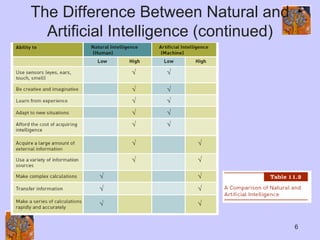
The Difference Between Natural and
Artificial Intelligence (continued)
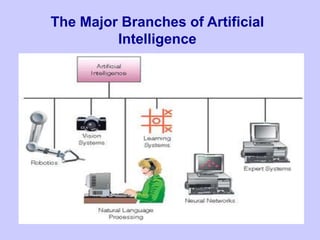
The Major Branches of Artificial
Intelligence
An Overview of Expert
Systems
Expert Systems
An expert system is software that attempts to
provide an answer to a problem, or clarify
uncertainties where normally one or more
human experts would need to be consulted.
Expert systems are most common in a specific
problem domain, and is a traditional
application and/or subfield of artificial
intelligence.
10
• Computerized expert systems
– Have been developed to diagnose problems,
predict future events, and solve energy
problems
– Use heuristics, or rules of thumb, to arrive at
conclusions or make suggestions
ES applications:
From airport tarmacs to online job banks to
medical labs, artificial intelligence is
everywhere.
Characteristics of an Expert System
• Can explain their reasoning or suggested decisions
• Can display “intelligent” behavior
• Can draw conclusions from complex relationships
• Can provide portable knowledge
• Can deal with uncertainty
• Not widely used or tested
Characteristics of an Expert System
• Limited to relatively narrow problems
• Cannot readily deal with “mixed” knowledge
• Possibility of error
• Cannot refine its own knowledge
• May have high development costs
• Raise legal and ethical concerns
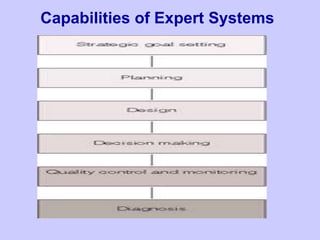
Capabilities of Expert Systems
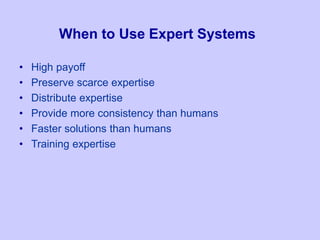
When to Use Expert Systems
• High payoff
• Preserve scarce expertise
• Distribute expertise
• Provide more consistency than humans
• Faster solutions than humans
• Training expertise
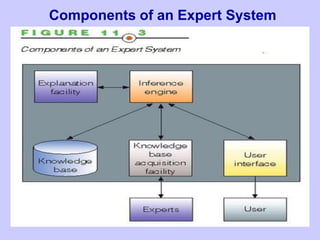
Components of an Expert System
Knowledge Base
• Assembling human experts
• The use of fuzzy logic
• The use of rules
• The use of cases
The use of fuzzy logic
The use of rules
Suppose a rule base contains
1. If Fritz is green then Fritz is a frog.
2. If Fritz is a frog then Fritz hops.
Suppose a goal is to conclude that Fritz hops. The rule
base would be searched and rule (2) would be selected
because its conclusion (the then clause) matches the goal.
It is not known that Fritz is a frog, so this "if" statement is
added to the goal list. The rule base is again searched and
this time rule (1) is selected because its then clause
matches the new goal just added to the list.
This time, the if clause (Fritz is green) is known to be true
and the goal that Fritz hops is concluded.
Inference Engine
• Seek information and relationships from
the knowledge base and provides
answers, predictions and suggestions in
the way a human expert would
• Backward chaining
• Forward chaining
Inference Engines
Comparison of backward and forward chaining
 Backward chaining
A method of reasoning that starts with conclusions
and works backward to the supporting facts.
 Forward chaining
A method of reasoning that starts with the facts and
works forward to the conclusions
Forward chaining starts with the data available and
uses the inference rules to conclude more data until
a desired goal is reached. Because the data
available determines which inference rules are used,
this method is also called data driven.
Backward chaining starts with a list of goals and
works backwards to see if there is data which will
allow it to conclude any of these goals.
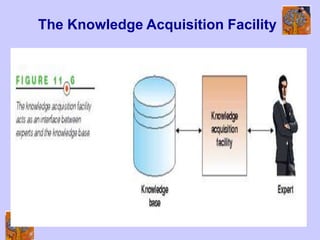
The Knowledge Acquisition Facility
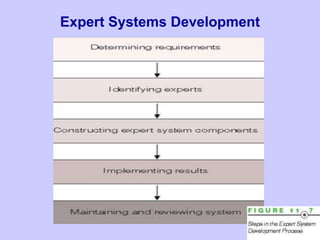
Expert Systems Development
Participants in Developing and Using
Expert Systems
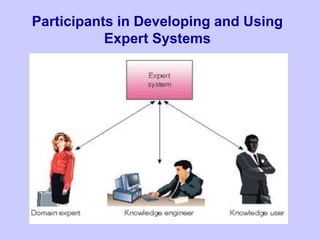
• Domain expert
• Knowledge engineer
• Knowledge user
Participants in Developing and Using
Expert Systems
Applications of Expert Systems and
Artificial Intelligence
• Credit granting and loan analysis
• Stock picking
• Catching cheats and terrorists
• Budgeting
Applications of Expert System and
Artificial Intelligence
• Information management and retrieval
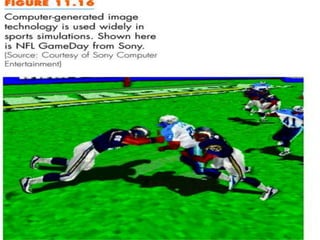
• Games
• Virus detection
• Hospitals and medical facilities
Virtual Reality
• Virtual reality (VR) is a technology which allows
a user to interact with a computer-simulated
environment, be it a real or imagined one.
• Most current virtual reality environments are
primarily visual experiences, displayed either on
a computer screen or through special
stereoscopic displays, but some simulations
include additional sensory information, such as
sound through speakers or headphones.
• Some advanced, haptic * systems now include
tactile information, generally known as force
feedback, in medical and gaming applications.
• * sense of touch e.g. effect/vibration
VRS
Virtual Reality
• Immersive virtual reality - user becomes
fully immersed in an artificial, three-
dimensional world that is completely
generated by a computer
• Virtual reality system - enables one or
more users to move and react in a
computer-simulated environment
Interface Devices
• Head-mounted display (HMD)
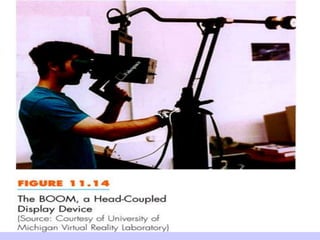
• Binocular Omni-Orientation Monitor (BOOM)
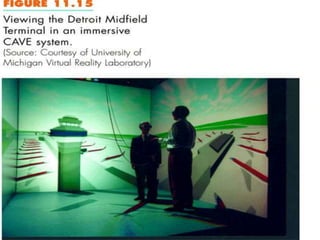
• CAVE
– A Cave Automatic Virtual Environment (better known by the recursive
acronym CAVE) is an immersive virtual reality environment where projectors are
directed to three, four, five or six of the walls of a room-sized cube.
• Haptic interface
List of CAVEs at universities
• The Virtual Reality Applications Center (VRAC) at Iowa State
University is the home to a pair of CAVEs: a 4 walled CAVE and a 6
walled CAVE (renovated in 2007, highest resolution CAVE in
world).
• Duke University has the DiVE, a 6-walled 'CAVE'.
• Indiana University had a 4-wall CAVE at the Bloomington campus
and now has a 4-wall Barco MoVE Lite at the Indianapolis campus
operated by the Advanced Visualization Lab
• University of Reading owns a CAVE which is used for several
research projects including medical visualisation.
• United Arab Emirates University A 3-walled CAVE used in
Architectural Education and Research. ([5])
• University College Dublin has a 4-walled front-projected CAVE.
• University of California, San Diego has a CAVE operated by the
Immersive Visualization Lab in the Atkinson Hall building, also
known as the Calit2 (California Institute for Telecommunications
and Information Technology) building. (www.calit2.net)
• University of Michigan owns a CAVE.
• Newcastle University has a 3-walled CAVE as part of its Virtual
Reality Suite.
• CAVEs are used for many things.
• Engineering companies use CAVEs to
enhance product development.
• Prototypes of parts can be created and
tested, interfaces can be developed, and
factory layouts can be simulated, all before
spending any money on physical parts
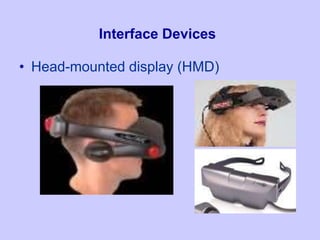
Interface Devices
• Head-mounted display (HMD)
Fig 11.14
Fig 11.15
Useful Applications
• Medicine – used to link stroke patients to
physical therapists
• Education and training – used by military for
aircraft maintenance
• Entertainment
– Star Wars Episode II: Attack of the Clones
Useful Applications
• Real Estate Marketing and Tourism
– Used to increase real estate sales
– Virtual reality tour of the White House
Summary
• Artificial intelligence - used to describe computers with ability to
mimic or duplicate functions of the human brain
• Intelligent behavior - includes the ability to learn from experience
• Expert systems - can explain their reasoning (or suggested
decisions) and display intelligent behavior
• Virtual reality systems - enables one or more users to move and
react in a computer-simulated environment
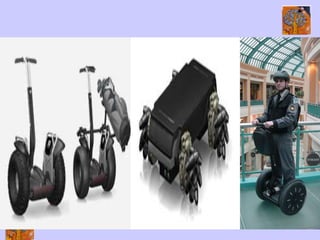
• Special-purpose systems - assist organizations and individuals in
new and exciting ways. For example, Segway
Week 11 12 chap11 c-2

Week 11 12 chap11 c-2

  • 1.
  • 2.
    An Overview ofArtificial Intelligence
  • 3.
    From the perspectiveof intelligence : artificial intelligence is making machines "intelligent" -- acting as we would expect people to act. AI began in the early 1960s -- the first attempts were game playing (checkers), theorem proving (a few simple theorems) and general problem solving (only very simple tasks)
  • 4.
    The Nature ofIntelligence • Learn from experience & apply the knowledge • Handle complex situations • Solve problems when important information is missing • Determine what is important
  • 5.
    The Nature ofIntelligence • React quickly & correctly to new situations • Understand visual images • Process & manipulate symbols • Be creative & imaginative • Use heuristics
  • 6.
    6 The Difference BetweenNatural and Artificial Intelligence (continued)
  • 7.
    The Major Branchesof Artificial Intelligence
  • 8.
    An Overview ofExpert Systems
  • 9.
    Expert Systems An expertsystem is software that attempts to provide an answer to a problem, or clarify uncertainties where normally one or more human experts would need to be consulted. Expert systems are most common in a specific problem domain, and is a traditional application and/or subfield of artificial intelligence.
  • 10.
    10 • Computerized expertsystems – Have been developed to diagnose problems, predict future events, and solve energy problems – Use heuristics, or rules of thumb, to arrive at conclusions or make suggestions
  • 11.
    ES applications: From airporttarmacs to online job banks to medical labs, artificial intelligence is everywhere.
  • 12.
    Characteristics of anExpert System • Can explain their reasoning or suggested decisions • Can display “intelligent” behavior • Can draw conclusions from complex relationships • Can provide portable knowledge • Can deal with uncertainty • Not widely used or tested
  • 13.
    Characteristics of anExpert System • Limited to relatively narrow problems • Cannot readily deal with “mixed” knowledge • Possibility of error • Cannot refine its own knowledge • May have high development costs • Raise legal and ethical concerns
  • 14.
  • 15.
    When to UseExpert Systems • High payoff • Preserve scarce expertise • Distribute expertise • Provide more consistency than humans • Faster solutions than humans • Training expertise
  • 16.
    Components of anExpert System
  • 17.
    Knowledge Base • Assemblinghuman experts • The use of fuzzy logic • The use of rules • The use of cases
  • 18.
    The use offuzzy logic The use of rules Suppose a rule base contains 1. If Fritz is green then Fritz is a frog. 2. If Fritz is a frog then Fritz hops. Suppose a goal is to conclude that Fritz hops. The rule base would be searched and rule (2) would be selected because its conclusion (the then clause) matches the goal. It is not known that Fritz is a frog, so this "if" statement is added to the goal list. The rule base is again searched and this time rule (1) is selected because its then clause matches the new goal just added to the list. This time, the if clause (Fritz is green) is known to be true and the goal that Fritz hops is concluded.
  • 19.
    Inference Engine • Seekinformation and relationships from the knowledge base and provides answers, predictions and suggestions in the way a human expert would • Backward chaining • Forward chaining
  • 20.
    Inference Engines Comparison ofbackward and forward chaining  Backward chaining A method of reasoning that starts with conclusions and works backward to the supporting facts.  Forward chaining A method of reasoning that starts with the facts and works forward to the conclusions
  • 21.
    Forward chaining startswith the data available and uses the inference rules to conclude more data until a desired goal is reached. Because the data available determines which inference rules are used, this method is also called data driven. Backward chaining starts with a list of goals and works backwards to see if there is data which will allow it to conclude any of these goals.
  • 22.
  • 23.
  • 24.
    Participants in Developingand Using Expert Systems • Domain expert • Knowledge engineer • Knowledge user
  • 25.
    Participants in Developingand Using Expert Systems
  • 26.
    Applications of ExpertSystems and Artificial Intelligence • Credit granting and loan analysis • Stock picking • Catching cheats and terrorists • Budgeting
  • 27.
    Applications of ExpertSystem and Artificial Intelligence • Information management and retrieval • Games • Virus detection • Hospitals and medical facilities
  • 28.
  • 29.
    • Virtual reality(VR) is a technology which allows a user to interact with a computer-simulated environment, be it a real or imagined one. • Most current virtual reality environments are primarily visual experiences, displayed either on a computer screen or through special stereoscopic displays, but some simulations include additional sensory information, such as sound through speakers or headphones. • Some advanced, haptic * systems now include tactile information, generally known as force feedback, in medical and gaming applications. • * sense of touch e.g. effect/vibration VRS
  • 30.
    Virtual Reality • Immersivevirtual reality - user becomes fully immersed in an artificial, three- dimensional world that is completely generated by a computer • Virtual reality system - enables one or more users to move and react in a computer-simulated environment
  • 31.
    Interface Devices • Head-mounteddisplay (HMD) • Binocular Omni-Orientation Monitor (BOOM) • CAVE – A Cave Automatic Virtual Environment (better known by the recursive acronym CAVE) is an immersive virtual reality environment where projectors are directed to three, four, five or six of the walls of a room-sized cube. • Haptic interface
  • 32.
    List of CAVEsat universities • The Virtual Reality Applications Center (VRAC) at Iowa State University is the home to a pair of CAVEs: a 4 walled CAVE and a 6 walled CAVE (renovated in 2007, highest resolution CAVE in world). • Duke University has the DiVE, a 6-walled 'CAVE'. • Indiana University had a 4-wall CAVE at the Bloomington campus and now has a 4-wall Barco MoVE Lite at the Indianapolis campus operated by the Advanced Visualization Lab • University of Reading owns a CAVE which is used for several research projects including medical visualisation. • United Arab Emirates University A 3-walled CAVE used in Architectural Education and Research. ([5]) • University College Dublin has a 4-walled front-projected CAVE. • University of California, San Diego has a CAVE operated by the Immersive Visualization Lab in the Atkinson Hall building, also known as the Calit2 (California Institute for Telecommunications and Information Technology) building. (www.calit2.net) • University of Michigan owns a CAVE. • Newcastle University has a 3-walled CAVE as part of its Virtual Reality Suite.
  • 33.
    • CAVEs areused for many things. • Engineering companies use CAVEs to enhance product development. • Prototypes of parts can be created and tested, interfaces can be developed, and factory layouts can be simulated, all before spending any money on physical parts
  • 34.
  • 35.
  • 36.
  • 38.
    Useful Applications • Medicine– used to link stroke patients to physical therapists • Education and training – used by military for aircraft maintenance • Entertainment – Star Wars Episode II: Attack of the Clones
  • 39.
    Useful Applications • RealEstate Marketing and Tourism – Used to increase real estate sales – Virtual reality tour of the White House
  • 40.
    Summary • Artificial intelligence- used to describe computers with ability to mimic or duplicate functions of the human brain • Intelligent behavior - includes the ability to learn from experience • Expert systems - can explain their reasoning (or suggested decisions) and display intelligent behavior • Virtual reality systems - enables one or more users to move and react in a computer-simulated environment • Special-purpose systems - assist organizations and individuals in new and exciting ways. For example, Segway