Week 2
Selected Poems of Sylvia Plath
ENG 404
Lecture by Faisal Ahmed
Faculty Member, Department of English
World University of Bangladesh
Lesson 1: Biography of
Sylvia Plath
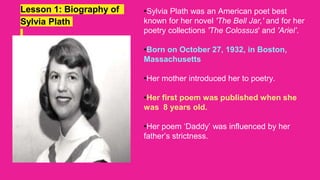
•Sylvia Plath was an American poet best
known for her novel 'The Bell Jar,' and for her
poetry collections 'The Colossus' and 'Ariel’.
•Born on October 27, 1932, in Boston,
Massachusetts
•Her mother introduced her to poetry.
•Her first poem was published when she
was 8 years old.
•Her poem ‘Daddy’ was influenced by her
father’s strictness.
Lesson 1: Biography of
Sylvia Plath
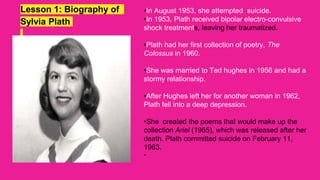
•In August 1953, she attempted suicide.
•In 1953, Plath received bipolar electro-convulsive
shock treatments, leaving her traumatized.
•Plath had her first collection of poetry, The
Colossus in 1960.
•She was married to Ted hughes in 1956 and had a
stormy relationship.
•After Hughes left her for another woman in 1962,
Plath fell into a deep depression.
•She created the poems that would make up the
collection Ariel (1965), which was released after her
death. Plath committed suicide on February 11,
1963.
•
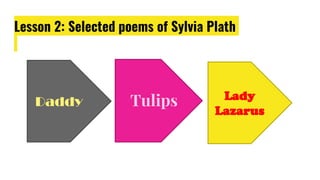
Lesson 2: Selected poems of Sylvia Plath
Daddy Tulips Lady
Lazarus
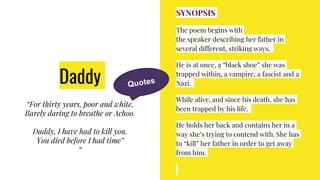
Daddy
“For thirty years, poor and white,
Barely daring to breathe or Achoo.
Daddy, I have had to kill you.
You died before I had time”
“
SYNOPSIS
The poem begins with
the speaker describing her father in
several different, striking ways.
He is at once, a “black shoe” she was
trapped within, a vampire, a fascist and a
Nazi.
While alive, and since his death, she has
been trapped by his life.
He holds her back and contains her in a
way she’s trying to contend with. She has
to “kill” her father in order to get away
from him.
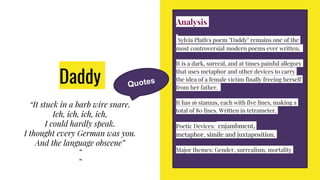
Daddy
“It stuck in a barb wire snare.
Ich, ich, ich, ich,
I could hardly speak.
I thought every German was you.
And the language obscene”
”
“
Analysis
Sylvia Plath's poem "Daddy" remains one of the
most controversial modern poems ever written.
It is a dark, surreal, and at times painful allegory
that uses metaphor and other devices to carry
the idea of a female victim finally freeing herself
from her father.
It has 16 stanzas, each with five lines, making a
total of 80 lines. Written in tetrameter,
Poetic Devices: enjambment,
metaphor, simile and juxtaposition.
Major themes: Gender, surrealism, mortality
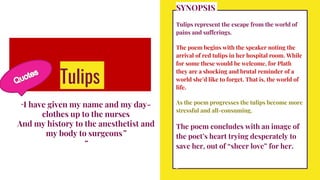
Tulips
“I have given my name and my day-
clothes up to the nurses
And my history to the anesthetist and
my body to surgeons”
“
SYNOPSIS
Tulips represent the escape from the world of
pains and sufferings.
The poem begins with the speaker noting the
arrival of red tulips in her hospital room. While
for some these would be welcome, for Plath
they are a shocking and brutal reminder of a
world she’d like to forget. That is, the world of
life.
As the poem progresses the tulips become more
stressful and all-consuming.
The poem concludes with an image of
the poet’s heart trying desperately to
save her, out of “sheer love” for her.
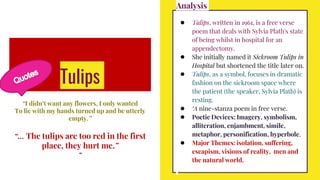
Tulips
“I didn’t want any flowers, I only wanted
To lie with my hands turned up and be utterly
empty.”
“… The tulips are too red in the first
place, they hurt me.”
“
Analysis
● Tulips, written in 1961, is a free verse
poem that deals with Sylvia Plath's state
of being whilst in hospital for an
appendectomy.
● She initially named it Sickroom Tulips in
Hospital but shortened the title later on.
● Tulips, as a symbol, focuses in dramatic
fashion on the sickroom space where
the patient (the speaker, Sylvia Plath) is
resting.
● ‘A nine-stanza poem in free verse.
● Poetic Devices: Imagery, symbolism,
alliteration, enjambment, simile,
metaphor, personification, hyperbole.
● Major Themes: isolation, suffering,
escapism, visions of reality, men and
the natural world.
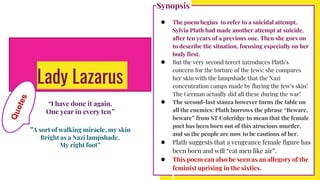
Lady Lazarus
“I have done it again.
One year in every ten”
“A sort of walking miracle, my skin
Bright as a Nazi lampshade,
My right foot”
Synopsis
● The poem begins to refer to a suicidal attempt.
Sylvia Plath had made another attempt at suicide,
after ten years of a previous one. Then she goes on
to describe the situation, focusing especially on her
body first.
● But the very second tercet introduces Plath’s
concern for the torture of the Jews: she compares
her skin with the lampshade that the Nazi
concentration camps made by flaying the Jew’s skin!
The German actually did all these during the war!
● The second-last stanza however turns the table on
all the enemies: Plath borrows the phrase “Beware,
beware” from ST Coleridge to mean that the female
poet has been born out of this atrocious murder,
and so the people are now to be cautious of her.
● Plath suggests that a vengeance female figure has
been born and will “eat men like air”.
● This poem can also be seen as an allegory of the
feminist uprising in the sixties.
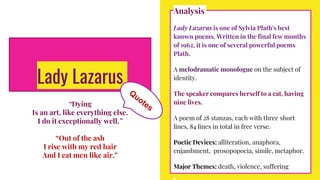
Lady Lazarus
“Dying
Is an art, like everything else.
I do it exceptionally well.”
“Out of the ash
I rise with my red hair
And I eat men like air.”
Analysis
Lady Lazarus is one of Sylvia Plath's best
known poems. Written in the final few months
of 1962, it is one of several powerful poems
Plath.
A melodramatic monologue on the subject of
identity.
The speaker compares herself to a cat, having
nine lives.
A poem of 28 stanzas, each with three short
lines, 84 lines in total in free verse.
Poetic Devices: alliteration, anaphora,
enjambment, prosopopoeia, simile, metaphor.
Major Themes: death, violence, suffering
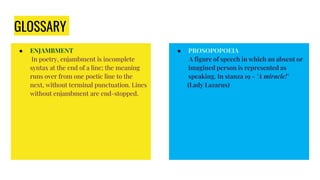
GLOSSARY
● ENJAMBMENT
In poetry, enjambment is incomplete
syntax at the end of a line; the meaning
runs over from one poetic line to the
next, without terminal punctuation. Lines
without enjambment are end-stopped.
● PROSOPOPOEIA
A figure of speech in which an absent or
imagined person is represented as
speaking. In stanza 19 - 'A miracle!'
(Lady Lazarus)
Week 2
End of the Lessons

Week 2-eng 404-p pt slides

  • 1.
    Week 2 Selected Poemsof Sylvia Plath ENG 404 Lecture by Faisal Ahmed Faculty Member, Department of English World University of Bangladesh
  • 2.
    Lesson 1: Biographyof Sylvia Plath •Sylvia Plath was an American poet best known for her novel 'The Bell Jar,' and for her poetry collections 'The Colossus' and 'Ariel’. •Born on October 27, 1932, in Boston, Massachusetts •Her mother introduced her to poetry. •Her first poem was published when she was 8 years old. •Her poem ‘Daddy’ was influenced by her father’s strictness.
  • 3.
    Lesson 1: Biographyof Sylvia Plath •In August 1953, she attempted suicide. •In 1953, Plath received bipolar electro-convulsive shock treatments, leaving her traumatized. •Plath had her first collection of poetry, The Colossus in 1960. •She was married to Ted hughes in 1956 and had a stormy relationship. •After Hughes left her for another woman in 1962, Plath fell into a deep depression. •She created the poems that would make up the collection Ariel (1965), which was released after her death. Plath committed suicide on February 11, 1963. •
  • 4.
    Lesson 2: Selectedpoems of Sylvia Plath Daddy Tulips Lady Lazarus
  • 5.
    Daddy “For thirty years,poor and white, Barely daring to breathe or Achoo. Daddy, I have had to kill you. You died before I had time” “ SYNOPSIS The poem begins with the speaker describing her father in several different, striking ways. He is at once, a “black shoe” she was trapped within, a vampire, a fascist and a Nazi. While alive, and since his death, she has been trapped by his life. He holds her back and contains her in a way she’s trying to contend with. She has to “kill” her father in order to get away from him.
  • 6.
    Daddy “It stuck ina barb wire snare. Ich, ich, ich, ich, I could hardly speak. I thought every German was you. And the language obscene” ” “ Analysis Sylvia Plath's poem "Daddy" remains one of the most controversial modern poems ever written. It is a dark, surreal, and at times painful allegory that uses metaphor and other devices to carry the idea of a female victim finally freeing herself from her father. It has 16 stanzas, each with five lines, making a total of 80 lines. Written in tetrameter, Poetic Devices: enjambment, metaphor, simile and juxtaposition. Major themes: Gender, surrealism, mortality
  • 7.
    Tulips “I have givenmy name and my day- clothes up to the nurses And my history to the anesthetist and my body to surgeons” “ SYNOPSIS Tulips represent the escape from the world of pains and sufferings. The poem begins with the speaker noting the arrival of red tulips in her hospital room. While for some these would be welcome, for Plath they are a shocking and brutal reminder of a world she’d like to forget. That is, the world of life. As the poem progresses the tulips become more stressful and all-consuming. The poem concludes with an image of the poet’s heart trying desperately to save her, out of “sheer love” for her.
  • 8.
    Tulips “I didn’t wantany flowers, I only wanted To lie with my hands turned up and be utterly empty.” “… The tulips are too red in the first place, they hurt me.” “ Analysis ● Tulips, written in 1961, is a free verse poem that deals with Sylvia Plath's state of being whilst in hospital for an appendectomy. ● She initially named it Sickroom Tulips in Hospital but shortened the title later on. ● Tulips, as a symbol, focuses in dramatic fashion on the sickroom space where the patient (the speaker, Sylvia Plath) is resting. ● ‘A nine-stanza poem in free verse. ● Poetic Devices: Imagery, symbolism, alliteration, enjambment, simile, metaphor, personification, hyperbole. ● Major Themes: isolation, suffering, escapism, visions of reality, men and the natural world.
  • 9.
    Lady Lazarus “I havedone it again. One year in every ten” “A sort of walking miracle, my skin Bright as a Nazi lampshade, My right foot” Synopsis ● The poem begins to refer to a suicidal attempt. Sylvia Plath had made another attempt at suicide, after ten years of a previous one. Then she goes on to describe the situation, focusing especially on her body first. ● But the very second tercet introduces Plath’s concern for the torture of the Jews: she compares her skin with the lampshade that the Nazi concentration camps made by flaying the Jew’s skin! The German actually did all these during the war! ● The second-last stanza however turns the table on all the enemies: Plath borrows the phrase “Beware, beware” from ST Coleridge to mean that the female poet has been born out of this atrocious murder, and so the people are now to be cautious of her. ● Plath suggests that a vengeance female figure has been born and will “eat men like air”. ● This poem can also be seen as an allegory of the feminist uprising in the sixties.
  • 10.
    Lady Lazarus “Dying Is anart, like everything else. I do it exceptionally well.” “Out of the ash I rise with my red hair And I eat men like air.” Analysis Lady Lazarus is one of Sylvia Plath's best known poems. Written in the final few months of 1962, it is one of several powerful poems Plath. A melodramatic monologue on the subject of identity. The speaker compares herself to a cat, having nine lives. A poem of 28 stanzas, each with three short lines, 84 lines in total in free verse. Poetic Devices: alliteration, anaphora, enjambment, prosopopoeia, simile, metaphor. Major Themes: death, violence, suffering
  • 11.
    GLOSSARY ● ENJAMBMENT In poetry,enjambment is incomplete syntax at the end of a line; the meaning runs over from one poetic line to the next, without terminal punctuation. Lines without enjambment are end-stopped. ● PROSOPOPOEIA A figure of speech in which an absent or imagined person is represented as speaking. In stanza 19 - 'A miracle!' (Lady Lazarus)
  • 12.
    Week 2 End ofthe Lessons