The document provides an analysis of John Keats' poem "Ode to a Grecian Urn". It includes the author's name, topic, and department submitted to. It then discusses some key aspects of the poem, including how Keats refers to the urn as an "unravish'd bride of quietness" and "foster-child of silence and slow time". It also explains how Keats sees the urn as a "sylvan historian" that tells a story through its images. One of the main themes Keats conveys is that "Beauty is a Truth and Truth is a Beauty".
Name :- GohelAnkita KishorbhaI
Roll no :- 12
Paper :- 5( The Romantic Literature)
Topic :- Analysis Ode to Grecian Urn.
Submitted :- Department of English.
Email Id :- ak.gohel4433@gmail.com
Year :- 2015-2017
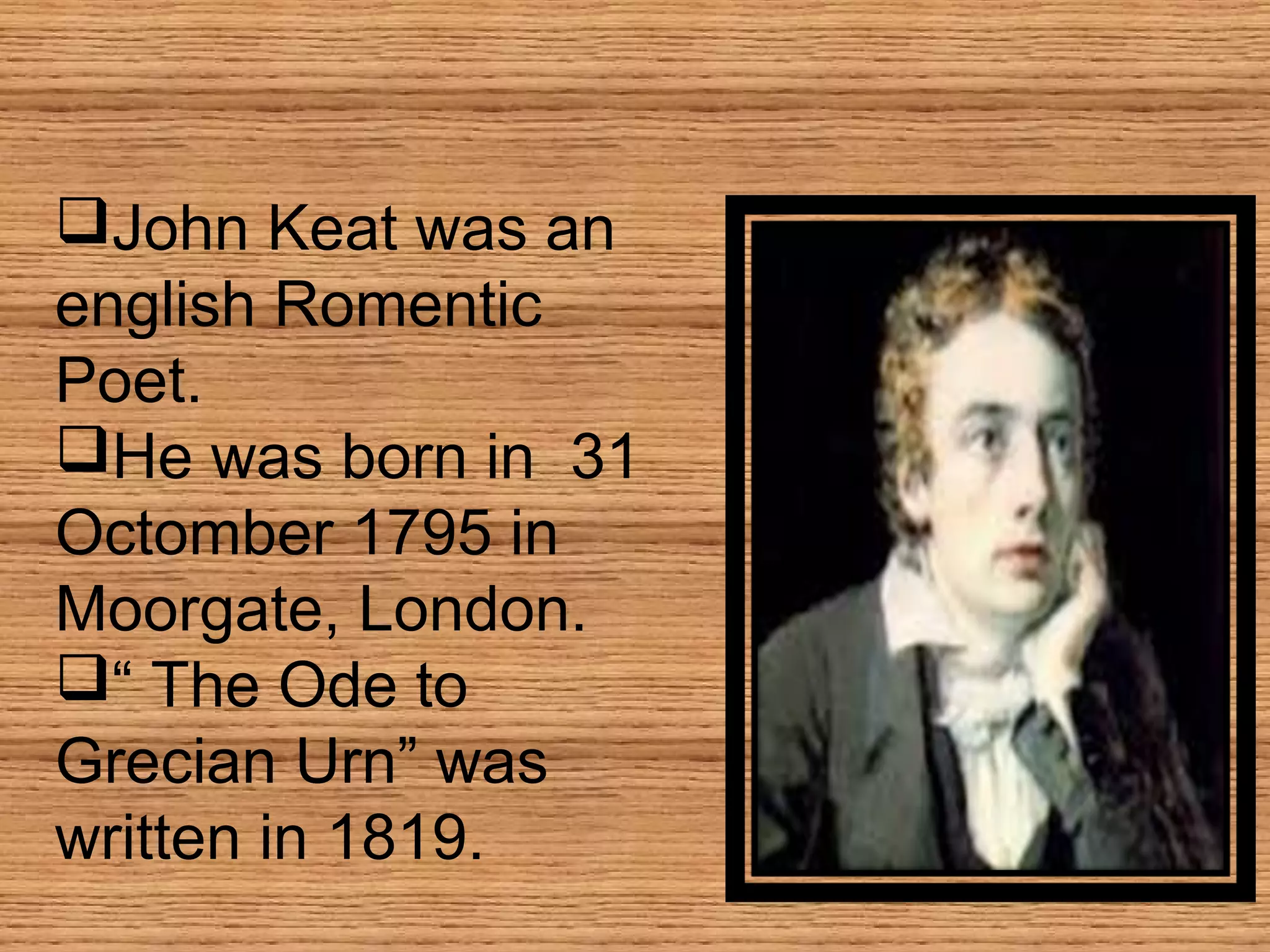
John Keat wasan
english Romentic
Poet.
He was born in 31
Octomber 1795 in
Moorgate, London.
“ The Ode to
Grecian Urn” was
written in 1819.
4.
A lyricpoem, typically one in
the form of an address to a
particular subject, written in
varied or irregular metre.
A classical poem of a kind
originally meant to be sung.
What is an Ode ?
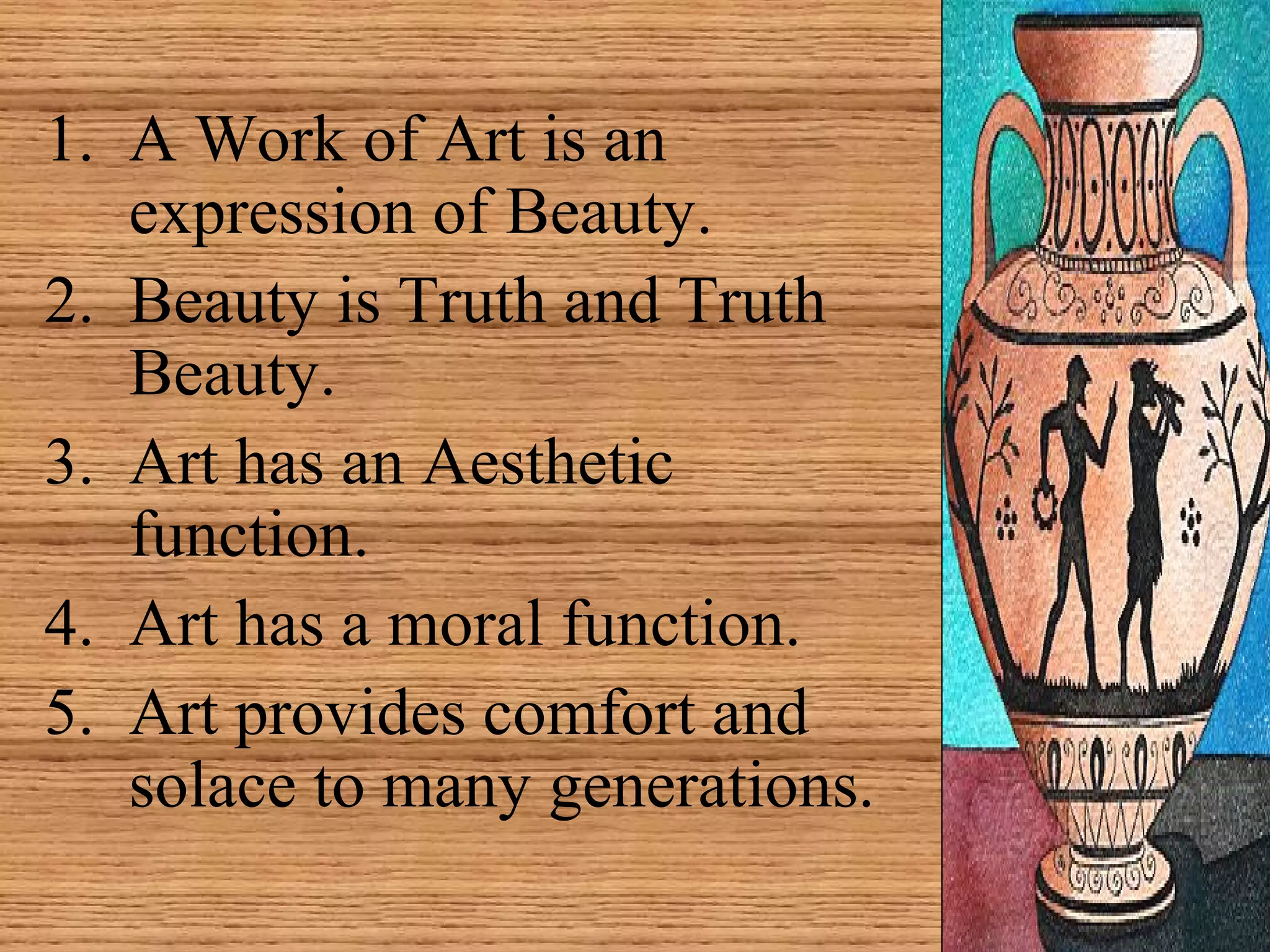
1. A Workof Art is an
expression of Beauty.
2. Beauty is Truth and Truth
Beauty.
3. Art has an Aesthetic
function.
4. Art has a moral function.
5. Art provides comfort and
solace to many generations.
7.
Keats calls theurn an “unravish’d bride of
quietness” because it has existed for centuries
without undergoing any changes (it is “unrevised”)
as it sits quietly on a shelf or table.
,
JJJJHGHGGVGHVHGVStanza 1:-
Thou still unravish'd bride of quietness,
Stanza 1:-
Thou still unravish'd bride of quietness,
8.
He also callsit a “foster-child of silence and time”
because it is has been adopted by silence and
time, parents who have conferred on the urn
eternal stillness.
Thou still unravish'd bride of quietness,
Thou foster-child of silence and slow time,
Thou still unravish'd bride of quietness,
Thou foster-child of silence and slow time,
,
Thou foster-child of silence and slow
time,
9.
Thou still unravish'dbride of quietness,
Thou foster-child of silence and slow time,
Thou still unravish'd bride of quietness,
Thou foster-child of silence and slow time,
,
In addition, Keats refers to the urn as a
“sylvan historian” because it records a
pastoral scene from long ago. (“Sylvan”
refers to anything pertaining to woods or
forests.) This scene tells a story (“legend”) in
pictures framed with leaves (“leaf-fringed”)–a
story that the urn tells more charmingly with
its images than Keats does with his pen.
10.
Heard melodies aresweet, but those unhear’d
Are sweeter: therefore, ye soft pipes, play on;
Heard melodies are sweet, but those unhear’d
Are sweeter: therefore, ye soft pipes, play on;
Because in heard music there is no place for
a flight of imagination, while in unheard music
fancy gets a free play. Imagination gives an
exquisite sweetness and richness which can
never found in the heard music. unheard music
appeals to the soul, it has spiritual, not the
physical appeal.
Stanza:2Stanza:2
11.
Beauty is aTruth and Truth
is a Beauty.
John Keat.








![Romantic age[1]](https://cdn.slidesharecdn.com/ss_thumbnails/romanticage1-200310082315-thumbnail.jpg?width=640&height=640&fit=bounds)


