Draupadi
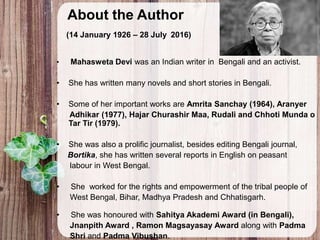
Mahashweta Devi
Gokhale Education Society’s
S.M.R.K. B.K. A.K Mahila Mahavidyalaya, Nasik-5
.
CC English (HL)
T.Y.B.Com. Sem V
Unit1
Ms.Geetanjali Gitay
Assistant Professor
Dept. of English
• Mahasweta Devi was an Indian writer in Bengali and an activist.
• She has written many novels and short stories in Bengali.
• Some of her important works are Amrita Sanchay (1964), Aranyer
Adhikar (1977), Hajar Churashir Maa, Rudali and Chhoti Munda o
Tar Tir (1979).
• She was also a prolific journalist, besides editing Bengali journal,
Bortika, she has written several reports in English on peasant
labour in West Bengal.
• She worked for the rights and empowerment of the tribal people of
West Bengal, Bihar, Madhya Pradesh and Chhatisgarh.
• She was honoured with Sahitya Akademi Award (in Bengali),
Jnanpith Award , Ramon Magsayasay Award along with Padma
Shri and Padma Vibushan.
About the Author
(14 January 1926 – 28 July 2016)
Background of the Story
• “Draupadi” is one of the three stories from the collection “Agnigarbha”
published in 1978 and set against the Naxalite activities of 1967-72.
• In May 1972, a peasant uprising in protest against oppression of the
landless peasantry and tribal cultivators took place at Naxalbari, in
the Northern tip of West Bengal.
• This was supported by Communist revolutionaries, who later formed
Communist Party of India.
• In 1970, several students from cities also joined the peasant movemen
• The West Bengal Government retaliated sharply and with help of the
Centre, the police and the military forces brutally put an end to both
urban and peasant action.
• In this story, the main character, Draupadi,( the tribal version is Dopdi)
• and her husband Dulna are on the most wanted list of West Bengal.
• What happens to both of them is what we come to know in the story.
• The story is translated in English by Gayatri Chakraborty Spivak.
Characters of the Story
• Draupadi (Dopdi) Mejhen – a tribal woman
of Santhal tribe aged 27.
• Dulna Majhi - her husband.
• Surja Sahu –Landlord killed by Draupadi and Dulna.
• Captain Arjan Singh– in charge of Operation Forest.
•
• Senanayak- a Bengali specialist in combat
• and extreme Left politics.
Plot Summary
• The story is set in jungle of Jharkhani located in Bankrajharh district of
West Bengal.
• The story begins with a conversation between two policemen who are
discussing about Dopdi and her husband Dulna. We come to know that
both of them are the most wanted by the police.
• Dulna and Dopdi worked at harvests, rotating between the districts of
Birbhum, Burdwan, Murshidabad and Bankura.
• In 1971, during the famous Operation Bakuli, when many peasants
were gunned down, these two escaped causing much pain to Captain
Arjan Singh who was the in charge of the operation.
• They were in fact the main culprits who murdered the landlord Surja
Sahu and his son, occupying upper- caste wells and tube wells during
the drought.
• They then went underground for a long time. The Special Forces
are searching for them badly.
• Captain Arjan Singh is back with Operation Forest
Plot Summary
• Dopdi and Dulna are guerilla warriors who use hatchets, bows and
arrows to kill people.
• They should be killed when sighted.
• Then, an information is received that many young men and women
, batch by batch and on jeeps, have attacked police station after
police station, and have disappeared into the forest of Jharkhani.
• After escaping from Operation Bakuli, Dopdi and Dulna have
worked at the house of every landowner and can efficiently inform
the killers about their targets.
• Finally , the forest of Jharkhani is surrounded by the soldiers of the
• Army. They also enter the forest and keep watch on the falls and
• Springs which are the only sources of drinking water.
One day, a Santal tribal drinking water is shot dead by a soldier,
that man is Dulna Majhi. Dopdi’s husband is thus killed. Before
dying he shouts ,” Ma-ho”.
• The Department of Defence is busy in making sense what “ Ma-ho”
means. The camp’s water carrier Chamru tell it is a war cry.
Plot Summary
• Then, leaving Dulna’s body on the stone, soldiers camourflage
themselves on the trees and keep a watch to see whether anyone
comes to take Dulna’s body.
• The search for Dopdi continues. She is the one who is now
saving fugitives. For army, catching her is important, because she
will lead them to others.
• Then we see Dopdi. She is walking slowly from village to the forest
with rice knotted in her belt. Mushai Tudu’s wife has given it to her.
On the very same day, she has seen a notice for reward in her name
in the Panchayat office. Reward of two hundred in her name. She
tells Dopdi that there is a lot of preparation to catch her. She tells
her not to come again or else police will burn their huts.
• Dopdi and Dulna Majhi’s real names are Upi Mehjen and Matang
Majhi.
• While walking, Dopdi recalls the murder of Surja Sahu, the
landlord, who won’t give water of his well to untouchables. Dulna
kills him as he is still paying for the debt taken by his great
grandfather.
Plot Summary
• Jharkhani forest is still two miles away. She is thinking of changing
the hideouts.
• She is walking towards her camp when she hears footsteps of at her
back.
• Finally, Dopadi is caught, it is Surja Sahu’s brother, Rotoni Sahu with
Shomai and Budhha.
• It is Senanayak, who has predicted her position.
• She is brought to police camp and brutally tortured.
• When she is asked to meet the Burra Sahib. Senanayak, she
challenges him and for once, he is scared of his target.
• The story ends here.
Observations
• This story portrays the Naxalite movement in Bengal. Oppressed
peasants revolted against the landlords and tried to bring them
to justice.
• The way Dopadi is treated, brings backs to mind the episode
from Mahabharat, where Duryodhan illtreats Draupadi in the
court. Dopadi thus stand for the women who still face
disrespect at the hands of society.
• Senanayak, police and army stand in the place of Kauravas.
However, though tortured, she does not give any information
about her comrades.
• Draupadi in Mahabharat is saved by Shri Krishna, however,
Dopadi in this story stands for herself refusing to take help
from men.
• This story thus records the unspeakable mistreatment of the
already oppressed peasants at the hands of police and army.
• This story is thus socially as well as politically significant.
Unit.1.5.draupadi.mahashweta devi

Unit.1.5.draupadi.mahashweta devi

  • 1.
    Draupadi Mahashweta Devi Gokhale EducationSociety’s S.M.R.K. B.K. A.K Mahila Mahavidyalaya, Nasik-5 . CC English (HL) T.Y.B.Com. Sem V Unit1 Ms.Geetanjali Gitay Assistant Professor Dept. of English
  • 2.
    • Mahasweta Deviwas an Indian writer in Bengali and an activist. • She has written many novels and short stories in Bengali. • Some of her important works are Amrita Sanchay (1964), Aranyer Adhikar (1977), Hajar Churashir Maa, Rudali and Chhoti Munda o Tar Tir (1979). • She was also a prolific journalist, besides editing Bengali journal, Bortika, she has written several reports in English on peasant labour in West Bengal. • She worked for the rights and empowerment of the tribal people of West Bengal, Bihar, Madhya Pradesh and Chhatisgarh. • She was honoured with Sahitya Akademi Award (in Bengali), Jnanpith Award , Ramon Magsayasay Award along with Padma Shri and Padma Vibushan. About the Author (14 January 1926 – 28 July 2016)
  • 3.
    Background of theStory • “Draupadi” is one of the three stories from the collection “Agnigarbha” published in 1978 and set against the Naxalite activities of 1967-72. • In May 1972, a peasant uprising in protest against oppression of the landless peasantry and tribal cultivators took place at Naxalbari, in the Northern tip of West Bengal. • This was supported by Communist revolutionaries, who later formed Communist Party of India. • In 1970, several students from cities also joined the peasant movemen • The West Bengal Government retaliated sharply and with help of the Centre, the police and the military forces brutally put an end to both urban and peasant action. • In this story, the main character, Draupadi,( the tribal version is Dopdi) • and her husband Dulna are on the most wanted list of West Bengal. • What happens to both of them is what we come to know in the story. • The story is translated in English by Gayatri Chakraborty Spivak.
  • 4.
    Characters of theStory • Draupadi (Dopdi) Mejhen – a tribal woman of Santhal tribe aged 27. • Dulna Majhi - her husband. • Surja Sahu –Landlord killed by Draupadi and Dulna. • Captain Arjan Singh– in charge of Operation Forest. • • Senanayak- a Bengali specialist in combat • and extreme Left politics.
  • 5.
    Plot Summary • Thestory is set in jungle of Jharkhani located in Bankrajharh district of West Bengal. • The story begins with a conversation between two policemen who are discussing about Dopdi and her husband Dulna. We come to know that both of them are the most wanted by the police. • Dulna and Dopdi worked at harvests, rotating between the districts of Birbhum, Burdwan, Murshidabad and Bankura. • In 1971, during the famous Operation Bakuli, when many peasants were gunned down, these two escaped causing much pain to Captain Arjan Singh who was the in charge of the operation. • They were in fact the main culprits who murdered the landlord Surja Sahu and his son, occupying upper- caste wells and tube wells during the drought. • They then went underground for a long time. The Special Forces are searching for them badly. • Captain Arjan Singh is back with Operation Forest
  • 6.
    Plot Summary • Dopdiand Dulna are guerilla warriors who use hatchets, bows and arrows to kill people. • They should be killed when sighted. • Then, an information is received that many young men and women , batch by batch and on jeeps, have attacked police station after police station, and have disappeared into the forest of Jharkhani. • After escaping from Operation Bakuli, Dopdi and Dulna have worked at the house of every landowner and can efficiently inform the killers about their targets. • Finally , the forest of Jharkhani is surrounded by the soldiers of the • Army. They also enter the forest and keep watch on the falls and • Springs which are the only sources of drinking water. One day, a Santal tribal drinking water is shot dead by a soldier, that man is Dulna Majhi. Dopdi’s husband is thus killed. Before dying he shouts ,” Ma-ho”. • The Department of Defence is busy in making sense what “ Ma-ho” means. The camp’s water carrier Chamru tell it is a war cry.
  • 7.
    Plot Summary • Then,leaving Dulna’s body on the stone, soldiers camourflage themselves on the trees and keep a watch to see whether anyone comes to take Dulna’s body. • The search for Dopdi continues. She is the one who is now saving fugitives. For army, catching her is important, because she will lead them to others. • Then we see Dopdi. She is walking slowly from village to the forest with rice knotted in her belt. Mushai Tudu’s wife has given it to her. On the very same day, she has seen a notice for reward in her name in the Panchayat office. Reward of two hundred in her name. She tells Dopdi that there is a lot of preparation to catch her. She tells her not to come again or else police will burn their huts. • Dopdi and Dulna Majhi’s real names are Upi Mehjen and Matang Majhi. • While walking, Dopdi recalls the murder of Surja Sahu, the landlord, who won’t give water of his well to untouchables. Dulna kills him as he is still paying for the debt taken by his great grandfather.
  • 8.
    Plot Summary • Jharkhaniforest is still two miles away. She is thinking of changing the hideouts. • She is walking towards her camp when she hears footsteps of at her back. • Finally, Dopadi is caught, it is Surja Sahu’s brother, Rotoni Sahu with Shomai and Budhha. • It is Senanayak, who has predicted her position. • She is brought to police camp and brutally tortured. • When she is asked to meet the Burra Sahib. Senanayak, she challenges him and for once, he is scared of his target. • The story ends here.
  • 9.
    Observations • This storyportrays the Naxalite movement in Bengal. Oppressed peasants revolted against the landlords and tried to bring them to justice. • The way Dopadi is treated, brings backs to mind the episode from Mahabharat, where Duryodhan illtreats Draupadi in the court. Dopadi thus stand for the women who still face disrespect at the hands of society. • Senanayak, police and army stand in the place of Kauravas. However, though tortured, she does not give any information about her comrades. • Draupadi in Mahabharat is saved by Shri Krishna, however, Dopadi in this story stands for herself refusing to take help from men. • This story thus records the unspeakable mistreatment of the already oppressed peasants at the hands of police and army. • This story is thus socially as well as politically significant.

Editor's Notes

  • #10 Peasant is a poor smallholder or agricultural labourer of low social status. Comrade is a colleague or a fellow worker in an organisation.