Presented by Kaytlyn Harrelson

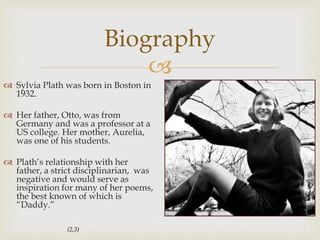
 Sylvia Plath was born in Boston in
1932.
 Her father, Otto, was from
Germany and was a professor at a
US college. Her mother, Aurelia,
was one of his students.
 Plath’s relationship with her
father, a strict disciplinarian, was
negative and would serve as
inspiration for many of her poems,
the best known of which is
“Daddy.”
Biography
(2,3)

 Plath was an excellent student and
received multitudes of awards and
was successful in publishing stories
and poetry in national magazines.
 During Plath’s undergraduate years in
college, she began to suffer from
severe depression that would
eventually lead to her suicide.
 On the subject of her illness, Plath
said, “It is as if my life were magically
run by two electric currents: joyous
positive and despairing negative—
whichever is running at the moment
dominates my life, floods it.” This is an
acute description of bipolar disorder,
for which there was no medication and
no cure during Plath’s time.
Biography, Cont.
(2,3)

 At the age of nineteen, Plath attempted
suicide by overdosing on sleeping pills.
She survived the attempt and was
made to go through electroshock
therapy following it. Her struggles
with mental illness at this point in her
life would later serve as inspiration for
the only novel she ever published, The
Bell Jar.
 Once Plath had recovered from this
attempt, she returned to college at
Smith and then earned a grant to study
abroad at Cambridge University in
England. This is where she would meet
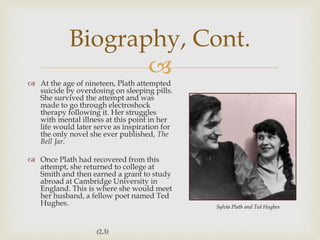
her husband, a fellow poet named Ted
Hughes.
Biography, Cont.
Sylvia Plath and Ted Hughes
(2,3)
 Throughout the first few years of
their marriage, Plath continued to
write and this is when her first
poetry collection, Colossus, was
published. For the most part, Plath’s
life was stable. She returned to the
United States, where she had two
children by Hughes, Frieda and
Nicholas, in 1960 and 1962,
respectively.
 The same year that Nicholas was
born, Ted Hughes left Plath for
another female poet named Assia
Wevill. Infidelity had been a
recurring issue in their
comparatively short marriage, but
Wevill was the woman who finally
drew Hughes completely away.
Biography, Cont.
Plath with her children,
Frieda and Nicholas.
Assia Wevill
(2, 3)

 That same winter, Plath was
thrown into deep depression
by the dissolution of her
marriage. During this time, she
wrote the poems that would
make up her most popular
poetry collection, Ariel.
 In 1963, Plath published The
Bell Jar under the pen name
Victoria Lucas.
 Shortly after the publication of
The Bell Jar, Plath took her own
life by inhaling gas from her
oven. The date of her death
was February 11, 1963.
Biography, Cont.
(2, 3)

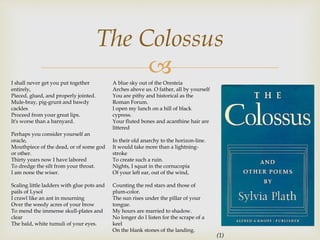
The Colossus
I shall never get you put together
entirely,
Pieced, glued, and properly jointed.
Mule-bray, pig-grunt and bawdy
cackles
Proceed from your great lips.
It's worse than a barnyard.
Perhaps you consider yourself an
oracle,
Mouthpiece of the dead, or of some god
or other.
Thirty years now I have labored
To dredge the silt from your throat.
I am none the wiser.
Scaling little ladders with glue pots and
pails of Lysol
I crawl like an ant in mourning
Over the weedy acres of your brow
To mend the immense skull-plates and
clear
The bald, white tumuli of your eyes.
A blue sky out of the Oresteia
Arches above us. O father, all by yourself
You are pithy and historical as the
Roman Forum.
I open my lunch on a hill of black
cypress.
Your fluted bones and acanthine hair are
littered
In their old anarchy to the horizon-line.
It would take more than a lightning-
stroke
To create such a ruin.
Nights, I squat in the cornucopia
Of your left ear, out of the wind,
Counting the red stars and those of
plum-color.
The sun rises under the pillar of your
tongue.
My hours are married to shadow.
No longer do I listen for the scrape of a
keel
On the blank stones of the landing.
(1)

 To me, The Colossus reads as a poem about Plath’s father. The
fallen giant represents her dead father and Plath, represented by
the giant’s attendant, still tends to him, seemingly uncaring that
the giant is dead and not benefitting from her care. This parallels
with Plath’s father’s death looming over her and affecting her work
long after he passed. Both the giant and Plath’s father are oblivious
to the toils the narrator and Plath go through in order to tend to
them, or keep their memory alive.
 Aside from these parallels, the narrator also addresses the fallen
giant as “O father, all by yourself” (23). While it is possible Plath
could be addressing a god of some kind, Plath readers can tell by
“Daddy” that Plath’s father had almost a godlike influence over
her, even after he passed away. Whether metaphorically or
literally, the giant representing her father makes sense.
My Interpretation

 Reception for The Colossus was generally positive, although it
was more popular in England than America. It was not the
work that would solidify Plath’s place among great American
writers, however.
 Ariel, written in the wake of Plath’s husband’s infidelities and
the return of her crippling depression, was published
posthumously and was received as “both a harbinger and an
early voice of the women's movement. As the posthumous
awarding of the 1982 Pulitzer Prize for Poetry to Plath's
Collected Poems showed, her audience was not limited to
women readers, nor did her writing express only feminist
sentiments” (Wagner-Martin).
Critical Reception
(4)

Works Cited
1. Plath, Sylvia. "The Colossus." American Poems. N.p., 20 Feb. 2003.
Web. 22 July 2015.
2. Sylvia Plath." Poetry Foundation. Poetry Foundation, n.d. Web. 22
July 2015.
3. Sylvia Plath." Poets.org. Academy of American Poets, n.d. Web.
22 July 2015.
4. Wagner-Martin, Linda. "Sylvia Plath." The Oxford Companion to
Women’s Writing in the United States. N.p.: Oxford UP, 2005. N.
pag. University of Illinois. Web. 22 July 2015.
Works Cited

Sylvia plath

  • 1.
  • 2.
      Sylvia Plathwas born in Boston in 1932.  Her father, Otto, was from Germany and was a professor at a US college. Her mother, Aurelia, was one of his students.  Plath’s relationship with her father, a strict disciplinarian, was negative and would serve as inspiration for many of her poems, the best known of which is “Daddy.” Biography (2,3)
  • 3.
      Plath wasan excellent student and received multitudes of awards and was successful in publishing stories and poetry in national magazines.  During Plath’s undergraduate years in college, she began to suffer from severe depression that would eventually lead to her suicide.  On the subject of her illness, Plath said, “It is as if my life were magically run by two electric currents: joyous positive and despairing negative— whichever is running at the moment dominates my life, floods it.” This is an acute description of bipolar disorder, for which there was no medication and no cure during Plath’s time. Biography, Cont. (2,3)
  • 4.
      At theage of nineteen, Plath attempted suicide by overdosing on sleeping pills. She survived the attempt and was made to go through electroshock therapy following it. Her struggles with mental illness at this point in her life would later serve as inspiration for the only novel she ever published, The Bell Jar.  Once Plath had recovered from this attempt, she returned to college at Smith and then earned a grant to study abroad at Cambridge University in England. This is where she would meet her husband, a fellow poet named Ted Hughes. Biography, Cont. Sylvia Plath and Ted Hughes (2,3)
  • 5.
     Throughout thefirst few years of their marriage, Plath continued to write and this is when her first poetry collection, Colossus, was published. For the most part, Plath’s life was stable. She returned to the United States, where she had two children by Hughes, Frieda and Nicholas, in 1960 and 1962, respectively.  The same year that Nicholas was born, Ted Hughes left Plath for another female poet named Assia Wevill. Infidelity had been a recurring issue in their comparatively short marriage, but Wevill was the woman who finally drew Hughes completely away. Biography, Cont. Plath with her children, Frieda and Nicholas. Assia Wevill (2, 3)
  • 6.
      That samewinter, Plath was thrown into deep depression by the dissolution of her marriage. During this time, she wrote the poems that would make up her most popular poetry collection, Ariel.  In 1963, Plath published The Bell Jar under the pen name Victoria Lucas.  Shortly after the publication of The Bell Jar, Plath took her own life by inhaling gas from her oven. The date of her death was February 11, 1963. Biography, Cont. (2, 3)
  • 7.
     The Colossus I shallnever get you put together entirely, Pieced, glued, and properly jointed. Mule-bray, pig-grunt and bawdy cackles Proceed from your great lips. It's worse than a barnyard. Perhaps you consider yourself an oracle, Mouthpiece of the dead, or of some god or other. Thirty years now I have labored To dredge the silt from your throat. I am none the wiser. Scaling little ladders with glue pots and pails of Lysol I crawl like an ant in mourning Over the weedy acres of your brow To mend the immense skull-plates and clear The bald, white tumuli of your eyes. A blue sky out of the Oresteia Arches above us. O father, all by yourself You are pithy and historical as the Roman Forum. I open my lunch on a hill of black cypress. Your fluted bones and acanthine hair are littered In their old anarchy to the horizon-line. It would take more than a lightning- stroke To create such a ruin. Nights, I squat in the cornucopia Of your left ear, out of the wind, Counting the red stars and those of plum-color. The sun rises under the pillar of your tongue. My hours are married to shadow. No longer do I listen for the scrape of a keel On the blank stones of the landing. (1)
  • 8.
      To me,The Colossus reads as a poem about Plath’s father. The fallen giant represents her dead father and Plath, represented by the giant’s attendant, still tends to him, seemingly uncaring that the giant is dead and not benefitting from her care. This parallels with Plath’s father’s death looming over her and affecting her work long after he passed. Both the giant and Plath’s father are oblivious to the toils the narrator and Plath go through in order to tend to them, or keep their memory alive.  Aside from these parallels, the narrator also addresses the fallen giant as “O father, all by yourself” (23). While it is possible Plath could be addressing a god of some kind, Plath readers can tell by “Daddy” that Plath’s father had almost a godlike influence over her, even after he passed away. Whether metaphorically or literally, the giant representing her father makes sense. My Interpretation
  • 9.
      Reception forThe Colossus was generally positive, although it was more popular in England than America. It was not the work that would solidify Plath’s place among great American writers, however.  Ariel, written in the wake of Plath’s husband’s infidelities and the return of her crippling depression, was published posthumously and was received as “both a harbinger and an early voice of the women's movement. As the posthumous awarding of the 1982 Pulitzer Prize for Poetry to Plath's Collected Poems showed, her audience was not limited to women readers, nor did her writing express only feminist sentiments” (Wagner-Martin). Critical Reception (4)
  • 10.
     Works Cited 1. Plath,Sylvia. "The Colossus." American Poems. N.p., 20 Feb. 2003. Web. 22 July 2015. 2. Sylvia Plath." Poetry Foundation. Poetry Foundation, n.d. Web. 22 July 2015. 3. Sylvia Plath." Poets.org. Academy of American Poets, n.d. Web. 22 July 2015. 4. Wagner-Martin, Linda. "Sylvia Plath." The Oxford Companion to Women’s Writing in the United States. N.p.: Oxford UP, 2005. N. pag. University of Illinois. Web. 22 July 2015. Works Cited