Welcome
to this Class in the
Department of English
Uttara University
By
William Congreve
The Way of the World
Conducted By:
Monir Hossen
Lecturer
Department of English
Uttara University
Email: monir.eng.cou@gmail.com
E
Index
1. Biography
2. Historical Context
3. Plot overview
4. Characters
5. Themes
6. Critical Comment
7. Literary Features
8. Comedy of Manners
9. Conclusion
4
5
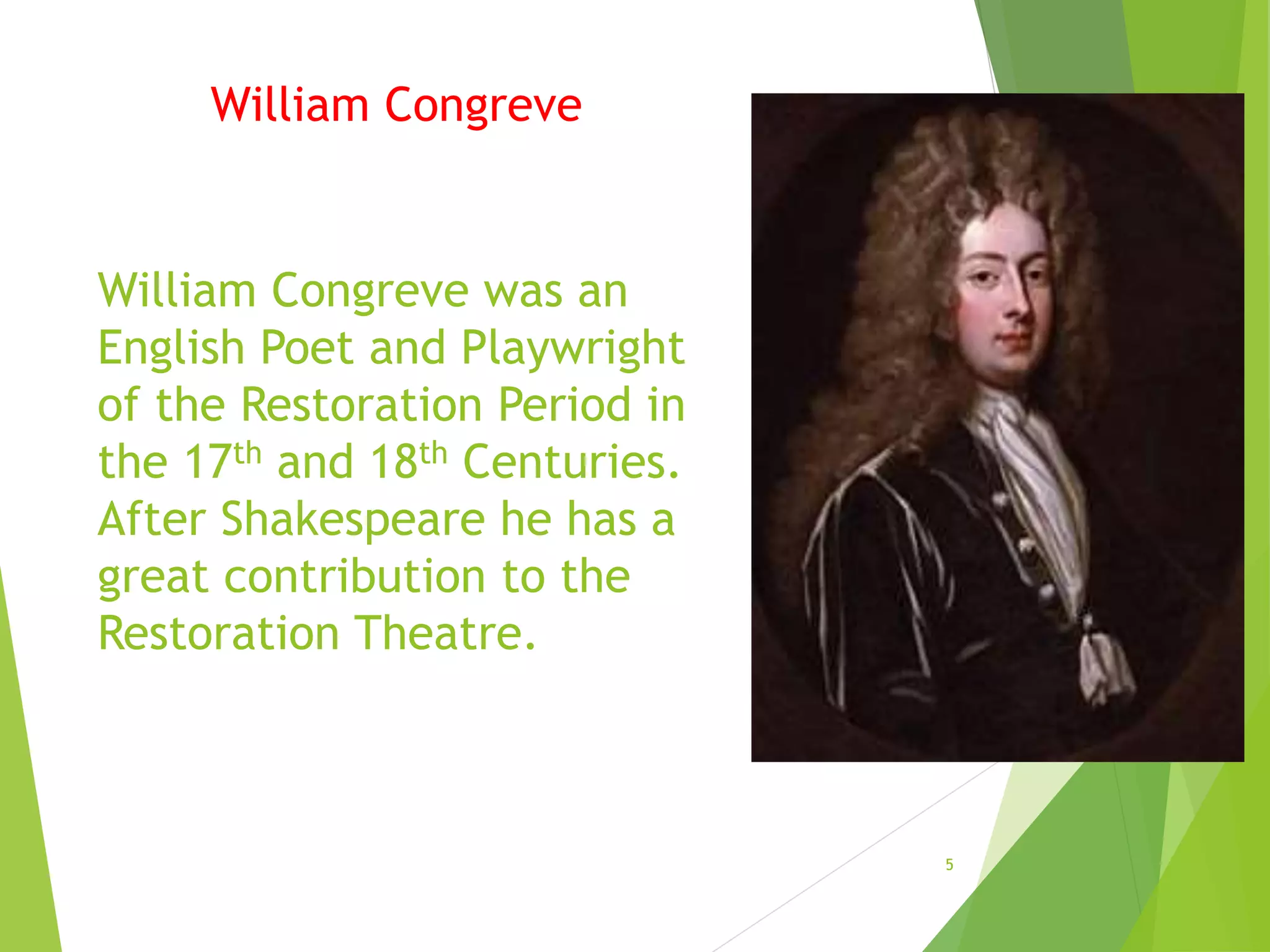
William Congreve was an
English Poet and Playwright
of the Restoration Period in
the 17th and 18th Centuries.
After Shakespeare he has a
great contribution to the
Restoration Theatre.
William Congreve
6
 He was born in January of 1670 in Bardsey
Grange, Yorkshire, England
 Young William attended Kilkenny College then
 Trinity College, Dublin
 After graduation became a disciple of John
Dryden
 Entered the Middle Temple to study law
 Literary career started from 1692
 Influenced by Plato, Aesop, and Shakespeare.
William Congreve
Works published under the
pseudonym "Cleophil"
 Incognita (1692), "an Essay”
The comedy
 The Old Batchelor
 Love for Love (1694)
 The Way of the World (1700)
The first poetic tragedy
 The Mourning Bride (1697)
 The Mourning Bride
 The Mourning Muse of Alexis
 The Tears of Amaryllis for Amyntas
7
Quotations of William Congreve
 Music has charms to sooth a savage
breast, to soften rocks, or bend a knotted
oak.
 Never go to bed angry, stay up and fight.
 Uncertainty and expectation are the joys
of
 life. Security is an insipid thing.
 If this be not love, it is madness, and
then it is pardonable.
8
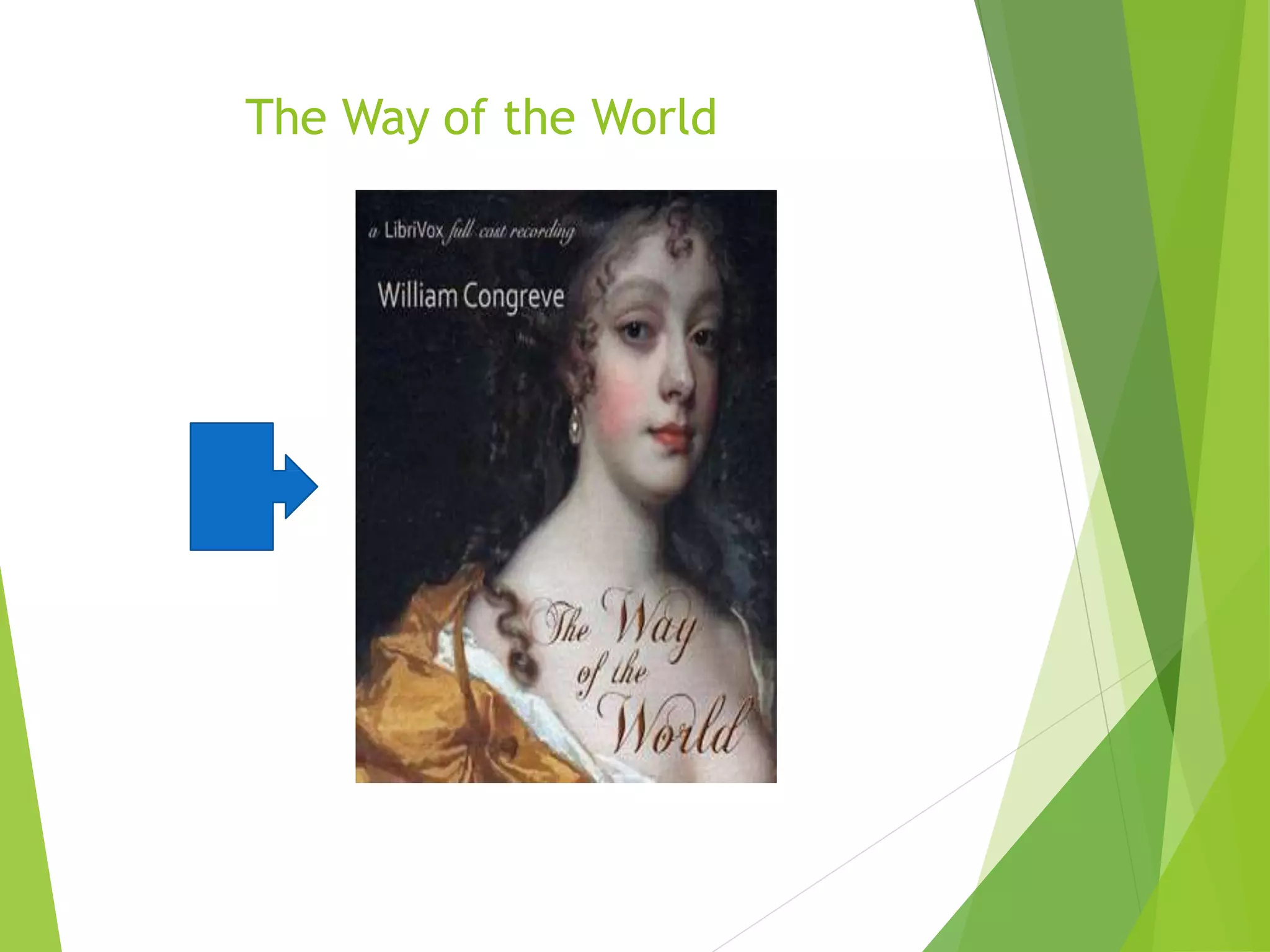
The Way of the World
Historical Context
10
The period in English history from 1670 to 1729, when
Congreve lived and worked, was marked by a dramatic
political event, which gave its name to the literary tradition
known as Restoration drama. In 1660, Charles II came to the
throne, and the monarchy, which had been in exile, once
again ruled England. Although that restoration period was
short-lived (Parliament regained power in 1688), it was
important to western culture in that it provided a perfect
milieu for the comedy of manners.
The English comedies of this time, Congreve's included, take
the manners of high society and the aristocracy as material
for satire, focusing their attention, as Henry T. E. Perry
writes in The Comic Spirit in Restoration Drama "upon the
surface of a highly polished and fundamentally insecure
civilization."
Setting of the Play
11
Chocolate-house
Chocolate-house. Setting for act 1. Such houses as Will’s near
Covent Garden and White’s near St. James Park were the
fashionable meeting places of young gallants and wits. Often
gaming was associated with them.
 London
 St. James Park
 Country
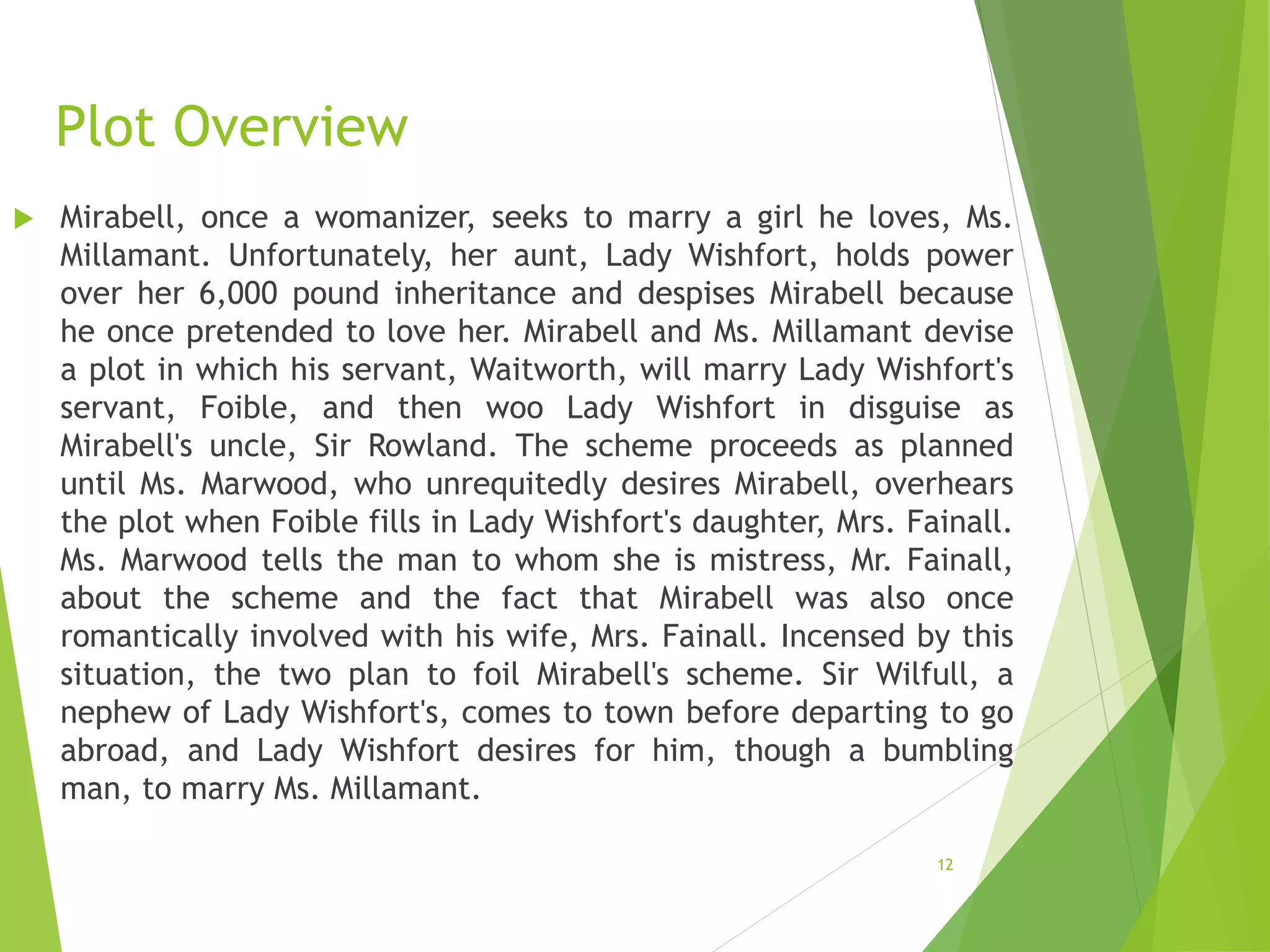
Plot Overview
 Mirabell, once a womanizer, seeks to marry a girl he loves, Ms.
Millamant. Unfortunately, her aunt, Lady Wishfort, holds power
over her 6,000 pound inheritance and despises Mirabell because
he once pretended to love her. Mirabell and Ms. Millamant devise
a plot in which his servant, Waitworth, will marry Lady Wishfort's
servant, Foible, and then woo Lady Wishfort in disguise as
Mirabell's uncle, Sir Rowland. The scheme proceeds as planned
until Ms. Marwood, who unrequitedly desires Mirabell, overhears
the plot when Foible fills in Lady Wishfort's daughter, Mrs. Fainall.
Ms. Marwood tells the man to whom she is mistress, Mr. Fainall,
about the scheme and the fact that Mirabell was also once
romantically involved with his wife, Mrs. Fainall. Incensed by this
situation, the two plan to foil Mirabell's scheme. Sir Wilfull, a
nephew of Lady Wishfort's, comes to town before departing to go
abroad, and Lady Wishfort desires for him, though a bumbling
man, to marry Ms. Millamant.
12
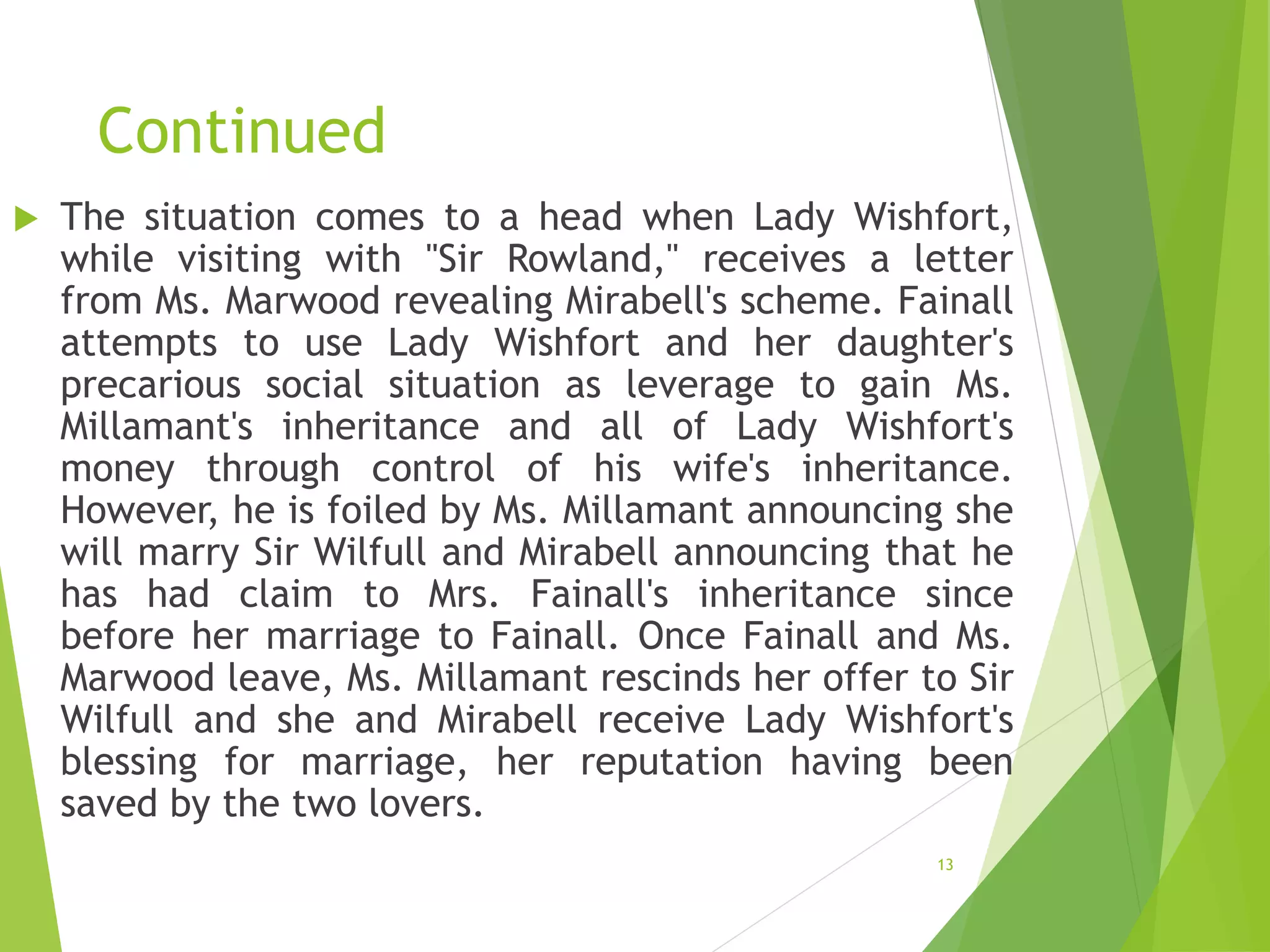
Continued
 The situation comes to a head when Lady Wishfort,
while visiting with "Sir Rowland," receives a letter
from Ms. Marwood revealing Mirabell's scheme. Fainall
attempts to use Lady Wishfort and her daughter's
precarious social situation as leverage to gain Ms.
Millamant's inheritance and all of Lady Wishfort's
money through control of his wife's inheritance.
However, he is foiled by Ms. Millamant announcing she
will marry Sir Wilfull and Mirabell announcing that he
has had claim to Mrs. Fainall's inheritance since
before her marriage to Fainall. Once Fainall and Ms.
Marwood leave, Ms. Millamant rescinds her offer to Sir
Wilfull and she and Mirabell receive Lady Wishfort's
blessing for marriage, her reputation having been
saved by the two lovers.
13
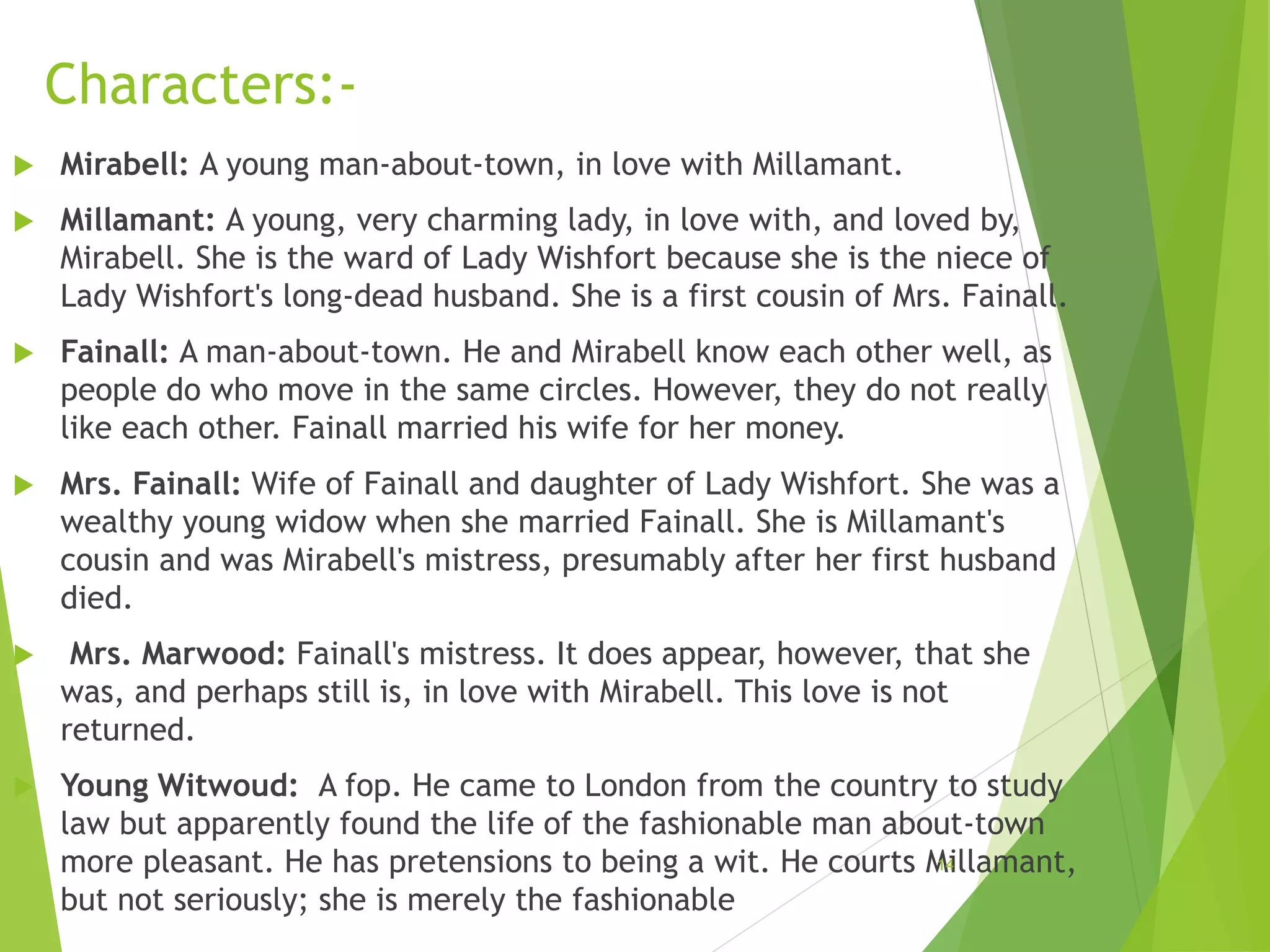
Characters:-
 Mirabell: A young man-about-town, in love with Millamant.
 Millamant: A young, very charming lady, in love with, and loved by,
Mirabell. She is the ward of Lady Wishfort because she is the niece of
Lady Wishfort's long-dead husband. She is a first cousin of Mrs. Fainall.
 Fainall: A man-about-town. He and Mirabell know each other well, as
people do who move in the same circles. However, they do not really
like each other. Fainall married his wife for her money.
 Mrs. Fainall: Wife of Fainall and daughter of Lady Wishfort. She was a
wealthy young widow when she married Fainall. She is Millamant's
cousin and was Mirabell's mistress, presumably after her first husband
died.
 Mrs. Marwood: Fainall's mistress. It does appear, however, that she
was, and perhaps still is, in love with Mirabell. This love is not
returned.
 Young Witwoud: A fop. He came to London from the country to study
law but apparently found the life of the fashionable man about-town
more pleasant. He has pretensions to being a wit. He courts Millamant,
but not seriously; she is merely the fashionable
14
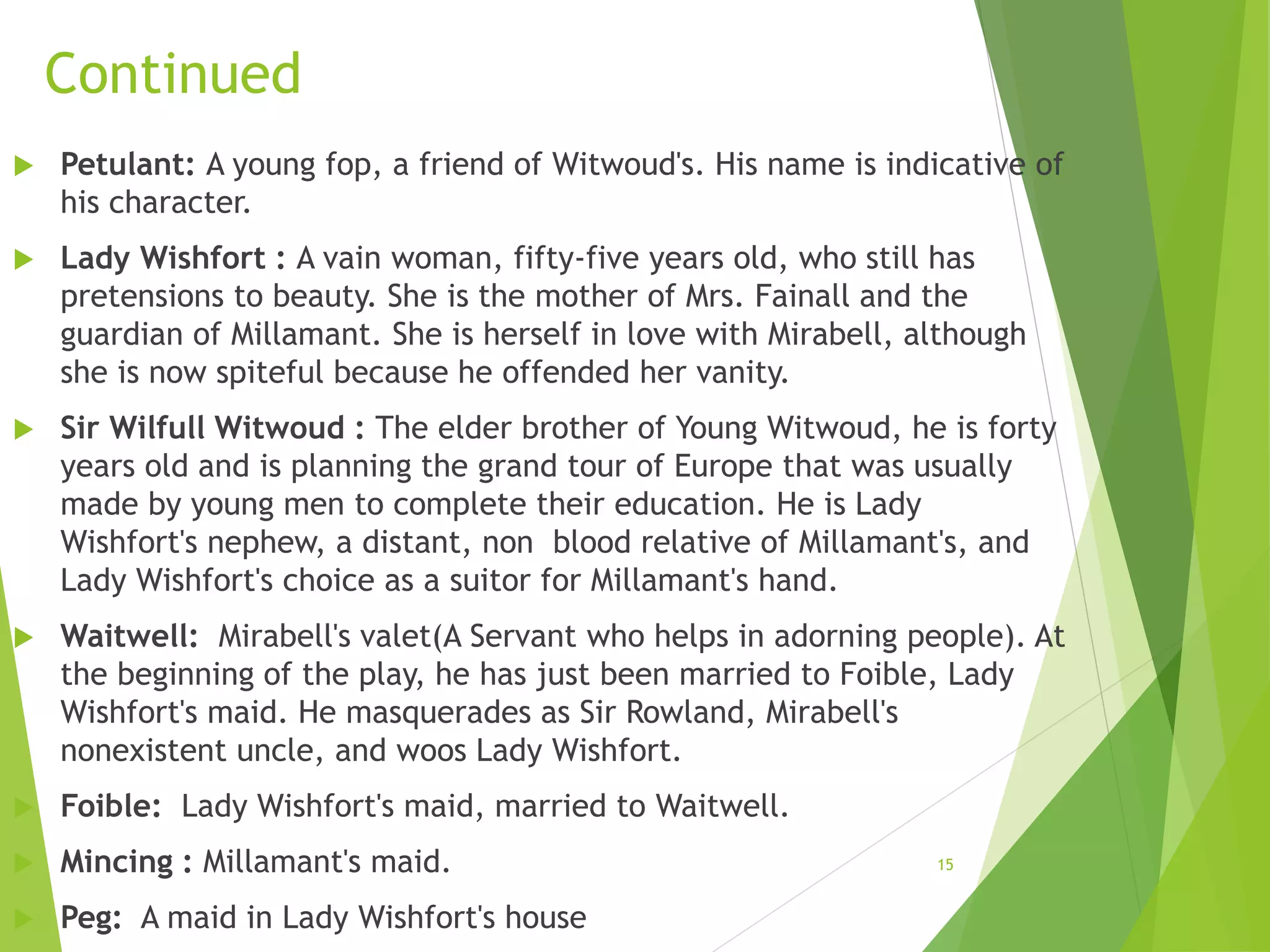
Continued
 Petulant: A young fop, a friend of Witwoud's. His name is indicative of
his character.
 Lady Wishfort : A vain woman, fifty-five years old, who still has
pretensions to beauty. She is the mother of Mrs. Fainall and the
guardian of Millamant. She is herself in love with Mirabell, although
she is now spiteful because he offended her vanity.
 Sir Wilfull Witwoud : The elder brother of Young Witwoud, he is forty
years old and is planning the grand tour of Europe that was usually
made by young men to complete their education. He is Lady
Wishfort's nephew, a distant, non blood relative of Millamant's, and
Lady Wishfort's choice as a suitor for Millamant's hand.
 Waitwell: Mirabell's valet(A Servant who helps in adorning people). At
the beginning of the play, he has just been married to Foible, Lady
Wishfort's maid. He masquerades as Sir Rowland, Mirabell's
nonexistent uncle, and woos Lady Wishfort.
 Foible: Lady Wishfort's maid, married to Waitwell.
 Mincing : Millamant's maid.
 Peg: A maid in Lady Wishfort's house
15
Key Facts of The Way of the World
 Social comedy that treated the love game with lightness,
humor, and some ribaldry
 Satire of social types: the fops, the pedants, and the vain
women
 Strong French influence which led to elegance of plotting,
characterization, and acting
 Plots and subplots, and generally an excess of action
 Treatment of love with an objective rationalism
 ideas - lovers preserve their integrity as individuals, love is
not metaphysical, sentimental, or a form of sacrifice, not
merely carnal; it includes trust, dignity, and mutual respect
16
The Restoration Comedy or The Comedy of Manners
 The action always takes place in London.
 There is always a contrast between the rural and the
urban. For example in Congreve's "The Way of the World"
Squire Witwoud is from the county of Shropshire and his
arrival in London results in a lot of amusement and
humour.
 The presence of at least one pair of very intelligent
young lovers.
 Witty dialogue is perhaps the most important feature of
the Comedy of Manners.
 All the other aspects of the play are usually sacrificed
for the sake of contriving a situation
 which would give rise to 'witty' dialogue.
 The appeal of the Comedy of Manners is to the
intelligence of the audience/reader and not to the
emotions.
17
Continued
 The women in these plays were very emancipated and
bold and independent, unlike the heroines of the
Sentimental dramas.
 The 'witty' dialogue was usually obscene, for the theatres
had just reopened after the Restoration.
 The institution of marriage was always held to ridicule.
Both husbands and wives openly expressed their
dissatisfaction of their spouses.
 These plays were mainly intended for the elegant and
sophisticated audiences of London city. Hence the
characters were almost always from the upper class
society of London.
 These plays portrayed the lifestyle of the idle rich of
London city very realistically.
 The plays were mildly satirical-the playwright could not
afford to hurt his upper class audience.
18
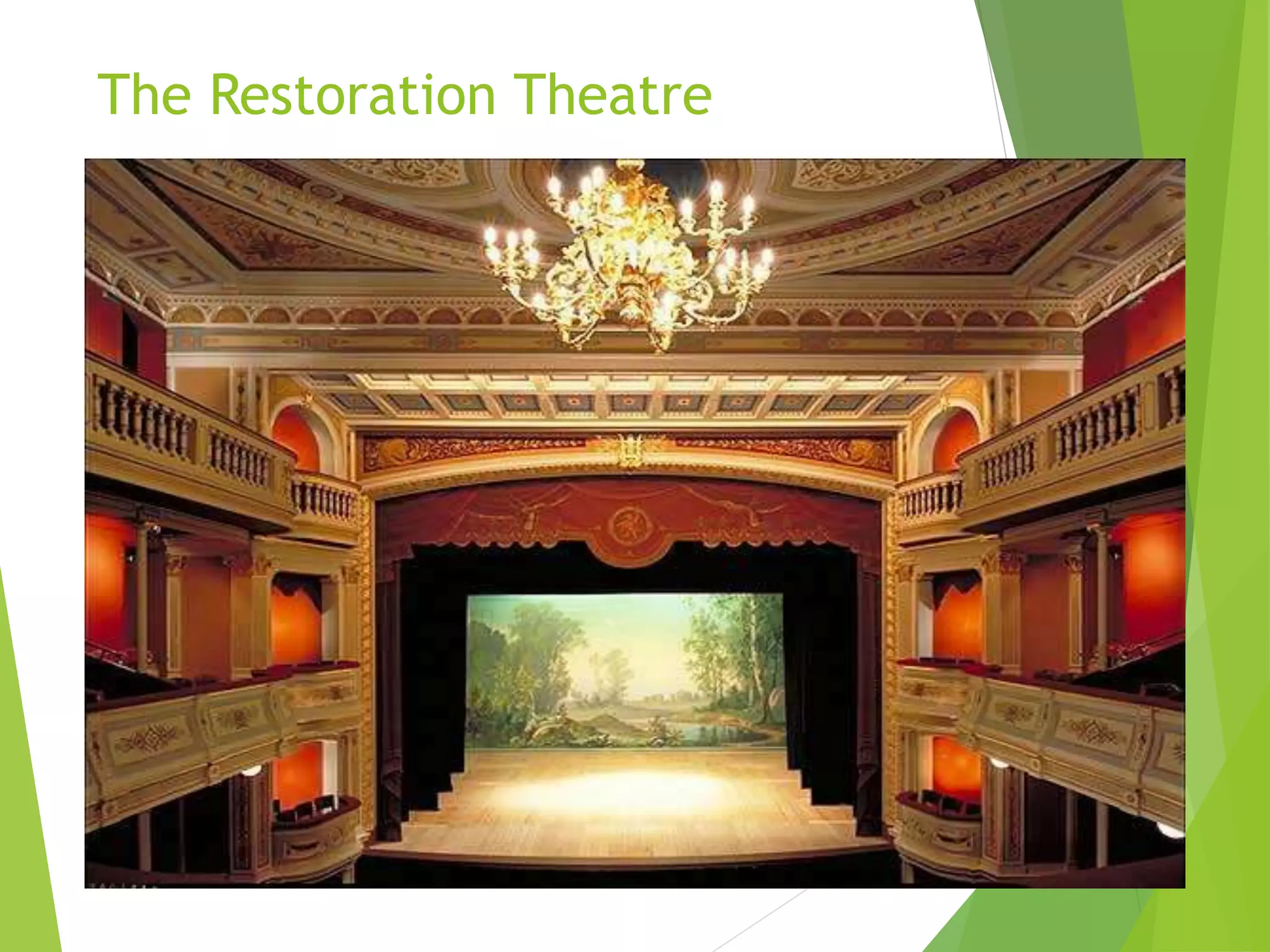
The Restoration Theatre
19
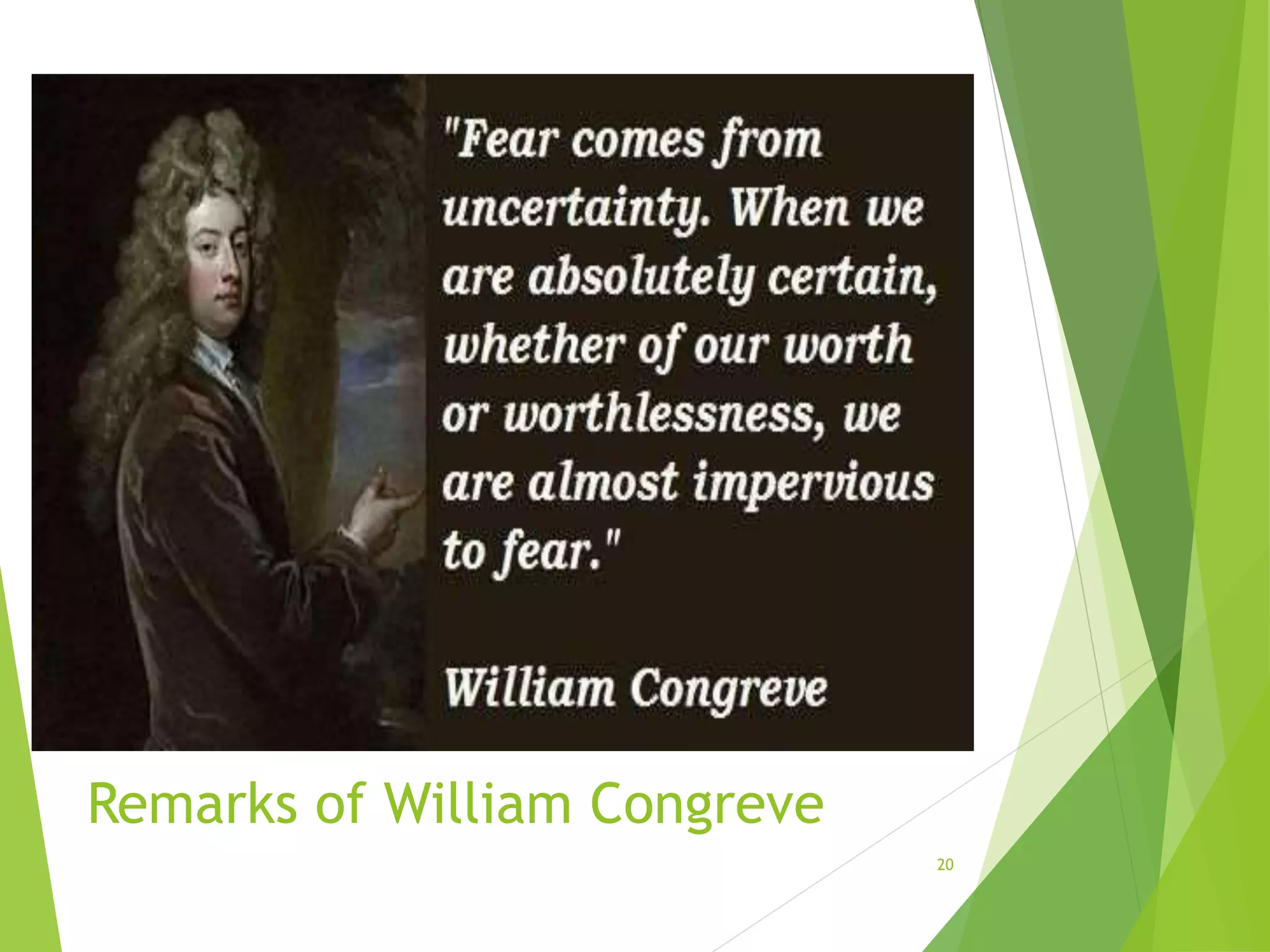
Remarks of William Congreve
20
21

The way of the world Presented by Monir Hossen

  • 1.
    Welcome to this Classin the Department of English Uttara University
  • 2.
  • 3.
    Conducted By: Monir Hossen Lecturer Departmentof English Uttara University Email: monir.eng.cou@gmail.com E
  • 4.
    Index 1. Biography 2. HistoricalContext 3. Plot overview 4. Characters 5. Themes 6. Critical Comment 7. Literary Features 8. Comedy of Manners 9. Conclusion 4
  • 5.
    5 William Congreve wasan English Poet and Playwright of the Restoration Period in the 17th and 18th Centuries. After Shakespeare he has a great contribution to the Restoration Theatre. William Congreve
  • 6.
    6  He wasborn in January of 1670 in Bardsey Grange, Yorkshire, England  Young William attended Kilkenny College then  Trinity College, Dublin  After graduation became a disciple of John Dryden  Entered the Middle Temple to study law  Literary career started from 1692  Influenced by Plato, Aesop, and Shakespeare. William Congreve
  • 7.
    Works published underthe pseudonym "Cleophil"  Incognita (1692), "an Essay” The comedy  The Old Batchelor  Love for Love (1694)  The Way of the World (1700) The first poetic tragedy  The Mourning Bride (1697)  The Mourning Bride  The Mourning Muse of Alexis  The Tears of Amaryllis for Amyntas 7
  • 8.
    Quotations of WilliamCongreve  Music has charms to sooth a savage breast, to soften rocks, or bend a knotted oak.  Never go to bed angry, stay up and fight.  Uncertainty and expectation are the joys of  life. Security is an insipid thing.  If this be not love, it is madness, and then it is pardonable. 8
  • 9.
    The Way ofthe World
  • 10.
    Historical Context 10 The periodin English history from 1670 to 1729, when Congreve lived and worked, was marked by a dramatic political event, which gave its name to the literary tradition known as Restoration drama. In 1660, Charles II came to the throne, and the monarchy, which had been in exile, once again ruled England. Although that restoration period was short-lived (Parliament regained power in 1688), it was important to western culture in that it provided a perfect milieu for the comedy of manners. The English comedies of this time, Congreve's included, take the manners of high society and the aristocracy as material for satire, focusing their attention, as Henry T. E. Perry writes in The Comic Spirit in Restoration Drama "upon the surface of a highly polished and fundamentally insecure civilization."
  • 11.
    Setting of thePlay 11 Chocolate-house Chocolate-house. Setting for act 1. Such houses as Will’s near Covent Garden and White’s near St. James Park were the fashionable meeting places of young gallants and wits. Often gaming was associated with them.  London  St. James Park  Country
  • 12.
    Plot Overview  Mirabell,once a womanizer, seeks to marry a girl he loves, Ms. Millamant. Unfortunately, her aunt, Lady Wishfort, holds power over her 6,000 pound inheritance and despises Mirabell because he once pretended to love her. Mirabell and Ms. Millamant devise a plot in which his servant, Waitworth, will marry Lady Wishfort's servant, Foible, and then woo Lady Wishfort in disguise as Mirabell's uncle, Sir Rowland. The scheme proceeds as planned until Ms. Marwood, who unrequitedly desires Mirabell, overhears the plot when Foible fills in Lady Wishfort's daughter, Mrs. Fainall. Ms. Marwood tells the man to whom she is mistress, Mr. Fainall, about the scheme and the fact that Mirabell was also once romantically involved with his wife, Mrs. Fainall. Incensed by this situation, the two plan to foil Mirabell's scheme. Sir Wilfull, a nephew of Lady Wishfort's, comes to town before departing to go abroad, and Lady Wishfort desires for him, though a bumbling man, to marry Ms. Millamant. 12
  • 13.
    Continued  The situationcomes to a head when Lady Wishfort, while visiting with "Sir Rowland," receives a letter from Ms. Marwood revealing Mirabell's scheme. Fainall attempts to use Lady Wishfort and her daughter's precarious social situation as leverage to gain Ms. Millamant's inheritance and all of Lady Wishfort's money through control of his wife's inheritance. However, he is foiled by Ms. Millamant announcing she will marry Sir Wilfull and Mirabell announcing that he has had claim to Mrs. Fainall's inheritance since before her marriage to Fainall. Once Fainall and Ms. Marwood leave, Ms. Millamant rescinds her offer to Sir Wilfull and she and Mirabell receive Lady Wishfort's blessing for marriage, her reputation having been saved by the two lovers. 13
  • 14.
    Characters:-  Mirabell: Ayoung man-about-town, in love with Millamant.  Millamant: A young, very charming lady, in love with, and loved by, Mirabell. She is the ward of Lady Wishfort because she is the niece of Lady Wishfort's long-dead husband. She is a first cousin of Mrs. Fainall.  Fainall: A man-about-town. He and Mirabell know each other well, as people do who move in the same circles. However, they do not really like each other. Fainall married his wife for her money.  Mrs. Fainall: Wife of Fainall and daughter of Lady Wishfort. She was a wealthy young widow when she married Fainall. She is Millamant's cousin and was Mirabell's mistress, presumably after her first husband died.  Mrs. Marwood: Fainall's mistress. It does appear, however, that she was, and perhaps still is, in love with Mirabell. This love is not returned.  Young Witwoud: A fop. He came to London from the country to study law but apparently found the life of the fashionable man about-town more pleasant. He has pretensions to being a wit. He courts Millamant, but not seriously; she is merely the fashionable 14
  • 15.
    Continued  Petulant: Ayoung fop, a friend of Witwoud's. His name is indicative of his character.  Lady Wishfort : A vain woman, fifty-five years old, who still has pretensions to beauty. She is the mother of Mrs. Fainall and the guardian of Millamant. She is herself in love with Mirabell, although she is now spiteful because he offended her vanity.  Sir Wilfull Witwoud : The elder brother of Young Witwoud, he is forty years old and is planning the grand tour of Europe that was usually made by young men to complete their education. He is Lady Wishfort's nephew, a distant, non blood relative of Millamant's, and Lady Wishfort's choice as a suitor for Millamant's hand.  Waitwell: Mirabell's valet(A Servant who helps in adorning people). At the beginning of the play, he has just been married to Foible, Lady Wishfort's maid. He masquerades as Sir Rowland, Mirabell's nonexistent uncle, and woos Lady Wishfort.  Foible: Lady Wishfort's maid, married to Waitwell.  Mincing : Millamant's maid.  Peg: A maid in Lady Wishfort's house 15
  • 16.
    Key Facts ofThe Way of the World  Social comedy that treated the love game with lightness, humor, and some ribaldry  Satire of social types: the fops, the pedants, and the vain women  Strong French influence which led to elegance of plotting, characterization, and acting  Plots and subplots, and generally an excess of action  Treatment of love with an objective rationalism  ideas - lovers preserve their integrity as individuals, love is not metaphysical, sentimental, or a form of sacrifice, not merely carnal; it includes trust, dignity, and mutual respect 16
  • 17.
    The Restoration Comedyor The Comedy of Manners  The action always takes place in London.  There is always a contrast between the rural and the urban. For example in Congreve's "The Way of the World" Squire Witwoud is from the county of Shropshire and his arrival in London results in a lot of amusement and humour.  The presence of at least one pair of very intelligent young lovers.  Witty dialogue is perhaps the most important feature of the Comedy of Manners.  All the other aspects of the play are usually sacrificed for the sake of contriving a situation  which would give rise to 'witty' dialogue.  The appeal of the Comedy of Manners is to the intelligence of the audience/reader and not to the emotions. 17
  • 18.
    Continued  The womenin these plays were very emancipated and bold and independent, unlike the heroines of the Sentimental dramas.  The 'witty' dialogue was usually obscene, for the theatres had just reopened after the Restoration.  The institution of marriage was always held to ridicule. Both husbands and wives openly expressed their dissatisfaction of their spouses.  These plays were mainly intended for the elegant and sophisticated audiences of London city. Hence the characters were almost always from the upper class society of London.  These plays portrayed the lifestyle of the idle rich of London city very realistically.  The plays were mildly satirical-the playwright could not afford to hurt his upper class audience. 18
  • 19.
  • 20.
    Remarks of WilliamCongreve 20
  • 21.