Futility Revision
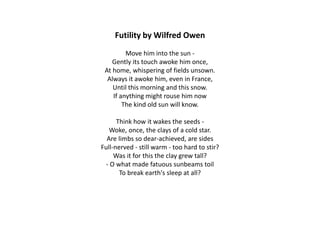
Futility by Wilfred Owen 
Move him into the sun - 
Gently its touch awoke him once, 
At home, whispering of fields unsown. 
Always it awoke him, even in France, 
Until this morning and this snow. 
If anything might rouse him now 
The kind old sun will know. 
Think how it wakes the seeds - 
Woke, once, the clays of a cold star. 
Are limbs so dear-achieved, are sides 
Full-nerved - still warm - too hard to stir? 
Was it for this the clay grew tall? 
- O what made fatuous sunbeams toil 
To break earth's sleep at all?
Wilfred Owen's poem Futility is one that he himself placed 
under the category Grief. 
Owen is considered to be one of the greatest poets of 
World War I, speaking out openly against its horrors which 
he experienced first hand in the trenches. 
Futility is a brief poem of fourteen lines divided into two 
stanzas; it is full of emotion and poignancy. 
The poem concerns the body of a soldier who is not 
named, but it appears to be someone that Owen knew 
personally.
Tracking the poem line by line 
In the opening line of the poem Owen mentions the sun, which 
is a recurring feature throughout the fourteen lines. There is a 
suggestion to move “him” – the soldier who has just died – into 
the sun in the hope that it might bring him back to life. 
The atmosphere or tone of the first stanza is quiet and peaceful; 
Owen uses words such as “Gently” and “whispering.” There is 
also assonance with a soft “ow” sound in “awoke,” “unsown,” 
“snow” and “know.”
The soldier must once have been a farmer, as Owen describes 
how the sun awoke him “whispering of fields unsown.” It awoke 
him “even in France,” in other words when he came to fight in 
the trenches. 
Line 5, however, marks a change, as the sun always woke the 
soldier up “Until this morning.” The sun cannot awaken the dead 
man, and the mention of snow suggests the coldness of death, 
contrasting with warm life-giving sunshine. 
As the first stanza comes to a close, Owen personifies the sun as 
being “kind old,” like a kindly old gentleman. The sun is the only 
entity that might bring life back to the dead soldier.
At the start of the second stanza Owen considers the sun's 
powers. He thinks about how it “wakes the seeds,” making them 
grow. He goes on to recall how it woke “the clays of a cold star,” 
in other words how it brought life to the earth. 
The alliteration here of the hard “c” sound emphasises the sense 
of coldness before life began. In lines 10 and 11 Owen uses 
enjambment to link the two lines and extend his ideas. He 
describes limbs as “so dear-achieved,” giving a sense of the 
effort that goes into raising a child and caring for them to 
adulthood. 
The soldier's body still has its nerves present and is “still warm;” 
this phrase is separated by a pair of dashes that draw attention 
to it.
Owen wonders why it is not possible to bring this man back to life. 
Line 11 is the first of three rhetorical questions in the second stanza, where 
Owen fully expresses his feelings of the futility of war. In line 12 the poet uses 
clay, echoing line 9, as a metaphor for man, questioning whether a person 
grows into an adult merely to die in war. 
In the poem's penultimate line, Owen describes the sun's rays as “fatuous,” 
in other words pointless, foolish or complacent. He wonders what the point 
was in life being created on earth at all, if so many men are killed when their 
adult life has only just begun. 
The poem ends with the third rhetorical question, creating a sense that Owen 
cannot comprehend the purpose of life on earth if it merely leads to soldiers 
dying senselessly.
Sound effects 
Wilfred Owen uses rhyme and half rhymes in a subtle way in 
Futility. In the first four lines there are half rhymes at the end of 
alternate lines, and then a full rhyme with “snow” and “know” in 
lines 5 and 7. Line 6 ends with “now,” which of course appears to 
end in the same way but does not rhyme with “snow” and 
“know.” 
There is, however, assonance in line 6 with “rouse” and “now.” In 
the second stanza, there is a half rhyme at the end of lines 8 and 
10, then a full rhyme at the end of lines 12 and 14. Lines 9 and 
11 end with “star” and “stir,” an alliterative half-rhyme. Line 13 
ends with “toil,” which creates a half rhyme with “tall” and “all.” 
Perhaps using full rhymes throughout the poem would have 
created a lighter tone, which is obviously not the effect the 
Owen desired. The use of half rhymes and alliteration is more 
subtle but creates fascinating sound patterns.
Futility is a poem charged with emotion; Owen 
had witnessed the deaths of friends of his while 
fighting in the war and his grief comes across 
powerfully here. War for Owen was senseless; for 
so many men to lose their lives, especially at a 
young age, made him question the purpose of our 
existence. The contrast between the peacefulness 
of the first stanza and the grief and anger of the 
second make this a poem that conveys its 
message with force.
Futility revision PowerPoint

Futility revision PowerPoint

  • 1.
  • 2.
    Futility by WilfredOwen Move him into the sun - Gently its touch awoke him once, At home, whispering of fields unsown. Always it awoke him, even in France, Until this morning and this snow. If anything might rouse him now The kind old sun will know. Think how it wakes the seeds - Woke, once, the clays of a cold star. Are limbs so dear-achieved, are sides Full-nerved - still warm - too hard to stir? Was it for this the clay grew tall? - O what made fatuous sunbeams toil To break earth's sleep at all?
  • 3.
    Wilfred Owen's poemFutility is one that he himself placed under the category Grief. Owen is considered to be one of the greatest poets of World War I, speaking out openly against its horrors which he experienced first hand in the trenches. Futility is a brief poem of fourteen lines divided into two stanzas; it is full of emotion and poignancy. The poem concerns the body of a soldier who is not named, but it appears to be someone that Owen knew personally.
  • 6.
    Tracking the poemline by line In the opening line of the poem Owen mentions the sun, which is a recurring feature throughout the fourteen lines. There is a suggestion to move “him” – the soldier who has just died – into the sun in the hope that it might bring him back to life. The atmosphere or tone of the first stanza is quiet and peaceful; Owen uses words such as “Gently” and “whispering.” There is also assonance with a soft “ow” sound in “awoke,” “unsown,” “snow” and “know.”
  • 7.
    The soldier mustonce have been a farmer, as Owen describes how the sun awoke him “whispering of fields unsown.” It awoke him “even in France,” in other words when he came to fight in the trenches. Line 5, however, marks a change, as the sun always woke the soldier up “Until this morning.” The sun cannot awaken the dead man, and the mention of snow suggests the coldness of death, contrasting with warm life-giving sunshine. As the first stanza comes to a close, Owen personifies the sun as being “kind old,” like a kindly old gentleman. The sun is the only entity that might bring life back to the dead soldier.
  • 8.
    At the startof the second stanza Owen considers the sun's powers. He thinks about how it “wakes the seeds,” making them grow. He goes on to recall how it woke “the clays of a cold star,” in other words how it brought life to the earth. The alliteration here of the hard “c” sound emphasises the sense of coldness before life began. In lines 10 and 11 Owen uses enjambment to link the two lines and extend his ideas. He describes limbs as “so dear-achieved,” giving a sense of the effort that goes into raising a child and caring for them to adulthood. The soldier's body still has its nerves present and is “still warm;” this phrase is separated by a pair of dashes that draw attention to it.
  • 9.
    Owen wonders whyit is not possible to bring this man back to life. Line 11 is the first of three rhetorical questions in the second stanza, where Owen fully expresses his feelings of the futility of war. In line 12 the poet uses clay, echoing line 9, as a metaphor for man, questioning whether a person grows into an adult merely to die in war. In the poem's penultimate line, Owen describes the sun's rays as “fatuous,” in other words pointless, foolish or complacent. He wonders what the point was in life being created on earth at all, if so many men are killed when their adult life has only just begun. The poem ends with the third rhetorical question, creating a sense that Owen cannot comprehend the purpose of life on earth if it merely leads to soldiers dying senselessly.
  • 10.
    Sound effects WilfredOwen uses rhyme and half rhymes in a subtle way in Futility. In the first four lines there are half rhymes at the end of alternate lines, and then a full rhyme with “snow” and “know” in lines 5 and 7. Line 6 ends with “now,” which of course appears to end in the same way but does not rhyme with “snow” and “know.” There is, however, assonance in line 6 with “rouse” and “now.” In the second stanza, there is a half rhyme at the end of lines 8 and 10, then a full rhyme at the end of lines 12 and 14. Lines 9 and 11 end with “star” and “stir,” an alliterative half-rhyme. Line 13 ends with “toil,” which creates a half rhyme with “tall” and “all.” Perhaps using full rhymes throughout the poem would have created a lighter tone, which is obviously not the effect the Owen desired. The use of half rhymes and alliteration is more subtle but creates fascinating sound patterns.
  • 11.
    Futility is apoem charged with emotion; Owen had witnessed the deaths of friends of his while fighting in the war and his grief comes across powerfully here. War for Owen was senseless; for so many men to lose their lives, especially at a young age, made him question the purpose of our existence. The contrast between the peacefulness of the first stanza and the grief and anger of the second make this a poem that conveys its message with force.