Organizational StructureAnd Communication Style
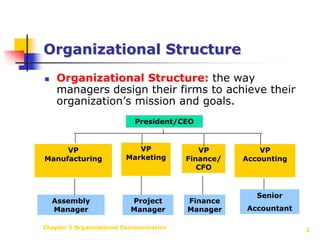
Chapter 5 Organizational Communication2Organizational StructureOrganizational Structure:the way managers design their firms to achieve their organization’s mission and goals.President/CEOVP MarketingVP ManufacturingVP Finance/ CFOVP AccountingSeniorAccountantFinance ManagerProject ManagerAssembly Manager
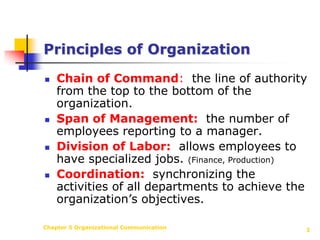
Chapter 5 Organizational Communication3Principles of OrganizationChain of Command:  the line of authority from the top to the bottom of the organization.Span of Management:  the number of employees reporting to a manager.Division of Labor:  allows employees to have specialized jobs. (Finance, Production)Coordination:  synchronizing the activities of all departments to achieve the organization’s objectives.
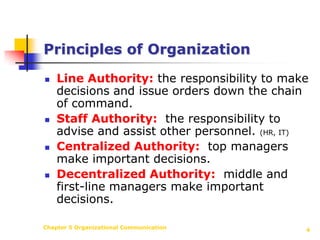
Chapter 5 Organizational Communication4Principles of OrganizationLine Authority: the responsibility to make decisions and issue orders down the chain of command.   Staff Authority:  the responsibility to advise and assist other personnel. (HR, IT)Centralized Authority:  top managers make important decisions.Decentralized Authority:  middle and first-line managers make important decisions.
Chapter 5 Organizational Communication5Types of DepartmentalizationDepartmentalization: is the grouping of related activities into unitsFunctional (Organizes input activities) Product (Organizes Products/Service)Customer (Customer Focused)Divisional Territory (Geographic/South East, NW, etc.)Matrix (Combines Functional and Product)Combination
Chapter 5 Organizational Communication6Contemporary OrganizationReengineering:redesign of work to combine fragmented tasks into streamlined processes that save time and money.Downsizing:reducing the size of the organization, often by cutting jobs, to save money.High Involvement Organizations:form of reengineering that uses a team approach to organize a new facility.Virtual Organization:comprised of independent service providers completing a specific task.Outsourcing:occurs when a firm has a different organization provide a service or a product for it.
Chapter 5 Organizational Communication7Types ofOrganizational Communication	Organizational communication: the compounded interpersonal communication process across an organization.Vertical communication: the flow of information both up and down the chain of command.Horizontal communication: the flow of information between colleagues and peers (informal communication).Grapevine: the informal vehicle through which messages flow throughout the organization.
Chapter 5 Organizational Communication8Communication NetworksCommunication networks: sets of employees who have stable contact through which information is generated and transmitted.Networks may be formed between departments, depending on the need to exchange information.Within departments, smaller networks may also form, taking on a variety of structures.Grapevine may not follow the formal organizational structure at all.
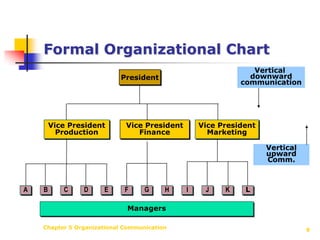
Chapter 5 Organizational Communication9Formal Organizational ChartVertical downwardcommunicationPresidentVice PresidentFinanceVice PresidentProductionVice PresidentMarketingVertical upwardComm.ABCDEFGHIJKLManagers
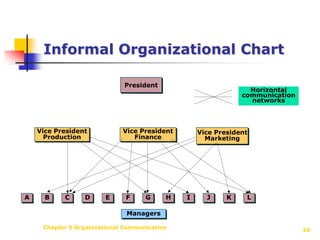
Chapter 5 Organizational Communication10Informal Organizational ChartHorizontalcommunicationnetworksPresidentVice PresidentFinanceVice PresidentProductionVice PresidentMarketingABCDEFGHIJKLManagers
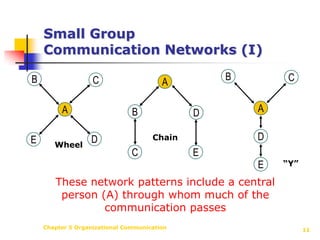
Chapter 5 Organizational Communication11Small GroupCommunication Networks (I)BCBCAAADBDDEWheelChain“Y”EECThese network patterns include a central person (A) through whom much of the communication passes
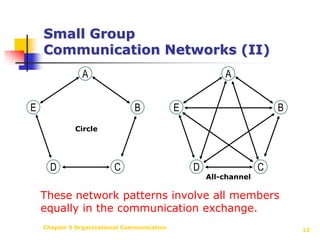
Chapter 5 Organizational Communication12Small GroupCommunication Networks (II)AABEBECircleCDCDAll-channelThese network patterns involve all members equally in the communication exchange.
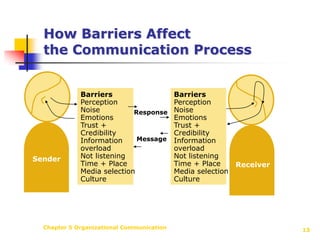
Chapter 5 Organizational Communication13How Barriers Affect the Communication ProcessBarriersPerceptionNoiseEmotionsTrust +CredibilityInformationoverloadNot listeningTime + PlaceMedia selectionCultureBarriersPerceptionNoiseEmotionsTrust +CredibilityInformationoverloadNot listeningTime + PlaceMedia selectionCultureResponseMessageSenderReceiver
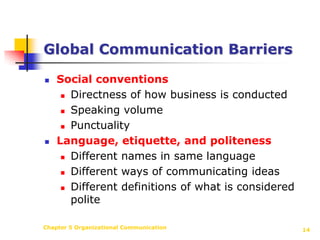
Chapter 5 Organizational Communication14Global Communication BarriersSocial conventionsDirectness of how business is conductedSpeaking volumePunctualityLanguage, etiquette, and politenessDifferent names in same languageDifferent ways of communicating ideasDifferent definitions of what is considered polite
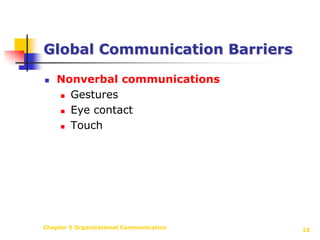
Chapter 5 Organizational Communication15Global Communication BarriersNonverbal communicationsGesturesEye contactTouch
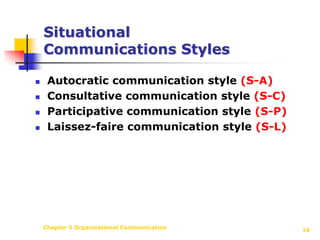
Chapter 5 Organizational Communication16SituationalCommunications StylesAutocratic communication style (S-A)Consultative communication style (S-C)Participative communication style (S-P)Laissez-faire communication style (S-L)
Chapter 5 Organizational Communication17Autocratic Communications Styles (S-A)High task-low relationship behavior (HT-LR)Initiation/Response: You initiate and control the communication with minimal, if any, responsePresentation/Elicitation: You make a presentation, expecting from other parties to comply, with little, if any, elicitation.Closed/Opened: You use a closed presentation, you will not consider the receiver’s input.
Chapter 5 Organizational Communication18Consultative Communication Style (S-C)High task-high relationship behavior (HT-HR)Initiation/Response: You initiate the communication, want other parties to buy into your influence.Presentation/Elicitation: You use elicitation to determine the goal of the communication, elicitation is low, goal is determined, relationship communication is elicited from other parties.Closed/Opened: You are closed to task acceptance, but open to person’s feelings (relationship)
Chapter 5 Organizational Communication19Participative Communications Styles (S-P)Low task-high relationship behavior (LT-HR)Initiation/Response: You respond with some initiation, helpful, convey personal support.Presentation/Elicitation: You elicit the other party’s ideas on how to reach objectives.Closed/Opened: If you participate well, the other party will come to a solution you can accept.  If not, you may have to reject.
Chapter 5 Organizational Communication20Laissez-faire Communications Styles (S-L)Low task-low relationship behavior (LT-LR)Initiation/Response: You respond to others with little if any initiation.Presentation/Elicitation: You present the other party with information, structure, etc. that other parties want.Closed/Opened: You convey that the other party is in charge, you will accept the message.
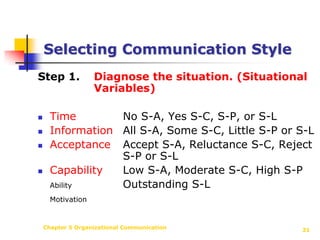
Chapter 5 Organizational Communication21Selecting Communication StyleStep 1.Diagnose the situation. (Situational 	Variables)Time			No S-A, Yes S-C, S-P, or S-LInformation	All S-A, Some S-C, Little S-P or S-LAcceptance	Accept S-A, Reluctance S-C, Reject 			S-P or S-LCapability	Low S-A, Moderate S-C, High S-PAbility			Outstanding S-LMotivation
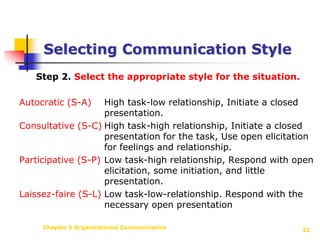
Chapter 5 Organizational Communication22Selecting Communication StyleStep 2. Select the appropriate style for the situation.Autocratic (S-A)	High task-low relationship, Initiate a closed 				presentation.Consultative (S-C)	High task-high relationship, Initiate a closed 			presentation for the task, Use open elicitation 			for feelings and relationship.Participative (S-P)	Low task-high relationship, Respond with open 			elicitation, some initiation, and little 					presentation.Laissez-faire (S-L)	Low task-low-relationship. Respond with the 			necessary open presentation
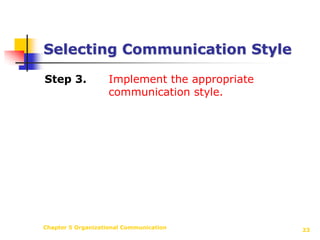
Chapter 5 Organizational Communication23Selecting Communication StyleStep 3.Implement the appropriate 				communication style.
Organizational CommunicationChapter – 5Questions, Comments???

Comunication structure and style

  • 1.
  • 2.
    Chapter 5 OrganizationalCommunication2Organizational StructureOrganizational Structure:the way managers design their firms to achieve their organization’s mission and goals.President/CEOVP MarketingVP ManufacturingVP Finance/ CFOVP AccountingSeniorAccountantFinance ManagerProject ManagerAssembly Manager
  • 3.
    Chapter 5 OrganizationalCommunication3Principles of OrganizationChain of Command: the line of authority from the top to the bottom of the organization.Span of Management: the number of employees reporting to a manager.Division of Labor: allows employees to have specialized jobs. (Finance, Production)Coordination: synchronizing the activities of all departments to achieve the organization’s objectives.
  • 4.
    Chapter 5 OrganizationalCommunication4Principles of OrganizationLine Authority: the responsibility to make decisions and issue orders down the chain of command. Staff Authority: the responsibility to advise and assist other personnel. (HR, IT)Centralized Authority: top managers make important decisions.Decentralized Authority: middle and first-line managers make important decisions.
  • 5.
    Chapter 5 OrganizationalCommunication5Types of DepartmentalizationDepartmentalization: is the grouping of related activities into unitsFunctional (Organizes input activities) Product (Organizes Products/Service)Customer (Customer Focused)Divisional Territory (Geographic/South East, NW, etc.)Matrix (Combines Functional and Product)Combination
  • 6.
    Chapter 5 OrganizationalCommunication6Contemporary OrganizationReengineering:redesign of work to combine fragmented tasks into streamlined processes that save time and money.Downsizing:reducing the size of the organization, often by cutting jobs, to save money.High Involvement Organizations:form of reengineering that uses a team approach to organize a new facility.Virtual Organization:comprised of independent service providers completing a specific task.Outsourcing:occurs when a firm has a different organization provide a service or a product for it.
  • 7.
    Chapter 5 OrganizationalCommunication7Types ofOrganizational Communication Organizational communication: the compounded interpersonal communication process across an organization.Vertical communication: the flow of information both up and down the chain of command.Horizontal communication: the flow of information between colleagues and peers (informal communication).Grapevine: the informal vehicle through which messages flow throughout the organization.
  • 8.
    Chapter 5 OrganizationalCommunication8Communication NetworksCommunication networks: sets of employees who have stable contact through which information is generated and transmitted.Networks may be formed between departments, depending on the need to exchange information.Within departments, smaller networks may also form, taking on a variety of structures.Grapevine may not follow the formal organizational structure at all.
  • 9.
    Chapter 5 OrganizationalCommunication9Formal Organizational ChartVertical downwardcommunicationPresidentVice PresidentFinanceVice PresidentProductionVice PresidentMarketingVertical upwardComm.ABCDEFGHIJKLManagers
  • 10.
    Chapter 5 OrganizationalCommunication10Informal Organizational ChartHorizontalcommunicationnetworksPresidentVice PresidentFinanceVice PresidentProductionVice PresidentMarketingABCDEFGHIJKLManagers
  • 11.
    Chapter 5 OrganizationalCommunication11Small GroupCommunication Networks (I)BCBCAAADBDDEWheelChain“Y”EECThese network patterns include a central person (A) through whom much of the communication passes
  • 12.
    Chapter 5 OrganizationalCommunication12Small GroupCommunication Networks (II)AABEBECircleCDCDAll-channelThese network patterns involve all members equally in the communication exchange.
  • 13.
    Chapter 5 OrganizationalCommunication13How Barriers Affect the Communication ProcessBarriersPerceptionNoiseEmotionsTrust +CredibilityInformationoverloadNot listeningTime + PlaceMedia selectionCultureBarriersPerceptionNoiseEmotionsTrust +CredibilityInformationoverloadNot listeningTime + PlaceMedia selectionCultureResponseMessageSenderReceiver
  • 14.
    Chapter 5 OrganizationalCommunication14Global Communication BarriersSocial conventionsDirectness of how business is conductedSpeaking volumePunctualityLanguage, etiquette, and politenessDifferent names in same languageDifferent ways of communicating ideasDifferent definitions of what is considered polite
  • 15.
    Chapter 5 OrganizationalCommunication15Global Communication BarriersNonverbal communicationsGesturesEye contactTouch
  • 16.
    Chapter 5 OrganizationalCommunication16SituationalCommunications StylesAutocratic communication style (S-A)Consultative communication style (S-C)Participative communication style (S-P)Laissez-faire communication style (S-L)
  • 17.
    Chapter 5 OrganizationalCommunication17Autocratic Communications Styles (S-A)High task-low relationship behavior (HT-LR)Initiation/Response: You initiate and control the communication with minimal, if any, responsePresentation/Elicitation: You make a presentation, expecting from other parties to comply, with little, if any, elicitation.Closed/Opened: You use a closed presentation, you will not consider the receiver’s input.
  • 18.
    Chapter 5 OrganizationalCommunication18Consultative Communication Style (S-C)High task-high relationship behavior (HT-HR)Initiation/Response: You initiate the communication, want other parties to buy into your influence.Presentation/Elicitation: You use elicitation to determine the goal of the communication, elicitation is low, goal is determined, relationship communication is elicited from other parties.Closed/Opened: You are closed to task acceptance, but open to person’s feelings (relationship)
  • 19.
    Chapter 5 OrganizationalCommunication19Participative Communications Styles (S-P)Low task-high relationship behavior (LT-HR)Initiation/Response: You respond with some initiation, helpful, convey personal support.Presentation/Elicitation: You elicit the other party’s ideas on how to reach objectives.Closed/Opened: If you participate well, the other party will come to a solution you can accept. If not, you may have to reject.
  • 20.
    Chapter 5 OrganizationalCommunication20Laissez-faire Communications Styles (S-L)Low task-low relationship behavior (LT-LR)Initiation/Response: You respond to others with little if any initiation.Presentation/Elicitation: You present the other party with information, structure, etc. that other parties want.Closed/Opened: You convey that the other party is in charge, you will accept the message.
  • 21.
    Chapter 5 OrganizationalCommunication21Selecting Communication StyleStep 1.Diagnose the situation. (Situational Variables)Time No S-A, Yes S-C, S-P, or S-LInformation All S-A, Some S-C, Little S-P or S-LAcceptance Accept S-A, Reluctance S-C, Reject S-P or S-LCapability Low S-A, Moderate S-C, High S-PAbility Outstanding S-LMotivation
  • 22.
    Chapter 5 OrganizationalCommunication22Selecting Communication StyleStep 2. Select the appropriate style for the situation.Autocratic (S-A) High task-low relationship, Initiate a closed presentation.Consultative (S-C) High task-high relationship, Initiate a closed presentation for the task, Use open elicitation for feelings and relationship.Participative (S-P) Low task-high relationship, Respond with open elicitation, some initiation, and little presentation.Laissez-faire (S-L) Low task-low-relationship. Respond with the necessary open presentation
  • 23.
    Chapter 5 OrganizationalCommunication23Selecting Communication StyleStep 3.Implement the appropriate communication style.
  • 24.