Tollefson 1
Week 12
TO DO THIS WEEK-
GATHER SOURCES- As per the assignment sheet, you will have a minimum of seven
or a maximum of ten total sources for this assignment. Three of these sources need
to be multimedia. (This includes graphs, graphics, pictures, charts, etc.) When these
sources are gathered, list them alphabetically, following MLA-8 works cited
guidelines.
DUE- Sunday, April 5th, at 11:59
WHAT IS A BIBLIOGRAPHY?
A bibliography is a list of the books referred to in a scholarly work, typically printed as an
appendix.
Academic papers and other forms of essays use a bibliography, or works cited page, for the
reader to have access to the sources the author used.
Why would this be important? For author credibility, correct intellectual property
deference and value, and a direction for further research if a reader so wishes.
~Credibility
An author in any setting is held as more credible if they use other credible sources
to base their arguments or ideas on. Say for instance you read this article on
Buzzfeed about Coronavirus mutating at a fast rate and infecting rats. I would find
this concerning, and I would check the articles sources. If there were none, I would
completely disregard the article. If the sources were sketchy at best, I would look to
see who else is writing about this subject. If the sources were highly credible like the
CDC and WHO, I would start to believe them.
~Intellectual Property
Say someone writes this dissertation about how the physical world is actually a
form of the real thing. And, they say it’s like we’re in a cave and we can only see the
shadows of reality, like flames reflected in the dark. For you savvy readers you
recognize these thoughts as a sad display of Platonic reasoning. But the author’s not
cited Plato at all in the essay. This isn’t ok! You think. How dare this author claim
these thoughts are their own when this classic philosophy, and how dare they posit
Tollefson 2
other ideas based on this reasoning so as it looks like their own philosophy! In text
citation is used not only with quotations, but with intellectual ideas as well as to not
make it look like you’re the one who came up with these concepts.
~Further Research
So then let’s say this dissertation gets edited and corrected and you find that this
author uses Platonic philosophy to create an argument which supports
extermination as the method for dealing with unwanted citizens like the differently-
abled, prisoners, and orphans. You think to yourself; this needs more research. Or,
perhaps, you think how the hell did they reach that conclusion? So, you check their
source list. You can tell by looking up their selection of philosophers and writers
that this author relies on known un-credible sources. “Looking up” can mean just
googling the author and the book, or actually reading the book.
Helpful Tip- Use the keywords list and the topic sentence you created during Library week
to help you find your sources. Because you need multimedia sources, remember to look at
video sources, podcasts, blogs, interviews, videogames, Instagram vids, tiktoks etc.
WHAT ARE CITATIONS?
Citations are the individual source information, listed in a specific way. Citations generally
have author name, title of piece, publisher information and date published.
In Part 4, Chapter 12b-2 of Becoming Rhetorical, you can find helpful information about
checking citations or creating your own citations.
Below (on the next page) is a correct MLA-8 works cited page, with correct citations. Notice
that the first line of each citation is not indented, but the remaining lines are. Some
citations, like book citations, are much shorter than online publications.
Copy and paste this link for additional help and examples-
https://owl.purdue.edu/owl/research_and_citation/mla_style/mla_formatting_and_style_guide/mla_fo
rmatting_and_style_guide.html
Tollefson 3
(Your Bibliography should look exactly like this, including page number and name)
Works Cited
Anderson, Ben. “Affective Atmospheres.” Emotion, Space and Society 2.2 (2009): 77-81.
Deleuze, Gilles & Felix Guattari. “Introduction: Rhizome,” A Thousand Plateaus. Minneapolis:
University of Minnesota Press, tr. Brian Massumi, 1987.
Dibley, Ben, & Michelle Kelly. "Morale and Mass Observation: Governing the Affective
Atmosphere on the Home-Front." Museum and Society [Online], 13.1 (2015): 22-41.
Web. 1 Apr. 2019
Gellner, Ernest. “Nationalism Reconsidered and E.H. Carr.” Review of International Studies,
Cambridge University Press, Vol. 18, No. 4 (Oct., 1992), pp. 285-293
https://www.jstor.org/stable/pdf/20097307.pdf?refreqid=excelsior%3A80934dd5
5ffc1fd349a3d0ede429eb79.
Habib, Khalil M., and Lee Trepanier, editors. “Ibn Tufayl’s Critique of Cosmopolitanism in
Hayy Ibn Yaqzan.” Cosmopolitanism in the Age of Globalization: Citizens without
States, University Press of Kentucky, 2011, pp. 97–116. JSTOR,
www.jstor.org/stable/j.ctt2jcjp2.7.
Main, Thomas J. The Rise of the Alt-Right. Brooking Institution Press, 2018.
Ngai, Sianne. Ugly Feelings, Harvard University Press, 2009. ProQuest Ebook Central,
https://ida.lib.uidaho.edu:2127/lib/uidaho/detail.action?docID=3300232.
Nussbaum, Martha C. Joshua Cohen, ed. For Love of Country? Beacon Press, 2002.
Tangney, June Price and Kurt W. Fischer, eds. Self-Conscious Emotions; The Psychology of
Shame, Guilt, Embarrassment, and Pride. The Guildford Press, 1995.
Viroli, Maurizio. For Love of Country: An Essay On Patriotism and Nationalism. Oxford
University Press, November 01, 2003. Oxford Scholarship Online. Date Accessed 30
Mar. 2019.
Images
“Bamboo Running Species.” Bamboo Australia. Bambooaustralia.com.au. Online access
04/23/2019. https://www.bambooaustralia.com.au/bamboo-running-species/.

Week 12 102

  • 1.
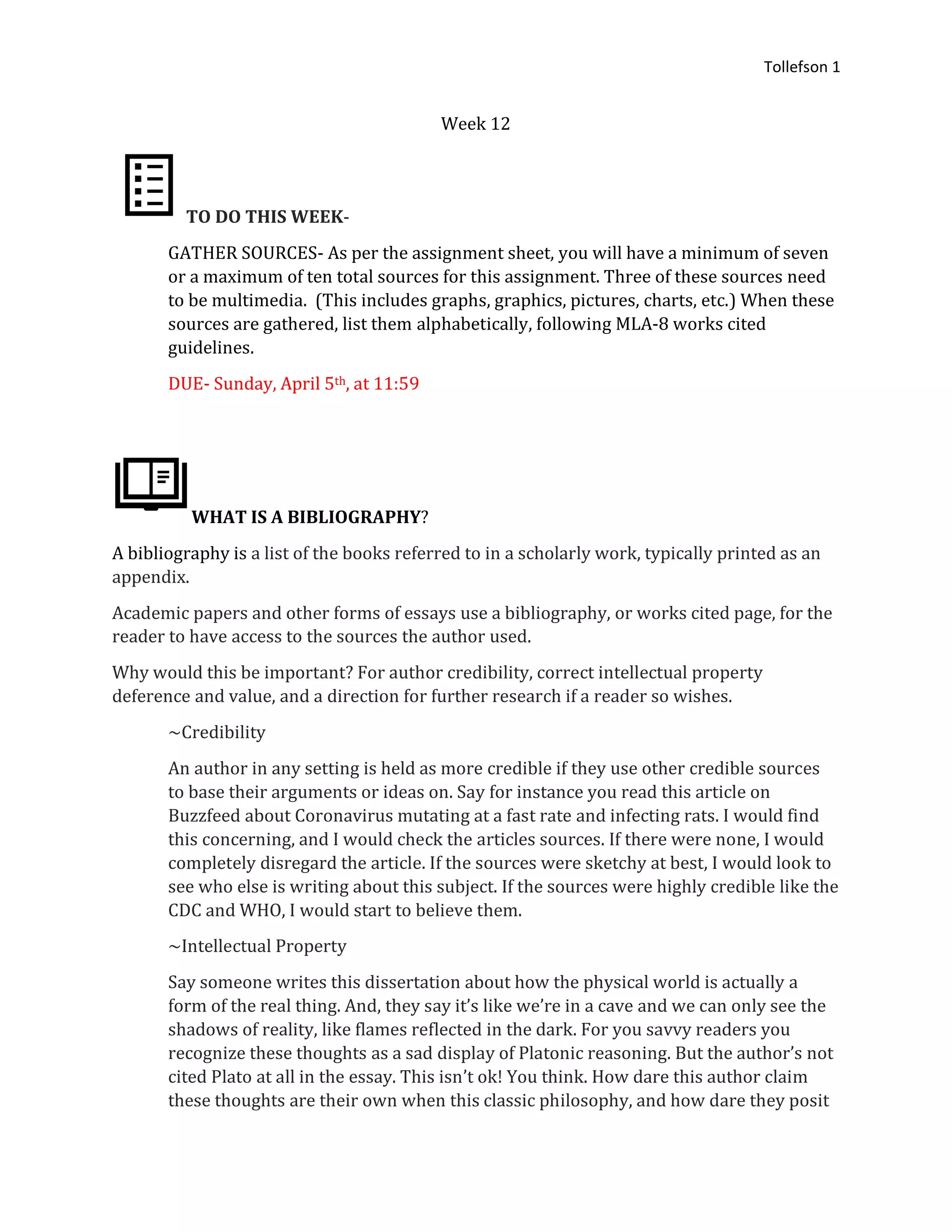
    Tollefson 1 Week 12 TODO THIS WEEK- GATHER SOURCES- As per the assignment sheet, you will have a minimum of seven or a maximum of ten total sources for this assignment. Three of these sources need to be multimedia. (This includes graphs, graphics, pictures, charts, etc.) When these sources are gathered, list them alphabetically, following MLA-8 works cited guidelines. DUE- Sunday, April 5th, at 11:59 WHAT IS A BIBLIOGRAPHY? A bibliography is a list of the books referred to in a scholarly work, typically printed as an appendix. Academic papers and other forms of essays use a bibliography, or works cited page, for the reader to have access to the sources the author used. Why would this be important? For author credibility, correct intellectual property deference and value, and a direction for further research if a reader so wishes. ~Credibility An author in any setting is held as more credible if they use other credible sources to base their arguments or ideas on. Say for instance you read this article on Buzzfeed about Coronavirus mutating at a fast rate and infecting rats. I would find this concerning, and I would check the articles sources. If there were none, I would completely disregard the article. If the sources were sketchy at best, I would look to see who else is writing about this subject. If the sources were highly credible like the CDC and WHO, I would start to believe them. ~Intellectual Property Say someone writes this dissertation about how the physical world is actually a form of the real thing. And, they say it’s like we’re in a cave and we can only see the shadows of reality, like flames reflected in the dark. For you savvy readers you recognize these thoughts as a sad display of Platonic reasoning. But the author’s not cited Plato at all in the essay. This isn’t ok! You think. How dare this author claim these thoughts are their own when this classic philosophy, and how dare they posit
  • 2.
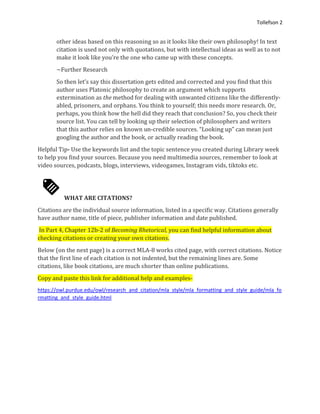
    Tollefson 2 other ideasbased on this reasoning so as it looks like their own philosophy! In text citation is used not only with quotations, but with intellectual ideas as well as to not make it look like you’re the one who came up with these concepts. ~Further Research So then let’s say this dissertation gets edited and corrected and you find that this author uses Platonic philosophy to create an argument which supports extermination as the method for dealing with unwanted citizens like the differently- abled, prisoners, and orphans. You think to yourself; this needs more research. Or, perhaps, you think how the hell did they reach that conclusion? So, you check their source list. You can tell by looking up their selection of philosophers and writers that this author relies on known un-credible sources. “Looking up” can mean just googling the author and the book, or actually reading the book. Helpful Tip- Use the keywords list and the topic sentence you created during Library week to help you find your sources. Because you need multimedia sources, remember to look at video sources, podcasts, blogs, interviews, videogames, Instagram vids, tiktoks etc. WHAT ARE CITATIONS? Citations are the individual source information, listed in a specific way. Citations generally have author name, title of piece, publisher information and date published. In Part 4, Chapter 12b-2 of Becoming Rhetorical, you can find helpful information about checking citations or creating your own citations. Below (on the next page) is a correct MLA-8 works cited page, with correct citations. Notice that the first line of each citation is not indented, but the remaining lines are. Some citations, like book citations, are much shorter than online publications. Copy and paste this link for additional help and examples- https://owl.purdue.edu/owl/research_and_citation/mla_style/mla_formatting_and_style_guide/mla_fo rmatting_and_style_guide.html
  • 3.
    Tollefson 3 (Your Bibliographyshould look exactly like this, including page number and name) Works Cited Anderson, Ben. “Affective Atmospheres.” Emotion, Space and Society 2.2 (2009): 77-81. Deleuze, Gilles & Felix Guattari. “Introduction: Rhizome,” A Thousand Plateaus. Minneapolis: University of Minnesota Press, tr. Brian Massumi, 1987. Dibley, Ben, & Michelle Kelly. "Morale and Mass Observation: Governing the Affective Atmosphere on the Home-Front." Museum and Society [Online], 13.1 (2015): 22-41. Web. 1 Apr. 2019 Gellner, Ernest. “Nationalism Reconsidered and E.H. Carr.” Review of International Studies, Cambridge University Press, Vol. 18, No. 4 (Oct., 1992), pp. 285-293 https://www.jstor.org/stable/pdf/20097307.pdf?refreqid=excelsior%3A80934dd5 5ffc1fd349a3d0ede429eb79. Habib, Khalil M., and Lee Trepanier, editors. “Ibn Tufayl’s Critique of Cosmopolitanism in Hayy Ibn Yaqzan.” Cosmopolitanism in the Age of Globalization: Citizens without States, University Press of Kentucky, 2011, pp. 97–116. JSTOR, www.jstor.org/stable/j.ctt2jcjp2.7. Main, Thomas J. The Rise of the Alt-Right. Brooking Institution Press, 2018. Ngai, Sianne. Ugly Feelings, Harvard University Press, 2009. ProQuest Ebook Central, https://ida.lib.uidaho.edu:2127/lib/uidaho/detail.action?docID=3300232. Nussbaum, Martha C. Joshua Cohen, ed. For Love of Country? Beacon Press, 2002. Tangney, June Price and Kurt W. Fischer, eds. Self-Conscious Emotions; The Psychology of Shame, Guilt, Embarrassment, and Pride. The Guildford Press, 1995. Viroli, Maurizio. For Love of Country: An Essay On Patriotism and Nationalism. Oxford University Press, November 01, 2003. Oxford Scholarship Online. Date Accessed 30 Mar. 2019. Images “Bamboo Running Species.” Bamboo Australia. Bambooaustralia.com.au. Online access 04/23/2019. https://www.bambooaustralia.com.au/bamboo-running-species/.