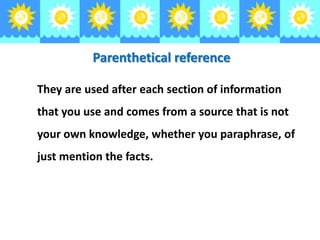
Parenthetical reference
They are used after each section of information

that you use and comes from a source that is not
your own knowledge, whether you paraphrase, of
just mention the facts.
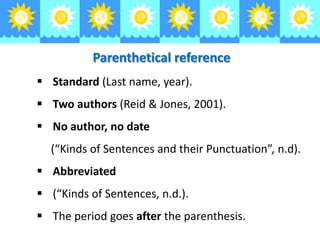
Parenthetical reference
 Standard (Last name, year).
 Two authors (Reid & Jones, 2001).
 No author, no date

(“Kinds of Sentences and their Punctuation”, n.d).
 Abbreviated
 (“Kinds of Sentences, n.d.).
 The period goes after the parenthesis.
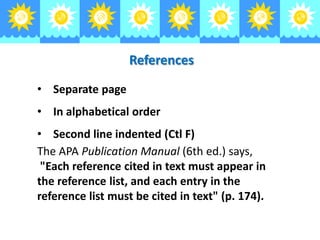
References
• Separate page

• In alphabetical order
• Second line indented (Ctl F)
The APA Publication Manual (6th ed.) says,
"Each reference cited in text must appear in
the reference list, and each entry in the
reference list must be cited in text" (p. 174).
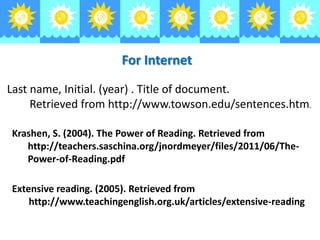
For Internet
Last name, Initial. (year) . Title of document.
Retrieved from http://www.towson.edu/sentences.htm.
Krashen, S. (2004). The Power of Reading. Retrieved from
http://teachers.saschina.org/jnordmeyer/files/2011/06/ThePower-of-Reading.pdf
Extensive reading. (2005). Retrieved from
http://www.teachingenglish.org.uk/articles/extensive-reading
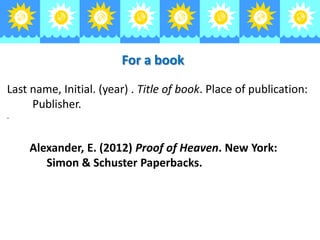
For a book
Last name, Initial. (year) . Title of book. Place of publication:
Publisher.
.

Alexander, E. (2012) Proof of Heaven. New York:
Simon & Schuster Paperbacks.
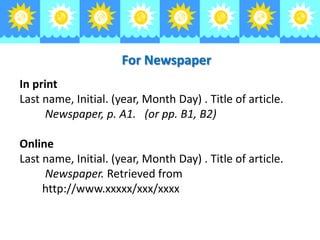
For Newspaper
In print
Last name, Initial. (year, Month Day) . Title of article.
Newspaper, p. A1. (or pp. B1, B2)
Online
Last name, Initial. (year, Month Day) . Title of article.
Newspaper. Retrieved from
http://www.xxxxx/xxx/xxxx
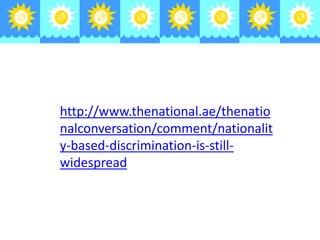
http://www.thenational.ae/thenatio
nalconversation/comment/nationalit
y-based-discrimination-is-stillwidespread
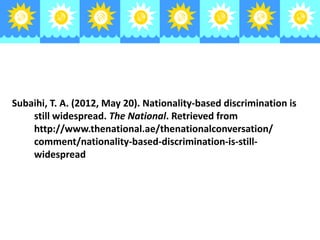
Subaihi, T. A. (2012, May 20). Nationality-based discrimination is
still widespread. The National. Retrieved from
http://www.thenational.ae/thenationalconversation/
comment/nationality-based-discrimination-is-stillwidespread
Direct Quotations
1. Do not fill your paper with direct quotations!!!
2. Use them only when they are important for
credibility.
3. Remember that they need an introduction.
4. Include the page number if you have it.
For direct quotations, use apostrophes and include the page
number:
-According to Palladino and Wade (2010), “a flexible mind is a
healthy mind” (p. 147).
-In 2010, Palladino and Wade noted that “a flexible mind is a
healthy mind” (p. 147).
-In fact, “a flexible mind is a healthy mind” (Palladino & Wade,
2010, p. 147).
-“A flexible mind is a healthy mind,” according to Palladino and
Wade’s (2010, p. 147)
-Palladino and Wade’s (2010) results indicate that “a flexible
mind is a healthy mind” (p. 147).
When a direct quotation is more than three line, it is
indented and no apostrophes are used. In this case, the
period goes first, then the parenthetical reference.
These competencies can be summarized as follows:

The ability to communicate warmly and effectively, empathy and
respect for youth, accurate knowledge of the factual material, ability
to relate to students in a trusted an open way, ability to treat
appropriate material confidentiality, skill in creating a supportive
classroom environment and an understanding of individual
strengths and limitations. (Yarber & McCabe, 1981, p. 288)

Apa Summary

  • 1.
    Parenthetical reference They areused after each section of information that you use and comes from a source that is not your own knowledge, whether you paraphrase, of just mention the facts.
  • 2.
    Parenthetical reference  Standard(Last name, year).  Two authors (Reid & Jones, 2001).  No author, no date (“Kinds of Sentences and their Punctuation”, n.d).  Abbreviated  (“Kinds of Sentences, n.d.).  The period goes after the parenthesis.
  • 3.
    References • Separate page •In alphabetical order • Second line indented (Ctl F) The APA Publication Manual (6th ed.) says, "Each reference cited in text must appear in the reference list, and each entry in the reference list must be cited in text" (p. 174).
  • 4.
    For Internet Last name,Initial. (year) . Title of document. Retrieved from http://www.towson.edu/sentences.htm. Krashen, S. (2004). The Power of Reading. Retrieved from http://teachers.saschina.org/jnordmeyer/files/2011/06/ThePower-of-Reading.pdf Extensive reading. (2005). Retrieved from http://www.teachingenglish.org.uk/articles/extensive-reading
  • 5.
    For a book Lastname, Initial. (year) . Title of book. Place of publication: Publisher. . Alexander, E. (2012) Proof of Heaven. New York: Simon & Schuster Paperbacks.
  • 6.
    For Newspaper In print Lastname, Initial. (year, Month Day) . Title of article. Newspaper, p. A1. (or pp. B1, B2) Online Last name, Initial. (year, Month Day) . Title of article. Newspaper. Retrieved from http://www.xxxxx/xxx/xxxx
  • 7.
  • 8.
    Subaihi, T. A.(2012, May 20). Nationality-based discrimination is still widespread. The National. Retrieved from http://www.thenational.ae/thenationalconversation/ comment/nationality-based-discrimination-is-stillwidespread
  • 9.
    Direct Quotations 1. Donot fill your paper with direct quotations!!! 2. Use them only when they are important for credibility. 3. Remember that they need an introduction. 4. Include the page number if you have it.
  • 10.
    For direct quotations,use apostrophes and include the page number: -According to Palladino and Wade (2010), “a flexible mind is a healthy mind” (p. 147). -In 2010, Palladino and Wade noted that “a flexible mind is a healthy mind” (p. 147). -In fact, “a flexible mind is a healthy mind” (Palladino & Wade, 2010, p. 147). -“A flexible mind is a healthy mind,” according to Palladino and Wade’s (2010, p. 147) -Palladino and Wade’s (2010) results indicate that “a flexible mind is a healthy mind” (p. 147).
  • 11.
    When a directquotation is more than three line, it is indented and no apostrophes are used. In this case, the period goes first, then the parenthetical reference. These competencies can be summarized as follows: The ability to communicate warmly and effectively, empathy and respect for youth, accurate knowledge of the factual material, ability to relate to students in a trusted an open way, ability to treat appropriate material confidentiality, skill in creating a supportive classroom environment and an understanding of individual strengths and limitations. (Yarber & McCabe, 1981, p. 288)