MINIMUM ATTRACTIVE RATE OF RETURN
MUHAMMAD IRFAN
Assistant Professor, Sarhad University, Peshawar.
MINIMUM ATTRACTIVE RATE OF RETURN (MARR)
 The MARR is a minimum return the company
will accept on the money it invests.
 The MARR is usually calculated by financial
analysts in the company and provided to those
who evaluate projects.
 It is the same as the interest rate used for
Present Worth and Annual Worth analysis.
 MARR is also called the cost of capital.
MINIMUM ATTRACTIVE RATE OF RETURN (MARR)
EXAMPLE
If 1/3 of the capital of a firm is borrowed at 6%
and the remainder of its capital is equity
earning 12%, then the assumed minimum
rate of return is
1/3*6%+2/3*12%=10%
MARR AND CAPITAL BUDGETING
 MARR determination is a task of capital
budgeting.
 Capital budgeting is a critical function that
takes place at the highest level of management.
 Capital budgeting .
 The series of decisions by individual economic units
as to how much and where resources will be
obtained and expended for future use, particularly in
the production of future goods and services.
THE SCOPE OF CAPITAL BUDGETING
 How the money is acquired and from what sources.
 How individual capital project opportunities (and
combination of opportunities) are identified and
evaluated.
 How minimum requirements of acceptability are set.
 How final project selections are made.
 How post-mortem reviews are conducted.
COST OF CAPITAL
 The cost of capital represents the overall
cost of financing to the firm
 The cost of capital is normally the relevant
discount rate to use in analyzing an
investment
 The overall cost of capital is a weighted average of
the various sources, including debt, preferred stock,
and common equity:
WACC = Weighted Average Cost of Capital
WACC = After-tax costs x weight
MARR CALCULATION
 If using borrowed funds, then the MARR should be based
on the rate of cost of those borrowed funds alone.
 If a firm tends to adjust its capitalization structure to the
point at which the real costs of new debt and new equity
capital are equal then the MAAR should be based on the
cost of equity funds alone.
 Another way to determine the MAAR is to consider it as an
opportunity cost in the “capital rationing” perspective.
Capital rationing describes what is necessary when there is
a limitation of funds relative to prospective proposals to use
the funds.
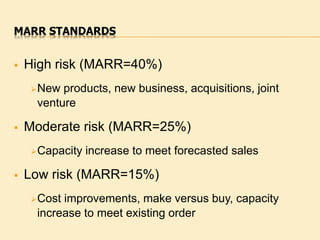
MARR STANDARDS
 High risk (MARR=40%)
New products, new business, acquisitions, joint
venture
 Moderate risk (MARR=25%)
Capacity increase to meet forecasted sales
 Low risk (MARR=15%)
Cost improvements, make versus buy, capacity
increase to meet existing order
Thank You…

(Week 10)

  • 2.
    MINIMUM ATTRACTIVE RATEOF RETURN MUHAMMAD IRFAN Assistant Professor, Sarhad University, Peshawar.
  • 3.
    MINIMUM ATTRACTIVE RATEOF RETURN (MARR)  The MARR is a minimum return the company will accept on the money it invests.  The MARR is usually calculated by financial analysts in the company and provided to those who evaluate projects.  It is the same as the interest rate used for Present Worth and Annual Worth analysis.  MARR is also called the cost of capital.
  • 4.
    MINIMUM ATTRACTIVE RATEOF RETURN (MARR)
  • 5.
    EXAMPLE If 1/3 ofthe capital of a firm is borrowed at 6% and the remainder of its capital is equity earning 12%, then the assumed minimum rate of return is 1/3*6%+2/3*12%=10%
  • 6.
    MARR AND CAPITALBUDGETING  MARR determination is a task of capital budgeting.  Capital budgeting is a critical function that takes place at the highest level of management.  Capital budgeting .  The series of decisions by individual economic units as to how much and where resources will be obtained and expended for future use, particularly in the production of future goods and services.
  • 7.
    THE SCOPE OFCAPITAL BUDGETING  How the money is acquired and from what sources.  How individual capital project opportunities (and combination of opportunities) are identified and evaluated.  How minimum requirements of acceptability are set.  How final project selections are made.  How post-mortem reviews are conducted.
  • 8.
    COST OF CAPITAL The cost of capital represents the overall cost of financing to the firm  The cost of capital is normally the relevant discount rate to use in analyzing an investment  The overall cost of capital is a weighted average of the various sources, including debt, preferred stock, and common equity: WACC = Weighted Average Cost of Capital WACC = After-tax costs x weight
  • 9.
    MARR CALCULATION  Ifusing borrowed funds, then the MARR should be based on the rate of cost of those borrowed funds alone.  If a firm tends to adjust its capitalization structure to the point at which the real costs of new debt and new equity capital are equal then the MAAR should be based on the cost of equity funds alone.  Another way to determine the MAAR is to consider it as an opportunity cost in the “capital rationing” perspective. Capital rationing describes what is necessary when there is a limitation of funds relative to prospective proposals to use the funds.
  • 10.
    MARR STANDARDS  Highrisk (MARR=40%) New products, new business, acquisitions, joint venture  Moderate risk (MARR=25%) Capacity increase to meet forecasted sales  Low risk (MARR=15%) Cost improvements, make versus buy, capacity increase to meet existing order
  • 11.