BUSINESS MODEL CANVAS
AGENDA
 Meaning
 Structure
 Example
 Advantages
 Disadvantages
 Conclusion
BUSINESS MODEL CANVAS
 Business Model Canvas is a strategic management tool
 It establishes and communicates a business idea or concept
 It is a mission statement for one’s product roadmap
 It provides entrepreneurs with a tool to:
 Analyze
 Structure, and
 Evolve a business
 While always keeping the bigger picture front of mind
 It was created by Swiss entrepreneur “Alexander Osterwalder”
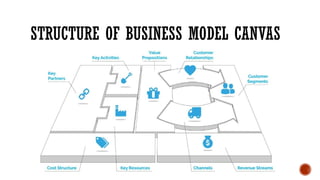
STRUCTURE OF BUSINESS MODEL CANVAS
BUSINESS MODEL CANVAS – 9 BLOCKS
Customer Segment
Value Proposition
Distribution Channels
Customer Relationship
Revenue Streams
Key Resources
Key Activities
Key Partners
Cost Structure
CUSTOMER SEGMENT
 Daily operations highly depend on customers and their behavioral
patterns
 That’s why customer segmentation is a must when creating a business
model
 In this block, one needs to describe the buyer persona:
 Demographics
 Professional status
 Motivation and goals
 Shopping preferences
VALUE PROPOSITION
 It is a brief description of ones product and its ultimate value
 In other words, write down in a Business Model Canvas why
consumers should buy the goods or services
 It solves the problem or drives additional value for an end-client
DISTRIBUTION CHANNELS
 Five phases of channel development:
 Awareness includes channels that establish the initial contact with the
target audience and develop the connection. It usually involves marketing
channels
 Evaluation implies allowing potential buyers to try one’s goods and see
the value. Popular channels are free samples, reviews, and case studies
 Purchase is about when and by what means customers can buy one’s
product. The channels vary significantly depending on the prevalence of
online or offline communication
 Delivery describes how an end consumer receives a product
 After-sales is usually limited to customer support that provides after-sales
service and resolves problems
CUSTOMER RELATIONSHIP
 A customer relationship strategy determines how the target audience interacts
with one’s brand. Five types of customer relationships :
 Personal assistance is a traditional approach where a customer interacts with a
personal assistant when contacting one’s brand. It implies a high level of
personal care and deep, meaningful relationships
 Self-service is the opposite of personal assistance: a brand doesn’t directly
communicate with a consumer – instead, the consumer can understand the
product via guides and FAQs
 Automated service involves AI-based suggestions and bots that can provide
basic assistance.This type is more engaging than self-service
 Communities are spaces developed by a brand itself to help the audience
understand the product better
 Co-creation implies educating the customers via user-generated content
REVENUE STREAMS
 It is about determining where one’s revenue comes from?
 One should consider buyer’s persona to identify what the target
audience is ready to pay for. Several methods of monetization:
 Direct sales: Implies selling the service or product for a fee
 Advertising: It’s relevant for such niches as blogging or IT platforms.
The revenue comes from advertisers who want to reach one’s audience
 Freemium: This applies to services only. Some features are free, while
premium ones are paid for
 Subscription: It’s similar to a fee-based monetization. The only
difference is that a consumer pays for getting access to the service for
a limited time, not forever
KEY RESOURCES
 Key resources are divided into four categories:
 Tangible – Any physical resources, from real estate to equipment. The
stocks also fall in the category.
 Intangible – Intellectual property like patents, copyrights, licenses, and
customer knowledge
 Human – Employees that make the business run
 Financial – All the finance, regardless of whether it’s an obligation or not. It
includes cash, bank loans, grants or donations, and other finances
KEY ACTIVITIES
 Key activities are the business activities vital for work
 They vary from industry to industry. Some design this block by
uniting the activities into one out of three categories:
 Production
 Problem-solving
 Platform
 For example, software developers fall in the first category as they
design new products, while an IT company with its own taxi service is
attributed to the third category
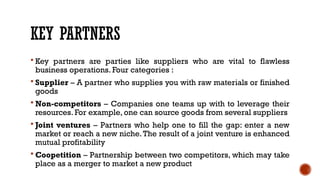
KEY PARTNERS
 Key partners are parties like suppliers who are vital to flawless
business operations. Four categories :
 Supplier – A partner who supplies you with raw materials or finished
goods
 Non-competitors – Companies one teams up with to leverage their
resources. For example, one can source goods from several suppliers
 Joint ventures – Partners who help one to fill the gap: enter a new
market or reach a new niche.The result of a joint venture is enhanced
mutual profitability
 Coopetition – Partnership between two competitors, which may take
place as a merger to market a new product
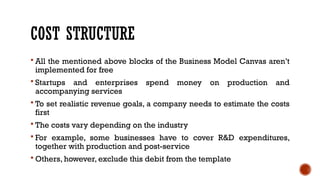
COST STRUCTURE
 All the mentioned above blocks of the Business Model Canvas aren’t
implemented for free
 Startups and enterprises spend money on production and
accompanying services
 To set realistic revenue goals, a company needs to estimate the costs
first
 The costs vary depending on the industry
 For example, some businesses have to cover R&D expenditures,
together with production and post-service
 Others, however, exclude this debit from the template
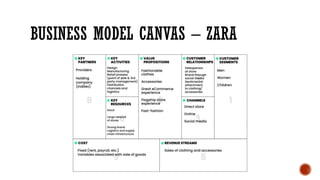
BUSINESS MODEL CANVAS – ZARA
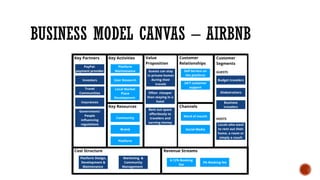
BUSINESS MODEL CANVAS – AIRBNB
ADVANTAGES OF BUSINESS MODEL CANVAS
Focused
Clear and concise
Target customer needs
Reduces the risk of failure
Scientific framework that works
DISADVANTAGES OF BUSINESS MODEL CANVAS
NOT a strategy. One still need a business plan
Doesn’t take into account the competitive arena
Often based on assumptions rather than facts
Doesn’t take into account sustainability (Economy, society,
and environment)
Doesn’t show the different stakeholders involved in the
business model
Lacks available components
CONCLUSION
The Business Model Canvas is an invaluable tool for every
organization
Helps streamline planning, development, and execution
Aligns everyone’s objectives and cut inconsistencies
Syncs various people who contribute to one’s business
objectives
Imperative to prepare a business model canvas in the ever-
changing market

Business model canvas used for strategy students

  • 1.
  • 2.
    AGENDA  Meaning  Structure Example  Advantages  Disadvantages  Conclusion
  • 3.
    BUSINESS MODEL CANVAS Business Model Canvas is a strategic management tool  It establishes and communicates a business idea or concept  It is a mission statement for one’s product roadmap  It provides entrepreneurs with a tool to:  Analyze  Structure, and  Evolve a business  While always keeping the bigger picture front of mind  It was created by Swiss entrepreneur “Alexander Osterwalder”
  • 4.
  • 5.
    BUSINESS MODEL CANVAS– 9 BLOCKS Customer Segment Value Proposition Distribution Channels Customer Relationship Revenue Streams Key Resources Key Activities Key Partners Cost Structure
  • 6.
    CUSTOMER SEGMENT  Dailyoperations highly depend on customers and their behavioral patterns  That’s why customer segmentation is a must when creating a business model  In this block, one needs to describe the buyer persona:  Demographics  Professional status  Motivation and goals  Shopping preferences
  • 7.
    VALUE PROPOSITION  Itis a brief description of ones product and its ultimate value  In other words, write down in a Business Model Canvas why consumers should buy the goods or services  It solves the problem or drives additional value for an end-client
  • 8.
    DISTRIBUTION CHANNELS  Fivephases of channel development:  Awareness includes channels that establish the initial contact with the target audience and develop the connection. It usually involves marketing channels  Evaluation implies allowing potential buyers to try one’s goods and see the value. Popular channels are free samples, reviews, and case studies  Purchase is about when and by what means customers can buy one’s product. The channels vary significantly depending on the prevalence of online or offline communication  Delivery describes how an end consumer receives a product  After-sales is usually limited to customer support that provides after-sales service and resolves problems
  • 9.
    CUSTOMER RELATIONSHIP  Acustomer relationship strategy determines how the target audience interacts with one’s brand. Five types of customer relationships :  Personal assistance is a traditional approach where a customer interacts with a personal assistant when contacting one’s brand. It implies a high level of personal care and deep, meaningful relationships  Self-service is the opposite of personal assistance: a brand doesn’t directly communicate with a consumer – instead, the consumer can understand the product via guides and FAQs  Automated service involves AI-based suggestions and bots that can provide basic assistance.This type is more engaging than self-service  Communities are spaces developed by a brand itself to help the audience understand the product better  Co-creation implies educating the customers via user-generated content
  • 10.
    REVENUE STREAMS  Itis about determining where one’s revenue comes from?  One should consider buyer’s persona to identify what the target audience is ready to pay for. Several methods of monetization:  Direct sales: Implies selling the service or product for a fee  Advertising: It’s relevant for such niches as blogging or IT platforms. The revenue comes from advertisers who want to reach one’s audience  Freemium: This applies to services only. Some features are free, while premium ones are paid for  Subscription: It’s similar to a fee-based monetization. The only difference is that a consumer pays for getting access to the service for a limited time, not forever
  • 11.
    KEY RESOURCES  Keyresources are divided into four categories:  Tangible – Any physical resources, from real estate to equipment. The stocks also fall in the category.  Intangible – Intellectual property like patents, copyrights, licenses, and customer knowledge  Human – Employees that make the business run  Financial – All the finance, regardless of whether it’s an obligation or not. It includes cash, bank loans, grants or donations, and other finances
  • 12.
    KEY ACTIVITIES  Keyactivities are the business activities vital for work  They vary from industry to industry. Some design this block by uniting the activities into one out of three categories:  Production  Problem-solving  Platform  For example, software developers fall in the first category as they design new products, while an IT company with its own taxi service is attributed to the third category
  • 13.
    KEY PARTNERS  Keypartners are parties like suppliers who are vital to flawless business operations. Four categories :  Supplier – A partner who supplies you with raw materials or finished goods  Non-competitors – Companies one teams up with to leverage their resources. For example, one can source goods from several suppliers  Joint ventures – Partners who help one to fill the gap: enter a new market or reach a new niche.The result of a joint venture is enhanced mutual profitability  Coopetition – Partnership between two competitors, which may take place as a merger to market a new product
  • 14.
    COST STRUCTURE  Allthe mentioned above blocks of the Business Model Canvas aren’t implemented for free  Startups and enterprises spend money on production and accompanying services  To set realistic revenue goals, a company needs to estimate the costs first  The costs vary depending on the industry  For example, some businesses have to cover R&D expenditures, together with production and post-service  Others, however, exclude this debit from the template
  • 15.
  • 16.
  • 17.
    ADVANTAGES OF BUSINESSMODEL CANVAS Focused Clear and concise Target customer needs Reduces the risk of failure Scientific framework that works
  • 18.
    DISADVANTAGES OF BUSINESSMODEL CANVAS NOT a strategy. One still need a business plan Doesn’t take into account the competitive arena Often based on assumptions rather than facts Doesn’t take into account sustainability (Economy, society, and environment) Doesn’t show the different stakeholders involved in the business model Lacks available components
  • 19.
    CONCLUSION The Business ModelCanvas is an invaluable tool for every organization Helps streamline planning, development, and execution Aligns everyone’s objectives and cut inconsistencies Syncs various people who contribute to one’s business objectives Imperative to prepare a business model canvas in the ever- changing market