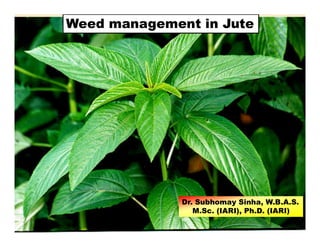
Weed management in Jute
Dr. Subhomay Sinha, W.B.A.S.
M.Sc. (IARI), Ph.D. (IARI)
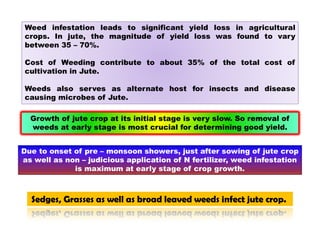
Weed infestation leads to significant yield loss in agricultural
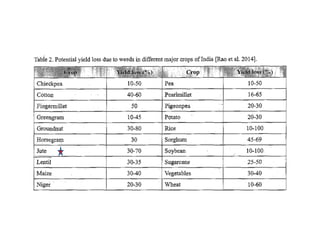
crops. In jute, the magnitude of yield loss was found to vary
between 35 – 70%.
Cost of Weeding contribute to about 35% of the total cost of
cultivation in Jute.
Weeds also serves as alternate host for insects and disease
causing microbes of Jute.
Growth of jute crop at its initial stage is very slow. So removal of
weeds at early stage is most crucial for determining good yield.
Due to onset of pre – monsoon showers, just after sowing of jute crop
as well as non – judicious application of N fertilizer, weed infestation
is maximum at early stage of crop growth.
Sedges, Grasses as well as broad leaved weeds infect jute crop.
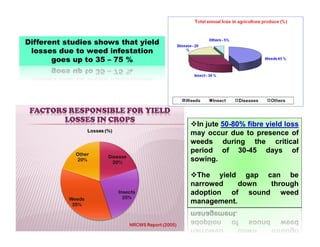
Different studies shows that yield
losses due to weed infestation
goes up to 35 – 75 %
In jute 50-80% fibre yield loss
may occur due to presence of
weeds during the critical
period of 30-45 days of
sowing.
The yield gap can be
narrowed down through
adoption of sound weed
management.
Identification of problematic
weed flora of JUTE
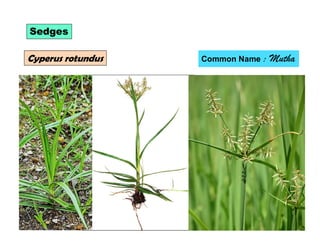
Sedges
Cyperus rotundus Common Name : Mutha
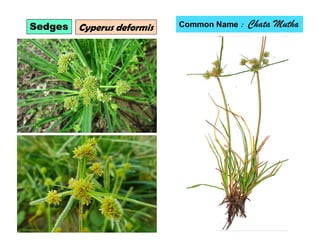
Sedges Cyperus deformis Common Name : Chata Mutha
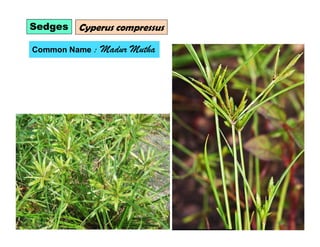
Sedges Cyperus compressus
Common Name : Madur Mutha
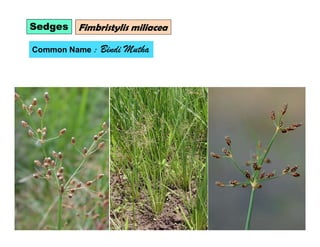
Sedges Fimbristylis miliacea
Common Name : Bindi Mutha
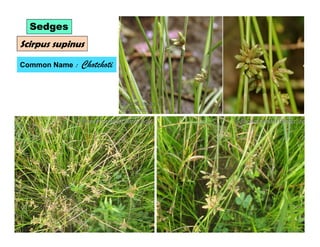
Sedges
Scirpus supinus
Common Name : Chotchoti
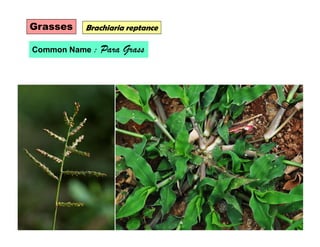
Grasses Brachiaria reptance
Common Name : Para Grass
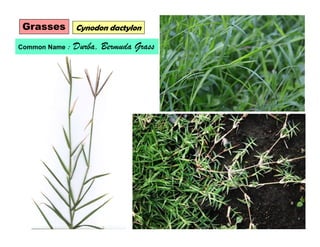
Grasses Cynodon dactylon
Common Name : Durba, Bermuda Grass
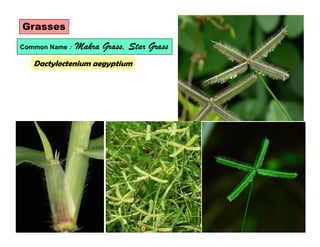
Dactyloctenium aegyptium
Grasses
Common Name : Makra Grass, Star Grass
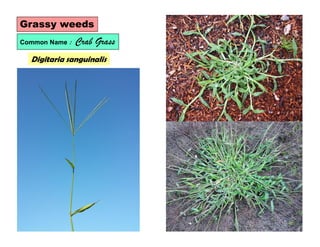
Digitaria sanguinalis
Grassy weeds
Common Name : Crab Grass
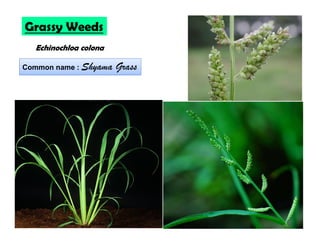
Grassy Weeds
Echinochloa colona
Common name : Shyama Grass
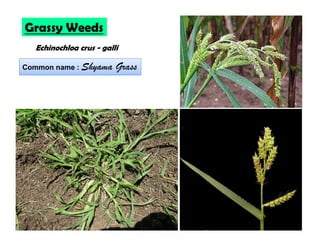
Grassy Weeds
Echinochloa crus - galli
Common name : Shyama GrassCommon name : Shyama Grass
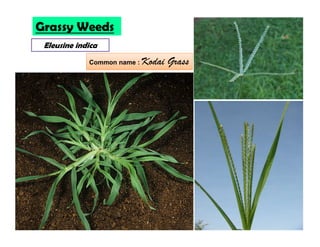
Eleusine indica
Grassy Weeds
Common name : Kodai Grass
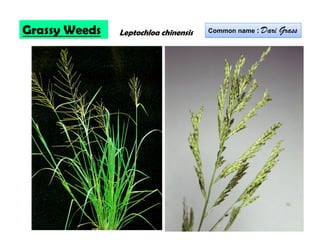
Leptochloa chinensisGrassy Weeds Common name : Dari Grass
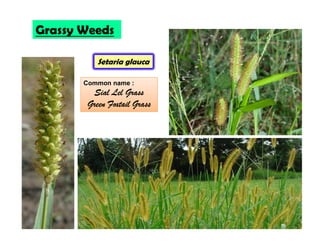
Setaria glauca
Grassy Weeds
Common name :
Sial Lel Grass
Green Foxtail Grass
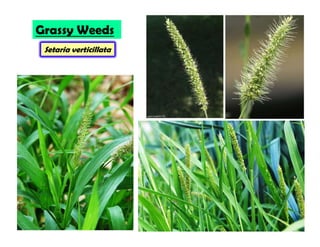
Setaria verticillata
Grassy Weeds
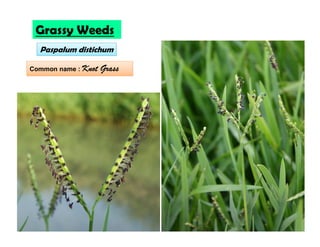
Paspalum distichum
Grassy Weeds
Common name : Knot Grass
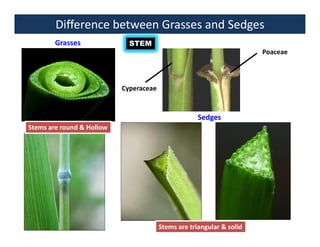
Difference between Grasses and Sedges
Grasses
Sedges
Poaceae
Cyperaceae
STEM
Stems are round & Hollow
Stems are triangular & solid
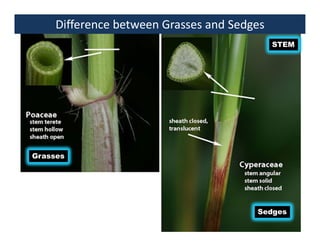
STEM
Difference between Grasses and Sedges
Sedges
Grasses
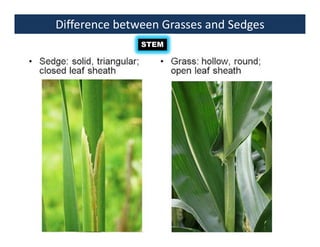
Difference between Grasses and Sedges
STEM
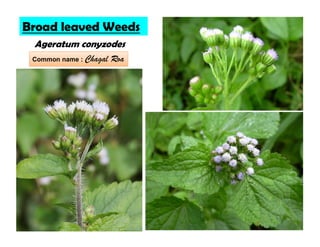
Ageratum conyzodes
Broad leaved Weeds
Common name : Chagal Roa
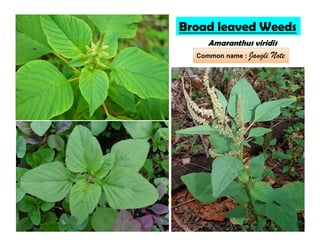
Broad leaved Weeds
Amaranthus viridis
Common name : Jangli Note
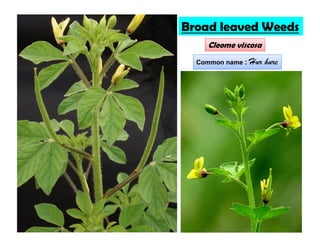
Broad leaved Weeds
Cleome viscosa
Common name : Hur hure
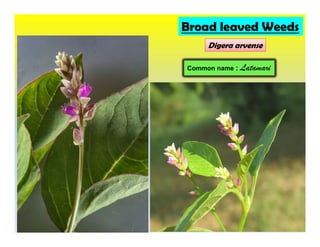
Broad leaved Weeds
Digera arvense
Common name : Latamari
Broad leaved Weeds
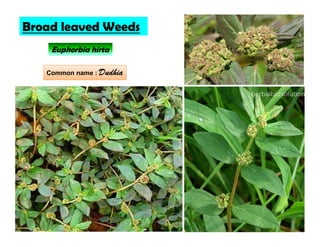
Euphorbia hirta
Common name : Dudhia
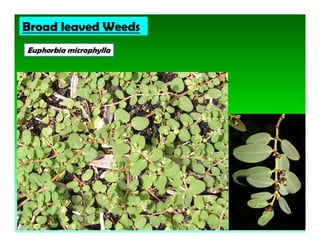
Euphorbia microphylla
Broad leaved Weeds
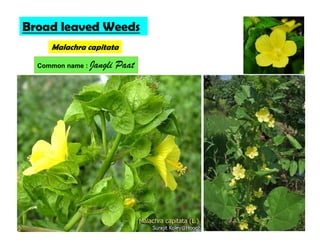
Malachra capitata
Broad leaved Weeds
Common name : Jangli Paat
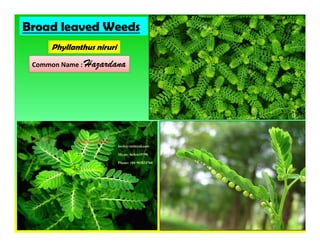
Phyllanthus niruri
Broad leaved Weeds
Common Name : Hazardana
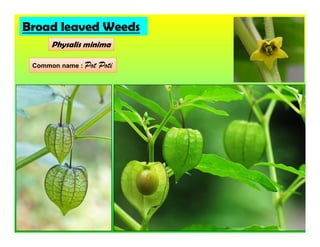
Physalis minima
Broad leaved Weeds
Common name : Pot Poti
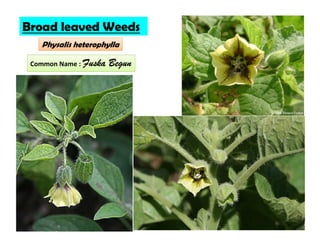
Physalis heterophylla
Broad leaved Weeds
Common Name : Fuska Begun
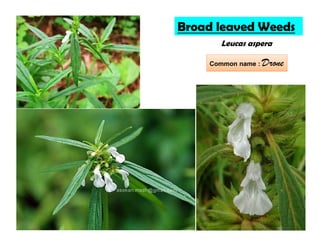
Leucas aspera
Broad leaved Weeds
Common name : Drone
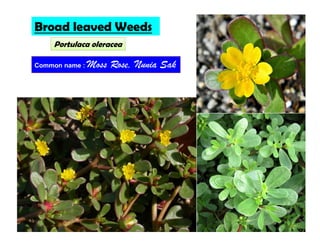
Portulaca oleracea
Broad leaved Weeds
Common name : Moss Rose, Nunia Sak
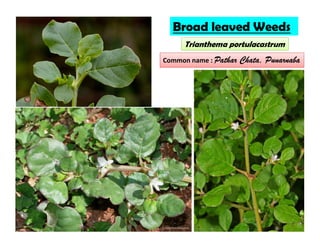
Trianthema portulacastrum
Broad leaved Weeds
Common name : Pathar Chata, Punarnaba
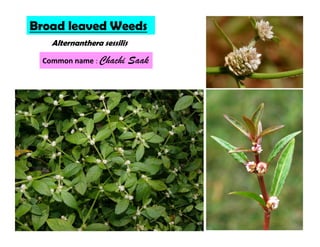
Alternanthera sessilis
Broad leaved Weeds
Common name : Chachi Saak
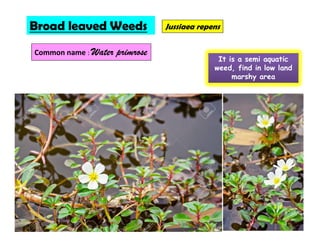
Jussiaea repensBroad leaved Weeds
Common name : Water primrose
It is a semi aquatic
weed, find in low land
marshy area
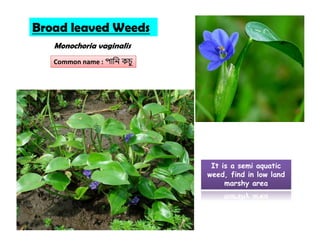
Broad leaved Weeds
Monochoria vaginalis
Common name : পািন কচ
It is a semi aquatic
weed, find in low land
marshy area
In jute, 10 – 45 days after seedling emergence has been found
CRITICAL period for weed growth and therefore post-emergence
herbicides application or suitable intercultural operations should
not be delayed beyond this period.
Weed emergence after 45 days of jute sowing did not reduce the
yield. Hence, season long intercultural operations or herbicides
application is not required for jute.
It caused 40-70% of yield loss if not controlled properly.
Critical period for weed management in Jute
Weed Management in Jute
Preventive methods:
 Use of clean seeds, preferable certified seed should be used.
 Use of well rotten organic manures, because partially rotton FYM contains
viable weed seeds, which may germinate and infest the field.
 Avoid using soil from infested area to clean area,
 Restrict cattle grazing as through cattle’s dropping, there is high chance of
weed contamination.
 Cleaning of irrigation and drainage channel, bunds so that no weeds could
grow there.
Weed Management in Jute
Cultural methods:
 Early sowing of Suitable varieties helps to escape heavy weed growth
which begins just after onset of pre – monsoon showers.
 Line sowing of jute with 25 cm× 7 cm and optimum plant population (5.5 -
6.0 lakhs/ha) facilitate the intercultural practices, resulting in
competitive advantage of Jute crops. Line sowing with multi row seed drill
is very effective in this situation.
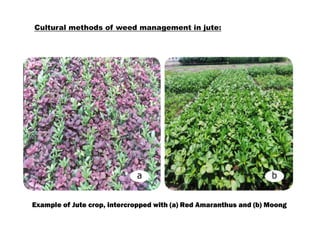
 Intercropping of short-duration, quick-growing and early-maturing crops
like MOONG (Variety : Pant Mung – 4, Pant Mung – 5) or SUMMER
RADDISH or RED AMARANTHUS results suppression of weed growth.
Red amaranthus suppress all other types of weed growth, when sown at a
high rate. This crop is harvested at 21 DAS, and as it get a good price,
the cost of manual weeding can be compensated from it.
 Stale Seed bed technique is a very effective tool towards weed
smothering.
Example of Jute crop, intercropped with (a) Red Amaranthus and (b) Moong
Cultural methods of weed management in jute:
Weed Management in Jute
Mechanical methods:
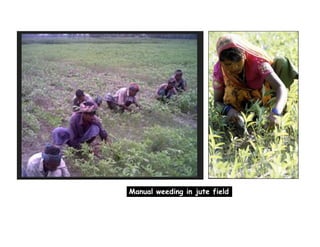
 Manual weeding, involves human labour, though it is very costly. It has
been observed that two hand weeding (one at 20-25 days and second at
35-40 days after sowing) give the season long weed control in jute.
 Weeding with wheel hoe or nail weeder is very effective, especially in line
sown jute crop. Wheel hoeing at 20 to 25 days and one hand weeding at
35-40 days after sowing gives excellent control of weeds in jute.
Weeding through nail weeder results soil mulching, which helps to reduce
moisture conservation and raising soil temperature.
 After weeding there should be 50 – 60 nos. of plant / sq. M. which is
optimum for giving best result.
Manual weeding in jute field
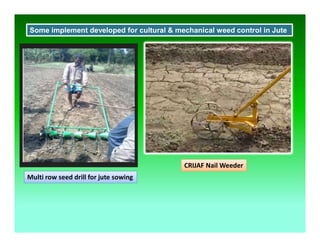
Multi row seed drill for jute sowing
CRIJAF Nail Weeder
Some implement developed for cultural & mechanical weed control in Jute
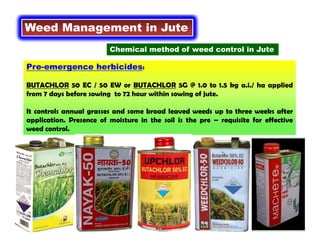
Pre-emergence herbicides:
BUTACHLOR 50 EC / 50 EW or BUTACHLOR 5G @ 1.0 to 1.5 kg a.i./ ha applied
from 7 days before sowing to 72 hour within sowing of jute.
It controls annual grasses and some broad leaved weeds up to three weeks after
application. Presence of moisture in the soil is the pre – requisite for effective
weed control.
Weed Management in Jute
Chemical method of weed control in Jute
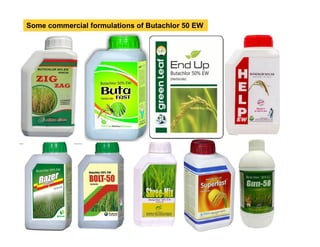
Some commercial formulations of Butachlor 50 EW
Pre – emergence Herbicide
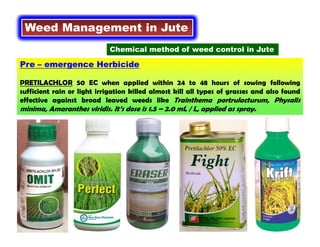
PRETILACHLOR 50 EC when applied within 24 to 48 hours of sowing following
sufficient rain or light irrigation killed almost kill all types of grasses and also found
effective against broad leaved weeds like Trainthema portrulacturum, Physalis
minima, Amaranthes viridis. It’s dose is 1.5 – 2.0 mL / L, applied as spray.
Weed Management in Jute
Chemical method of weed control in Jute
Pre – emergence Herbicide
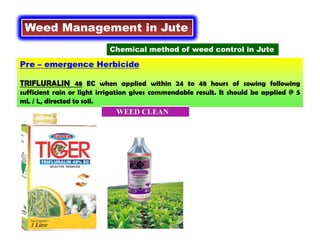
TRIFLURALIN 48 EC when applied within 24 to 48 hours of sowing following
sufficient rain or light irrigation gives commendable result. It should be applied @ 5
mL / L, directed to soil.
Weed Management in Jute
Chemical method of weed control in Jute
Post – emergence Herbicide
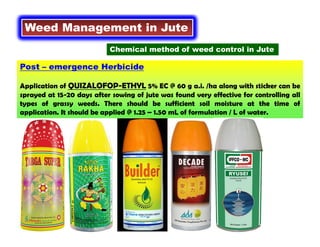
Application of QUIZALOFOP-ETHYL 5% EC @ 60 g a.i. /ha along with sticker can be
sprayed at 15-20 days after sowing of jute was found very effective for controlling all
types of grassy weeds. There should be sufficient soil moisture at the time of
application. It should be applied @ 1.25 – 1.50 mL of formulation / L of water.
Weed Management in Jute
Chemical method of weed control in Jute
Post – emergence Herbicide
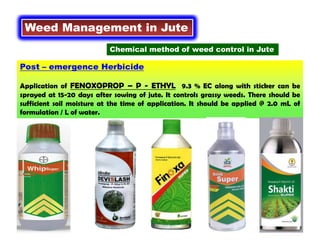
Application of FENOXOPROP – P - ETHYL 9.3 % EC along with sticker can be
sprayed at 15-20 days after sowing of jute. It controls grassy weeds. There should be
sufficient soil moisture at the time of application. It should be applied @ 2.0 mL of
formulation / L of water.
Weed Management in Jute
Chemical method of weed control in Jute
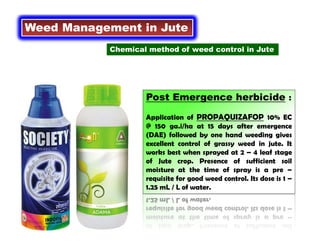
Post Emergence herbicide :
Application of PROPAQUIZAFOP 10% EC
@ 150 ga.i/ha at 15 days after emergence
(DAE) followed by one hand weeding gives
excellent control of grassy weed in jute. It
works best when sprayed at 2 – 4 leaf stage
of Jute crop. Presence of sufficient soil
moisture at the time of spray is a pre –
requisite for good weed control. Its dose is 1 –
1.25 mL / L of water.
Weed Management in Jute
Chemical method of weed control in Jute
Weed Management in Jute
Chemical method of weed control in Jute
Post – emergence Herbicide
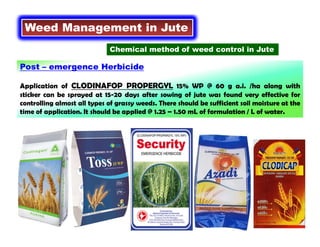
Application of CLODINAFOP PROPERGYL 15% WP @ 60 g a.i. /ha along with
sticker can be sprayed at 15-20 days after sowing of jute was found very effective for
controlling almost all types of grassy weeds. There should be sufficient soil moisture at the
time of application. It should be applied @ 1.25 – 1.50 mL of formulation / L of water.
Integrated Weed Management approach in Jute
Application of pre – emergence Herbicides like Butachlor 50 EC / EW
or Pretilachlor 50 EC followed by application of Quizalofop- ethyl @5%
EC @ 60 g a.i. /ha as post- emergence herbicides at 21 – 25 DAS with
one mechanical/ manual weeding at 35 days after sowing has been
found very effective in controlling weeds in jute.
Post emergence herbicides should not be applied to jute crop beyond 25
DAS, otherwise detrimental effect on jute crop may arise through
phytotoxicity.
All the post emergence herbicides are able to control Grassy weeds only.
Grassy weeds contributes the major part of weed flora in jute crop, but these
are not able to control broad leaved weeds.

Weed control strategy in jute

  • 1.
    Weed management inJute Dr. Subhomay Sinha, W.B.A.S. M.Sc. (IARI), Ph.D. (IARI)
  • 2.
    Weed infestation leadsto significant yield loss in agricultural crops. In jute, the magnitude of yield loss was found to vary between 35 – 70%. Cost of Weeding contribute to about 35% of the total cost of cultivation in Jute. Weeds also serves as alternate host for insects and disease causing microbes of Jute. Growth of jute crop at its initial stage is very slow. So removal of weeds at early stage is most crucial for determining good yield. Due to onset of pre – monsoon showers, just after sowing of jute crop as well as non – judicious application of N fertilizer, weed infestation is maximum at early stage of crop growth. Sedges, Grasses as well as broad leaved weeds infect jute crop.
  • 3.
    Different studies showsthat yield losses due to weed infestation goes up to 35 – 75 % In jute 50-80% fibre yield loss may occur due to presence of weeds during the critical period of 30-45 days of sowing. The yield gap can be narrowed down through adoption of sound weed management.
  • 5.
  • 6.
  • 7.
    Sedges Cyperus deformisCommon Name : Chata Mutha
  • 8.
  • 9.
  • 10.
  • 11.
  • 12.
    Grasses Cynodon dactylon CommonName : Durba, Bermuda Grass
  • 13.
  • 14.
  • 15.
  • 16.
    Grassy Weeds Echinochloa crus- galli Common name : Shyama GrassCommon name : Shyama Grass
  • 17.
  • 18.
    Leptochloa chinensisGrassy WeedsCommon name : Dari Grass
  • 19.
    Setaria glauca Grassy Weeds Commonname : Sial Lel Grass Green Foxtail Grass
  • 20.
  • 21.
  • 22.
    Difference between Grassesand Sedges Grasses Sedges Poaceae Cyperaceae STEM Stems are round & Hollow Stems are triangular & solid
  • 23.
    STEM Difference between Grassesand Sedges Sedges Grasses
  • 24.
  • 25.
    Ageratum conyzodes Broad leavedWeeds Common name : Chagal Roa
  • 26.
    Broad leaved Weeds Amaranthusviridis Common name : Jangli Note
  • 27.
    Broad leaved Weeds Cleomeviscosa Common name : Hur hure
  • 28.
    Broad leaved Weeds Digeraarvense Common name : Latamari
  • 29.
    Broad leaved Weeds Euphorbiahirta Common name : Dudhia
  • 30.
  • 31.
    Malachra capitata Broad leavedWeeds Common name : Jangli Paat
  • 32.
    Phyllanthus niruri Broad leavedWeeds Common Name : Hazardana
  • 33.
    Physalis minima Broad leavedWeeds Common name : Pot Poti
  • 34.
    Physalis heterophylla Broad leavedWeeds Common Name : Fuska Begun
  • 35.
    Leucas aspera Broad leavedWeeds Common name : Drone
  • 36.
    Portulaca oleracea Broad leavedWeeds Common name : Moss Rose, Nunia Sak
  • 37.
    Trianthema portulacastrum Broad leavedWeeds Common name : Pathar Chata, Punarnaba
  • 38.
    Alternanthera sessilis Broad leavedWeeds Common name : Chachi Saak
  • 39.
    Jussiaea repensBroad leavedWeeds Common name : Water primrose It is a semi aquatic weed, find in low land marshy area
  • 40.
    Broad leaved Weeds Monochoriavaginalis Common name : পািন কচ It is a semi aquatic weed, find in low land marshy area
  • 41.
    In jute, 10– 45 days after seedling emergence has been found CRITICAL period for weed growth and therefore post-emergence herbicides application or suitable intercultural operations should not be delayed beyond this period. Weed emergence after 45 days of jute sowing did not reduce the yield. Hence, season long intercultural operations or herbicides application is not required for jute. It caused 40-70% of yield loss if not controlled properly. Critical period for weed management in Jute
  • 42.
    Weed Management inJute Preventive methods:  Use of clean seeds, preferable certified seed should be used.  Use of well rotten organic manures, because partially rotton FYM contains viable weed seeds, which may germinate and infest the field.  Avoid using soil from infested area to clean area,  Restrict cattle grazing as through cattle’s dropping, there is high chance of weed contamination.  Cleaning of irrigation and drainage channel, bunds so that no weeds could grow there.
  • 43.
    Weed Management inJute Cultural methods:  Early sowing of Suitable varieties helps to escape heavy weed growth which begins just after onset of pre – monsoon showers.  Line sowing of jute with 25 cm× 7 cm and optimum plant population (5.5 - 6.0 lakhs/ha) facilitate the intercultural practices, resulting in competitive advantage of Jute crops. Line sowing with multi row seed drill is very effective in this situation.  Intercropping of short-duration, quick-growing and early-maturing crops like MOONG (Variety : Pant Mung – 4, Pant Mung – 5) or SUMMER RADDISH or RED AMARANTHUS results suppression of weed growth. Red amaranthus suppress all other types of weed growth, when sown at a high rate. This crop is harvested at 21 DAS, and as it get a good price, the cost of manual weeding can be compensated from it.  Stale Seed bed technique is a very effective tool towards weed smothering.
  • 44.
    Example of Jutecrop, intercropped with (a) Red Amaranthus and (b) Moong Cultural methods of weed management in jute:
  • 45.
    Weed Management inJute Mechanical methods:  Manual weeding, involves human labour, though it is very costly. It has been observed that two hand weeding (one at 20-25 days and second at 35-40 days after sowing) give the season long weed control in jute.  Weeding with wheel hoe or nail weeder is very effective, especially in line sown jute crop. Wheel hoeing at 20 to 25 days and one hand weeding at 35-40 days after sowing gives excellent control of weeds in jute. Weeding through nail weeder results soil mulching, which helps to reduce moisture conservation and raising soil temperature.  After weeding there should be 50 – 60 nos. of plant / sq. M. which is optimum for giving best result.
  • 46.
  • 47.
    Multi row seeddrill for jute sowing CRIJAF Nail Weeder Some implement developed for cultural & mechanical weed control in Jute
  • 48.
    Pre-emergence herbicides: BUTACHLOR 50EC / 50 EW or BUTACHLOR 5G @ 1.0 to 1.5 kg a.i./ ha applied from 7 days before sowing to 72 hour within sowing of jute. It controls annual grasses and some broad leaved weeds up to three weeks after application. Presence of moisture in the soil is the pre – requisite for effective weed control. Weed Management in Jute Chemical method of weed control in Jute
  • 49.
    Some commercial formulationsof Butachlor 50 EW
  • 50.
    Pre – emergenceHerbicide PRETILACHLOR 50 EC when applied within 24 to 48 hours of sowing following sufficient rain or light irrigation killed almost kill all types of grasses and also found effective against broad leaved weeds like Trainthema portrulacturum, Physalis minima, Amaranthes viridis. It’s dose is 1.5 – 2.0 mL / L, applied as spray. Weed Management in Jute Chemical method of weed control in Jute
  • 51.
    Pre – emergenceHerbicide TRIFLURALIN 48 EC when applied within 24 to 48 hours of sowing following sufficient rain or light irrigation gives commendable result. It should be applied @ 5 mL / L, directed to soil. Weed Management in Jute Chemical method of weed control in Jute
  • 52.
    Post – emergenceHerbicide Application of QUIZALOFOP-ETHYL 5% EC @ 60 g a.i. /ha along with sticker can be sprayed at 15-20 days after sowing of jute was found very effective for controlling all types of grassy weeds. There should be sufficient soil moisture at the time of application. It should be applied @ 1.25 – 1.50 mL of formulation / L of water. Weed Management in Jute Chemical method of weed control in Jute
  • 53.
    Post – emergenceHerbicide Application of FENOXOPROP – P - ETHYL 9.3 % EC along with sticker can be sprayed at 15-20 days after sowing of jute. It controls grassy weeds. There should be sufficient soil moisture at the time of application. It should be applied @ 2.0 mL of formulation / L of water. Weed Management in Jute Chemical method of weed control in Jute
  • 54.
    Post Emergence herbicide: Application of PROPAQUIZAFOP 10% EC @ 150 ga.i/ha at 15 days after emergence (DAE) followed by one hand weeding gives excellent control of grassy weed in jute. It works best when sprayed at 2 – 4 leaf stage of Jute crop. Presence of sufficient soil moisture at the time of spray is a pre – requisite for good weed control. Its dose is 1 – 1.25 mL / L of water. Weed Management in Jute Chemical method of weed control in Jute
  • 55.
    Weed Management inJute Chemical method of weed control in Jute Post – emergence Herbicide Application of CLODINAFOP PROPERGYL 15% WP @ 60 g a.i. /ha along with sticker can be sprayed at 15-20 days after sowing of jute was found very effective for controlling almost all types of grassy weeds. There should be sufficient soil moisture at the time of application. It should be applied @ 1.25 – 1.50 mL of formulation / L of water.
  • 56.
    Integrated Weed Managementapproach in Jute Application of pre – emergence Herbicides like Butachlor 50 EC / EW or Pretilachlor 50 EC followed by application of Quizalofop- ethyl @5% EC @ 60 g a.i. /ha as post- emergence herbicides at 21 – 25 DAS with one mechanical/ manual weeding at 35 days after sowing has been found very effective in controlling weeds in jute. Post emergence herbicides should not be applied to jute crop beyond 25 DAS, otherwise detrimental effect on jute crop may arise through phytotoxicity. All the post emergence herbicides are able to control Grassy weeds only. Grassy weeds contributes the major part of weed flora in jute crop, but these are not able to control broad leaved weeds.