Intercultural operations
in vegetable crops
HOR -424
COMMERCIAL VEGETABLE
PRODUCTION
PRESENTED BY- VAISHALI PILLAI
ID NO. 13165
B.SC(AG) PART IV
What is weed and how it affects
crop production?
• Weeds are unwanted plants in crop field
and its surrounding. They can easily
establish and flourish under non-ideal
conditions of growth and may affect human
welfare adversely. They compete with the
crop for water, soil nutrients, light and
space and ultimately have direct impact
on yield and quality of the crop.
• Weeds also act as host for insects,
pathogens and nematodes.
• Direct seeded crops like radish, carrot,
peas, beans, palak, amaranth, okra and
fenugreek are more vulnerable to weed
competition before emergence and during
establishment of young plants. Weed seeds
easily germinate under varied conditions
and have long seed viability. They have
prolonged seed dormancy in some cases
where they do not germinate for years under
unfavourable conditions
.
IMPORTANT WEEDS IN
VEGETABLE CROPS
– Annual weeds: Weeds of this group complete their life cycle
in one season or in a year and thus are called annual weeds.
• monsoon annuals (Kharif season): Echinochloa
colomum (water grass/Jhanda), Euphorbia hirta (Badi
dudhi) etc.
• Winter annuals (rabi season): e.g. Phalaris minor
(Canary grass/Guli-danda), Vicia sativa (Common
vetch/RoriRewari) etc.
– Biennial weeds: Those weeds that grow in the
first season and complete their life cycle in the
following season are referred as biennials. e.g.
wild carrot (Daucus carota) etc.
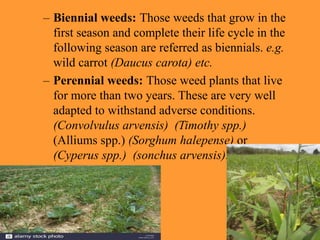
– Perennial weeds: Those weed plants that live
for more than two years. These are very well
adapted to withstand adverse conditions.
(Convolvulus arvensis) (Timothy spp.)
(Alliums spp.) (Sorghum halepense) or
(Cyperus spp.) (sonchus arvensis).
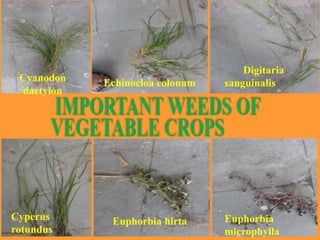
Cyanodon
dactylon
Echinocloa colonum
Digitaria
sanguinalis
Cyperus
rotundus
Euphorbia hirta Euphorbia
microphylla
Weed Control
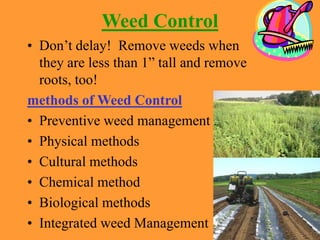
• Don’t delay! Remove weeds when
they are less than 1” tall and remove
roots, too!
methods of Weed Control
• Preventive weed management
• Physical methods
• Cultural methods
• Chemical method
• Biological methods
• Integrated weed Management
mechanical or Physical
methods
mechanical or Physical methods: Removing the weeds
physically with hands or by using tools/ implements
is called mechanical method. Common mechanical methods of
weed control are:
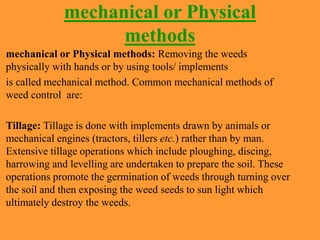
Tillage: Tillage is done with implements drawn by animals or
mechanical engines (tractors, tillers etc.) rather than by man.
Extensive tillage operations which include ploughing, discing,
harrowing and levelling are undertaken to prepare the soil. These
operations promote the germination of weeds through turning over
the soil and then exposing the weed seeds to sun light which
ultimately destroy the weeds.
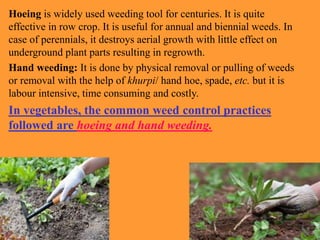
Hoeing is widely used weeding tool for centuries. It is quite
effective in row crop. It is useful for annual and biennial weeds. In
case of perennials, it destroys aerial growth with little effect on
underground plant parts resulting in regrowth.
Hand weeding: It is done by physical removal or pulling of weeds
or removal with the help of khurpi/ hand hoe, spade, etc. but it is
labour intensive, time consuming and costly.
In vegetables, the common weed control practices
followed are hoeing and hand weeding.
Chemical weed control
Soil fumigants like carbon dioxide, methyl bromide, chloropicrin,
cynamide etc. and soil sterilants like, simazine, atrazine, formaldehyde
etc. are applied to soil to kill weeds.
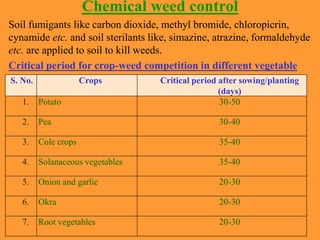
Critical period for crop-weed competition in different vegetable
cropsS. No. Crops Critical period after sowing/planting
(days)
1. Potato 30-50
2. Pea 30-40
3. Cole crops 35-40
4. Solanaceous vegetables 35-40
5. Onion and garlic 20-30
6. Okra 20-30
7. Root vegetables 20-30
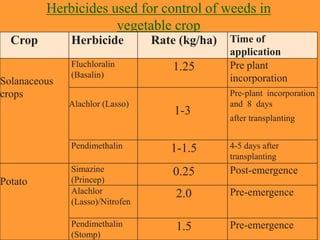
Herbicides used for control of weeds in
vegetable crop
Crop Herbicide Rate (kg/ha) Time of
application
Solanaceous
crops
Fluchloralin
(Basalin)
1.25 Pre plant
incorporation
Alachlor (Lasso)
1-3
Pre-plant incorporation
and 8 days
after transplanting
Pendimethalin 1-1.5 4-5 days after
transplanting
Potato
Simazine
(Princep)
0.25 Post-emergence
Alachlor
(Lasso)/Nitrofen
2.0 Pre-emergence
Pendimethalin
(Stomp)
1.5 Pre-emergence
CULTURAL METHOD
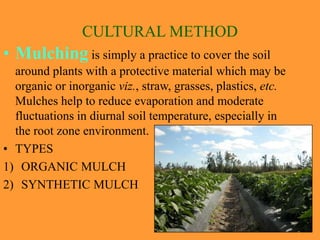
• Mulching is simply a practice to cover the soil
around plants with a protective material which may be
organic or inorganic viz., straw, grasses, plastics, etc.
Mulches help to reduce evaporation and moderate
fluctuations in diurnal soil temperature, especially in
the root zone environment.
• TYPES
1) ORGANIC MULCH
2) SYNTHETIC MULCH
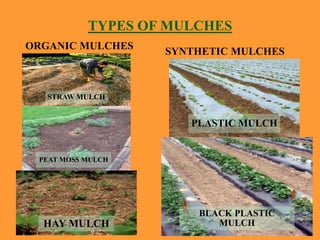
TYPES OF MULCHES
ORGANIC MULCHES
STRAW MULCH
SYNTHETIC MULCHES
PEAT MOSS MULCH
HAY MULCH
PLASTIC MULCH
BLACK PLASTIC
MULCH
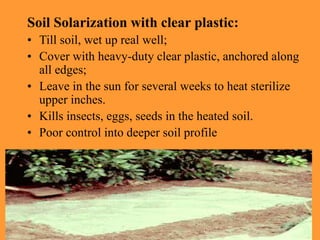
Soil Solarization with clear plastic:
• Till soil, wet up real well;
• Cover with heavy-duty clear plastic, anchored along
all edges;
• Leave in the sun for several weeks to heat sterilize
upper inches.
• Kills insects, eggs, seeds in the heated soil.
• Poor control into deeper soil profile
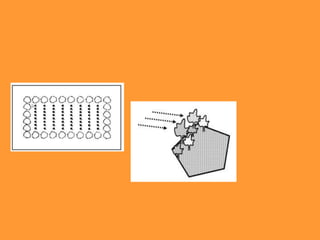
• Reduced wind and increased retention of moisture
Protect houses and crops against strong wind
The leaves shed by trees return organic matter to the soil,
increasing its structural stability, erosion resistance and
capacity to store water
Nitrogen fixing by leguminous trees – Mexican lilac
Create strong and impenetrable fences - Jatropha tree
Provide oil that can be used for biofuels or turned into soap
– Jatropha tree
Provide food (fruit trees)
Medicinal benefits– Neem tree
Provide sustainable fire wood – Neem tree

Hor424

  • 1.
    Intercultural operations in vegetablecrops HOR -424 COMMERCIAL VEGETABLE PRODUCTION PRESENTED BY- VAISHALI PILLAI ID NO. 13165 B.SC(AG) PART IV
  • 2.
    What is weedand how it affects crop production? • Weeds are unwanted plants in crop field and its surrounding. They can easily establish and flourish under non-ideal conditions of growth and may affect human welfare adversely. They compete with the crop for water, soil nutrients, light and space and ultimately have direct impact on yield and quality of the crop.
  • 3.
    • Weeds alsoact as host for insects, pathogens and nematodes. • Direct seeded crops like radish, carrot, peas, beans, palak, amaranth, okra and fenugreek are more vulnerable to weed competition before emergence and during establishment of young plants. Weed seeds easily germinate under varied conditions and have long seed viability. They have prolonged seed dormancy in some cases where they do not germinate for years under unfavourable conditions .
  • 4.
    IMPORTANT WEEDS IN VEGETABLECROPS – Annual weeds: Weeds of this group complete their life cycle in one season or in a year and thus are called annual weeds. • monsoon annuals (Kharif season): Echinochloa colomum (water grass/Jhanda), Euphorbia hirta (Badi dudhi) etc. • Winter annuals (rabi season): e.g. Phalaris minor (Canary grass/Guli-danda), Vicia sativa (Common vetch/RoriRewari) etc.
  • 5.
    – Biennial weeds:Those weeds that grow in the first season and complete their life cycle in the following season are referred as biennials. e.g. wild carrot (Daucus carota) etc. – Perennial weeds: Those weed plants that live for more than two years. These are very well adapted to withstand adverse conditions. (Convolvulus arvensis) (Timothy spp.) (Alliums spp.) (Sorghum halepense) or (Cyperus spp.) (sonchus arvensis).
  • 6.
  • 7.
    Weed Control • Don’tdelay! Remove weeds when they are less than 1” tall and remove roots, too! methods of Weed Control • Preventive weed management • Physical methods • Cultural methods • Chemical method • Biological methods • Integrated weed Management
  • 8.
    mechanical or Physical methods mechanicalor Physical methods: Removing the weeds physically with hands or by using tools/ implements is called mechanical method. Common mechanical methods of weed control are: Tillage: Tillage is done with implements drawn by animals or mechanical engines (tractors, tillers etc.) rather than by man. Extensive tillage operations which include ploughing, discing, harrowing and levelling are undertaken to prepare the soil. These operations promote the germination of weeds through turning over the soil and then exposing the weed seeds to sun light which ultimately destroy the weeds.
  • 9.
    Hoeing is widelyused weeding tool for centuries. It is quite effective in row crop. It is useful for annual and biennial weeds. In case of perennials, it destroys aerial growth with little effect on underground plant parts resulting in regrowth. Hand weeding: It is done by physical removal or pulling of weeds or removal with the help of khurpi/ hand hoe, spade, etc. but it is labour intensive, time consuming and costly. In vegetables, the common weed control practices followed are hoeing and hand weeding.
  • 10.
    Chemical weed control Soilfumigants like carbon dioxide, methyl bromide, chloropicrin, cynamide etc. and soil sterilants like, simazine, atrazine, formaldehyde etc. are applied to soil to kill weeds. Critical period for crop-weed competition in different vegetable cropsS. No. Crops Critical period after sowing/planting (days) 1. Potato 30-50 2. Pea 30-40 3. Cole crops 35-40 4. Solanaceous vegetables 35-40 5. Onion and garlic 20-30 6. Okra 20-30 7. Root vegetables 20-30
  • 11.
    Herbicides used forcontrol of weeds in vegetable crop Crop Herbicide Rate (kg/ha) Time of application Solanaceous crops Fluchloralin (Basalin) 1.25 Pre plant incorporation Alachlor (Lasso) 1-3 Pre-plant incorporation and 8 days after transplanting Pendimethalin 1-1.5 4-5 days after transplanting Potato Simazine (Princep) 0.25 Post-emergence Alachlor (Lasso)/Nitrofen 2.0 Pre-emergence Pendimethalin (Stomp) 1.5 Pre-emergence
  • 12.
    CULTURAL METHOD • Mulchingis simply a practice to cover the soil around plants with a protective material which may be organic or inorganic viz., straw, grasses, plastics, etc. Mulches help to reduce evaporation and moderate fluctuations in diurnal soil temperature, especially in the root zone environment. • TYPES 1) ORGANIC MULCH 2) SYNTHETIC MULCH
  • 13.
    TYPES OF MULCHES ORGANICMULCHES STRAW MULCH SYNTHETIC MULCHES PEAT MOSS MULCH HAY MULCH PLASTIC MULCH BLACK PLASTIC MULCH
  • 14.
    Soil Solarization withclear plastic: • Till soil, wet up real well; • Cover with heavy-duty clear plastic, anchored along all edges; • Leave in the sun for several weeks to heat sterilize upper inches. • Kills insects, eggs, seeds in the heated soil. • Poor control into deeper soil profile
  • 17.
    • Reduced windand increased retention of moisture Protect houses and crops against strong wind The leaves shed by trees return organic matter to the soil, increasing its structural stability, erosion resistance and capacity to store water Nitrogen fixing by leguminous trees – Mexican lilac Create strong and impenetrable fences - Jatropha tree Provide oil that can be used for biofuels or turned into soap – Jatropha tree Provide food (fruit trees) Medicinal benefits– Neem tree Provide sustainable fire wood – Neem tree