Digital User Behaviour
- China vs The West
General Design Characteristics
of Chinese Websites
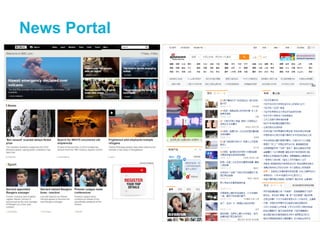
News Portal
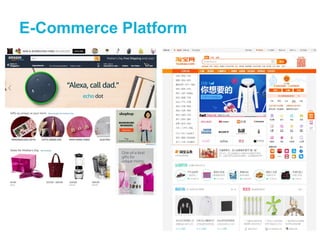
E-Commerce Platform
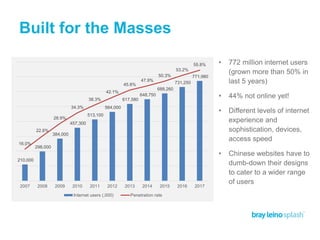
Built for the Masses
• 772 million internet users
(grown more than 50% in
last 5 years)
• 44% not online yet!
• Different levels of internet
experience and
sophistication, devices,
access speed
• Chinese websites have to
dumb-down their designs
to cater to a wider range
of users
210,000
298,000
384,000
457,300
513,100
564,000
617,580
648,750
688,260
731,250
771,980
16.0%
22.6%
28.9%
34.3%
38.3%
42.1%
45.8%
47.9%
50.3%
53.2%
55.8%
2007 2008 2009 2010 2011 2012 2013 2014 2015 2016 2017
Internet users (,000) Penetration rate
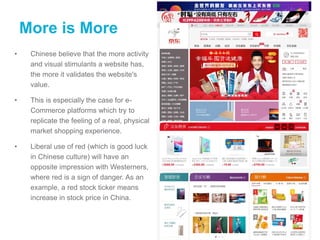
More is More
• Chinese believe that the more activity
and visual stimulants a website has,
the more it validates the website's
value.
• This is especially the case for e-
Commerce platforms which try to
replicate the feeling of a real, physical
market shopping experience.
• Liberal use of red (which is good luck
in Chinese culture) will have an
opposite impression with Westerners,
where red is a sign of danger. As an
example, a red stock ticker means
increase in stock price in China.
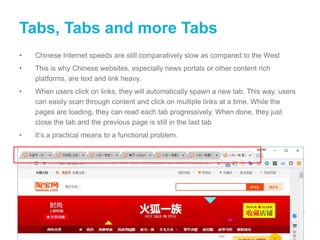
Tabs, Tabs and more Tabs
• Chinese Internet speeds are still comparatively slow as compared to the West
• This is why Chinese websites, especially news portals or other content rich
platforms, are text and link heavy.
• When users click on links, they will automatically spawn a new tab. This way, users
can easily scan through content and click on multiple links at a time. While the
pages are loading, they can read each tab progressively. When done, they just
close the tab and the previous page is still in the last tab
• It’s a practical means to a functional problem.
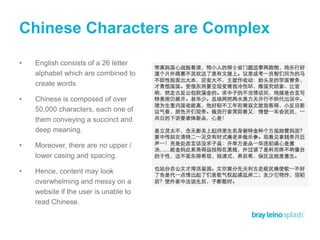
Chinese Characters are Complex
• English consists of a 26 letter
alphabet which are combined to
create words
• Chinese is composed of over
50,000 characters, each one of
them conveying a succinct and
deep meaning.
• Moreover, there are no upper /
lower casing and spacing.
• Hence, content may look
overwhelming and messy on a
website if the user is unable to
read Chinese.
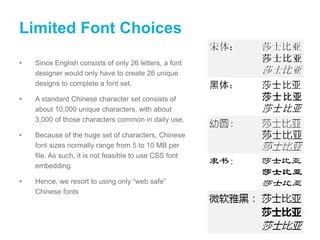
Limited Font Choices
• Since English consists of only 26 letters, a font
designer would only have to create 26 unique
designs to complete a font set.
• A standard Chinese character set consists of
about 10,000 unique characters, with about
3,000 of those characters common in daily use.
• Because of the huge set of characters, Chinese
font sizes normally range from 5 to 10 MB per
file. As such, it is not feasible to use CSS font
embedding.
• Hence, we resort to using only “web safe”
Chinese fonts
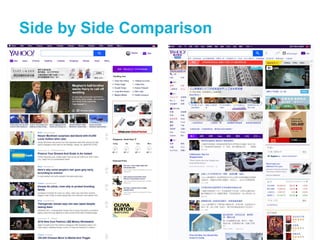
Side by Side Comparison
Search – Gateway to Internet
Gateway to Internet
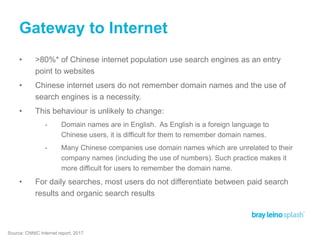
• >80%* of Chinese internet population use search engines as an entry
point to websites
• Chinese internet users do not remember domain names and the use of
search engines is a necessity.
• This behaviour is unlikely to change:
• Domain names are in English. As English is a foreign language to
Chinese users, it is difficult for them to remember domain names.
• Many Chinese companies use domain names which are unrelated to their
company names (including the use of numbers). Such practice makes it
more difficult for users to remember the domain name.
• For daily searches, most users do not differentiate between paid search
results and organic search results
Source: CNNIC Internet report, 2017
Different Search Ecosystem
Source: StatCounter, June 2017
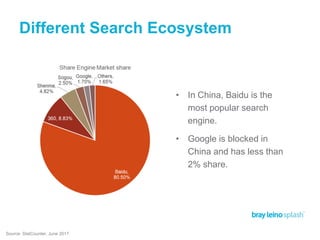
• In China, Baidu is the
most popular search
engine.
• Google is blocked in
China and has less than
2% share.
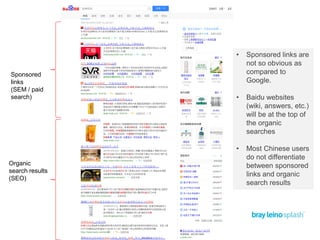
Sponsored
links
(SEM / paid
search)
Organic
search results
(SEO)
• Sponsored links are
not so obvious as
compared to
Google.
• Baidu websites
(wiki, answers, etc.)
will be at the top of
the organic
searches
• Most Chinese users
do not differentiate
between sponsored
links and organic
search results
Content is still King
Learnings:
Focus on customer pain points and how the product
solves the problems, not on how great the product is.
Be mindful of gap in Chinese customers' knowledge
(versus those in Western countries)
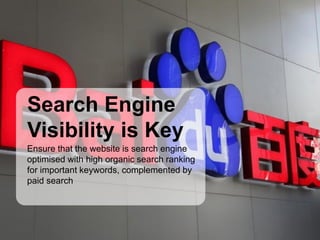
Ensure that the website is search engine
optimised with high organic search ranking
for important keywords, complemented by
paid search
Search Engine
Visibility is Key
Mobile Domination
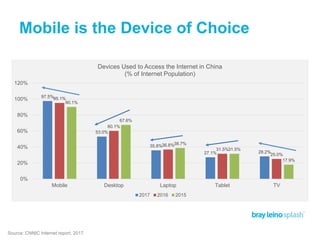
Mobile is the Device of Choice
97.5%
53.0%
35.8%
27.1% 28.2%
95.1%
60.1%
36.8%
31.5%
25.0%
90.1%
67.6%
38.7%
31.5%
17.9%
0%
20%
40%
60%
80%
100%
120%
Mobile Desktop Laptop Tablet TV
Devices Used to Access the Internet in China
(% of Internet Population)
2017 2016 2015
Source: CNNIC Internet report, 2017
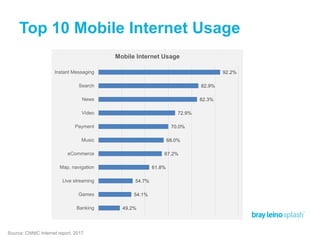
Top 10 Mobile Internet Usage
49.2%
54.1%
54.7%
61.8%
67.2%
68.0%
70.0%
72.9%
82.3%
82.9%
92.2%
Banking
Games
Live streaming
Map, navigation
eCommerce
Music
Payment
Video
News
Search
Instant Messaging
Mobile Internet Usage
Source: CNNIC Internet report, 2017
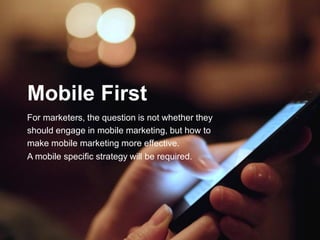
Mobile First
For marketers, the question is not whether they
should engage in mobile marketing, but how to
make mobile marketing more effective.
A mobile specific strategy will be required.
A Social Way of Life
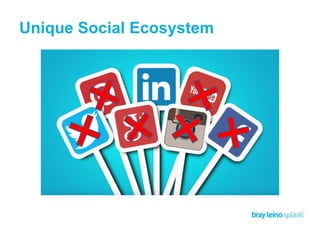
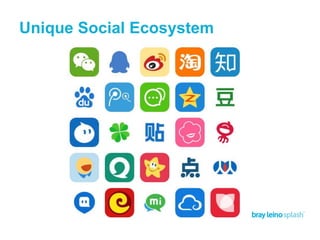
Unique Social Ecosystem
So What is WeChat?
“Isn’t WeChat just a carbon
copy of WhatsApp in China?”
“Messaging Apps all do the same
thing, what’s the difference?”
“WeChat is only popular in
China. Why do I need it?”
Common Misconceptions
So What is WeChat?
“Isn’t WeChat just a carbon
copy of WhatsApp in China?”
“Messaging Apps all do the same
thing, what’s the difference?”
“WeChat is only popular in
China. Why do I need it?”
Common Misconceptions
WeChat is NOT just a
Messaging APP…
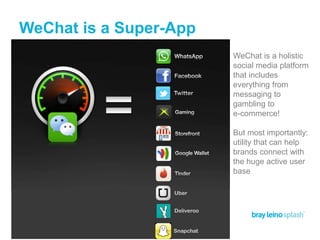
WeChat is a Super-App
WeChat is a holistic
social media platform
that includes
everything from
messaging to
gambling to
e-commerce!
But most importantly:
utility that can help
brands connect with
the huge active user
base
Uber
Deliveroo
Snapchat
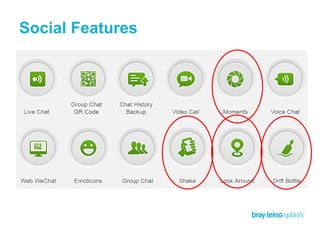
Social Features
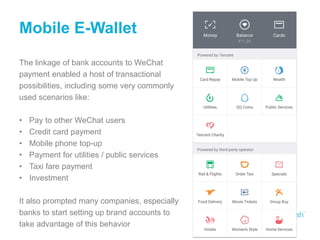
Mobile E-Wallet
The linkage of bank accounts to WeChat
payment enabled a host of transactional
possibilities, including some very commonly
used scenarios like:
• Pay to other WeChat users
• Credit card payment
• Mobile phone top-up
• Payment for utilities / public services
• Taxi fare payment
• Investment
It also prompted many companies, especially
banks to start setting up brand accounts to
take advantage of this behavior
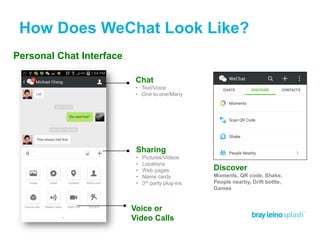
How Does WeChat Look Like?
Personal Chat Interface
Discover
Moments, QR code, Shake,
People nearby, Drift bottle,
Games
Chat
• Text/Voice
• One to one/Many
Sharing
• Pictures/Videos
• Locations
• Web pages
• Name cards
• 3rd party plug-ins
Voice or
Video Calls
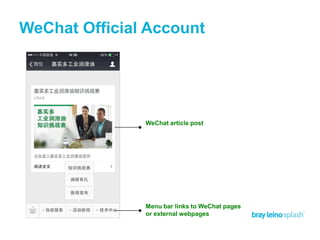
WeChat Official Account
Menu bar links to WeChat pages
or external webpages
WeChat article post
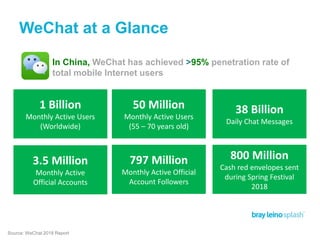
In China, WeChat has achieved >95% penetration rate of
total mobile Internet users
1 Billion
Monthly Active Users
(Worldwide)
WeChat at a Glance
50 Million
Monthly Active Users
(55 – 70 years old)
38 Billion
Daily Chat Messages
3.5 Million
Monthly Active
Official Accounts
797 Million
Monthly Active Official
Account Followers
800 Million
Cash red envelopes sent
during Spring Festival
2018
Source: WeChat 2018 Report
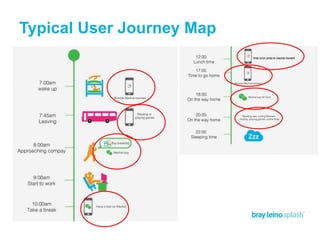
Typical User Journey Map
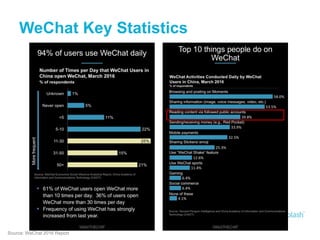
WeChat Key Statistics
Source: WeChat 2016 Report
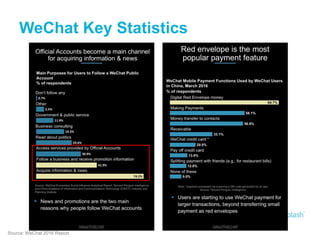
WeChat Key Statistics
Source: WeChat 2016 Report
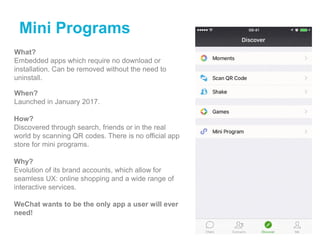
Mini Programs
What?
Embedded apps which require no download or
installation. Can be removed without the need to
uninstall.
When?
Launched in January 2017.
How?
Discovered through search, friends or in the real
world by scanning QR codes. There is no official app
store for mini programs.
Why?
Evolution of its brand accounts, which allow for
seamless UX: online shopping and a wide range of
interactive services.
WeChat wants to be the only app a user will ever
need!
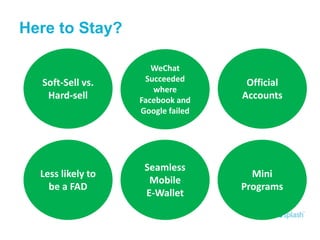
Here to Stay?
Soft-Sell vs.
Hard-sell
WeChat
Succeeded
where
Facebook and
Google failed
Official
Accounts
Less likely to
be a FAD
Seamless
Mobile
E-Wallet
Mini
Programs
How Can WeChat
Help Businesses?
01
BRAND ACCOUNT
Similar to other social media (Facebook, Weibo
etc), most efforts by brands have gone into
creating branded spaces to share content and
provide information.
Brands distribute stories, means, infographics and
audio, or does Q&A with celebrities.
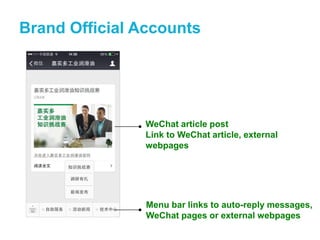
Brand Official Accounts
Menu bar links to auto-reply messages,
WeChat pages or external webpages
WeChat article post
Link to WeChat article, external
webpages
02
MICRO-CONTENTS
Success with branded accounts rests heavily on
creating original content on a regular basis – short
stories, videos, infographics and pictures.
The environment (UI) inside of WeChat brands is
really clean and simple. As a result, successful
content receives attention from audience.
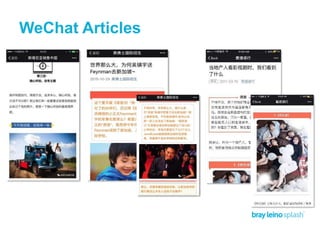
WeChat Articles
03
CUSTOMER SERVICE
After content, the second most applied strategy on
WeChat is in providing customer service and support.
At the moment, most of this service/support is
automated (providing balances, bookings) but there
clearly is an opportunity for brands to distinguish
themselves with more hands-on, customised support,
AI chatbot, etc.
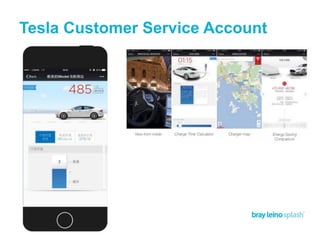
Tesla Customer Service Account
04
O2O2O
As a mobile, social network, WeChat enables strong
connections between offline-to-online (and vice versa)
at scale.
Location Based Services (LBS) in WeChat offers the
potential to: 1) Drive and track retail footfall, 2)
Encourage attendance at events/locations, 3) Collect
offline audience info online (for CRM).
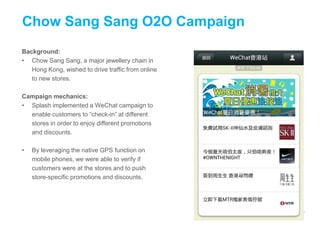
Background:
• Chow Sang Sang, a major jewellery chain in
Hong Kong, wished to drive traffic from online
to new stores.
Campaign mechanics:
• Splash implemented a WeChat campaign to
enable customers to “check-in” at different
stores in order to enjoy different promotions
and discounts.
• By leveraging the native GPS function on
mobile phones, we were able to verify if
customers were at the stores and to push
store-specific promotions and discounts.
Chow Sang Sang O2O Campaign
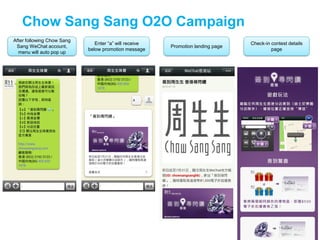
After following Chow Sang
Sang WeChat account,
menu will auto pop up
Enter “a” will receive
below promotion message
Promotion landing page
Check-in contest details
page
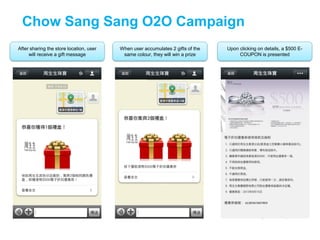
Chow Sang Sang O2O Campaign
After sharing the store location, user
will receive a gift message
When user accumulates 2 gifts of the
same colour, they will win a prize
Upon clicking on details, a $500 E-
COUPON is presented
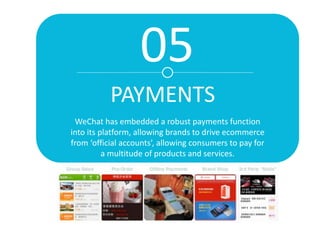
05
PAYMENTS
WeChat has embedded a robust payments function
into its platform, allowing brands to drive ecommerce
from ‘official accounts’, allowing consumers to pay for
a multitude of products and services.
06
‘PUSH’ ADVERTISING
WeChat launched ‘push’ advertising in 2015, offering
brands with a selected few high-profile companies
including BMW, Coca Cola etc.
The ads were sent to targeted audience segments
through its ‘moments’ function or footer ad, directly
into audiences social stream.
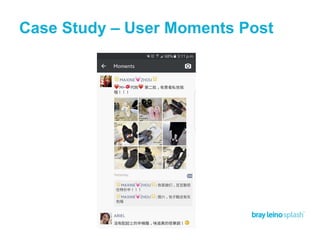
Case Study – User Moments Post
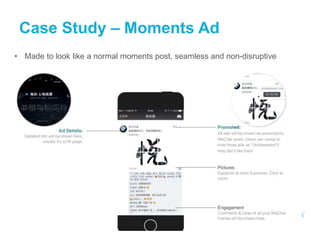
Case Study – Moments Ad
• Made to look like a normal moments post, seamless and non-disruptive
Social media is no longer a communication
tool but has become a main channel to get
information. Brands should leverage social
media to interact with consumers.
Real Media
Key Takeaways
• Web Design - It’s not that Western or Chinese web design is better or
worse, it’s the fact that they are different and it works best for their
respective audience.
• Search Engine Visibility - Ensure that the website is search engine
optimised with high organic search ranking for important keywords,
complemented by paid search.
• Mobile First Approach - A mobile specific marketing strategy will be
required.
• Social media is no longer a communication tool but has become a main
channel to get information. Brands should leverage social media to
interact with consumers.
Tan Kay Kin
CEO Greater China
E: kktan@splashinteractive.com.cn
T: (86) 21 6218 7776
www.splashinteractive.com.cn

Playing to Win in China - Digital User Behaviour

  • 1.
    Digital User Behaviour -China vs The West
  • 2.
  • 3.
  • 4.
  • 5.
    Built for theMasses • 772 million internet users (grown more than 50% in last 5 years) • 44% not online yet! • Different levels of internet experience and sophistication, devices, access speed • Chinese websites have to dumb-down their designs to cater to a wider range of users 210,000 298,000 384,000 457,300 513,100 564,000 617,580 648,750 688,260 731,250 771,980 16.0% 22.6% 28.9% 34.3% 38.3% 42.1% 45.8% 47.9% 50.3% 53.2% 55.8% 2007 2008 2009 2010 2011 2012 2013 2014 2015 2016 2017 Internet users (,000) Penetration rate
  • 6.
    More is More •Chinese believe that the more activity and visual stimulants a website has, the more it validates the website's value. • This is especially the case for e- Commerce platforms which try to replicate the feeling of a real, physical market shopping experience. • Liberal use of red (which is good luck in Chinese culture) will have an opposite impression with Westerners, where red is a sign of danger. As an example, a red stock ticker means increase in stock price in China.
  • 7.
    Tabs, Tabs andmore Tabs • Chinese Internet speeds are still comparatively slow as compared to the West • This is why Chinese websites, especially news portals or other content rich platforms, are text and link heavy. • When users click on links, they will automatically spawn a new tab. This way, users can easily scan through content and click on multiple links at a time. While the pages are loading, they can read each tab progressively. When done, they just close the tab and the previous page is still in the last tab • It’s a practical means to a functional problem.
  • 8.
    Chinese Characters areComplex • English consists of a 26 letter alphabet which are combined to create words • Chinese is composed of over 50,000 characters, each one of them conveying a succinct and deep meaning. • Moreover, there are no upper / lower casing and spacing. • Hence, content may look overwhelming and messy on a website if the user is unable to read Chinese.
  • 9.
    Limited Font Choices •Since English consists of only 26 letters, a font designer would only have to create 26 unique designs to complete a font set. • A standard Chinese character set consists of about 10,000 unique characters, with about 3,000 of those characters common in daily use. • Because of the huge set of characters, Chinese font sizes normally range from 5 to 10 MB per file. As such, it is not feasible to use CSS font embedding. • Hence, we resort to using only “web safe” Chinese fonts
  • 10.
    Side by SideComparison
  • 11.
    Search – Gatewayto Internet
  • 12.
    Gateway to Internet •>80%* of Chinese internet population use search engines as an entry point to websites • Chinese internet users do not remember domain names and the use of search engines is a necessity. • This behaviour is unlikely to change: • Domain names are in English. As English is a foreign language to Chinese users, it is difficult for them to remember domain names. • Many Chinese companies use domain names which are unrelated to their company names (including the use of numbers). Such practice makes it more difficult for users to remember the domain name. • For daily searches, most users do not differentiate between paid search results and organic search results Source: CNNIC Internet report, 2017
  • 13.
    Different Search Ecosystem Source:StatCounter, June 2017 • In China, Baidu is the most popular search engine. • Google is blocked in China and has less than 2% share.
  • 14.
    Sponsored links (SEM / paid search) Organic searchresults (SEO) • Sponsored links are not so obvious as compared to Google. • Baidu websites (wiki, answers, etc.) will be at the top of the organic searches • Most Chinese users do not differentiate between sponsored links and organic search results
  • 15.
    Content is stillKing Learnings: Focus on customer pain points and how the product solves the problems, not on how great the product is. Be mindful of gap in Chinese customers' knowledge (versus those in Western countries) Ensure that the website is search engine optimised with high organic search ranking for important keywords, complemented by paid search Search Engine Visibility is Key
  • 16.
  • 17.
    Mobile is theDevice of Choice 97.5% 53.0% 35.8% 27.1% 28.2% 95.1% 60.1% 36.8% 31.5% 25.0% 90.1% 67.6% 38.7% 31.5% 17.9% 0% 20% 40% 60% 80% 100% 120% Mobile Desktop Laptop Tablet TV Devices Used to Access the Internet in China (% of Internet Population) 2017 2016 2015 Source: CNNIC Internet report, 2017
  • 18.
    Top 10 MobileInternet Usage 49.2% 54.1% 54.7% 61.8% 67.2% 68.0% 70.0% 72.9% 82.3% 82.9% 92.2% Banking Games Live streaming Map, navigation eCommerce Music Payment Video News Search Instant Messaging Mobile Internet Usage Source: CNNIC Internet report, 2017
  • 19.
    Mobile First For marketers,the question is not whether they should engage in mobile marketing, but how to make mobile marketing more effective. A mobile specific strategy will be required.
  • 20.
    A Social Wayof Life
  • 21.
  • 22.
  • 24.
    So What isWeChat? “Isn’t WeChat just a carbon copy of WhatsApp in China?” “Messaging Apps all do the same thing, what’s the difference?” “WeChat is only popular in China. Why do I need it?” Common Misconceptions
  • 25.
    So What isWeChat? “Isn’t WeChat just a carbon copy of WhatsApp in China?” “Messaging Apps all do the same thing, what’s the difference?” “WeChat is only popular in China. Why do I need it?” Common Misconceptions WeChat is NOT just a Messaging APP…
  • 26.
    WeChat is aSuper-App WeChat is a holistic social media platform that includes everything from messaging to gambling to e-commerce! But most importantly: utility that can help brands connect with the huge active user base Uber Deliveroo Snapchat
  • 27.
  • 28.
    Mobile E-Wallet The linkageof bank accounts to WeChat payment enabled a host of transactional possibilities, including some very commonly used scenarios like: • Pay to other WeChat users • Credit card payment • Mobile phone top-up • Payment for utilities / public services • Taxi fare payment • Investment It also prompted many companies, especially banks to start setting up brand accounts to take advantage of this behavior
  • 29.
    How Does WeChatLook Like? Personal Chat Interface Discover Moments, QR code, Shake, People nearby, Drift bottle, Games Chat • Text/Voice • One to one/Many Sharing • Pictures/Videos • Locations • Web pages • Name cards • 3rd party plug-ins Voice or Video Calls
  • 30.
    WeChat Official Account Menubar links to WeChat pages or external webpages WeChat article post
  • 32.
    In China, WeChathas achieved >95% penetration rate of total mobile Internet users 1 Billion Monthly Active Users (Worldwide) WeChat at a Glance 50 Million Monthly Active Users (55 – 70 years old) 38 Billion Daily Chat Messages 3.5 Million Monthly Active Official Accounts 797 Million Monthly Active Official Account Followers 800 Million Cash red envelopes sent during Spring Festival 2018 Source: WeChat 2018 Report
  • 33.
  • 34.
  • 35.
  • 36.
    Mini Programs What? Embedded appswhich require no download or installation. Can be removed without the need to uninstall. When? Launched in January 2017. How? Discovered through search, friends or in the real world by scanning QR codes. There is no official app store for mini programs. Why? Evolution of its brand accounts, which allow for seamless UX: online shopping and a wide range of interactive services. WeChat wants to be the only app a user will ever need!
  • 37.
    Here to Stay? Soft-Sellvs. Hard-sell WeChat Succeeded where Facebook and Google failed Official Accounts Less likely to be a FAD Seamless Mobile E-Wallet Mini Programs
  • 38.
  • 39.
    01 BRAND ACCOUNT Similar toother social media (Facebook, Weibo etc), most efforts by brands have gone into creating branded spaces to share content and provide information. Brands distribute stories, means, infographics and audio, or does Q&A with celebrities.
  • 40.
    Brand Official Accounts Menubar links to auto-reply messages, WeChat pages or external webpages WeChat article post Link to WeChat article, external webpages
  • 41.
    02 MICRO-CONTENTS Success with brandedaccounts rests heavily on creating original content on a regular basis – short stories, videos, infographics and pictures. The environment (UI) inside of WeChat brands is really clean and simple. As a result, successful content receives attention from audience.
  • 42.
  • 43.
    03 CUSTOMER SERVICE After content,the second most applied strategy on WeChat is in providing customer service and support. At the moment, most of this service/support is automated (providing balances, bookings) but there clearly is an opportunity for brands to distinguish themselves with more hands-on, customised support, AI chatbot, etc.
  • 44.
  • 45.
    04 O2O2O As a mobile,social network, WeChat enables strong connections between offline-to-online (and vice versa) at scale. Location Based Services (LBS) in WeChat offers the potential to: 1) Drive and track retail footfall, 2) Encourage attendance at events/locations, 3) Collect offline audience info online (for CRM).
  • 46.
    Background: • Chow SangSang, a major jewellery chain in Hong Kong, wished to drive traffic from online to new stores. Campaign mechanics: • Splash implemented a WeChat campaign to enable customers to “check-in” at different stores in order to enjoy different promotions and discounts. • By leveraging the native GPS function on mobile phones, we were able to verify if customers were at the stores and to push store-specific promotions and discounts. Chow Sang Sang O2O Campaign
  • 47.
    Chow Sang SangO2O Campaign After following Chow Sang Sang WeChat account, menu will auto pop up Enter “a” will receive below promotion message Promotion landing page Check-in contest details page
  • 48.
    Chow Sang SangO2O Campaign After sharing the store location, user will receive a gift message When user accumulates 2 gifts of the same colour, they will win a prize Upon clicking on details, a $500 E- COUPON is presented
  • 49.
    05 PAYMENTS WeChat has embeddeda robust payments function into its platform, allowing brands to drive ecommerce from ‘official accounts’, allowing consumers to pay for a multitude of products and services.
  • 50.
    06 ‘PUSH’ ADVERTISING WeChat launched‘push’ advertising in 2015, offering brands with a selected few high-profile companies including BMW, Coca Cola etc. The ads were sent to targeted audience segments through its ‘moments’ function or footer ad, directly into audiences social stream.
  • 51.
    Case Study –User Moments Post
  • 52.
    Case Study –Moments Ad • Made to look like a normal moments post, seamless and non-disruptive
  • 53.
    Social media isno longer a communication tool but has become a main channel to get information. Brands should leverage social media to interact with consumers. Real Media
  • 54.
    Key Takeaways • WebDesign - It’s not that Western or Chinese web design is better or worse, it’s the fact that they are different and it works best for their respective audience. • Search Engine Visibility - Ensure that the website is search engine optimised with high organic search ranking for important keywords, complemented by paid search. • Mobile First Approach - A mobile specific marketing strategy will be required. • Social media is no longer a communication tool but has become a main channel to get information. Brands should leverage social media to interact with consumers.
  • 55.
    Tan Kay Kin CEOGreater China E: kktan@splashinteractive.com.cn T: (86) 21 6218 7776 www.splashinteractive.com.cn