INTERNET
L E S S O N 1 : E VA L U AT I N G W E B S I T E S
I N F O R M AT I O N L I T E R A C Y S E R I E S
INVESTIGATORS
ESSENTIAL QUESTION…
Why is it important to evaluate
(examine) the source and validity
(whether something is factual) of the
information found on a Web site?
TO ACCESS THIS PRESENTATION:
http://pcms.putnam.libguides.com/websites
LET’S LEARN ABOUT EXPLORERS!
• Group 1: Cabot
• Group 2: Drake
• Group 3: Columbus
• Group 4: de Leon
• Group 5: Magellan
• Group 6: Hudson
• Group 7: Vespucci
In your groups, click on your assigned explorer and read the article
about your explorer. You will have to read and answer 3 questions
about this person.
Once you have located the answers to the questions about your
explorer, write them down. We will share what you learn with your
classmates:
THE TRUTH ABOUT EXPLORERS
• Here are some sites that give factual information about these explorers:
– John Cabot
– Sir Francis Drake
– Christopher Columbus
– Juan Ponce de Leon
– Ferdinand Magellan
– Henry Hudson
– Amerigo Vespucci
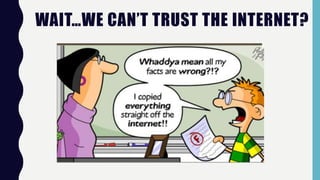
WAIT…WE CAN’T TRUST THE INTERNET?
HOW CAN WE DETERMINE
THE VALIDITY OF A
WEBSITE?
ANATOMY OF A WEB PAGE
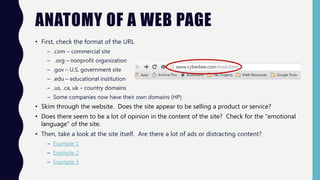
• First, check the format of the URL
– .com – commercial site
– .org – nonprofit organization
– .gov – U.S. government site
– .edu – educational institution
– .us, .ca, uk – country domains
– Some companies now have their own domains (HP)
• Skim through the website. Does the site appear to be selling a product or service?
• Does there seem to be a lot of opinion in the content of the site? Check for the "emotional
language” of the site.
• Then, take a look at the site itself. Are there a lot of ads or distracting content?
– Example 1
– Example 2
– Example 3
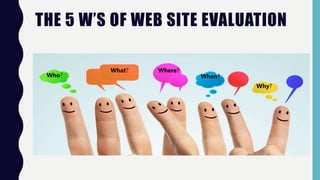
THE 5 W’S OF WEB SITE EVALUATION
Who?
What? Where?
When?
Why?
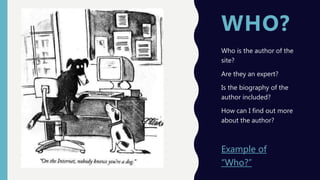
WHO?
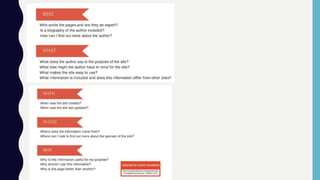
Who is the author of the
site?
Are they an expert?
Is the biography of the
author included?
How can I find out more
about the author?
Example of
“Who?”
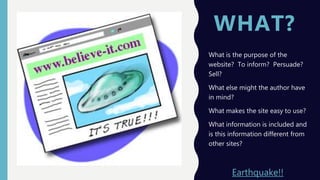
WHAT?
What is the purpose of the
website? To inform? Persuade?
Sell?
What else might the author have
in mind?
What makes the site easy to use?
What information is included and
is this information different from
other sites?
Earthquake!!
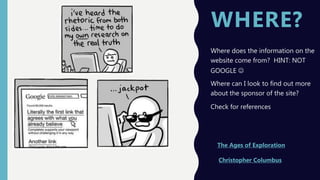
WHERE?
Where does the information on the
website come from? HINT: NOT
GOOGLE 
Where can I look to find out more
about the sponsor of the site?
Check for references
The Ages of Exploration
Christopher Columbus
WHEN?
When was the site
created?
When was it last
updated?
Date of website can
often be found at the
bottom of the page.
WHY?
Why is this information
useful for my purpose?
Why should I use this
information?
Why is this site or page
better than another?
NOTES TO REMEMBER…
• A web page can look very authentic and may seem to meet the criteria for the 5W’s
• Likewise, a website may have several ads and not be well-designed, but still
contains valid and reliable information.
• You need to READ and THINK about what you are reading when you are
researching.
– Check for ACCURACY! Does the information seem true? Can you verify the
information?
– Use COMMON SENSE! If something on the website or page seems silly or “out there”,
it may not be a reliable site.
• Always check more than one site to compare information and facts
• Let’s take a look at this site:
– Analysis of a Killer Tornado
NOW, IT’S YOUR TURN!
• Visit the following links and complete a Website Evaluation Rubric for each site. Can
you determine which ones provide accurate information and which ones do not?
– Help Save the Pacific Tree Octopus
– Central Intelligence Agency
– Google Technology
– Internet Library
– The Dangers of DHMO
– Google Gulp
ESSENTIAL QUESTION…
Why is it important to evaluate
(examine) the source and validity
(whether something is factual) of the
information found on a Web site?
Let's Play Kahoot!
Go to kahoot.it and wait for
the Game Pin

Website evaluation

  • 1.
    INTERNET L E SS O N 1 : E VA L U AT I N G W E B S I T E S I N F O R M AT I O N L I T E R A C Y S E R I E S INVESTIGATORS
  • 2.
    ESSENTIAL QUESTION… Why isit important to evaluate (examine) the source and validity (whether something is factual) of the information found on a Web site?
  • 3.
    TO ACCESS THISPRESENTATION: http://pcms.putnam.libguides.com/websites
  • 4.
    LET’S LEARN ABOUTEXPLORERS! • Group 1: Cabot • Group 2: Drake • Group 3: Columbus • Group 4: de Leon • Group 5: Magellan • Group 6: Hudson • Group 7: Vespucci In your groups, click on your assigned explorer and read the article about your explorer. You will have to read and answer 3 questions about this person. Once you have located the answers to the questions about your explorer, write them down. We will share what you learn with your classmates:
  • 5.
    THE TRUTH ABOUTEXPLORERS • Here are some sites that give factual information about these explorers: – John Cabot – Sir Francis Drake – Christopher Columbus – Juan Ponce de Leon – Ferdinand Magellan – Henry Hudson – Amerigo Vespucci
  • 6.
  • 7.
    HOW CAN WEDETERMINE THE VALIDITY OF A WEBSITE?
  • 8.
    ANATOMY OF AWEB PAGE • First, check the format of the URL – .com – commercial site – .org – nonprofit organization – .gov – U.S. government site – .edu – educational institution – .us, .ca, uk – country domains – Some companies now have their own domains (HP) • Skim through the website. Does the site appear to be selling a product or service? • Does there seem to be a lot of opinion in the content of the site? Check for the "emotional language” of the site. • Then, take a look at the site itself. Are there a lot of ads or distracting content? – Example 1 – Example 2 – Example 3
  • 9.
    THE 5 W’SOF WEB SITE EVALUATION Who? What? Where? When? Why?
  • 10.
    WHO? Who is theauthor of the site? Are they an expert? Is the biography of the author included? How can I find out more about the author? Example of “Who?”
  • 11.
    WHAT? What is thepurpose of the website? To inform? Persuade? Sell? What else might the author have in mind? What makes the site easy to use? What information is included and is this information different from other sites? Earthquake!!
  • 12.
    WHERE? Where does theinformation on the website come from? HINT: NOT GOOGLE  Where can I look to find out more about the sponsor of the site? Check for references The Ages of Exploration Christopher Columbus
  • 13.
    WHEN? When was thesite created? When was it last updated? Date of website can often be found at the bottom of the page.
  • 14.
    WHY? Why is thisinformation useful for my purpose? Why should I use this information? Why is this site or page better than another?
  • 16.
    NOTES TO REMEMBER… •A web page can look very authentic and may seem to meet the criteria for the 5W’s • Likewise, a website may have several ads and not be well-designed, but still contains valid and reliable information. • You need to READ and THINK about what you are reading when you are researching. – Check for ACCURACY! Does the information seem true? Can you verify the information? – Use COMMON SENSE! If something on the website or page seems silly or “out there”, it may not be a reliable site. • Always check more than one site to compare information and facts • Let’s take a look at this site: – Analysis of a Killer Tornado
  • 17.
    NOW, IT’S YOURTURN! • Visit the following links and complete a Website Evaluation Rubric for each site. Can you determine which ones provide accurate information and which ones do not? – Help Save the Pacific Tree Octopus – Central Intelligence Agency – Google Technology – Internet Library – The Dangers of DHMO – Google Gulp
  • 18.
    ESSENTIAL QUESTION… Why isit important to evaluate (examine) the source and validity (whether something is factual) of the information found on a Web site? Let's Play Kahoot! Go to kahoot.it and wait for the Game Pin