Ensuring Your Resources are Valid   by Christin Banes
   Visit the following site, and make some
    observations about the type of information you
    find there: Aluminum Foil Deflector Beanies
   You will notice information found is well-
    organized and the style of the page seems to be
    professional, but upon further investigation,
    some issues pop up…
   The information here is not supported by
    scientific fact, or by functional links, and the
    author does not offer verifiable information
    about his background
 Let’s discuss the reasons a
web site may be useful or not
and how to decide if a site is valid.

 By the end of this lesson, you will
be able to look at a site online and
determine if the site is reliable through
a simple, clear evaluation process.
   Introduction to Evaluation
   The Five W’s of Evaluation
       Who?
       What?
       When?
       Where?
       Why?
   Domain extensions
   Quiz
   Information can be posted to           You should be looking for:
    the Internet by anyone and               authenticity- true information
                                              that is supported elsewhere and
    editorial or expert review is not         proven fact
    always used, so don’t always             Authorship-written by an expert
    trust it.                                 with a reputable education, an
                                              author with a biography and links
   May look credible meaning links           to more information about them,
    to other sites, nicely presented,         an author who can be contacted,
    and supporting information, but           authors who used verifiable
                                              resources
    is actually untrue.                      Bias- information that only
   It is best to get a base of               represents one side of an
    knowledge from print resources            argument
                                             Usability-a site that easy to
    like databases, encyclopedias or          navigate through, information
    nonfiction books to know when             that is correct and can be verified
    information is questionable.              and links that work
   Who wrote the pages
    and are they an expert?
    Is there a biography?
   Can I find out more
    about the author-Look in
    the “about us” or
    “contact us” sections?
   Where was the author
    educated?
   Can you verify the
    authority of the
    information source?
 I can probably find information about the
  author in the…
a. “About us” or “contact us” section
b. The “Games” section
c. The “photo gallery” section
d. The “blogs” section
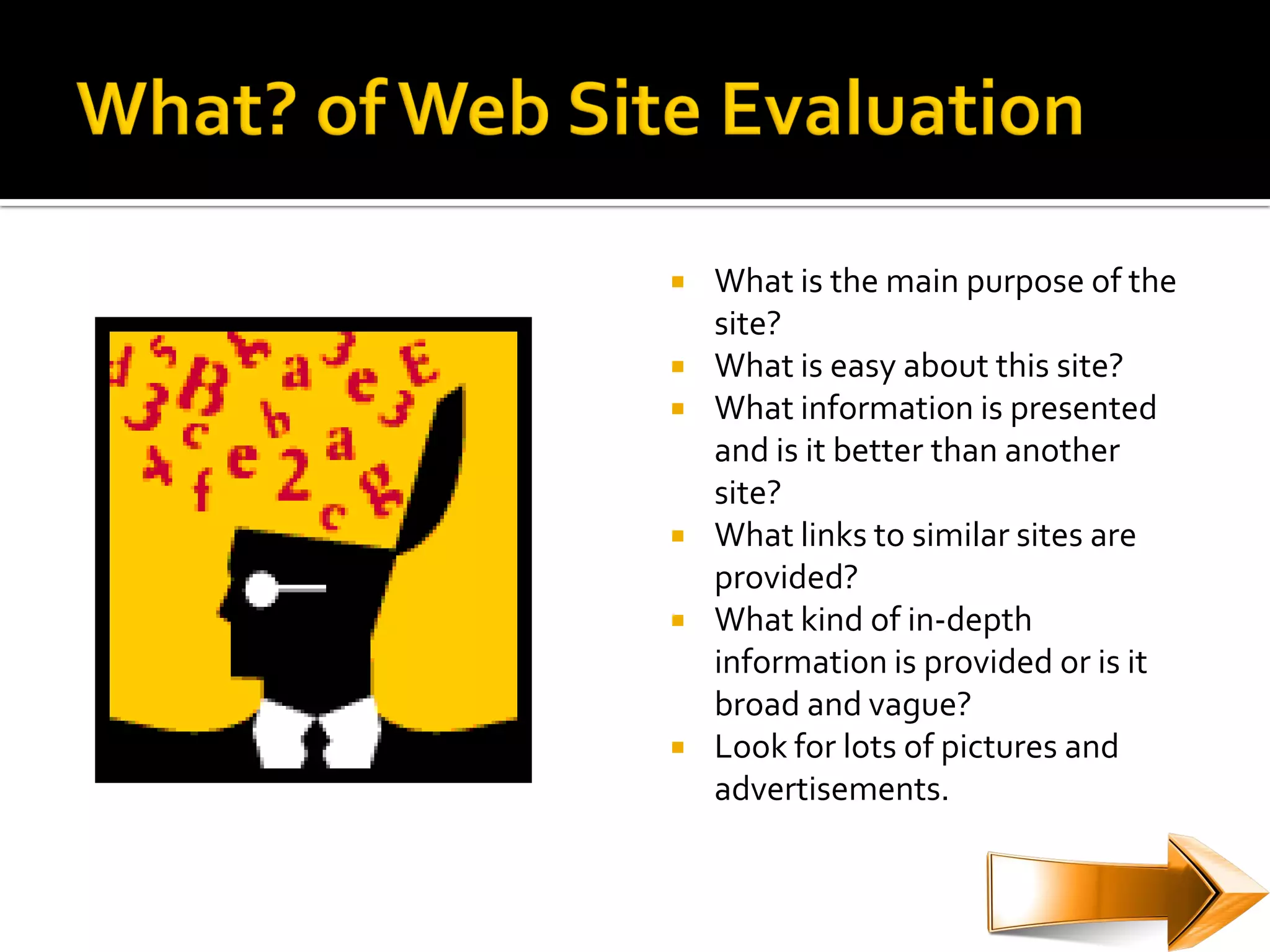
   What is the main purpose of the
    site?
   What is easy about this site?
   What information is presented
    and is it better than another
    site?
   What links to similar sites are
    provided?
   What kind of in-depth
    information is provided or is it
    broad and vague?
   Look for lots of pictures and
    advertisements.
 If the main purpose of a site is to give
  information it will NOT
a. Be a governmental site
b. Persuade me to think a certain way
c. Be an educational site
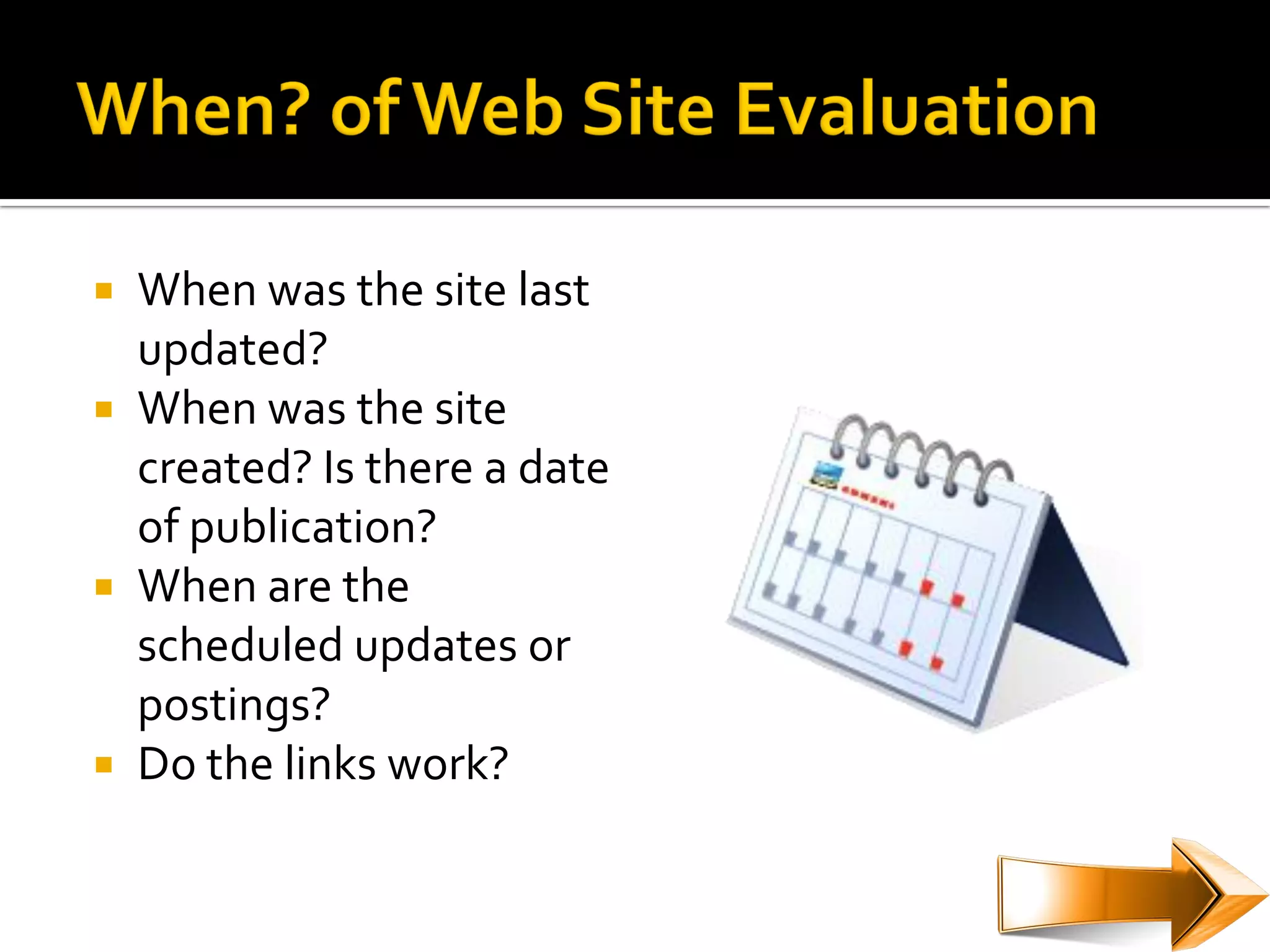
 When was the site last
  updated?
 When was the site
  created? Is there a date
  of publication?
 When are the
  scheduled updates or
  postings?
 Do the links work?
 A site whose links are for the most part
  inoperable is probably out of date and not
  kept up by its author.
a. True
b. False
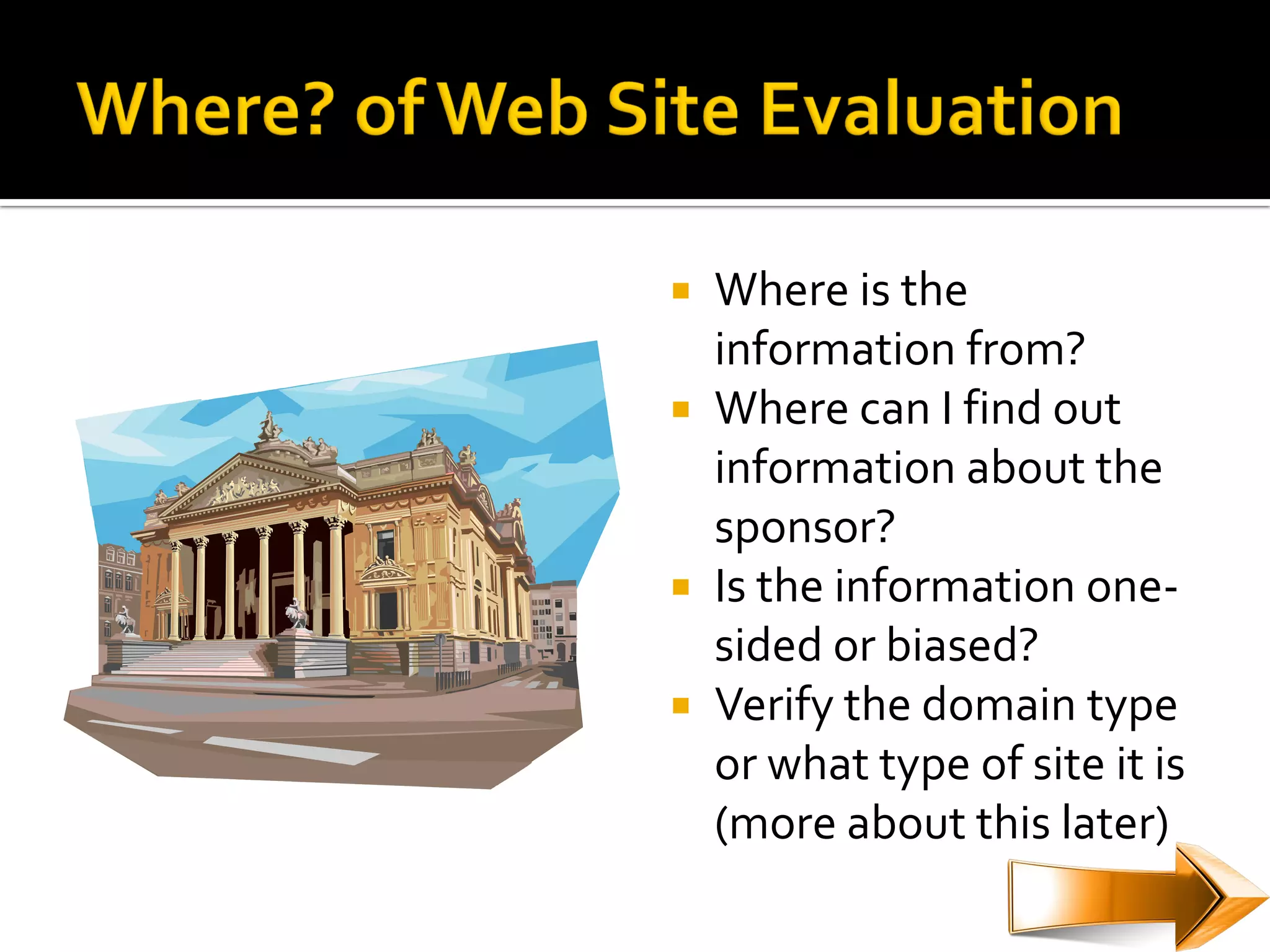
 Where is the
  information from?
 Where can I find out
  information about the
  sponsor?
 Is the information one-
  sided or biased?
 Verify the domain type
  or what type of site it is
  (more about this later)
 Information will usually be good if it is from…
a. A governmental site
b. An educational site
c. A professional site of an expert
d. All of the above
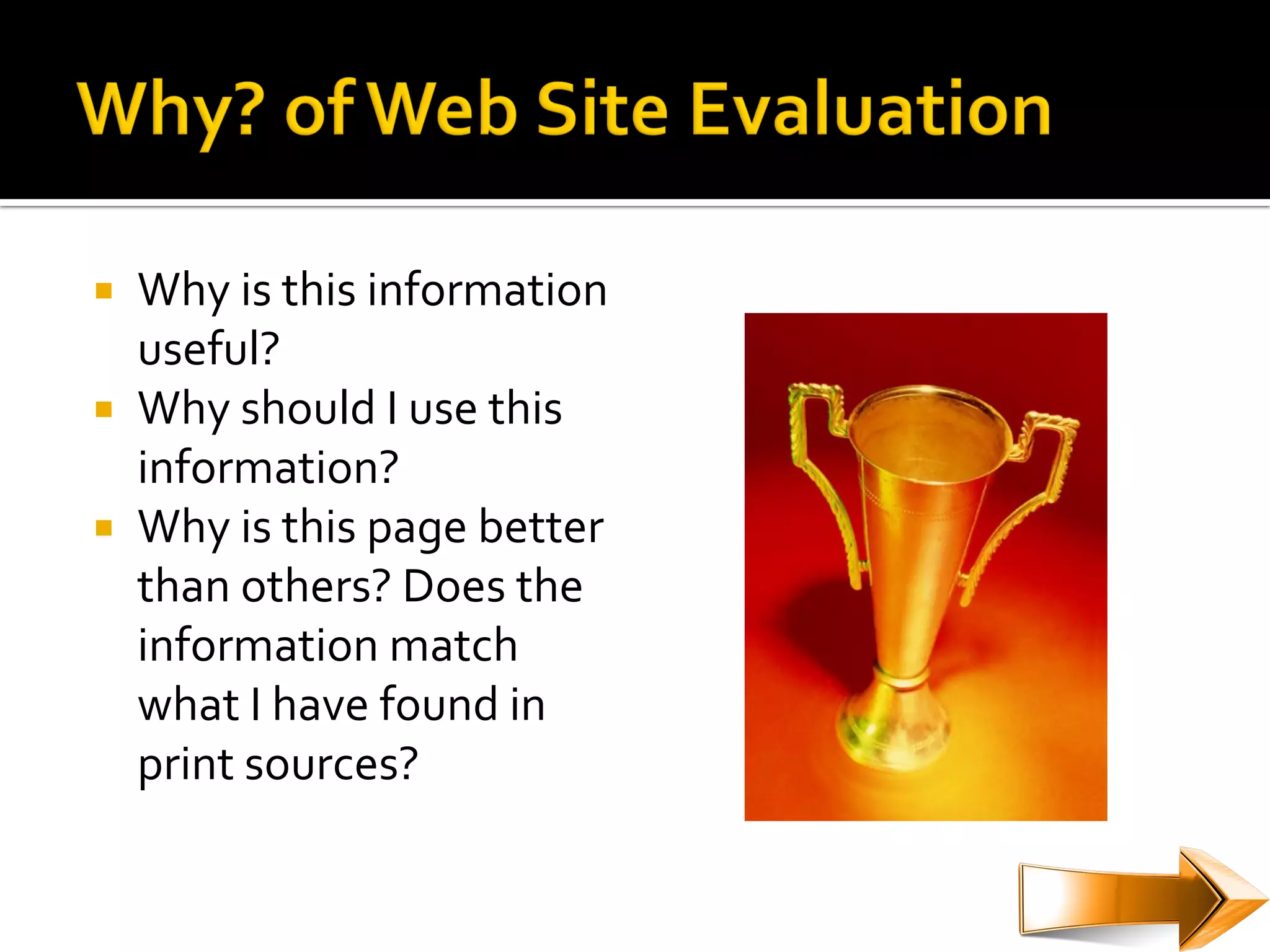
 Why is this information
  useful?
 Why should I use this
  information?
 Why is this page better
  than others? Does the
  information match
  what I have found in
  print sources?
 Good sources for initial printed information
  include:
a. Databases
b. Encyclopedias
c. Nonfiction books
d. All of the above
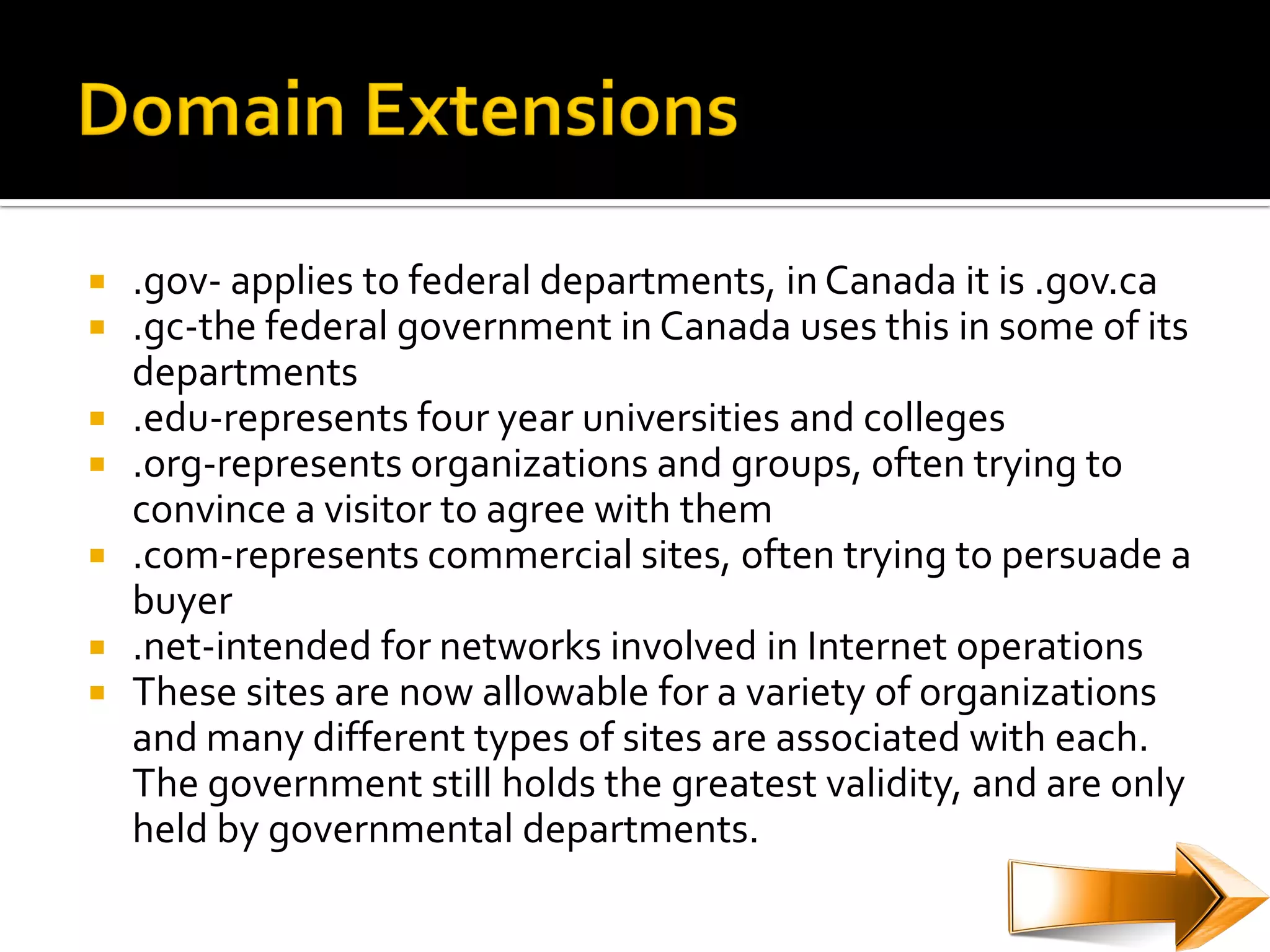
 .gov- applies to federal departments, in Canada it is .gov.ca
 .gc-the federal government in Canada uses this in some of its
  departments
 .edu-represents four year universities and colleges
 .org-represents organizations and groups, often trying to
  convince a visitor to agree with them
 .com-represents commercial sites, often trying to persuade a
  buyer
 .net-intended for networks involved in Internet operations
 These sites are now allowable for a variety of organizations
  and many different types of sites are associated with each.
  The government still holds the greatest validity, and are only
  held by governmental departments.
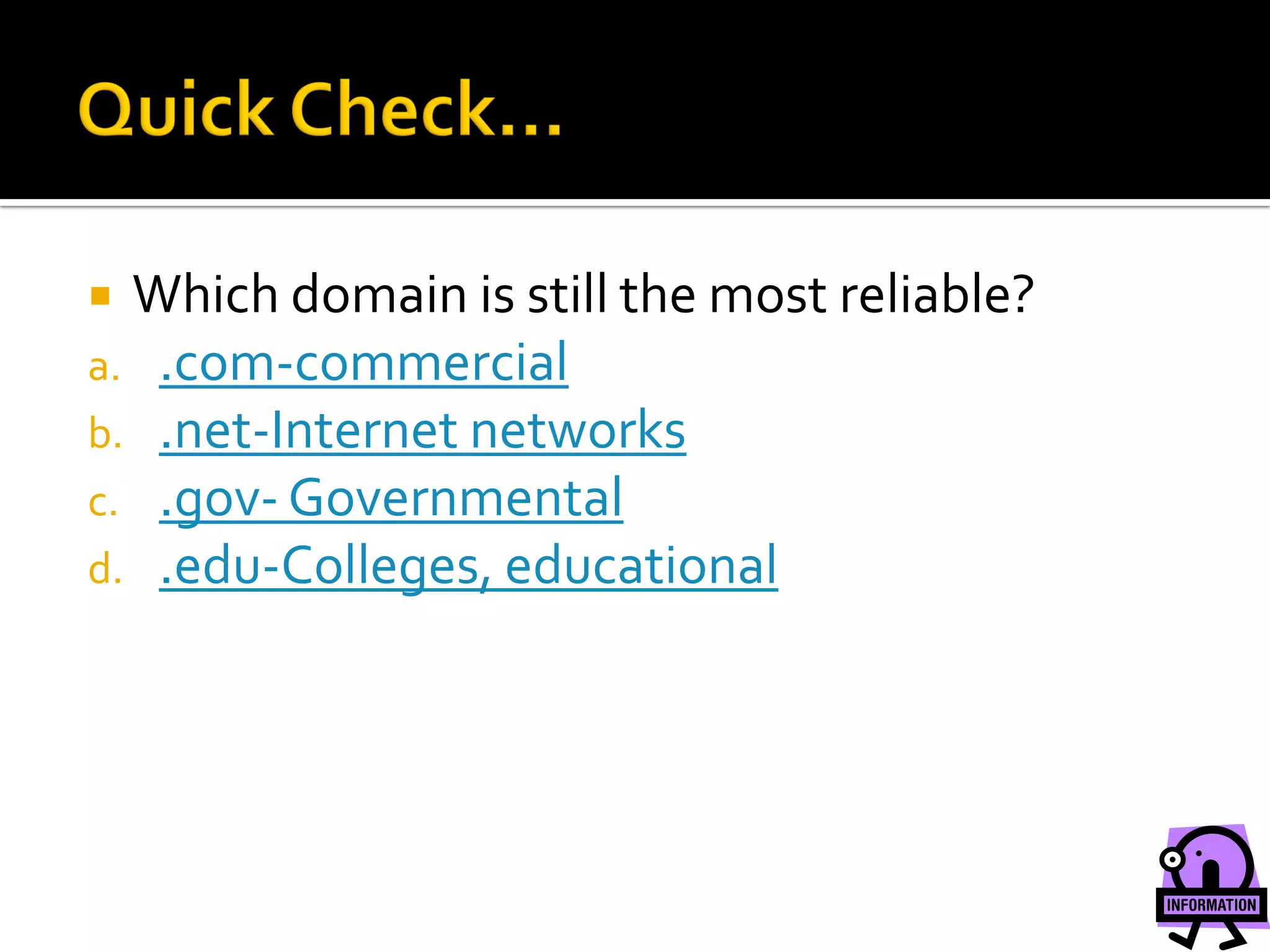
 Which domain is still the most reliable?
a. .com-commercial
b. .net-Internet networks
c. .gov- Governmental
d. .edu-Colleges, educational
1.   Are commercial sites good sources of
     information?
a.   no, they are always biased
b.   Yes
c.   Sometimes, but lookout for persuasive
     advertising
2. Where should I begin my research process?
a. Ask the teacher
b. In a print source like a nonfiction book or
   encyclopedia
c. online
3. Who would be the best provider of
  information?
a. A group of kids
b. An organization trying to get me to buy
   something
c. An expert on the subject
4. Should you use a site without an author?
a. Never
b. Sometimes, if it is a page on a reputable site
    I have reviewed
c. Yes
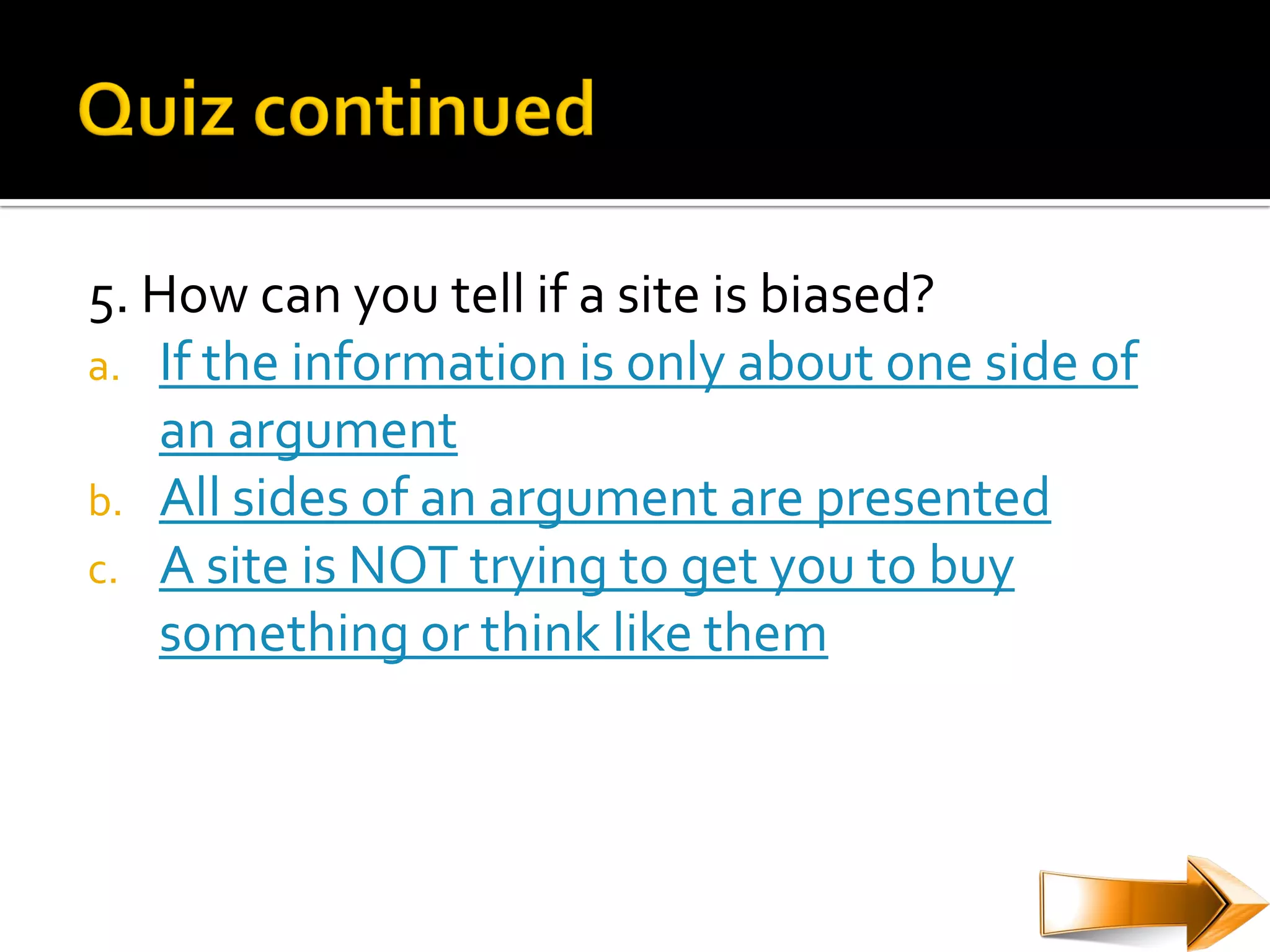
5. How can you tell if a site is biased?
a. If the information is only about one side of
   an argument
b. All sides of an argument are presented
c. A site is NOT trying to get you to buy
   something or think like them
Return to question #
 Use the form found at the following site to
  find a good site on the properties and uses of
  aluminum
http://school.discoveryeducation.com/schrockg
  uide/pdf/evalmidd.pdf

Print out the form, complete it and turn it in.
Schrock, Kathy. (2001). Information-Literacy Primer: Learning to research
   on the web. Edutopia. George Lucas Educational Foundation. 30 June
   2010.

Schrock, Kathy. (2010). Teacher Helpers: Critical Evaluation Information.
   Discovery Education. 30 June 2010. Retrieved from
   http://school.discoveryeducation.com/schrockguide/eval.html

(2010). The Five W’s of Cyberspace. Media Awareness Network. 1 July 2010.
   Retrieved from http://www.media-
   awareness.ca/english/resources/educational/handouts/internet/5ws_cyb
   erspace.cfm

Web site

  • 1.
    Ensuring Your Resourcesare Valid by Christin Banes
  • 2.
    Visit the following site, and make some observations about the type of information you find there: Aluminum Foil Deflector Beanies  You will notice information found is well- organized and the style of the page seems to be professional, but upon further investigation, some issues pop up…  The information here is not supported by scientific fact, or by functional links, and the author does not offer verifiable information about his background
  • 3.
     Let’s discussthe reasons a web site may be useful or not and how to decide if a site is valid.  By the end of this lesson, you will be able to look at a site online and determine if the site is reliable through a simple, clear evaluation process.
  • 4.
    Introduction to Evaluation  The Five W’s of Evaluation  Who?  What?  When?  Where?  Why?  Domain extensions  Quiz
  • 5.
    Information can be posted to  You should be looking for: the Internet by anyone and  authenticity- true information that is supported elsewhere and editorial or expert review is not proven fact always used, so don’t always  Authorship-written by an expert trust it. with a reputable education, an author with a biography and links  May look credible meaning links to more information about them, to other sites, nicely presented, an author who can be contacted, and supporting information, but authors who used verifiable resources is actually untrue.  Bias- information that only  It is best to get a base of represents one side of an knowledge from print resources argument  Usability-a site that easy to like databases, encyclopedias or navigate through, information nonfiction books to know when that is correct and can be verified information is questionable. and links that work
  • 6.
    Who wrote the pages and are they an expert? Is there a biography?  Can I find out more about the author-Look in the “about us” or “contact us” sections?  Where was the author educated?  Can you verify the authority of the information source?
  • 7.
     I canprobably find information about the author in the… a. “About us” or “contact us” section b. The “Games” section c. The “photo gallery” section d. The “blogs” section
  • 10.
    What is the main purpose of the site?  What is easy about this site?  What information is presented and is it better than another site?  What links to similar sites are provided?  What kind of in-depth information is provided or is it broad and vague?  Look for lots of pictures and advertisements.
  • 11.
     If themain purpose of a site is to give information it will NOT a. Be a governmental site b. Persuade me to think a certain way c. Be an educational site
  • 14.
     When wasthe site last updated?  When was the site created? Is there a date of publication?  When are the scheduled updates or postings?  Do the links work?
  • 15.
     A sitewhose links are for the most part inoperable is probably out of date and not kept up by its author. a. True b. False
  • 18.
     Where isthe information from?  Where can I find out information about the sponsor?  Is the information one- sided or biased?  Verify the domain type or what type of site it is (more about this later)
  • 19.
     Information willusually be good if it is from… a. A governmental site b. An educational site c. A professional site of an expert d. All of the above
  • 22.
     Why isthis information useful?  Why should I use this information?  Why is this page better than others? Does the information match what I have found in print sources?
  • 23.
     Good sourcesfor initial printed information include: a. Databases b. Encyclopedias c. Nonfiction books d. All of the above
  • 26.
     .gov- appliesto federal departments, in Canada it is .gov.ca  .gc-the federal government in Canada uses this in some of its departments  .edu-represents four year universities and colleges  .org-represents organizations and groups, often trying to convince a visitor to agree with them  .com-represents commercial sites, often trying to persuade a buyer  .net-intended for networks involved in Internet operations  These sites are now allowable for a variety of organizations and many different types of sites are associated with each. The government still holds the greatest validity, and are only held by governmental departments.
  • 27.
     Which domainis still the most reliable? a. .com-commercial b. .net-Internet networks c. .gov- Governmental d. .edu-Colleges, educational
  • 30.
    1. Are commercial sites good sources of information? a. no, they are always biased b. Yes c. Sometimes, but lookout for persuasive advertising
  • 31.
    2. Where shouldI begin my research process? a. Ask the teacher b. In a print source like a nonfiction book or encyclopedia c. online
  • 32.
    3. Who wouldbe the best provider of information? a. A group of kids b. An organization trying to get me to buy something c. An expert on the subject
  • 33.
    4. Should youuse a site without an author? a. Never b. Sometimes, if it is a page on a reputable site I have reviewed c. Yes
  • 34.
    5. How canyou tell if a site is biased? a. If the information is only about one side of an argument b. All sides of an argument are presented c. A site is NOT trying to get you to buy something or think like them
  • 35.
  • 36.
  • 38.
     Use theform found at the following site to find a good site on the properties and uses of aluminum http://school.discoveryeducation.com/schrockg uide/pdf/evalmidd.pdf Print out the form, complete it and turn it in.
  • 39.
    Schrock, Kathy. (2001).Information-Literacy Primer: Learning to research on the web. Edutopia. George Lucas Educational Foundation. 30 June 2010. Schrock, Kathy. (2010). Teacher Helpers: Critical Evaluation Information. Discovery Education. 30 June 2010. Retrieved from http://school.discoveryeducation.com/schrockguide/eval.html (2010). The Five W’s of Cyberspace. Media Awareness Network. 1 July 2010. Retrieved from http://www.media- awareness.ca/english/resources/educational/handouts/internet/5ws_cyb erspace.cfm