©	OECD/IEA	2017	 ©	OECD/IEA	2017	
Oil	and	gas	methane	
emissions	and	the	
environmental	case	
for	natural	gas
Tim	Gould	and	Christophe	McGlade
©	OECD/IEA	2017	
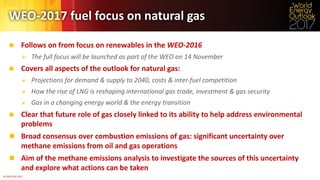
WEO-2017	fuel	focus	on	natural	gas	
n Follows	on	from	focus	on	renewables	in	the	WEO-2016
Ø The	full	focus	will	be	launched	as	part	of	the	WEO	on	14	November
n Covers	all	aspects	of	the	outlook	for	natural	gas:
Ø Projections	for	demand	&	supply	to	2040,	costs	&	inter-fuel	competition
Ø How	the	rise	of	LNG	is	reshaping	international	gas	trade,	investment	&	gas	security
Ø Gas	in	a	changing	energy	world	&	the	energy	transition
n Clear	that	future	role	of	gas	closely	linked	to	its	ability	to	help	address	environmental	
problems
n Broad	consensus	over	combustion	emissions	of	gas:	significant	uncertainty	over	
methane	emissions	from	oil	and	gas	operations
n Aim	of	the	methane	emissions	analysis	to	investigate	the	sources	of	this	uncertainty	
and	explore	what	actions	can	be	taken
©	OECD/IEA	2017	
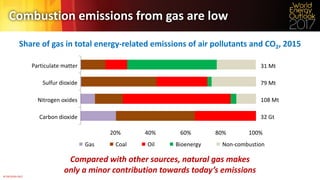
Combustion	emissions	from	gas	are	low
Share	of	gas	in	total	energy-related	emissions	of	air	pollutants	and	CO2,	2015
Compared	with	other	sources,	natural	gas	makes
only	a	minor	contribution	towards	today’s	emissions
20% 40% 60% 80% 100%
Carbon	dioxide
Nitrogen	oxides
Sulfur	dioxide
Particulate	matter
Gas Coal Oil Bioenergy Non-combustion
31	Mt
79	Mt
108	Mt
32	Gt
©	OECD/IEA	2017	
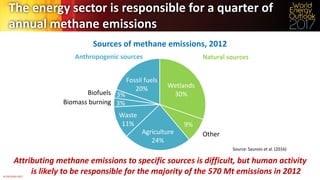
The	energy	sector	is	responsible	for	a	quarter	of	
annual	methane	emissions
Sources	of	methane	emissions,	2012
Attributing	methane	emissions	to	specific	sources	is	difficult,	but	human	activity	
is	likely	to	be	responsible	for	the	majority	of	the	570	Mt	emissions	in	2012
3%
Wetlands
30%
9%	
Agriculture
24%
Waste
11%
Biomass	burning
Biofuels
Fossil	fuels
20%
Anthropogenic	sources Natural	sources
Source:	Saunois et	al.	(2016)	
3%
3%
Other
©	OECD/IEA	2017	
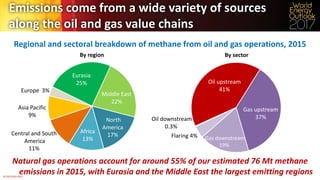
Emissions	come	from	a	wide	variety	of	sources	
along	the	oil	and	gas	value	chains
Regional	and	sectoral	breakdown	of	methane	from	oil	and	gas	operations,	2015
Natural	gas	operations	account	for	around	55%	of	our	estimated	76	Mt	methane	
emissions	in	2015,	with	Eurasia	and	the	Middle	East	the	largest	emitting	regions
Eurasia
25%
Middle	East
22%
North
America	
17%	
Africa
13%
Central	and	South	
America
11%
Asia	Pacific
9%
Europe		3%
By	region
Gas	upstream
37%
Gas	downstream
19%
Flaring	4%
Oil	downstream
0.3%
Oil	upstream
41%
By	sector
©	OECD/IEA	2017	
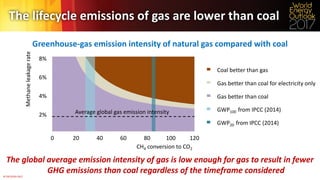
The	lifecycle	emissions	of	gas	are	lower	than	coal
Greenhouse-gas	emission	intensity	of	natural	gas	compared	with	coal
The	global	average	emission	intensity	of	gas	is	low	enough	for	gas	to	result	in	fewer	
GHG	emissions	than	coal	regardless	of	the	timeframe	considered
2%
4%
6%
8%
0 20 40 60 80 100 120
CH4 conversion	to	CO2
Coal	better	than	gas
Gas	better	than	coal	for	electricity	only
Gas	better	than	coal
GWP100		from	IPCC	(2014)
GWP20		from	IPCC	(2014)
Methane	leakage	rate
Average	global	gas	emission	intensity
©	OECD/IEA	2017	
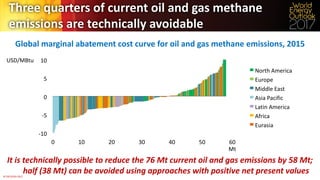
Three	quarters	of	current	oil	and	gas	methane	
emissions	are	technically	avoidable
Global	marginal	abatement	cost	curve	for	oil	and	gas	methane	emissions,	2015
It	is	technically	possible	to	reduce	the	76	Mt	current	oil	and	gas	emissions	by	58	Mt;	
half	(38	Mt)	can	be	avoided	using	approaches	with	positive	net	present	values
North	America
Europe
Middle	East
Asia	Pacific
Latin	America
Africa
Eurasia
-10
-5
0
5
10
60
Mt
0 10 20 30 40 50
USD/MBtu
©	OECD/IEA	2017	
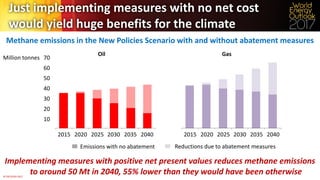
Just	implementing	measures	with	no	net	cost	
would	yield	huge	benefits	for	the	climate
Methane	emissions	in	the	New	Policies	Scenario	with	and	without	abatement	measures
Implementing	measures	with	positive	net	present	values	reduces	methane	emissions	
to	around	50	Mt	in	2040,	55%	lower	than	they	would	have	been	otherwise
10
20
30
40
50
60
70Million	tonnes
2015 2020 2025 2030 2035 2040
GasOil
2015 2020 2025 2030 2035 2040
Emissions	with	no	abatement Reductions	due	to	abatement	measures
©	OECD/IEA	2017	
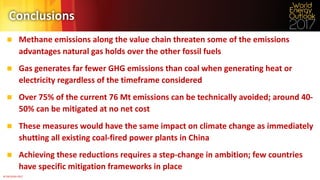
Conclusions
n Methane	emissions	along	the	value	chain	threaten	some	of	the	emissions	
advantages	natural	gas	holds	over	the	other	fossil	fuels
n Gas	generates	far	fewer	GHG	emissions	than	coal	when	generating	heat	or	
electricity	regardless	of	the	timeframe	considered
n Over	75%	of	the	current	76	Mt	emissions	can	be	technically	avoided;	around	40-
50%	can	be	mitigated	at	no	net	cost
n These	measures	would	have	the	same	impact	on	climate	change	as	immediately	
shutting	all	existing	coal-fired	power	plants	in	China
n Achieving	these	reductions	requires	a	step-change	in	ambition;	few	countries	
have	specific	mitigation	frameworks	in	place

Webinar : Oil and gas methane emissions