Introduction to
A3 Problem Solving
Presented by Tracy O’Rourke
1
About Our Presenter
• Managing Partner at
GoLeanSixSigma.com
• Co-author of
The Problem-Solver’s Toolkit
• Co-host of the
Just-In-Time Café Podcast
Tracy O’Rourke
/Tracy-ORourke
@RourkeTracy
2
How to Interact
Answer Polls! Ask a Question!
3
Where Are You From?
Share your location in the Question area in your
Control Panel!
4
Who Is GoLeanSixSigma.com?
• GoLeanSixSigma.com makes it easy for everyone
everywhere to build their problem-solving muscles
• We provide the most practical, easy to understand
and enjoyable Lean and Six Sigma resources
available
5
We’ve Helped People From…
6
Today’s Agenda
• Defining the A3
• Discovering why the A3 matters
• Breaking down the elements of the A3
• Committing to using the A3
7
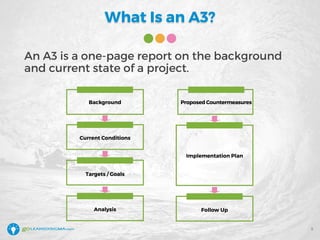
What Is an A3?
An A3 is a one-page report on the background
and current state of a project.
8
Why Use An A3?
• Common approach:
Plan-Do-Check-Act (PDCA)
• Tool to make Lean thinking
visible
• Working document throughout
the process
• Communication tool
• Tool to build problem-solving
muscles
9
I like one-
pagers. So
much easier to
manage!
Poll #1
10
How have you used an A3?
A. I haven’t used one
B. Used at the end of an improvement to
document it
C. Used during all of the PDCA cycle of
improvements
D. Other
Scientific Method:
A method of procedure that has characterized
natural science since the 16th century,
It consists of systematic observation,
measurement, and experiment, and the
formulation, testing, and modification of
hypotheses.
11
Scientific Method
12
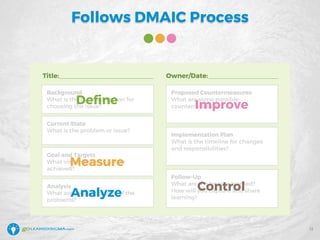
Follows DMAIC Process
Define
Measure
Analyze
Improve
Control
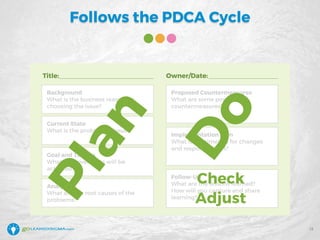
Follows the PDCA Cycle
13
Plan
Do
Check
Adjust
14
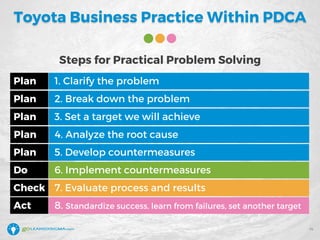
Steps for Practical Problem Solving
1. Clarify the problemPlan
2. Break down the problemPlan
3. Set a target we will achievePlan
4. Analyze the root causePlan
5. Develop countermeasuresPlan
6. Implement countermeasuresDo
7. Evaluate process and resultsCheck
8. Standardize success, learn from failures, set another targetAct
Toyota Business Practice Within PDCA
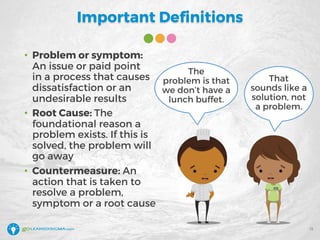
Important Definitions
• Problem or symptom:
An issue or paid point
in a process that causes
dissatisfaction or an
undesirable results
• Root Cause: The
foundational reason a
problem exists. If this is
solved, the problem will
go away
• Countermeasure: An
action that is taken to
resolve a problem,
symptom or a root cause
15
That
sounds like a
solution, not
a problem.
The
problem is that
we don’t have a
lunch buffet.
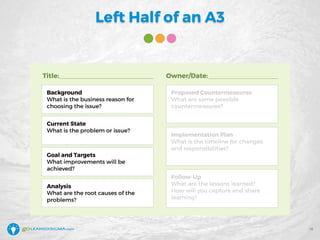
Left Half of an A3
16
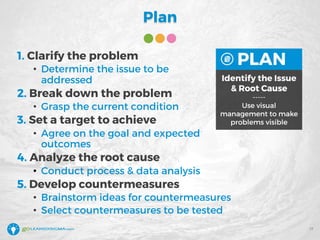
1. Clarify the problem
• Determine the issue to be
addressed
2. Break down the problem
• Grasp the current condition
3. Set a target to achieve
• Agree on the goal and expected
outcomes
4. Analyze the root cause
• Conduct process & data analysis
5. Develop countermeasures
• Brainstorm ideas for countermeasures

• Select countermeasures to be tested
17
Plan
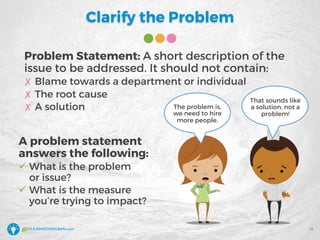
Problem Statement: A short description of the
issue to be addressed. It should not contain:
✘ Blame towards a department or individual
✘ The root cause
✘ A solution
18
A problem statement
answers the following:
ü What is the problem
or issue?
ü What is the measure
you’re trying to impact?
The problem is,
we need to hire
more people.
That sounds like
a solution, not a
problem!
Clarify the Problem
19
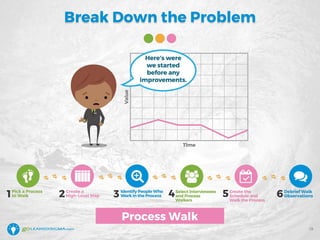
Process Walk
Break Down the Problem
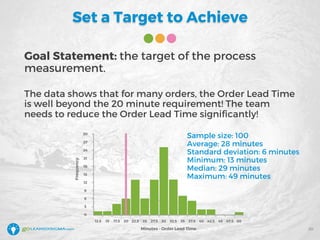
Goal Statement: the target of the process
measurement.
The data shows that for many orders, the Order Lead Time
is well beyond the 20 minute requirement! The team
needs to reduce the Order Lead Time significantly!
20
Sample size: 100
Average: 28 minutes
Standard deviation: 6 minutes
Minimum: 13 minutes
Median: 29 minutes
Maximum: 49 minutes
Set a Target to Achieve
Hypothesis Statement: an educated guess
about the suspected cause (or causes) of defects
in a process.
21
Analyze Root Cause
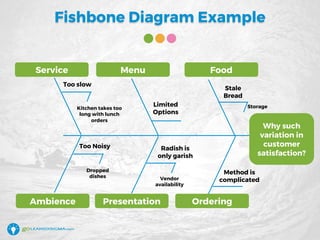
Fishbone Diagram Example
Stale
Bread
Limited
Options
Too slow
Too Noisy Radish is
only garish
Method is
complicated
Kitchen takes too
long with lunch
orders
Storage
Dropped
dishes Vendor
availability
PresentationAmbience Ordering
Service Menu Food
Why such
variation in
customer
satisfaction?
Bahama Bistro A3: Left Half
23
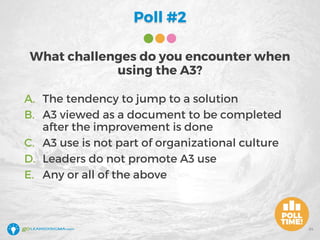
Poll #2
24
What challenges do you encounter when
using the A3?
A. The tendency to jump to a solution
B. A3 viewed as a document to be completed
after the improvement is done
C. A3 use is not part of organizational culture
D. Leaders do not promote A3 use
E. Any or all of the above
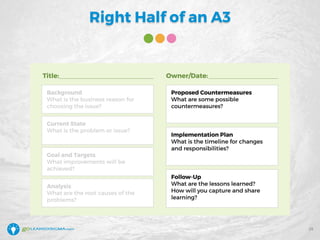
Right Half of an A3
25
6. Implement countermeasures
• Coordinate and launch the pilot
or test
• Troubleshoot as needed
• Document deviations from plan
26
Do
Proposed Countermeasures
• Proposed Countermeasures: The term
“countermeasures” is used instead of “solution.”
Rather than saying a problem is “solved,”
countermeasures are temporary responses to
specific problems that will serve until a better
approach is found or conditions change.
• Implementation Plan: What are the main
actions and outcomes for executing the plan?
• This includes the 4Ws and 1H: What, When,
Where, Who and How
27
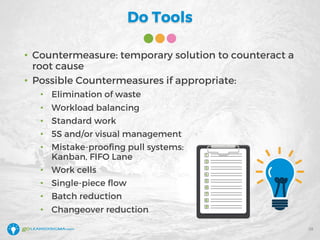
• Countermeasure: temporary solution to counteract a
root cause
• Possible Countermeasures if appropriate:
• Elimination of waste
• Workload balancing
• Standard work
• 5S and/or visual management
• Mistake-proofing pull systems:
Kanban, FIFO Lane
• Work cells
• Single-piece flow
• Batch reduction
• Changeover reduction
28
Do Tools
Implementation Plan
• What is the project or improvement effort you
would like to easily document?
• How would some of the questions help you
think through and communicate what is
happening?
• Where could you use this framework to help
your team think through issues?
29
30
Check / Study
7. Evaluate process and results
• Reflect on the pilot/test
• Assess what worked and what
didn’t
• Gather feedback from pilot/test
participants
• Document learnings
31
Check / Study
32
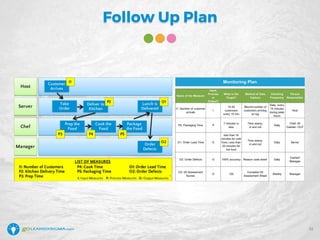
Follow Up Plan
8. Standardize success, learn
from failures, set another
target
• If pilot/test is a success, plan for
sustainability
• Document a new or revised
pilot/test
• Make adjustments as required
• Go back to “Plan” start a new
cycle of improvement
33
Act / Adjust
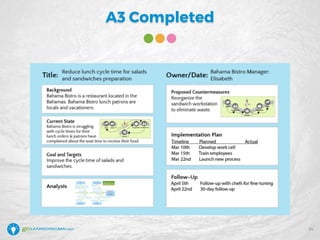
A3 Completed
34
Related Webinars
35
How Leaders Use A3s
to Coach Employees
Introduction to PDCA
Today We Covered
• Defining the A3
• Discovering why the A3 matters
• Breaking down the elements of the A3
• Committing to using the A3
36
Questions?
37
Getting Started
Learn more by starting some more training!
• White Belt Training & Certification (Training is FREE)
• Yellow Belt Training & Certification (Training is FREE)
• Green Belt Training & Certification
• Black Belt Training & Certification
• Lean Training & Certification
Coupon Code: 20A3PS
20% discount on all courses!
*Expires September 16, 2018
38
eBook: The Problem-Solver’s Toolkit
39
• Available on our site!
goleansixsigma.com/
product/problem-solvers-
toolkit/
• Kindle version available
on Amazon
Upcoming Webinar: Sept. 11, 11am PDT
Register today at GoLeanSixSigma.com/webinars
We’ll select upcoming webinars based on your feedback, so please share
your feedback on the survey at the end of close of this webinar.
40
Just-In-Time Café Podcast
Tune in at GoLeanSixSigma.com/cafe for the latest
Lean Six Sigma news, easy ways to apply Lean Six Sigma
and interviews with process improvement leaders like you!
41
Success Stories
Check out more success stories from Go-Getters just like you
at GoLeanSixSigma.com/Success
42
Wonder Women of Quality
Join us each month as we highlight another unsung
hero of Quality!
43
Questions?
44
Thank You for Joining Us!
More questions? Ask us at
contact@goleansixsigma.com
Click here to download free tools,
templates, infographics and more!
@GoLeanSixSigma/company/GoLeanSixSigma-com /GoLeanSixSigma 45

WEBINAR: Introduction to A3 Problem Solving

  • 1.
    Introduction to A3 ProblemSolving Presented by Tracy O’Rourke 1
  • 2.
    About Our Presenter •Managing Partner at GoLeanSixSigma.com • Co-author of The Problem-Solver’s Toolkit • Co-host of the Just-In-Time Café Podcast Tracy O’Rourke /Tracy-ORourke @RourkeTracy 2
  • 3.
    How to Interact AnswerPolls! Ask a Question! 3
  • 4.
    Where Are YouFrom? Share your location in the Question area in your Control Panel! 4
  • 5.
    Who Is GoLeanSixSigma.com? •GoLeanSixSigma.com makes it easy for everyone everywhere to build their problem-solving muscles • We provide the most practical, easy to understand and enjoyable Lean and Six Sigma resources available 5
  • 6.
  • 7.
    Today’s Agenda • Definingthe A3 • Discovering why the A3 matters • Breaking down the elements of the A3 • Committing to using the A3 7
  • 8.
    What Is anA3? An A3 is a one-page report on the background and current state of a project. 8
  • 9.
    Why Use AnA3? • Common approach: Plan-Do-Check-Act (PDCA) • Tool to make Lean thinking visible • Working document throughout the process • Communication tool • Tool to build problem-solving muscles 9 I like one- pagers. So much easier to manage!
  • 10.
    Poll #1 10 How haveyou used an A3? A. I haven’t used one B. Used at the end of an improvement to document it C. Used during all of the PDCA cycle of improvements D. Other
  • 11.
    Scientific Method: A methodof procedure that has characterized natural science since the 16th century, It consists of systematic observation, measurement, and experiment, and the formulation, testing, and modification of hypotheses. 11 Scientific Method
  • 12.
  • 13.
    Follows the PDCACycle 13 Plan Do Check Adjust
  • 14.
    14 Steps for PracticalProblem Solving 1. Clarify the problemPlan 2. Break down the problemPlan 3. Set a target we will achievePlan 4. Analyze the root causePlan 5. Develop countermeasuresPlan 6. Implement countermeasuresDo 7. Evaluate process and resultsCheck 8. Standardize success, learn from failures, set another targetAct Toyota Business Practice Within PDCA
  • 15.
    Important Definitions • Problemor symptom: An issue or paid point in a process that causes dissatisfaction or an undesirable results • Root Cause: The foundational reason a problem exists. If this is solved, the problem will go away • Countermeasure: An action that is taken to resolve a problem, symptom or a root cause 15 That sounds like a solution, not a problem. The problem is that we don’t have a lunch buffet.
  • 16.
    Left Half ofan A3 16
  • 17.
    1. Clarify theproblem • Determine the issue to be addressed 2. Break down the problem • Grasp the current condition 3. Set a target to achieve • Agree on the goal and expected outcomes 4. Analyze the root cause • Conduct process & data analysis 5. Develop countermeasures • Brainstorm ideas for countermeasures • Select countermeasures to be tested 17 Plan
  • 18.
    Problem Statement: Ashort description of the issue to be addressed. It should not contain: ✘ Blame towards a department or individual ✘ The root cause ✘ A solution 18 A problem statement answers the following: ü What is the problem or issue? ü What is the measure you’re trying to impact? The problem is, we need to hire more people. That sounds like a solution, not a problem! Clarify the Problem
  • 19.
  • 20.
    Goal Statement: thetarget of the process measurement. The data shows that for many orders, the Order Lead Time is well beyond the 20 minute requirement! The team needs to reduce the Order Lead Time significantly! 20 Sample size: 100 Average: 28 minutes Standard deviation: 6 minutes Minimum: 13 minutes Median: 29 minutes Maximum: 49 minutes Set a Target to Achieve
  • 21.
    Hypothesis Statement: aneducated guess about the suspected cause (or causes) of defects in a process. 21 Analyze Root Cause
  • 22.
    Fishbone Diagram Example Stale Bread Limited Options Tooslow Too Noisy Radish is only garish Method is complicated Kitchen takes too long with lunch orders Storage Dropped dishes Vendor availability PresentationAmbience Ordering Service Menu Food Why such variation in customer satisfaction?
  • 23.
    Bahama Bistro A3:Left Half 23
  • 24.
    Poll #2 24 What challengesdo you encounter when using the A3? A. The tendency to jump to a solution B. A3 viewed as a document to be completed after the improvement is done C. A3 use is not part of organizational culture D. Leaders do not promote A3 use E. Any or all of the above
  • 25.
    Right Half ofan A3 25
  • 26.
    6. Implement countermeasures •Coordinate and launch the pilot or test • Troubleshoot as needed • Document deviations from plan 26 Do
  • 27.
    Proposed Countermeasures • ProposedCountermeasures: The term “countermeasures” is used instead of “solution.” Rather than saying a problem is “solved,” countermeasures are temporary responses to specific problems that will serve until a better approach is found or conditions change. • Implementation Plan: What are the main actions and outcomes for executing the plan? • This includes the 4Ws and 1H: What, When, Where, Who and How 27
  • 28.
    • Countermeasure: temporarysolution to counteract a root cause • Possible Countermeasures if appropriate: • Elimination of waste • Workload balancing • Standard work • 5S and/or visual management • Mistake-proofing pull systems: Kanban, FIFO Lane • Work cells • Single-piece flow • Batch reduction • Changeover reduction 28 Do Tools
  • 29.
    Implementation Plan • Whatis the project or improvement effort you would like to easily document? • How would some of the questions help you think through and communicate what is happening? • Where could you use this framework to help your team think through issues? 29
  • 30.
  • 31.
    7. Evaluate processand results • Reflect on the pilot/test • Assess what worked and what didn’t • Gather feedback from pilot/test participants • Document learnings 31 Check / Study
  • 32.
  • 33.
    8. Standardize success,learn from failures, set another target • If pilot/test is a success, plan for sustainability • Document a new or revised pilot/test • Make adjustments as required • Go back to “Plan” start a new cycle of improvement 33 Act / Adjust
  • 34.
  • 35.
    Related Webinars 35 How LeadersUse A3s to Coach Employees Introduction to PDCA
  • 36.
    Today We Covered •Defining the A3 • Discovering why the A3 matters • Breaking down the elements of the A3 • Committing to using the A3 36
  • 37.
  • 38.
    Getting Started Learn moreby starting some more training! • White Belt Training & Certification (Training is FREE) • Yellow Belt Training & Certification (Training is FREE) • Green Belt Training & Certification • Black Belt Training & Certification • Lean Training & Certification Coupon Code: 20A3PS 20% discount on all courses! *Expires September 16, 2018 38
  • 39.
    eBook: The Problem-Solver’sToolkit 39 • Available on our site! goleansixsigma.com/ product/problem-solvers- toolkit/ • Kindle version available on Amazon
  • 40.
    Upcoming Webinar: Sept.11, 11am PDT Register today at GoLeanSixSigma.com/webinars We’ll select upcoming webinars based on your feedback, so please share your feedback on the survey at the end of close of this webinar. 40
  • 41.
    Just-In-Time Café Podcast Tunein at GoLeanSixSigma.com/cafe for the latest Lean Six Sigma news, easy ways to apply Lean Six Sigma and interviews with process improvement leaders like you! 41
  • 42.
    Success Stories Check outmore success stories from Go-Getters just like you at GoLeanSixSigma.com/Success 42
  • 43.
    Wonder Women ofQuality Join us each month as we highlight another unsung hero of Quality! 43
  • 44.
  • 45.
    Thank You forJoining Us! More questions? Ask us at contact@goleansixsigma.com Click here to download free tools, templates, infographics and more! @GoLeanSixSigma/company/GoLeanSixSigma-com /GoLeanSixSigma 45