© Copyright 2018 Lean Enterprise Institute. All rights reserved.© Copyright 2018 Lean Enterprise Institute. All rights reserved.
Lean Enterprise Institute, the leaper image, and stick figure are registered trademarks of Lean Enterprise Institute, Inc.
Course Sample
Slides 10-18 are a small
sampling of the Introduction to
Problem Solving online course
© Copyright 2018 Lean Enterprise Institute. All rights reserved.
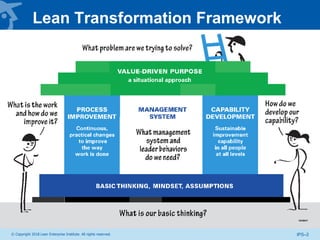
Lean Transformation Framework
What
is our
purpose?
What situational problem
do we need to address?
IPS–2
© Copyright 2018 Lean Enterprise Institute. All rights reserved.
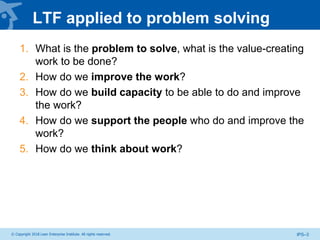
1. What is the problem to solve, what is the value-creating
work to be done?
2. How do we improve the work?
3. How do we build capacity to be able to do and improve
the work?
4. How do we support the people who do and improve the
work?
5. How do we think about work?
LTF applied to problem solving
IPS–3
© Copyright 2018 Lean Enterprise Institute. All rights reserved.
• Coaching questions are situational and evolve with
the learner
• The value of coaching is probing the learner to think
• There is not a specific set of questions to use
You must ask the right questions at the right time
Helpful coaching
IPS–1–4
© Copyright 2018 Lean Enterprise Institute. All rights reserved.
Break down the problem
Adapted from Getting the Right Things Done, pg. 168
* “Point of direct cause” is sometimes
referred to as Point of Occurrence
*
IPS–1–5
© Copyright 2018 Lean Enterprise Institute. All rights reserved.
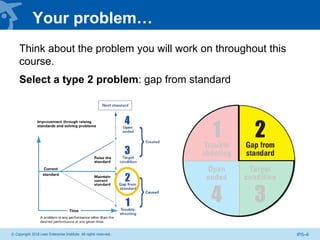
Think about the problem you will work on throughout this
course.
Select a type 2 problem: gap from standard
Your problem…
IPS–6
© Copyright 2018 Lean Enterprise Institute. All rights reserved.
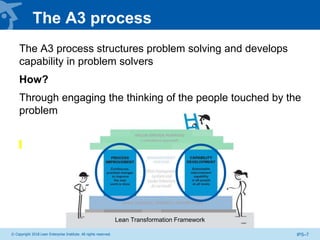
The A3 process structures problem solving and develops
capability in problem solvers
How?
Through engaging the thinking of the people touched by the
problem
The A3 process
Lean Transformation Framework
IPS–7
© Copyright 2018 Lean Enterprise Institute. All rights reserved.
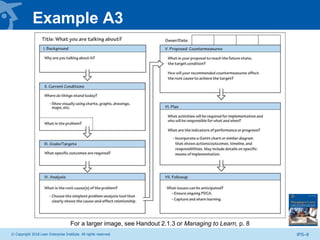
Example A3
For a larger image, see Handout 2.1.3 or Managing to Learn, p. 8
IPS–8
© Copyright 2018 Lean Enterprise Institute. All rights reserved.
Your A3 case example
IPS–9
© Copyright 2017 Lean Enterprise Institute. All rights reserved.© Copyright 2017 Lean Enterprise Institute. All rights reserved.
Lean Enterprise Institute, the leaper image, and stick figure are registered trademarks of Lean Enterprise Institute, Inc.
Online Course:
Introduction to
Problem Solving
© Copyright 2018 Lean Enterprise Institute. All rights reserved.
LEI is the world-recognized, leading source for clear and
accurate content about lean thinking and practice
The Isenberg School of Management is rated the #1 online
MBA program in the US, #3 worldwide (Financial Times 2017)
This course was developed to deliver a cohesive body of
knowledge and a logical learning path
Individuals take the course independently, which allows teams
and organizations to avoid the learning barriers of
time and location
It’s an effective way to scale up problem-solving
initiatives for individuals, teams, and companies
A winning partnership
IPS–11
© Copyright 2018 Lean Enterprise Institute. All rights reserved.
Why choose this course?
In “Introduction to Lean Thinking & Practice”,
students learned an overview of the lean
transformation framework.
In “Introduction to Problem Solving*”, students will:
• Build a foundational understanding of various
types of problems
• Learn how to approach one of the most common
types of problems appropriately
• Apply the lean transformation framework and use
A3 thinking to solve a personal problem of their
choosing
Courses can be taken sequentially or independent
of each other.
IPS–12
© Copyright 2018 Lean Enterprise Institute. All rights reserved.
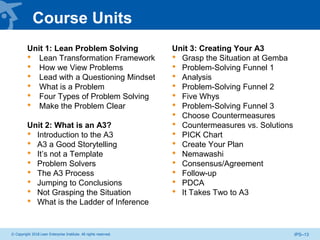
Unit 1: Lean Problem Solving
• Lean Transformation Framework
• How we View Problems
• Lead with a Questioning Mindset
• What is a Problem
• Four Types of Problem Solving
• Make the Problem Clear
Unit 2: What is an A3?
• Introduction to the A3
• A3 a Good Storytelling
• It’s not a Template
• Problem Solvers
• The A3 Process
• Jumping to Conclusions
• Not Grasping the Situation
• What is the Ladder of Inference
Unit 3: Creating Your A3
• Grasp the Situation at Gemba
• Problem-Solving Funnel 1
• Analysis
• Problem-Solving Funnel 2
• Five Whys
• Problem-Solving Funnel 3
• Choose Countermeasures
• Countermeasures vs. Solutions
• PICK Chart
• Create Your Plan
• Nemawashi
• Consensus/Agreement
• Follow-up
• PDCA
• It Takes Two to A3
Course Units
IPS–13
© Copyright 2018 Lean Enterprise Institute. All rights reserved.
Problem Solving
45 minutes
What is an A3?
2 hours
Creating Your A3
6.5 hours
*Times estimates are teaching content only.
Gemba-based activities may take 10+ hours.
Time estimates per unit
IPS–14
© Copyright 2018 Lean Enterprise Institute. All rights reserved.
Diversity of delivery
Lessons are delivered in a variety of formats, including video,
hands-on activities and reflections, readings from the course
textbook Managing to Learn, and presentations
IPS–15
© Copyright 2018 Lean Enterprise Institute. All rights reserved.
Course Textbook
Throughout the course students are required
to read the course textbook, Managing to
Learn.
The readings are integrated into the course
material. As students go through their own A3
problem solving journey, they will follow along
with an applied example through Porter and
Sanderson's stories.
IPS–16
© Copyright 2018 Lean Enterprise Institute. All rights reserved.
Printable activity example
IPS–17
© Copyright 2018 Lean Enterprise Institute. All rights reserved.© Copyright 2018 Lean Enterprise Institute. All rights reserved.
Lean Enterprise Institute, the leaper image, and stick figure are registered trademarks of Lean Enterprise Institute, Inc.
Learn more about this
course and register at
lean.org

Introduction to Problem Solving

  • 1.
    © Copyright 2018Lean Enterprise Institute. All rights reserved.© Copyright 2018 Lean Enterprise Institute. All rights reserved. Lean Enterprise Institute, the leaper image, and stick figure are registered trademarks of Lean Enterprise Institute, Inc. Course Sample Slides 10-18 are a small sampling of the Introduction to Problem Solving online course
  • 2.
    © Copyright 2018Lean Enterprise Institute. All rights reserved. Lean Transformation Framework What is our purpose? What situational problem do we need to address? IPS–2
  • 3.
    © Copyright 2018Lean Enterprise Institute. All rights reserved. 1. What is the problem to solve, what is the value-creating work to be done? 2. How do we improve the work? 3. How do we build capacity to be able to do and improve the work? 4. How do we support the people who do and improve the work? 5. How do we think about work? LTF applied to problem solving IPS–3
  • 4.
    © Copyright 2018Lean Enterprise Institute. All rights reserved. • Coaching questions are situational and evolve with the learner • The value of coaching is probing the learner to think • There is not a specific set of questions to use You must ask the right questions at the right time Helpful coaching IPS–1–4
  • 5.
    © Copyright 2018Lean Enterprise Institute. All rights reserved. Break down the problem Adapted from Getting the Right Things Done, pg. 168 * “Point of direct cause” is sometimes referred to as Point of Occurrence * IPS–1–5
  • 6.
    © Copyright 2018Lean Enterprise Institute. All rights reserved. Think about the problem you will work on throughout this course. Select a type 2 problem: gap from standard Your problem… IPS–6
  • 7.
    © Copyright 2018Lean Enterprise Institute. All rights reserved. The A3 process structures problem solving and develops capability in problem solvers How? Through engaging the thinking of the people touched by the problem The A3 process Lean Transformation Framework IPS–7
  • 8.
    © Copyright 2018Lean Enterprise Institute. All rights reserved. Example A3 For a larger image, see Handout 2.1.3 or Managing to Learn, p. 8 IPS–8
  • 9.
    © Copyright 2018Lean Enterprise Institute. All rights reserved. Your A3 case example IPS–9
  • 10.
    © Copyright 2017Lean Enterprise Institute. All rights reserved.© Copyright 2017 Lean Enterprise Institute. All rights reserved. Lean Enterprise Institute, the leaper image, and stick figure are registered trademarks of Lean Enterprise Institute, Inc. Online Course: Introduction to Problem Solving
  • 11.
    © Copyright 2018Lean Enterprise Institute. All rights reserved. LEI is the world-recognized, leading source for clear and accurate content about lean thinking and practice The Isenberg School of Management is rated the #1 online MBA program in the US, #3 worldwide (Financial Times 2017) This course was developed to deliver a cohesive body of knowledge and a logical learning path Individuals take the course independently, which allows teams and organizations to avoid the learning barriers of time and location It’s an effective way to scale up problem-solving initiatives for individuals, teams, and companies A winning partnership IPS–11
  • 12.
    © Copyright 2018Lean Enterprise Institute. All rights reserved. Why choose this course? In “Introduction to Lean Thinking & Practice”, students learned an overview of the lean transformation framework. In “Introduction to Problem Solving*”, students will: • Build a foundational understanding of various types of problems • Learn how to approach one of the most common types of problems appropriately • Apply the lean transformation framework and use A3 thinking to solve a personal problem of their choosing Courses can be taken sequentially or independent of each other. IPS–12
  • 13.
    © Copyright 2018Lean Enterprise Institute. All rights reserved. Unit 1: Lean Problem Solving • Lean Transformation Framework • How we View Problems • Lead with a Questioning Mindset • What is a Problem • Four Types of Problem Solving • Make the Problem Clear Unit 2: What is an A3? • Introduction to the A3 • A3 a Good Storytelling • It’s not a Template • Problem Solvers • The A3 Process • Jumping to Conclusions • Not Grasping the Situation • What is the Ladder of Inference Unit 3: Creating Your A3 • Grasp the Situation at Gemba • Problem-Solving Funnel 1 • Analysis • Problem-Solving Funnel 2 • Five Whys • Problem-Solving Funnel 3 • Choose Countermeasures • Countermeasures vs. Solutions • PICK Chart • Create Your Plan • Nemawashi • Consensus/Agreement • Follow-up • PDCA • It Takes Two to A3 Course Units IPS–13
  • 14.
    © Copyright 2018Lean Enterprise Institute. All rights reserved. Problem Solving 45 minutes What is an A3? 2 hours Creating Your A3 6.5 hours *Times estimates are teaching content only. Gemba-based activities may take 10+ hours. Time estimates per unit IPS–14
  • 15.
    © Copyright 2018Lean Enterprise Institute. All rights reserved. Diversity of delivery Lessons are delivered in a variety of formats, including video, hands-on activities and reflections, readings from the course textbook Managing to Learn, and presentations IPS–15
  • 16.
    © Copyright 2018Lean Enterprise Institute. All rights reserved. Course Textbook Throughout the course students are required to read the course textbook, Managing to Learn. The readings are integrated into the course material. As students go through their own A3 problem solving journey, they will follow along with an applied example through Porter and Sanderson's stories. IPS–16
  • 17.
    © Copyright 2018Lean Enterprise Institute. All rights reserved. Printable activity example IPS–17
  • 18.
    © Copyright 2018Lean Enterprise Institute. All rights reserved.© Copyright 2018 Lean Enterprise Institute. All rights reserved. Lean Enterprise Institute, the leaper image, and stick figure are registered trademarks of Lean Enterprise Institute, Inc. Learn more about this course and register at lean.org